
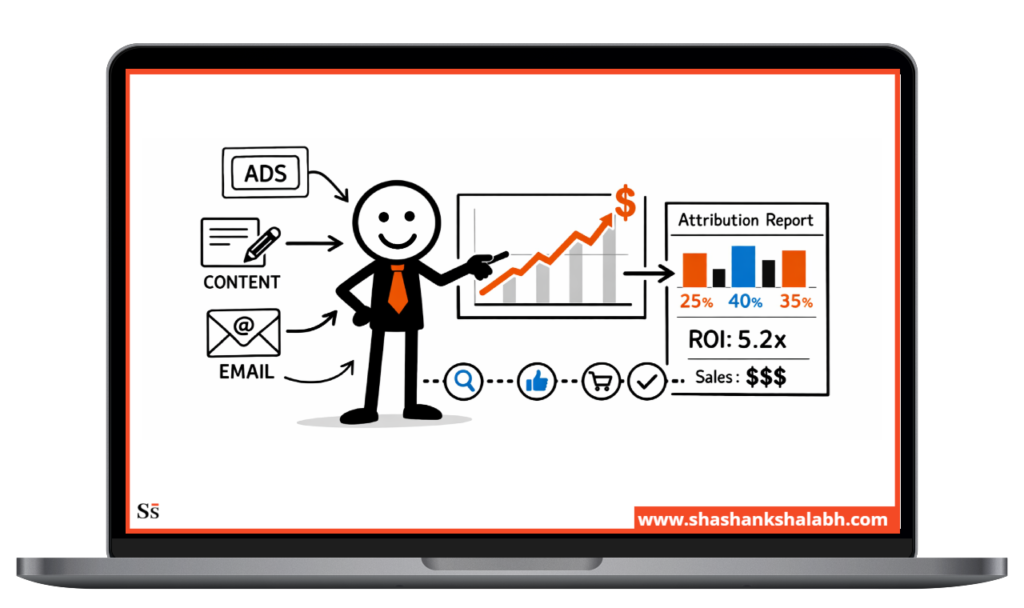
B2B marketing attribution is how you connect marketing activity to revenue.
It tells you which channels sourced pipeline, which touchpoints influenced deals, and whether your marketing spend is producing returns.
Most B2B companies either skip attribution entirely or set it up wrong. This post shows you how to do it right; from choosing a model to building reporting that actually drives decisions.
What this post covers:
- What B2B marketing attribution is and why it matters
- The five main attribution models and when to use each
- A step-by-step setup process
- Common mistakes that break attribution
- How attribution connects to revenue growth decisions
What Is B2B Marketing Attribution?
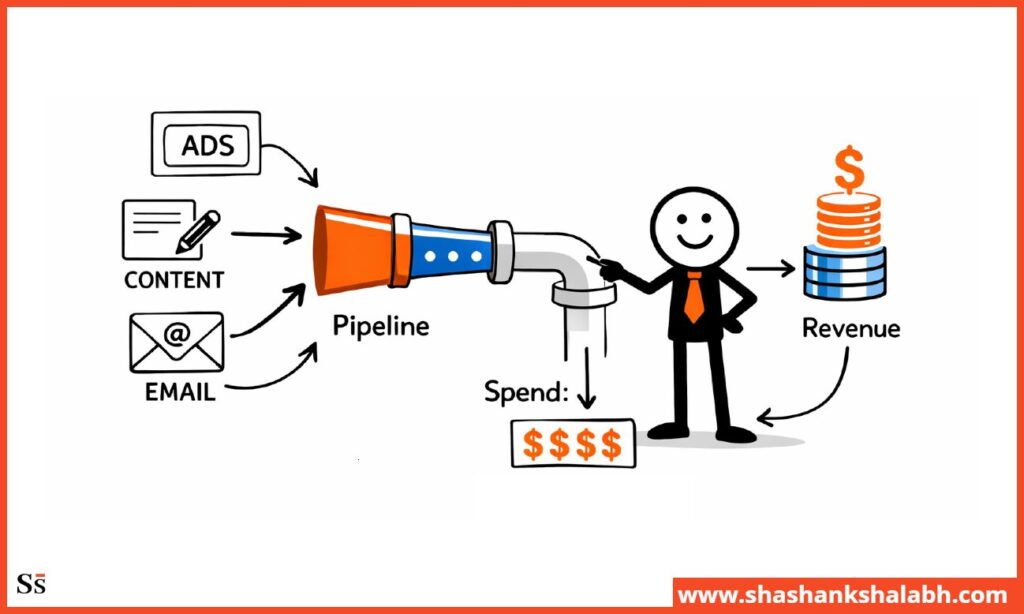
B2B marketing attribution is the process of connecting marketing activity to revenue outcomes. It answers one question: which marketing efforts contributed to a deal closing?
In practice, it means tracking every touchpoint a buyer has with your marketing (an ad click, a content download, a webinar registration, a sales email), and giving each touchpoint appropriate credit for its role in the sale.
Marketing attribution does three things for a B2B company.
First, it connects channels to the pipeline. It shows which channels are generating qualified opportunities (not just leads).
Two, it connects the pipeline to revenue. It shows which marketing-sourced opportunities actually close, and not just which ones entered the funnel.
And finally, attribution connects spend to ROI. It shows which marketing investments are producing returns, and which are consuming budget without contributing to revenue.
Without attribution, B2B marketing decisions are based on assumptions. With attribution, they’re based on data. That difference determines whether marketing scales efficiently or burns budget on the wrong channels.
Why Marketing Attribution Breaks in Most B2B Companies?
Most B2B companies attempt attribution and get it wrong. Here’s why.
Disconnected Tools That Don’t Share Data
The most common B2B marketing attribution problem is a technology stack where marketing and sales tools don’t talk to each other.
Marketing automation tracks leads, and the CRM tracks deals. Neither system knows what the other is doing.
Due to this, marketing claims credit for the pipeline that sales can’t verify, and sales closes deals with no marketing touchpoint visible in the data.
Clean attribution requires connected tools, not parallel systems.
Poor Data Quality at the Source
Attribution is only as good as the data feeding it.
If leads aren’t tagged with their source, UTM parameters aren’t consistent, and CRM records aren’t maintained, the attribution model produces numbers that look precise but aren’t. Garbage in, garbage out.
Before choosing an attribution model, the underlying data quality has to be clean enough to trust.
Over-Reliance on Last-Touch Attribution
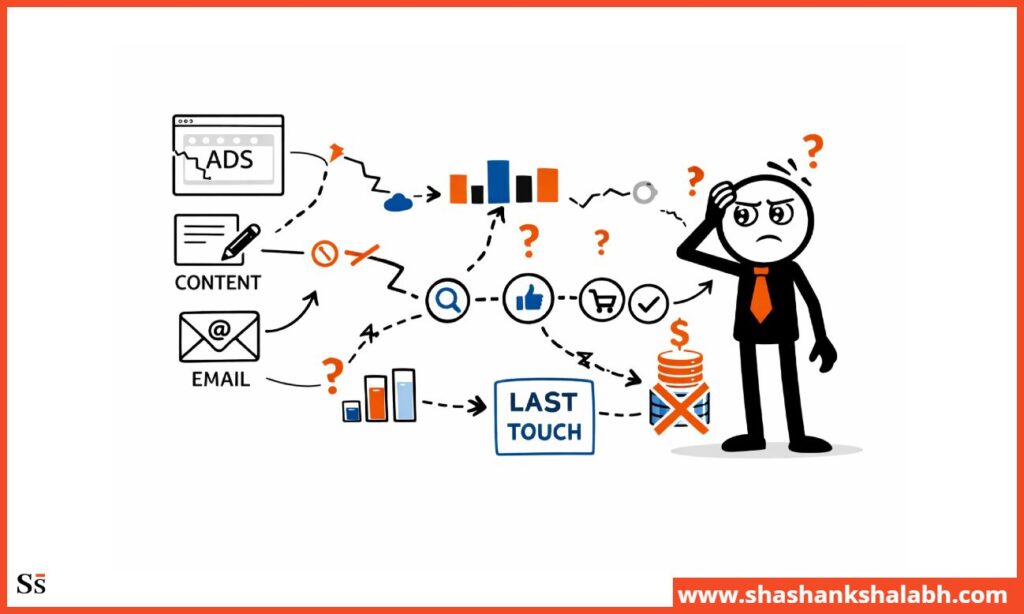
Last-touch attribution gives 100% of the credit to the final touchpoint before conversion. It’s simple to set up and easy to understand. It’s also wrong most of the time in a B2B setting.
Let’s say a buyer attended three webinars, downloaded two whitepapers, and clicked a paid ad before booking a demo. In this case, the paid ad gets all the credit under last-touch. And the three webinars and two whitepapers get nothing.
Last-touch systematically undervalues content, nurture, and brand channels that do real work earlier in the buying journey.
No Clear Model Before Data Collection
Many companies collect marketing data for months or years before deciding how they’ll attribute it.
Then they try to apply an attribution model retroactively to data that wasn’t structured for it. Attribution models need to be chosen before data collection begins. Because the model determines which data points need to be captured, how they need to be tagged, and what the CRM needs to record.
Long Sales Cycles: Multiple Sessions and Devices
B2B sales cycles of 3-12 months create attribution complexity that most tools weren’t designed for.
A buyer researches on a work laptop, downloads content on a phone, and books a demo from a different browser. Standard session-based tracking breaks across these touchpoints.
Without a buyer-level identity resolution approach (built around email address or CRM contact ID), multi-session attribution in long-cycle B2B is unreliable.
Types of B2B Marketing Attribution Models
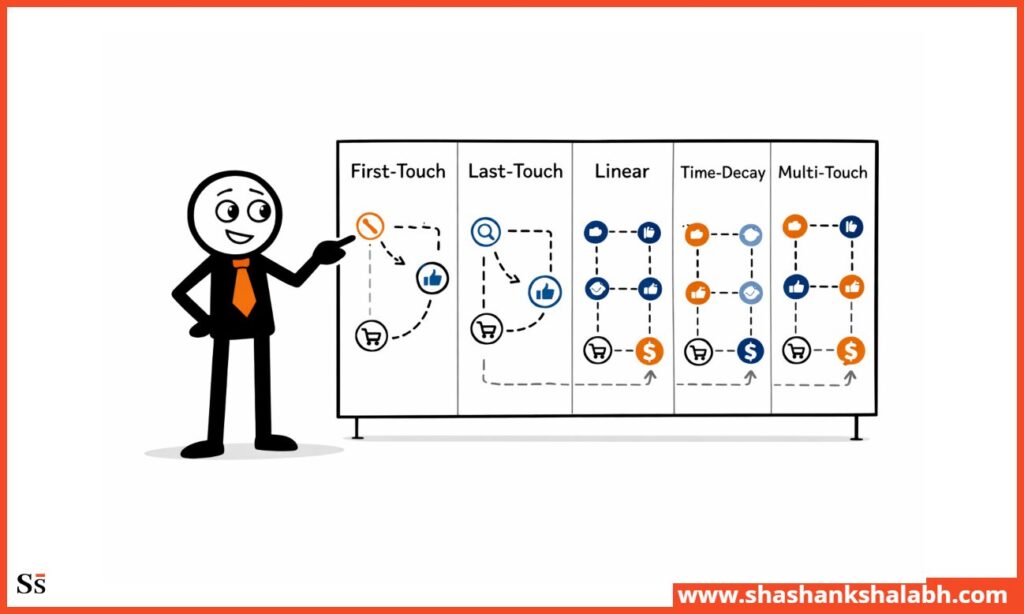
There are five main B2B marketing attribution models. Each gives credit differently.
Note that none is universally correct. And the right model depends on your sales cycle, channel mix, and what decisions you’re trying to make.
First-Touch Attribution
Under this model, 100% of the credit goes to the first touchpoint; the channel or campaign that first brought the buyer into the funnel. This model is good for understanding which channels are best at creating awareness and generating a net-new pipeline. It is useful when the primary question is “what’s driving top-of-funnel growth?”
However, first-touch attribution ignores everything that happened between first touch and close. For example, in the case of a buyer who first visited through organic search but converted through a sales email, organic search gets all the credit, while sales email gets none.
This model works well for early-stage companies trying to understand which channels are finding the right buyers first.
Last-Touch Attribution
Here, 100% of the credit goes to the last touchpoint before conversion.
This model helps understand what’s driving immediate conversion decisions. That is why it is useful for optimizing bottom-of-funnel tactics.
Last-touch attribution model systematically undervalues awareness and nurture channels. And it overvalues conversion-stage tactics that benefit from earlier marketing work.
Use this attribution model when you need a simple baseline model and your sales cycle is short (under 30 days). Don’t use this as a primary model for B2B with longer cycles.
Linear Attribution
Under this model, credit is divided equally across every touchpoint in the buyer journey.
Linear attribution is good for understanding the full picture of which channels are involved in deals, without overweighting any single touchpoint.
However, this model treats every touchpoint as equally important. A casual blog visit gets the same credit as a product demo request. This is rarely an accurate reflection of how buying decisions actually work.
Use this model as a starting point for multi-touch analysis. This can be useful when you want to see which channels appear most frequently across won deals.
Time-Decay Attribution
Here, touchpoints closer to the conversion date receive more credit. Earlier touchpoints receive less.
This marketing attribution model works well for B2B companies with medium-length sales cycles where recency genuinely reflects influence, and where the touchpoints that happened closer to close were more influential in the decision.
On the flip side, time-decay attribution undervalues early-stage content and brand channels that started the buying journey. A webinar that first introduced the buyer to the company six months ago gets minimal credit.
This B2B marketing attribution model works well for companies with 3-6 month sales cycles where nurture and late-stage content are the primary drivers of conversion.
Multi-Touch Attribution
Under this attribution model, credit is distributed across touchpoints based on a defined weighting system. In general, this means heavier weight for first touch, conversion point, and opportunity creation, with lighter weight for middle touchpoints.
Multi-touch attribution works well for B2B companies with longer sales cycles, multiple influencers in the buying process, and diverse channel mixes. This is the most accurate model for most scaling B2B companies.
Like all other B2B marketing attribution models, multi-touch also has certain limitations. It is more complex to set up and maintain. This model requires clean data across the full buyer journey. And weighting decisions involve judgment calls that should be revisited as the business evolves.
Multi-touch attribution can be used at businesses ($5M-$50M revenue) with sales cycles over 60 days and three or more active marketing channels. This is the model most scaling B2B companies should be working toward.
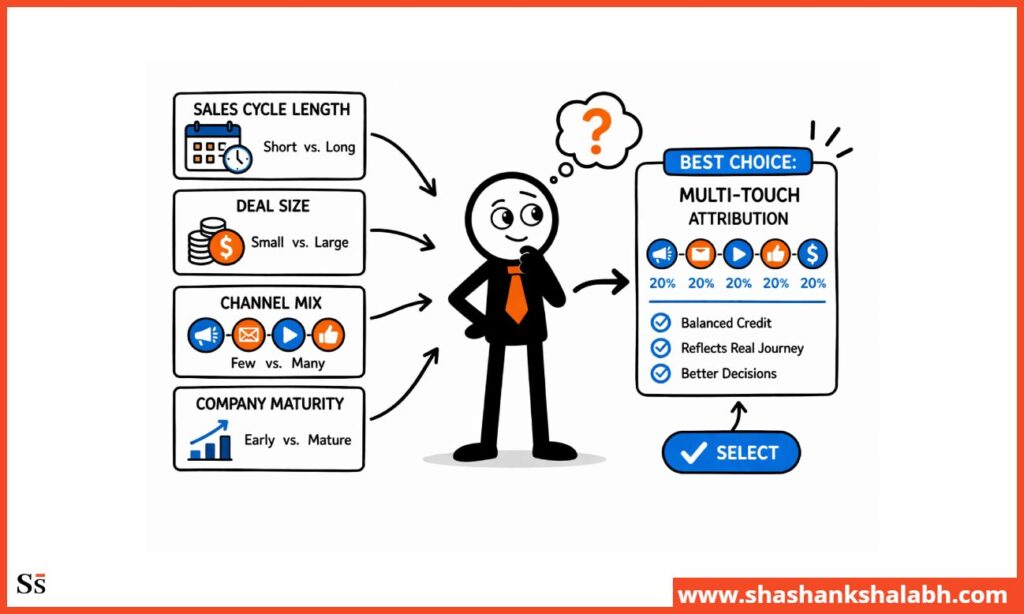
How to Choose the Right B2B Marketing Attribution Model?
The right attribution model depends on four factors. Work through these before committing to a model.
Sales Cycle Length
Short sales cycles, under 30 days, have fewer touchpoints. In this case, the last-touch or first-touch attribution models are simpler and often accurate enough.
However, sales cycles over 60 days almost always require multi-touch attribution. The more touchpoints in the journey, the more important it is to distribute credit across them.
Deal Size and Buying Complexity
Larger deals typically involve more stakeholders, longer evaluation periods, and more marketing touchpoints.
When a $200K deal involves six stakeholders over nine months, a single-touch model misses most of the story. Multi-touch attribution is more important as deal size and buying complexity increase.
Channel Mix
If the company runs two or three channels, a simpler attribution model works. However, when five or more channels are active (paid, organic, content, email, events, outbound), the interaction effects between channels become significant.
Multi-touch attribution is necessary to understand how channels work together, not just individually.
Company Stage and Data Maturity
Attribution model sophistication should match data infrastructure maturity.
A company with inconsistent UTM tagging and a poorly maintained CRM will produce unreliable results from a complex multi-touch model. Start with the simplest model the data supports accurately.
Build data quality first. Move to more sophisticated models as the infrastructure matures.
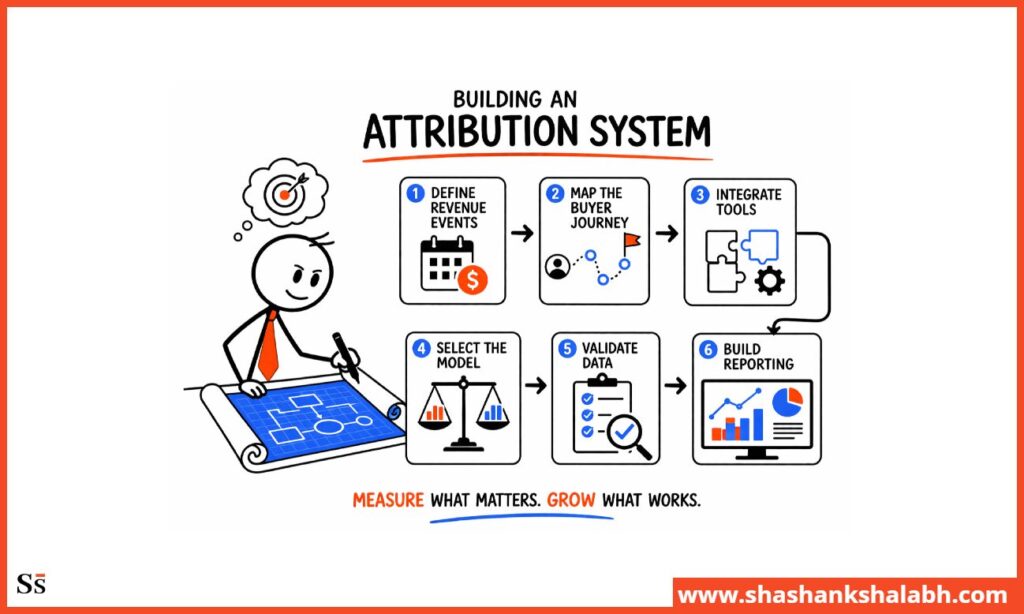
How to Set Up B2B Marketing Attribution?
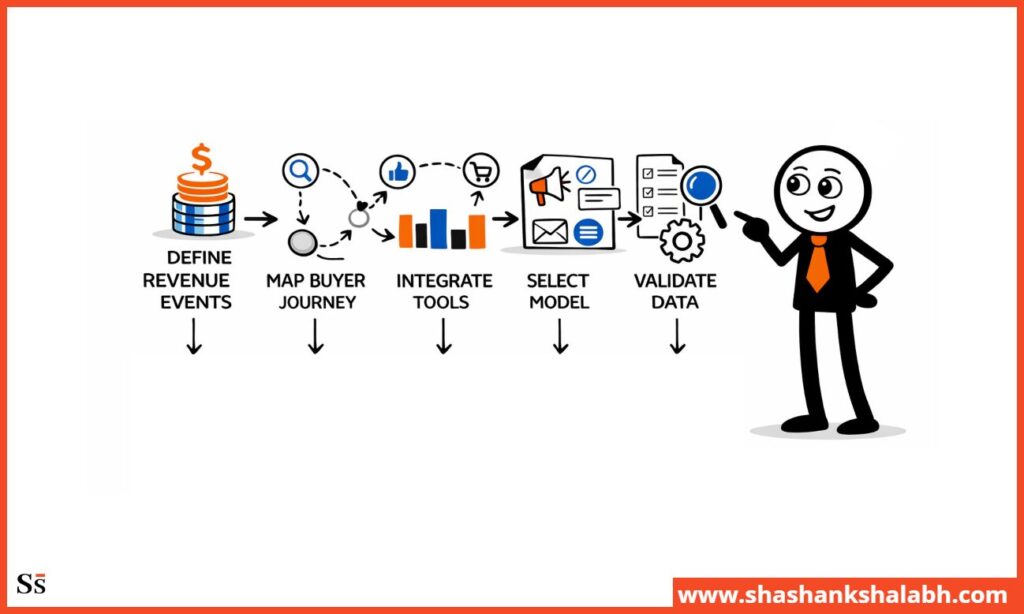
Attribution setup has six steps. Do them in order. Skipping ahead produces unreliable data.
Step 1: Define Revenue Events
Before tracking anything, define the events that matter.
- Lead: What counts as a lead?
- Lead to MQL: What converts a lead to a marketing-qualified lead (MQL)?
- MQL to SQL: What converts an MQL to a sales-qualified lead (SQL)? What is an opportunity?
These definitions need to be agreed between marketing and sales before any attribution data is collected. If marketing and sales define these events differently, the attribution data will mean different things to each team.
The output of this effort should be documented funnel stage definitions agreed by marketing and sales.
Step 2: Map the Buyer Journey
Map every touchpoint a buyer can have with marketing before becoming a customer.
This includes paid channels (search, social, display), organic channels (SEO, content, social), owned channels (email, webinars, direct), and sales-assisted channels (outbound sequences, sales content, demos).
The map doesn’t need to be perfect. It needs to be complete enough to capture the touchpoints that actually influence deals.
The output of this effort should be a buyer journey map with all active touchpoints identified and categorized by channel and stage.
Step 3: Integrate Your Tools
Attribution requires your marketing and sales tools to share data.
At minimum this means connecting your CRM (where deals live) to your marketing automation platform (where lead behavior is tracked).
Every touchpoint captured in marketing automation needs to be visible against the contact record in CRM. UTM parameters need to be consistent across all paid and organic channels so traffic sources are reliably identified.
Aim for a connected CRM and marketing automation with consistent UTM tagging and contact-level tracking across all active channels.
Step 4: Choose and Configure Your Attribution Model
With clean data and connected tools, choose the attribution model that fits your sales cycle, deal size, and channel mix.
Configure it in your analytics or attribution tool. Set the weighting for each touchpoint type if using multi-touch. Document the model configuration (what weights were chosen and why), so you can review and adjust it as the business evolves.
The output should be a configured and documented attribution model, and weighting decisions recorded with rationale.
Step 5: Validate Data Accuracy
Before using attribution data to make decisions, validate it.
Pull a sample of recently closed deals and trace the attribution path manually. Does the attribution model reflect what actually happened in those deals?
Are there touchpoints being missed (webinar attendance, direct traffic, partner referrals) that should be captured but aren’t?
Validation surfaces gaps in the setup before they affect decisions.
Aim for a validation report of reviewed sample deals, identified gaps, and adjusted setup.
Step 6: Build Reporting That Drives Decisions
Attribution data is only useful if it produces actionable reporting.
Build dashboards that answer the questions marketing and leadership actually need to answer:
- Which channels are sourcing the most pipeline
- Which channels have the best MQL-to-opportunity conversion rate
- What is CAC by channel
- What percentage of closed revenue was marketing-sourced
Review these reports monthly with marketing leadership and quarterly with the board.
The output should be an attribution dashboard showing pipeline by channel, CAC by channel, marketing-sourced revenue percentage; and monthly review cadence.
→ Marketing KPIs Every CEO Should Track
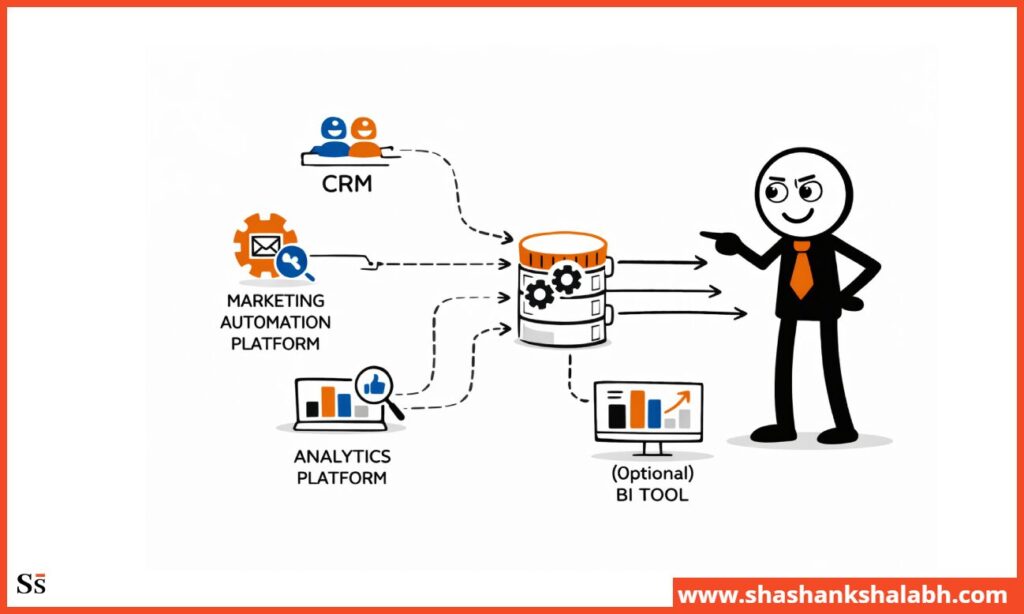
Tools: B2B Marketing Attribution Setup
Attribution doesn’t require expensive specialized software. It requires the right core tools connected correctly.
CRM (Customer Relationship Management)
The CRM is the system of record for all deals.
Every attribution model depends on the CRM being the single source of truth for pipeline and revenue. Contact records need to capture lead source, touchpoint history, and deal outcomes. Without a well-maintained CRM, attribution data is unreliable regardless of what other tools are in place.
Marketing Automation Platform
Marketing automation tracks buyer behavior such as email opens, content downloads, webinar registrations, page visits.
This behavioral data feeds the attribution model with the touchpoints that happen between first contact and close. The marketing automation platform needs to be connected to the CRM so touchpoint data is visible at the contact level alongside deal data.
Analytics Platform
A web analytics platform tracking traffic sources, landing page performance, and conversion events, captures the paid and organic touchpoints that happen before a buyer identifies themselves.
UTM parameters tag every traffic source so the CRM can record where each contact first came from. Without consistent UTM tagging, paid and organic channels lose attribution credit to “direct” or “unknown.”
Attribution or BI Tool (Optional)
For companies with complex multi-touch attribution needs, a dedicated attribution tool or business intelligence platform can process touchpoint data from multiple sources and apply sophisticated weighting models.
These tools are useful at scale, when a company is running several active channels and needs cross-channel analysis the CRM can’t produce natively. They’re not necessary to start. Build the foundation in CRM and marketing automation first.
Common B2B Marketing Attribution Mistakes
Here are the common (and avoidable) mistakes that appear in almost every attribution setup.
Relying Only on Last-Touch
Last-touch is the default in most CRM systems.
It’s also wrong for most B2B companies with sales cycles over 30 days. Companies that optimize their marketing mix based on last-touch data consistently underinvest in content, brand, and nurture channels, because those channels never get credit under last-touch.
Over time, pipeline quality declines as the top-of-funnel weakens.
Ignoring Pipeline Quality in Attribution Reporting
Attribution reporting that only measures pipeline volume misses half the picture.
A channel that generates 100 MQLs with a 10% MQL-to-opportunity conversion rate is less valuable than a channel that generates 40 MQLs with a 40% conversion rate. Attribution reporting needs to track both volume and quality, that is, pipeline sourced and pipeline that converts.
Treating All Touchpoints as Equal
Linear attribution, aka equal credit to every touchpoint, sounds fair.
In practice, it obscures which touchpoints are actually influencing deals.
A company that regularly sees deals accelerate after a specific webinar or case study should weigh that touchpoint higher. Attribution models should reflect how buying decisions actually happen; not divide credit equally as a default.
Overcomplicating the Model Before the Data Is Clean
Companies sometimes implement sophisticated multi-touch attribution before their data infrastructure supports it.
The result is precise-looking numbers built on unreliable data. Clean data with a simple model produces better decisions than messy data with a complex model.
Fix data quality first. Add model sophistication later.
Not Reviewing the Model as the Business Evolves
An attribution model calibrated for a $5M ARR company with two active channels will produce misleading results for a $20M ARR company with six channels.
Attribution models need to be reviewed annually, or when significant changes happen in channel mix, sales cycle length, or ICP. A model that was right 18 months ago may be systematically mis-attributing credit today.
How B2B Marketing Attribution Connects to Revenue Growth?
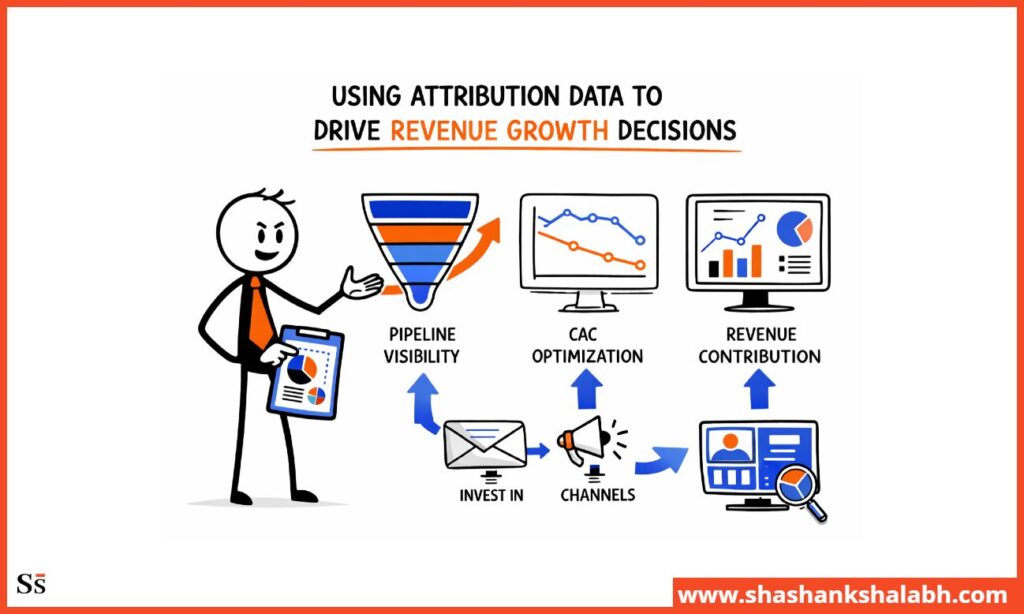
Attribution isn’t just a measurement exercise. It directly enables better revenue growth decisions.
Pipeline Visibility Improves Forecasting
When attribution shows which channels are producing pipeline, and at what volume and quality, marketing can forecast pipeline contribution the way sales forecasts deal close rates. Marketing-sourced pipeline becomes a number the revenue team can model against.
Forecast accuracy improves when pipeline inputs are visible and attributable.
CAC Optimization
Without channel-level attribution, CAC is an average across all channels.
This means high-performing channels subsidize low-performing ones without anyone knowing. Channel-level CAC data shows which channels are acquiring customers efficiently and which are consuming budget without returning pipeline.
You can reduce CAC by 20-35% within 6-12 months by reallocating budget from high-CAC to low-CAC channels based on real attribution data.
Channel Investment Decisions Become Data-Driven
Which channel should get more budget next quarter?
Without attribution, this is a gut call or a political negotiation.
With attribution, it’s a data question. Which channel has the best pipeline-to-revenue conversion rate at the current investment level, and where is the marginal return on additional spend highest?
Attribution turns channel investment from a debate into a decision.
Marketing’s Revenue Contribution
Marketing-sourced revenue percentage means what percentage of closed revenue was originally sourced by marketing.
This is one of the most important metrics in a high-growth business. It connects the marketing budget to business outcomes in language the board understands.
When this number is backed by clean attribution data, marketing’s case for investment is defensible. When it isn’t, marketing budget decisions are made on faith.

The Role of a Fractional CMO in B2B Marketing Attribution Setup
Attribution setup is a strategic decision before it’s a technical one. The model, the funnel definitions, and the reporting structure reflect strategic priorities. This is why attribution setup belongs at the executive level.
Designing the Attribution System
A fractional CMO designs the attribution system around the company’s specific sales cycle, channel mix, and decision-making needs.
This means choosing the right model, defining the funnel events, and specifying the tool integration requirements before implementation begins. Getting the design right before building saves months of rebuilding later.
Aligning Marketing and Sales on Shared Definitions
The biggest attribution failures are organizational.
Marketing and sales don’t agree on what an MQL is. CRM records aren’t maintained because sales doesn’t see the value. Funnel stage definitions shift without anyone updating the attribution model.
A fractional CMO establishes the shared definitions and joint accountability that make attribution data trustworthy across both functions.
Building Reporting That Reaches the Board
Attribution data needs to reach the board in a form they can use.
A fractional CMO translates attribution outputs such as channel performance, pipeline contribution, CAC by channel, into board-level reporting that connects marketing investment to revenue outcomes.
This is the difference between a marketing update and a revenue report.
→ Fractional CMO ROI → Go-To-Market Strategy for Scaling Companies
Checklist: B2B Marketing Attribution Setup
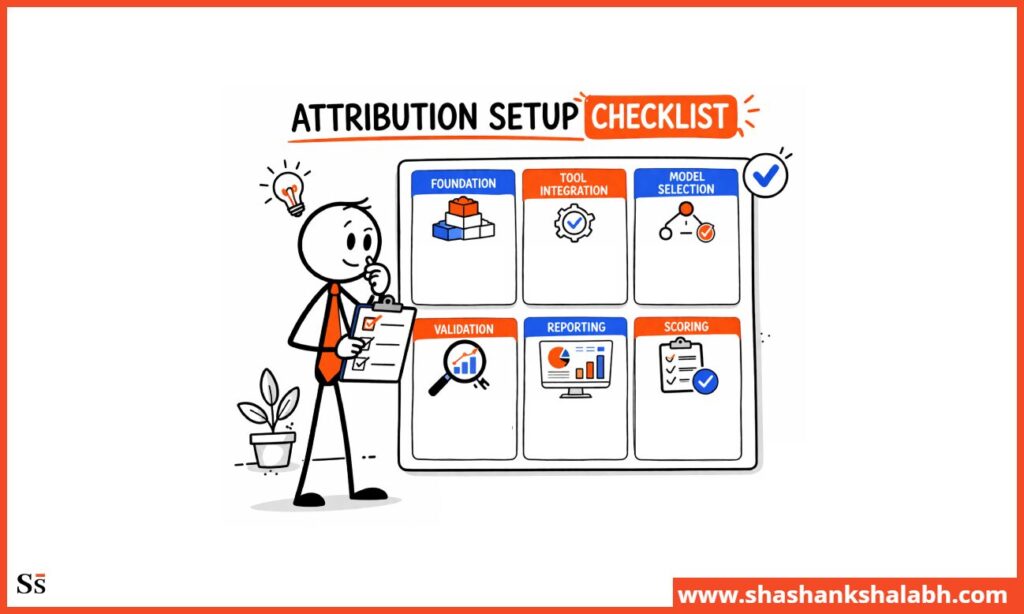
Use this checklist to quickly check how solid your attribution setup is:
Foundation
- Funnel stages are clearly defined and agreed on by marketing and sales
- CRM is the single source of truth for pipeline and revenue
- UTM parameters are consistent across all channels
Tools & Integration
- CRM and marketing automation are connected, with touchpoint data visible per contact
- Web analytics tracks traffic sources using consistent UTMs
- All active channels capture touchpoint data at the contact level
Model Selection
- Attribution model fits your sales cycle, deal size, and channel mix
- Model setup is documented, including why weighting decisions were made
- A simple model is tested before adding complexity
Validation
- Closed deals are spot-checked manually to confirm accuracy
- Any gaps in touchpoint tracking are found and fixed
- Marketing and sales both review attribution data for accuracy
Reporting
- Pipeline by channel dashboard is live and reviewed monthly
- Customer acquisition cost (CAC) is tracked by channel
- Marketing-sourced revenue is reported to leadership
- Model is reviewed yearly or after major business changes
Scoring
- 0-4 items: Needs major work before data can be trusted
- 5-9 items: Partially set up. Fix the biggest gaps first
- 10-13 items: Strong foundation. Refine for leadership reporting
- 14-15 items: Mature setup. Focus on optimizing decisions
FAQ: B2B Marketing Attribution
Here are the most common questions related to marketing attribution for the B2B domain.
What is B2B marketing attribution?
B2B marketing attribution connects your marketing activities to real revenue outcomes. It shows which channels, campaigns, and touchpoints helped close deals; and gives each the right credit based on the attribution model you use.
It answers three key questions: Which channels are generating pipeline? Which touchpoints are influencing deals? And is the marketing spend delivering returns?
Without attribution, marketing budget decisions rely on guesswork. With it, every dollar spent is tied to pipeline and revenue, giving you data-driven insights for smarter decisions.
Which attribution model is best for B2B?
There’s no one-size-fits-all attribution mode.
The best choice depends on your sales cycle, deal size, and mix of channels. For most B2B companies with sales cycles longer than 60 days and multiple active channels, multi-touch attribution gives the clearest picture. It spreads credit across the entire buyer journey instead of overvaluing a single touchpoint.
For companies just starting with attribution, or with limited data, it’s better to begin with first-touch or linear models. As your data improves, you can move to multi-touch for a more accurate view.
How do you set up marketing attribution?
Setting up B2B marketing attribution involves six steps (in order):
- Define revenue events: get marketing and sales on the same page.
- Map buyer journey touchpoints: track every interaction.
- Connect systems: link your CRM and marketing automation, using consistent UTM tags.
- Choose and configure a model: pick the right attribution approach and document it.
- Validate accuracy: check results against a sample of closed deals.
- Build dashboards: create reporting that drives real decisions.
Why is attribution difficult in B2B?
B2B attribution is tricky because sales cycles are long (often 3-12 months), buyers interact across multiple devices, and multiple stakeholders influence decisions.
Disconnected marketing and sales tools create data gaps, and defaulting to last-touch attribution oversimplifies things, often miscrediting the channels that actually drove revenue.
How does attribution impact marketing ROI?
Attribution boosts marketing ROI by showing the true cost of acquiring customers by channel. Without it, CAC is just an average, and high-performing channels unknowingly subsidize low-performing ones.
With channel-level data, budgets can shift from expensive channels to efficient ones, often reducing CAC by 20-35% in 6-12 months. It also makes marketing’s revenue contribution clear, linking spend to pipeline and closed deals in a way the board can understand and act on.

Closing Thought: B2B Marketing Attribution
It amuses me to see how a large number of businesses treat attribution as a technical problem.
In reality, it’s about making better decisions.
Companies that do it right use data to guide budgets, justify marketing spend, and lower CAC without guessing. Those that skip it make costly assumptions and only discover they were wrong when they miss revenue targets.
It is not complicated to set up attribution. However, it requires discipline: shared definitions, clean data, connected tools, and a model in place before collecting data.
Start simple. Get the foundation right. Build toward multi-touch as the data matures.

Shashank brings over 22 years of global omnichannel marketing experience. As a 4x Chief Marketing Officer, he has helped several organizations (Startups and Fortune 500) drive sustainable revenue growth through strategic marketing.