

A marketing team without direction is one of the most expensive problems a founder can have.
This is also one of the hardest to diagnose because it looks like a performance issue.
Here is how it looks.
Your team is working, pushing campaigns and content; but the pipeline is flat and revenue is missing targets.
Do you know what causes this?
Absence of strategic direction.
In this post, I will help you understand:
- Why do founders feel stuck
- The six reasons marketing teams lack direction
- A five-minute audit to identify the core issue
- How to fix this
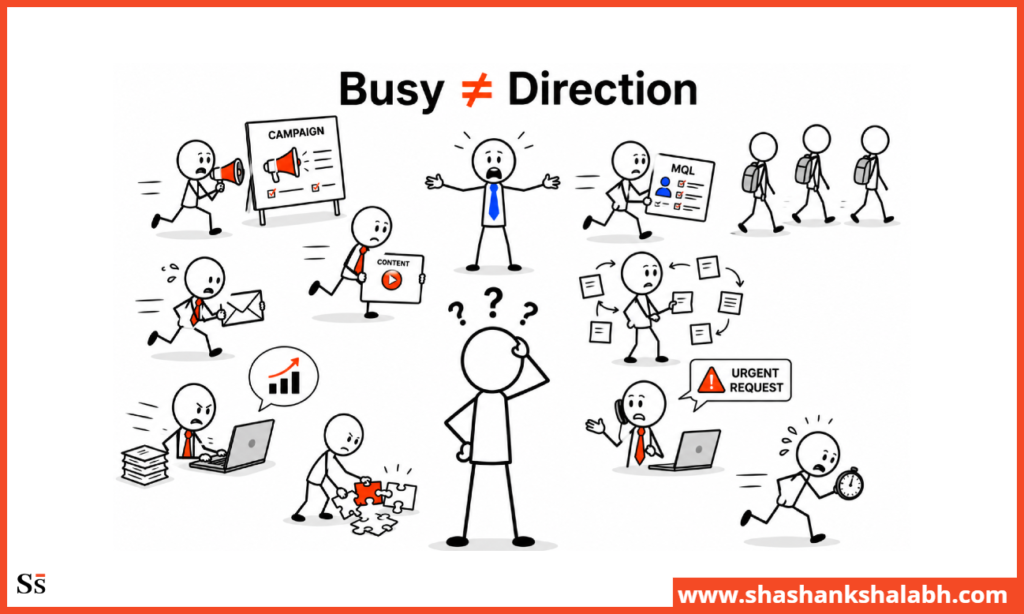
What Founders Mistake for Performance Problems?
The failure mode is invisible until someone looks at outcomes rather than activity.
As I mentioned earlier, your team could be hitting internal targets, and still the pipeline remains flat. Revenue is missing targets.
The founder is increasingly frustrated with a team that seems to be doing everything right while producing nothing that matters.
What are the symptoms of this problem?
- Every team member is busy but nobody can clearly articulate what marketing is trying to accomplish this quarter
- Priorities shift week to week based on whoever makes the most urgent request
- Marketing presents activity reports (impressions, clicks, MQL volume) with no connection to closed revenue
- The founder is still making every significant marketing decision despite having a marketing team
- High performers are leaving. The people with the most options are the first to exit a team without direction
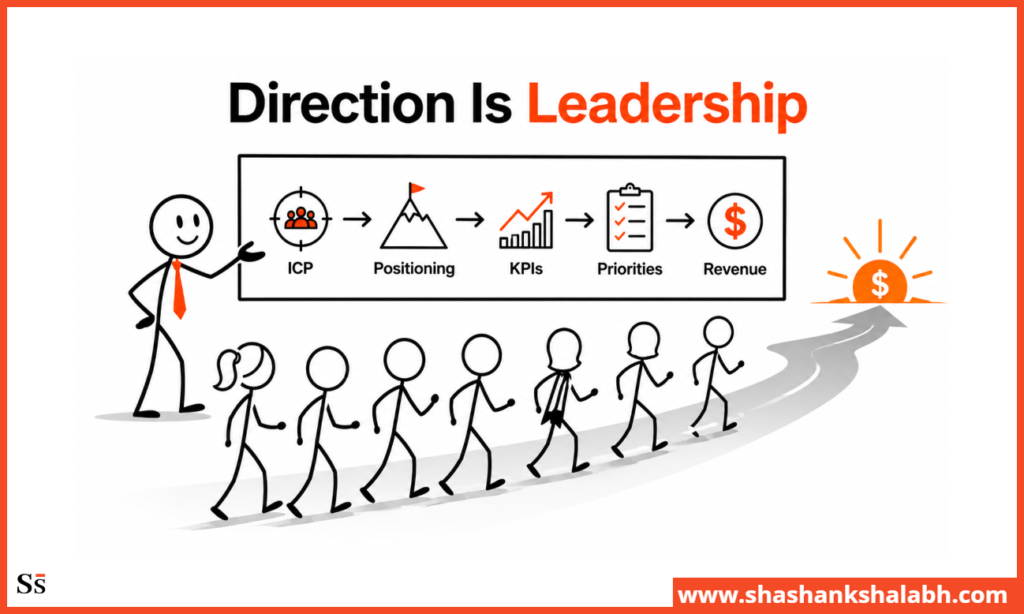
Why This Is a Leadership Issue?
You might argue that marketing teams without direction are underperforming.
Well, you are mistaken.
The real issue is that they are performing against unclear or wrong objectives.
Isn’t the goal of a marketing team to execute campaigns, produce content, and generate leads?
The problem is that nobody defined what the campaigns should accomplish, what the content should produce, or what the leads should become.
Once you give clear strategic direction to the same team, you will see dramatically different results within 60-90 days.
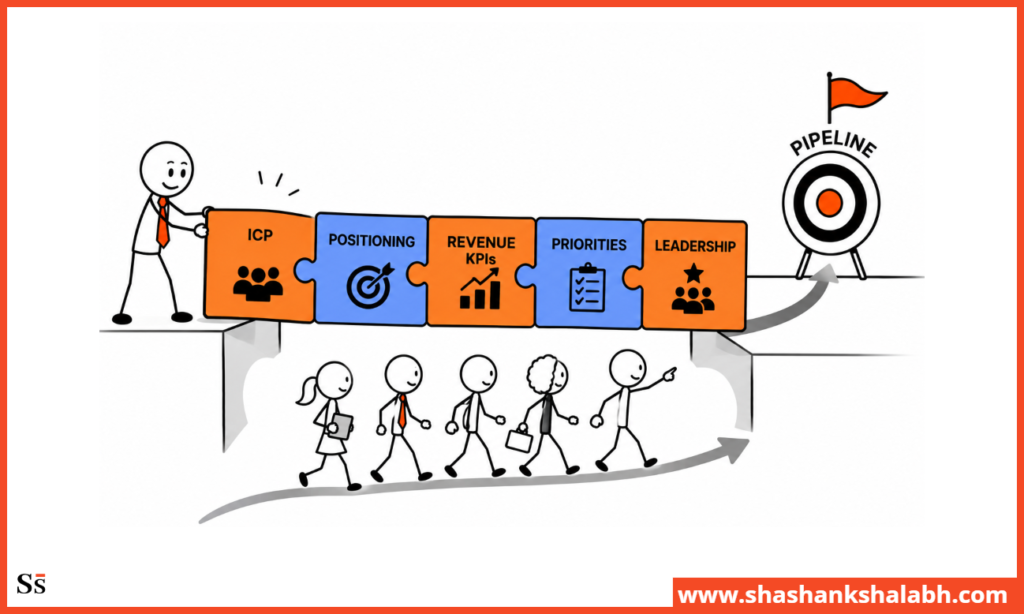
And by strategic direction, I mean specific ICP, differentiated positioning, revenue-connected KPIs, and a prioritized quarterly roadmap.
I have observed that many founders take the hasty route of firing and hiring without fixing the direction-issue. Or, they increase the budget, or even switch agencies.
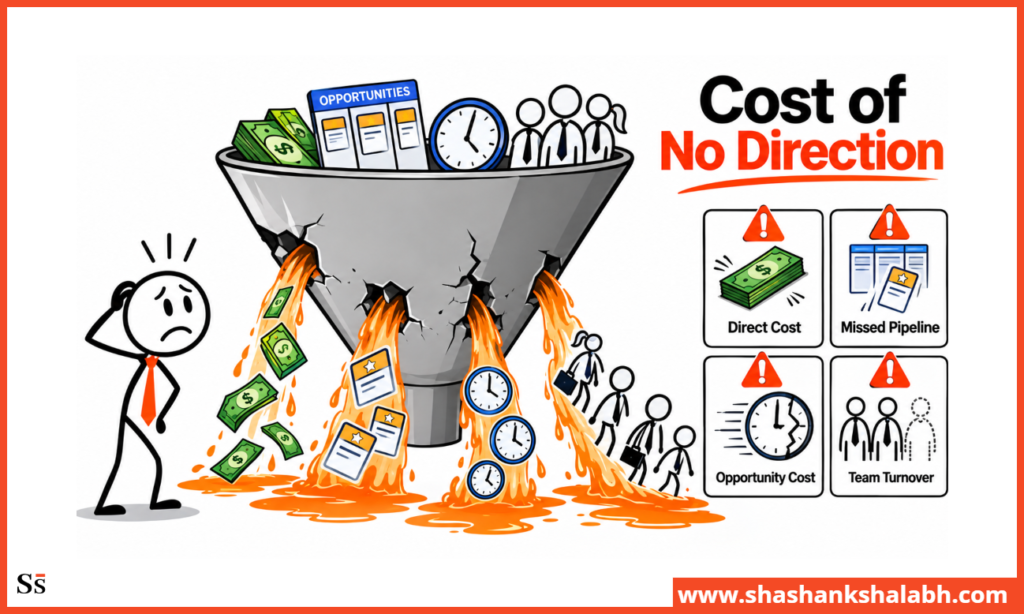
The Cost of a Directionless Marketing Team
You might question if it’s quantifiable to find the cost of a marketing team lacking direction.
Ofcourse, it is.
Direct cost
$120K-$300K annually in salaries producing activity without revenue. This is the ongoing cost of capable people executing in the wrong direction.
Indirect cost
12-18 months of missed pipeline while the direction problem goes undiagnosed as a talent or execution problem.
Opportunity cost
Falling behind competitors with a clear marketing strategy
These are the companies that are reaching the same buyers with sharper positioning and more specific messaging.
Team cost
High performers leave teams without direction.
The people with the most options leave first. What remains is a team that’s selected for tolerance of ambiguity rather than for strategic capability.
For more on how marketing leadership investment connects to revenue ROI, see Fractional CMO ROI.

The 6 Reasons Marketing Teams Lack Direction
Let me share with you why your marketing team lacks direction.
No Clear ICP Defining Who to Target
If you don’t have a clear ICP definition, every team member will have a slightly different idea of who the customer is.
And that disagreement will show up in campaigns. As a result, marketing will reach a broad audience without converting the right one.
Broad targeting looks productive. It produces high-volume activity with low-quality results.
How to fix this?
Define ICP from closed-won data before giving the team any campaign direction.
Every campaign brief, channel decision, and content piece should start from the ICP.
For more on the ICP rebuild process, see GTM Strategy for Scaling Companies.
No Positioning the Team Can Execute Against
Positioning is the strategic foundation that makes every marketing decision easier.
It tells the team what problem is being solved, for whom, and why the solution is specifically different from alternatives.
Without it, every team member makes independent creative decisions. And each piece of content, each ad, each email reflects a different interpretation of what the company does.
The result is a brand that looks different everywhere and converts nowhere.
How to fix this?
Develop positioning before briefing the team on any campaign.
What specific problem is solved, for which specific buyer, and what makes this solution specifically different from alternatives.
With clear positioning, every team member makes independently consistent decisions because they’re all starting from the same foundation.
Wrong KPIs Measuring the Wrong Things
Marketing teams optimize for what they’re measured on.
When the team is measured on MQL volume, content pieces published per month, and email open rate, they produce MQL volume, content, and email opens.
And none of it connects to revenue.
Founders often set marketing KPIs based on what’s easy to measure rather than what matters. MQL volume is easy to count. Pipeline contribution requires attribution infrastructure.
Content output is visible. Content pipeline impact is harder to track.
So the easy metrics become the official metrics, and the team dutifully optimizes for them while the business misses its revenue targets.
How to fix this?
Replace activity KPIs with revenue-connected metrics such as MQL-to-SQL conversion rate, pipeline contribution in dollars, marketing-sourced revenue percentage, and CAC by channel.
For more on the right KPI framework, check out this post: Marketing KPIs Every CEO Should Track.
No Prioritization Framework: Everything Is Urgent
Marketing teams without direction experience everything as equally important.
The CEO wants a new case study. Sales wants better collateral. The product team needs launch support. The blog needs updating. A conference is approaching. All of it arrives with urgency. None of it has an established priority.
Reactive teams spend most of their time on what’s loudest.
The result is a lot of mediocre work instead of a little excellent work.
How to fix this?
Implement a quarterly priority framework.
This should be three to five initiatives that directly connect to revenue targets, with everything else explicitly deprioritized or deferred.
The Founder Is Still Making Every Marketing Decision
When the founder is the de facto marketing director, the team executes rather than leads.
Every significant decision waits for founder input. This results in delayed campaigns and opportunities.
Founders who stay inside marketing decisions because they care about quality actually produce lower quality outcomes over time.
The team never develops independent strategic capability because it’s never required. The founder becomes the bottleneck on every initiative. The team becomes skilled at execution against defined briefs and incapable of strategic initiative.
How to fix this?
Define decision rights explicitly.
What the team decides independently. What requires founder input. What requires founder approval.
Document it.
Enforce it by pushing decisions back to the team even when the impulse is to just answer.
No Marketing Leader Between the Team and the Founder
Marketing managers execute campaigns and marketing directors manage execution.
CMOs own revenue outcomes.
Most companies between $3M–$15M ARR have execution management without executive ownership. They have a marketing manager or director doing their best without the strategic authority or experience to set direction.
A director-level leader can manage a campaign calendar. They can’t independently define ICP, build positioning, restructure the KPI framework, and present pipeline accountability to the board. That requires CMO-level capability.
How to fix this?
Bring in an executive marketing leader; a full-time CMO, a VP of Marketing with CMO-level strategic capability, or a fractional CMO who owns the strategic layer and gives the team the direction it needs to perform.
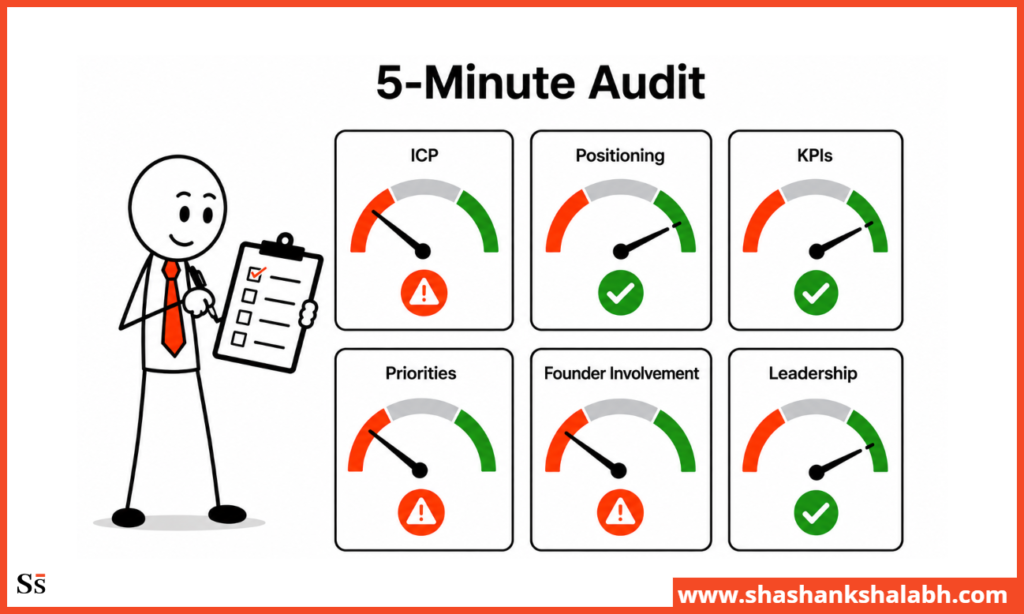
The Five-Minute Team Direction Audit
Here are the 6 questions to help you diagnose all these issues I mentioned earlier.
| Question | Issue |
| Can every member of the marketing team describe the ICP in the same specific terms? | No Clear ICP |
| Does all marketing output say the same core thing in different formats? | No Clear Positioning |
| Can the team tell you what marketing contributed to closed revenue last quarter, specifically, in dollars of pipeline sourced? | Wrong KPIs |
| Can each team member list their top three priorities this quarter without asking the founder? | No Prioritization Framework |
| Does the team make routine campaign decisions independently or wait for founder input? | Founder Over-Involvement |
| Is there someone in the marketing function whose primary accountability is revenue contribution, pipeline and CAC, rather than campaign delivery? | No Strategic Leader |
Here is something you can try to assess the issue quickly.
Ask each marketing team member independently, without preparation: “What is marketing trying to accomplish this quarter and how will we know if we succeeded?”
The answers to this one question tell more about marketing direction than any dashboard or activity report.
How to Bring Direction to a Marketing Team?
Define ICP before anything else.
Every other fix depends on knowing exactly who is being targeted.
Without ICP, the positioning work produces the wrong message. The KPI work measures the wrong metrics. The prioritization work optimizes the wrong campaigns. The team direction work points in the wrong direction.
Once ICP is defined, positioning becomes significantly easier. The question is specific: what does this specific buyer care about most, what alternatives are they considering, and why is this solution specifically right for them at this moment?
Positioning without ICP is guesswork. Positioning with ICP is inference from data.
Replace activity KPIs with revenue-connected metrics.
This is the fastest fix and the one that changes team behavior most immediately.
Remove MQL volume, content output, and email open rate as primary marketing KPIs. Replace with MQL-to-SQL conversion rate, pipeline contribution in dollars, marketing-sourced revenue percentage, and CAC by channel.
Establish quarterly priorities
Focus on three to five initiatives connected directly to revenue targets.
Review monthly. Adjust if business context changes. Don’t let urgency override priority.
Document what the team decides independently, what requires founder input, and what requires founder approval. Keep the approval list short; fewer than five categories. Push everything else to team ownership.
Bring in an executive marketing leader
Without executive ownership, direction drifts. ICP gets broad again as new campaigns target new audiences. KPIs drift back to activity as activity is easier to measure. Priorities get overridden by the founder’s most recent priority.
For more on when this is the right move, see Fractional CMO Services.
What a Marketing Team With Direction Looks Like
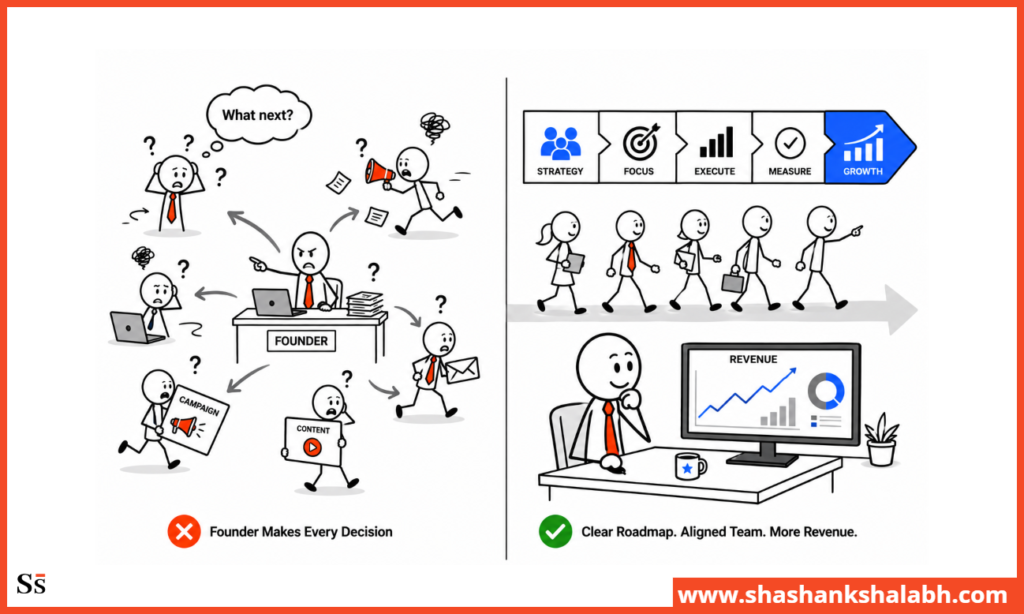
The Behavior Difference
| Without Direction | With Direction |
| What should we work on next? | Which of our current priorities does this serve? |
| Team reports activity completed | Team reports pipeline contribution and CAC trend. |
| Founder is in every campaign decision | Founder reviews revenue metrics monthly and trusts the team to execute against the established strategy. |
| High performers leave within 12 months | High performers stay and grow because their work compounds toward visible revenue outcomes. |
The Output Difference
When a marketing team has direction, fewer initiatives are executed excellently rather than many executed adequately.
You will see consistent messaging across every channel because every team member starts from the same ICP and positioning. There will be measurable pipeline contribution from marketing within 90 days of direction being installed.
And your CAC will start to decline as targeting tightens and conversion improves from better-aligned campaigns reaching the right buyers with the right message.
How a Fractional CMO Fixes Marketing Team Direction
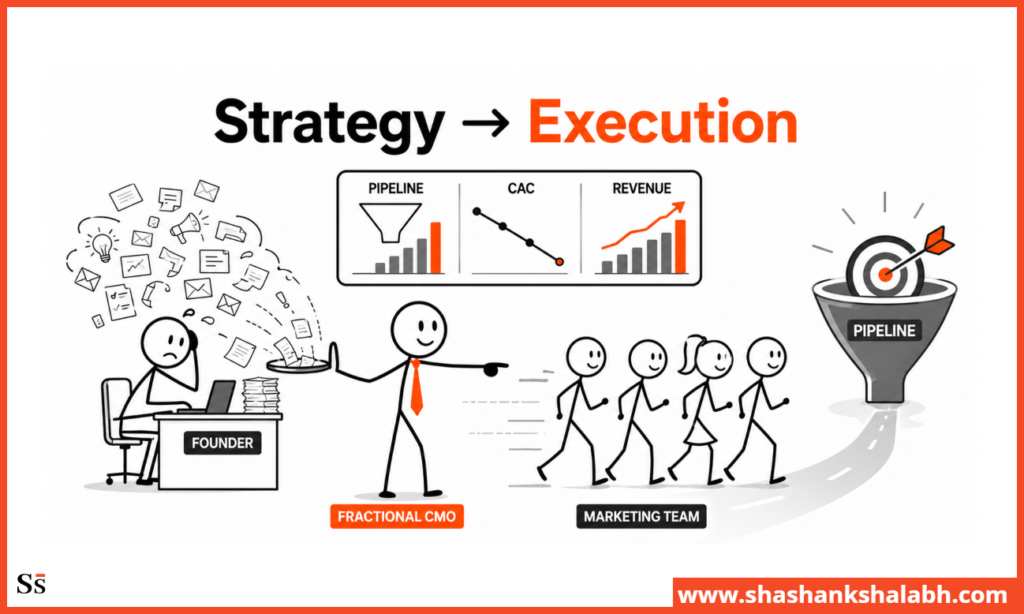
In the first 30 days, the fractional CMO builds the foundation the team has been missing.
This includes a clear ICP based on closed-won data, sharper positioning, revenue-focused KPIs, and priorities that don’t get hijacked by urgency.
The team already knows how to execute. What they haven’t had is a clear ICP, clear priorities, and a way to measure what actually matters.
The fractional CMO takes marketing off the founder’s plate. They own the strategy, make the big calls, and give the team clear direction.
Weekly team meetings focus on pipeline contribution and CAC, not campaign metrics. Each month, the founder and board see the numbers that matter: marketing-sourced revenue, pipeline coverage, and CAC by channel.
The team knows what they’ll be accountable for, so priorities change.
For more on what a fractional CMO owns in a full engagement, see Fractional CMO Responsibilities.
FAQ: Why Your Marketing Team Lacks Direction?
Let’s look at the common questions related to this topic.
Why does my marketing team keep missing targets despite working hard?
A team can work hard and still miss revenue targets when the strategy isn’t clear. They focus on what they’re measured on: content, MQLs, and campaign launches.
The solution is a better direction: a clear ICP, strong positioning, revenue-based KPIs, and priorities that stay consistent. Give the team that foundation, and the same people can produce very different results within 60-90 days.
How do I know if my marketing team lacks strategic direction?
Ask each team member the same question: “What is marketing trying to accomplish this quarter, and how will we know if we succeeded?”
If the answers are different, the team lacks direction. If the answers focus on campaigns, content, or lead volume, the team is measuring activity instead of outcomes. The right answers should point to revenue: pipeline, CAC, and marketing-sourced revenue.
One question can tell you a lot about how well the team is actually aligned.
What should a marketing team be accountable for?
Marketing should be accountable for four numbers:
- MQL-to-SQL conversion rate
- Marketing-sourced pipeline
- Marketing-sourced revenue
- CAC by channel
These show whether marketing is actually contributing to revenue. MQL volume, content output, and email opens only show activity.
What you measure is what the team prioritizes.
How do I give my marketing team direction without micromanaging?
Good direction without micromanagement comes down to three things: a clear ICP and positioning, revenue-focused KPIs, and clear decision-making boundaries.
The team should know what they own, what needs founder input, and what can wait until next quarter. Without that clarity, founders end up weighing in on every campaign and decision.
Give the team a solid strategy and room to make decisions, and the founder can finally step out of the day-to-day.
When does a company need a CMO instead of a marketing manager?
Companies need CMO-level leadership when marketing isn’t tied to revenue and the problem is strategy, not execution.
If the team can run campaigns but doesn’t have a clear ICP, positioning, or revenue targets, the missing piece is leadership.
For businesses doing $3M-$20M ARR, a fractional CMO can fill that gap for roughly $15K-$25K a month, without the cost of a full-time CMO. A full-time hire makes more sense as the company grows and the team becomes more complex.

Closing Thought
A marketing team without clear direction usually doesn’t need more people, another agency, or a bigger budget. It needs better leadership.
Give the team a clear ICP, strong positioning, revenue-based KPIs, and priorities that don’t change every week. That’s when the work starts to add up.
Without that foundation, the team stays busy. With it, the work starts driving revenue.

Shashank brings over 22 years of global omnichannel marketing experience. As a 4x Chief Marketing Officer, he has helped several organizations (Startups and Fortune 500) drive sustainable revenue growth through strategic marketing.