
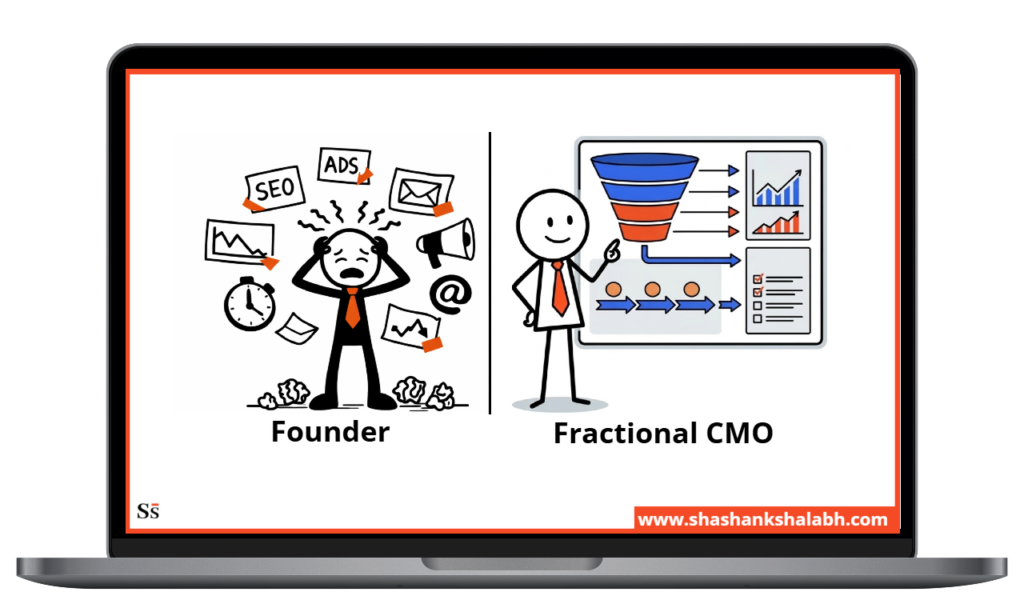
Founder-led marketing works until it doesn’t.
Most companies reach a point ($5M-$15M ARR) where the informal, intuition-driven marketing approach that produced early traction stops scaling.
The transition from founder-led to structured marketing isn’t a hiring decision. It’s an organizational maturity decision that determines whether a company can grow beyond what one person can personally drive.
What this post covers:
- Why founder-led marketing works early and where it breaks
- The four stages of marketing maturity
- How to build the first structured marketing system
- When to bring in a fractional CMO
- Diagnostic checklist for assessing marketing maturity

What Founder-Led Marketing Looks Like?
Founder-led marketing is the default state of most early-stage companies.
The founder is the primary marketing asset: the voice, the network, the narrative, and the decision-maker for every marketing activity.
In practice, you will see these common traits with founder-led marketing:
Founder-driven messaging
The company’s positioning, value proposition, and market narrative live in the founder’s head…
Content, sales decks, and outreach reflect the founder’s language, insights, and relationships. There is no documented strategic framework.
Ad hoc campaigns
Marketing activity is reactive rather than systematic. Campaigns rely on the founder’s bandwidth. There are no documented KPIs to evaluate marketing.
Intuition-based decisions
The founder uses their judgement (instead of using data) for channel selection, budget allocation, and messaging decisions.
This works when the founder’s intuition is sharp, and fails when the market evolves beyond what intuition alone can navigate.
Heavy founder involvement
Every significant marketing output requires founder review or initiation. Whether it’s a major piece of content, a campaign brief, or a partnership proposal, they all need the founder’s signoff. Marketing cannot produce strategic output without the founder in the loop.
Founder-led marketing is often the most efficient approach for businesses under $5M ARR. The problem is when companies try to scale it past the point where it can go.

Why Founder-Led Marketing Works Early?
Founder-led marketing succeeds in the early stages for reasons that are genuinely difficult to replicate with a structured team.
Founder Insight and Customer Proximity
Founders know the customer problem better than anyone else in the organization, often because they experienced it themselves. This proximity produces messaging that resonates authentically, content that addresses real pain points, and sales conversations that build genuine credibility.
Early customers buy the founder as much as the product. That dynamic is a real competitive advantage at an early stage.
Fast Experimentation & No Bureaucracy
Founder driven marketing moves at the speed of founder decision-making. There’s no approval process, no creative brief, no agency timeline. An idea becomes a campaign in days rather than weeks.
This speed advantage is significant when the company is still learning what works. Early-stage marketing requires rapid iteration that institutional processes slow down.
Authenticity That Builds Early Community
Founder-led content carries an authenticity that polished brand marketing rarely achieves. Early adopters respond to founders who are visible, transparent, and willing to engage directly. This authenticity builds the early community that gives many companies their first wave of organic growth.
Low Overhead in Capital-Constrained Environments
Before Series A, the marketing budget is often limited. Founder-led marketing produces results without the overhead of a marketing team, an agency, or a formal content operation.
The founder’s time is the primary input. While that time is expensive in opportunity cost terms, it doesn’t show up on the burn rate in a way that concerns early investors.
Why Founder-Led Marketing Breaks at Scale?
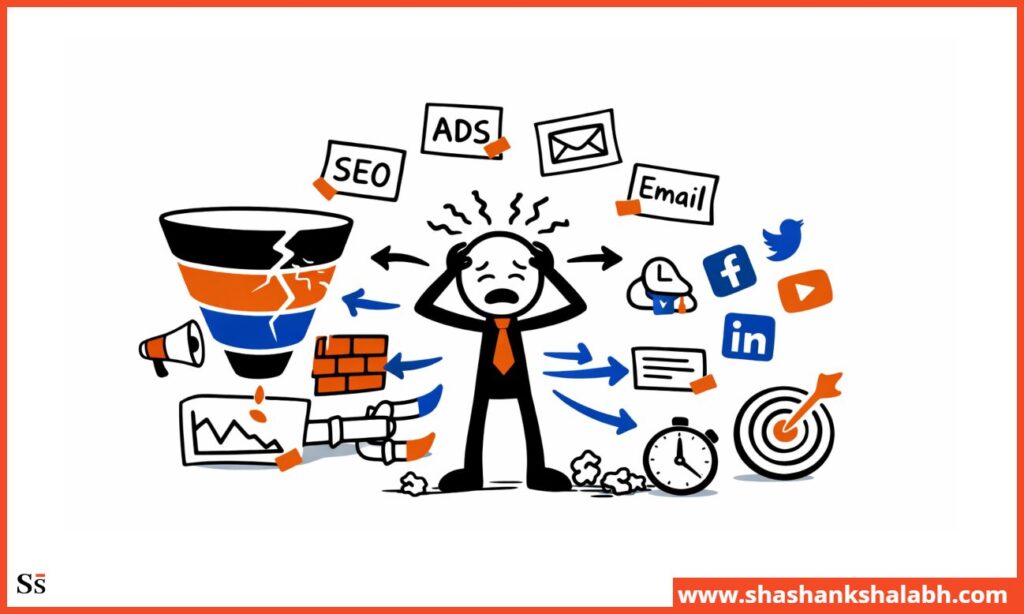
The same characteristics that make founder-led marketing strategy effective at an early stage become liabilities as the company grows. The transition point varies by company, but the failure patterns are consistent.
Bandwidth Constraints Limit Pipeline
A founder managing a growing company cannot also manage a growing marketing function.
Organizational complexity such as more team members, more customers, more operational demands leads to time crunch for marketing.
Pipeline becomes inconsistent because it depends on founder attention that is increasingly unavailable. The company’s revenue growth becomes constrained by the founder’s calendar.
Intuition Stops Scaling With the Market
Founder intuition about messaging, channels, and ICP is calibrated to the early market. This works well for the customers who adopted first, the problems that were most visible at founding, the competitive landscape that existed when the product launched.
As the market matures, competitors respond, and the buyer profile expands beyond early adopters, founder intuition becomes an increasingly unreliable guide. The messaging that resonated with the first 50 customers often doesn’t convert the next 500.
Lack of Specialization = Mediocre Results
Founders are generalists by necessity.
A founder running marketing is simultaneously managing content, paid acquisition, email, events, partnerships, and sales enablement.
At the early stage, broad coverage beats deep capability. At the growth stage, the reverse is true.
A specialist demand generation leader will outperform a generalist founder in paid acquisition. A specialist content marketer will outperform a founder in the organic pipeline. Founder-led marketing at scale produces average results across all channels rather than strong results in the channels that matter most.
Absent Systems Create Fragile Pipeline
Founder-led marketing produces results through personal effort. When the founder’s attention shifts, the pipeline shifts with it.
There’s no documented ICP, no repeatable demand generation process, no attribution model connecting marketing activity to revenue. Marketing is entirely dependent on founder involvement to produce output.
This becomes a serious problem when the company needs to demonstrate scalable, predictable revenue growth to a board or potential investors.
Organizational Scaling Requires Leadership the Founder Can’t Provide
When the marketing team grows beyond two or three people, those team members need strategic direction, role clarity, and performance accountability that the founder can’t provide consistently.
Marketing teams without dedicated executive leadership default to executing tasks without strategic context. They become a production function rather than a revenue function. High performers leave when they realize there’s no marketing leader to develop them or champion their work organizationally.
Signs a Company Has Outgrown Founder-Led Marketing
There is not one single moment that triggers the transition from founder-led to structured marketing. It’s a pattern of signals that accumulates over time. Here’s what the pattern looks like:
Marketing Complexity Is Increasing Faster Than Capacity
The company is running multiple channels, such as paid, organic, email, events, and partnerships, without a unified strategy connecting them.
Each channel is managed separately, measured against its own metrics, and optimized without reference to the overall pipeline target. Complexity has outgrown the capacity of one person to manage strategically.
Revenue Targets Require Marketing to Be a System
The board or investor expectations for the next 12 months require marketing to produce a specific pipeline volume.
When pipeline accountability becomes a board-level conversation, informal founder-led marketing stops being a credible operating model. The company needs documented processes, clear KPI ownership, and a marketing leader who can stand in front of the board and own the numbers.
The Founder Is the Bottleneck
When every significant marketing output requires founder approval, review, or initiation, and that requirement is slowing the team down, the founder becomes the constraint.
Recognizing this is difficult. Founders are often the highest-quality marketing thinker in the organization. But being the highest-quality thinker and being the bottleneck are not mutually exclusive.
The Marketing Team Lacks Strategic Direction
Activity is not a strategy.
If your marketing team is executing tasks without understanding why; producing content without a documented ICP, running campaigns without a positioning framework, and generating leads without a clear qualification criteria, there is an issue.
Team members in this environment can’t make good decisions independently because they don’t have the strategic context to guide them.
Sales Is Complaining About Lead Quality
Sales blaming marketing for lead quality is a symptom of founder-led marketing at scale. Without a documented ICP, formalized qualification criteria, and structured handoff protocols, marketing generates volume and sales determines quality informally.
The resulting misalignment produces exactly the dynamic that constrains growth. Sales spends time on unqualified leads, marketing generates leads that don’t convert, and both functions blame the other for the gap.
The Transition From Founder-Led to Structured Marketing
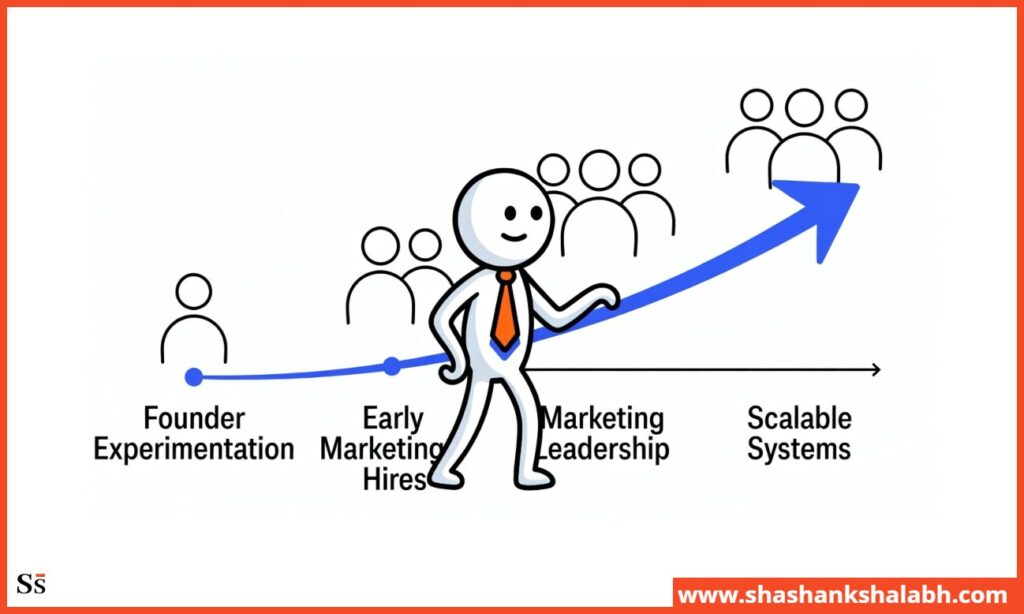
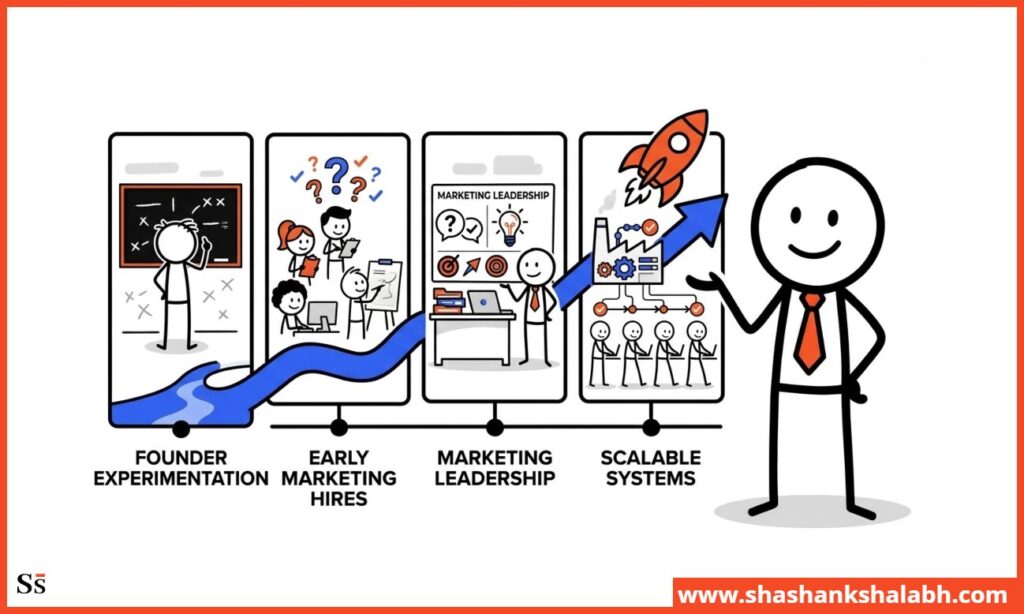
The transition from founder-led to structured marketing happens in four stages. Most companies get stuck between Stage 2 and Stage 3.
Stage 1: Founder Experimentation ($0-$2M ARR)
Marketing is entirely founder-led.
The founder tests channels, refines messaging, and builds early customer relationships. There’s no formal marketing team. The primary goal is identifying what works; which channels produce early customers, which messages resonate, which customer profiles convert and retain. Documentation is minimal. Speed matters more than process.
What success looks like: First customers acquired, initial product-market fit signals identified, early traction in one or two channels.
Stage 2: Early Marketing Hires ($2M-$5M ARR)
The company makes its first marketing hires (one or two generalists) who can execute across multiple channels. The founder is still setting strategic direction but is beginning to delegate execution.
Marketing is still largely founder-dependent for strategic decisions. The team is capable of executing against clear direction but can’t yet generate strategic direction independently.
What success looks like: Marketing execution is no longer entirely founder-dependent. Early pipeline infrastructure is in place. Basic attribution connects marketing activity to leads.
Stage 3: Marketing Leadership ($5M-$15M ARR)
This is the critical transition stage.
The company needs an executive marketer who owns the GTM strategy, manages the team, reports to the board, and is accountable for pipeline and CAC outcomes.
The founder steps back from day-to-day marketing decisions and transitions to a strategic input role. This is typically where a fractional CMO is most impactful as they provide the executive direction the team needs without the full-time cost burden of a $300K-$700K CMO hire.
What success looks like: Marketing operates with strategic direction independent of founder involvement. Pipeline is consistent and attributable. CAC is tracked and improving. The board receives marketing reporting that connects to revenue outcomes.
Stage 4: Scalable Systems ($15M-$50M ARR)
Marketing is a fully institutionalized revenue function. Documented processes govern every significant marketing activity.
The team has functional specialists in demand generation, content, product marketing, and RevOps.
The CMO (fractional or full-time depending on revenue and team size) reports directly to the CEO and presents quarterly to the board. Marketing-sourced revenue is tracked and growing as a percentage of total revenue.
What success looks like: Marketing produces a predictable pipeline without founder involvement. CAC payback is under 12 months. LTV:CAC ratio is 4:1-5:1.
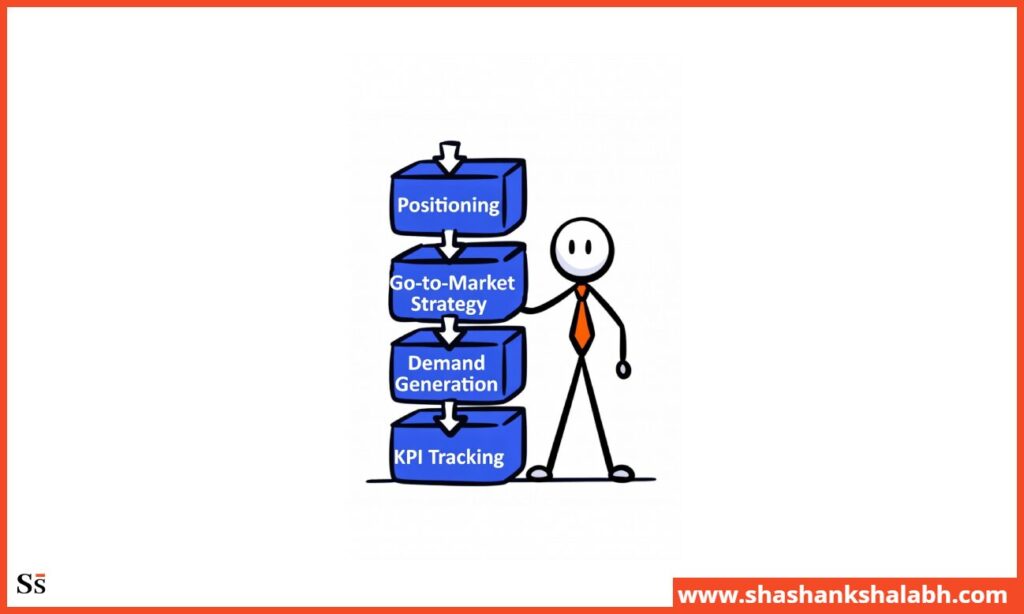
Building the First Structured Marketing System
The shift from founder-led to structured marketing requires building four foundational systems. Note that these phases are not sequential. They are interdependent. But most companies need to address them in roughly this order.
Positioning Clarity
The first structured marketing system is a documented positioning framework.
This answers who the ICP is, what problem the product solves for them, how the company is differentiated from alternatives, and what the economic buyer needs to hear to act.
The framework replaces the founder’s intuition as the strategic foundation for every marketing decision. Without it, every subsequent system is built on an unstable base.
Go-To-Market Strategy
Now, the business can build a GTM strategy.
This involves the channel mix, demand generation architecture, and budget allocation framework that connects positioning to pipeline.
A structured GTM strategy defines which two to three channels to invest in based on CAC efficiency for the specific ICP, what demand generation programs to run in each channel, and how to measure whether the strategy is working.
Read: Go-To-Market Strategy for Scaling Companies.
Demand Generation Infrastructure
Demand generation is the operational layer that makes the GTM strategy executable. This includes the campaigns, content programs, sequences, and systems that produce consistent pipeline.
This requires moving from ad hoc campaigns to documented, repeatable programs with clear owners, defined success metrics, and improvement cadences.
The goal here is to build pipeline consistency (not pipeline volume).
KPI Discipline
The final foundational system is a KPI framework that connects marketing activity to revenue outcomes.
For scaling companies, the core metrics are CAC, LTV:CAC ratio, pipeline coverage ratio, conversion rates by funnel stage, and marketing-sourced revenue percentage.
For B2B SaaS companies at growth stage, the benchmarks are a CAC payback period under 12 months, LTV:CAC ratio of 4:1-5:1, and pipeline coverage of 3:1 against revenue targets.
Without this framework, marketing can’t measure whether the transition to structured marketing is working.
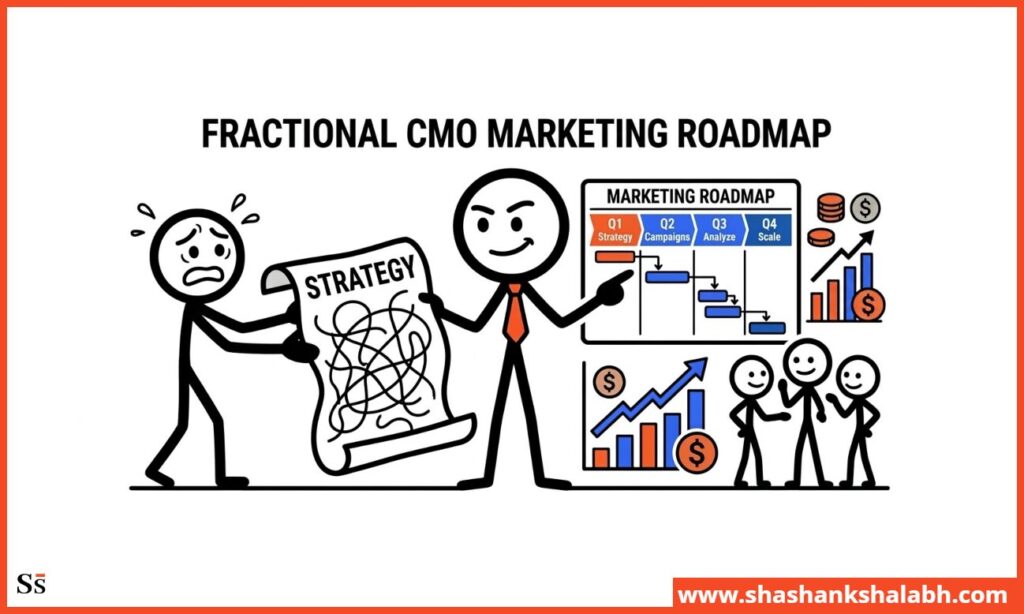
When Companies Bring in a Fractional CMO?
The fractional CMO typically enters the picture at Stage 3 of the marketing maturity model. This is when the company needs executive marketing leadership but the team size, revenue, and organizational complexity don’t yet justify a $300K-$700K full-time hire.
The Founder Is Overwhelmed
When the founder is simultaneously managing product, team, investors, and marketing, and all of them are suffering because of the divided attention, the marketing function needs its own executive leader.
A fractional CMO oversees the marketing strategy, team direction, and board reporting. This frees the founder to focus on the organizational leadership responsibilities that only the founder can carry.
Growth Has Plateaued Between $5M-$15M ARR
Revenue growth slowing between $5M-$15M ARR is one of the clearest signals that founder-led marketing has hit its ceiling.
The channels that produced early traction are saturating. The messaging is reaching diminishing returns. The team is executing without strategic direction. A fractional CMO diagnoses what’s broken and builds the structured marketing system that unlocks the next growth stage.

The Company Has Raised Series A and Needs Board Accountability
Post-Series A, the board expects marketing to report on pipeline, CAC, and LTV:CAC. A fractional CMO provides the executive marketing leadership that can stand in front of a board and own revenue accountability from marketing.
For most Series A companies between $5M-$15M ARR, a fractional CMO at $15K-$25K per month is the right bridge between founder-led marketing and a full-time CMO hire.
The Marketing Team Lacks Strategic Leadership
A marketing team of two to four people executing without strategic direction is a common and costly condition. The team produces output without a clear framework for what success looks like. A fractional CMO provides the strategic direction, role clarity, and KPI ownership that transforms a capable execution team into a productive revenue function.
Read: Marketing Organizational Design for Scaling Companies

How Structured Marketing Supports Scalable Growth?
Structured marketing brings four measurable improvements that compound over time.
Predictable Pipeline Replaces Inconsistent Volume
Structured marketing produces a consistent pipeline.
This covers a documented demand generation program against a defined ICP, with attribution connecting activity to opportunities. Pipeline coverage of 3:1 against revenue targets becomes achievable and measurable. The board can model revenue growth against a pipeline number they trust.
Revenue Accountability Replaces Activity Reporting
Structured marketing reports on revenue outcomes such as pipeline sourced, CAC trajectory, LTV:CAC ratio, marketing-sourced revenue percentage.
These metrics connect marketing investment to business outcomes in a language the board, investors, and CEO can act on. Activity reports give way to revenue dashboards.
Scalable Demand Generation Replaces Founder Effort
Documented demand generation systems produce a pipeline without founder involvement.
The founder’s personal network is no longer the primary demand source. Channels such as organic search, content programs, and paid acquisition improve with investment and optimization.
Cross-Functional Alignment Replaces Organizational Friction
Structured marketing establishes the shared pipeline definitions, handoff protocols, and joint forecasting cadence that eliminate sales-marketing misalignment.
Organizations with strong sales-marketing alignment grow 50-80% faster than misaligned businesses. The transition from founder-led marketing to structured marketing requires deliberately building this alignment into the organizational operating model.
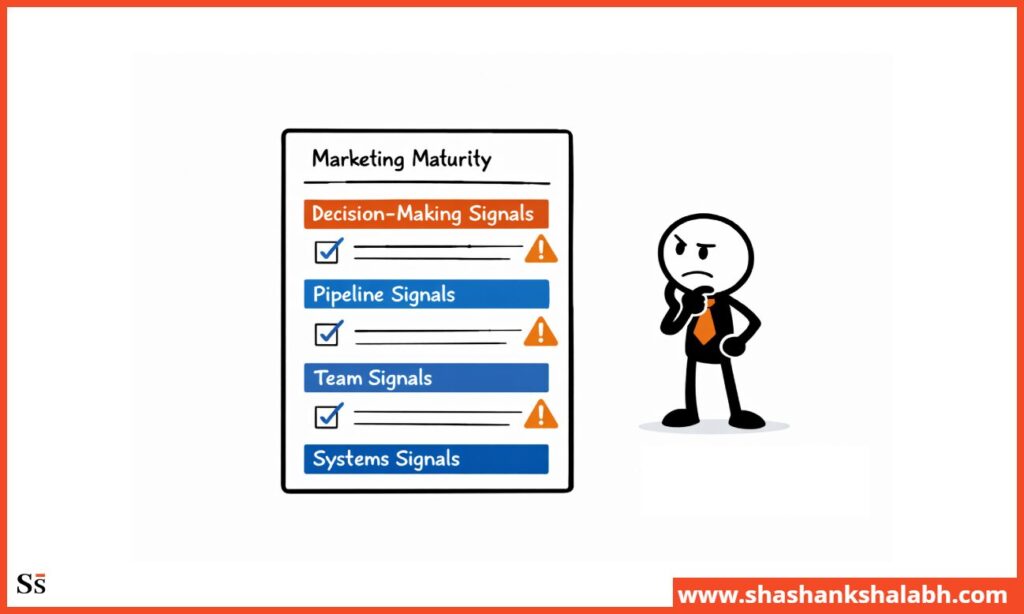
Checklist: Is Your Company Still in Founder-Led Marketing Mode?
Use this diagnostic to assess marketing maturity:
Decision-making signals:
- The founder approves all significant marketing campaigns before launch
- Marketing strategy is informal. There is no documented ICP, positioning framework, or GTM strategy
- The founder uses his judgment (and not data) to make channel and budget decisions
Pipeline signals:
- Pipeline volume fluctuates with founder attention and availability
- No attribution model connects marketing spend to closed revenue
- Sales and marketing don’t operate from shared pipeline definitions
Team signals:
- The marketing team can’t make significant strategic decisions without founder input
- No marketing executive owns KPI accountability for pipeline and CAC
- Marketing reports on activity metrics rather than revenue outcomes
Systems signals:
- There is no founder-independent demand generation process
- Marketing performance would decline materially if the founder stepped back for 90 days
- KPIs are unclear or not tracked consistently
Scoring:
- 0-3 items: Structured marketing is largely in place. Optimize rather than rebuild
- 4-6 items: Transition underway. Identify the specific gaps and prioritize
- 7-9 items: Founder-led marketing is constraining growth. You need executive leadership
- 10-12 items: Marketing maturity is a significant growth constraint. Act now
If the score is 7 or above, it is time to bring in a marketing leader.
Read: Fractional CMO for Growth-Stage Companies
FAQ: From Founder-Led Marketing to Structured Marketing
What is founder-led marketing?
Founder-led marketing means the founder is the primary marketing asset.
This shows up as informal strategy, ad hoc campaigns, intuition-based decisions, and heavy founder involvement in every significant marketing output.
Founder-led marketing is effective at an early stage when speed and authenticity matter more than systems and scalability. It becomes a growth constraint when the company needs a predictable pipeline that doesn’t depend on founder bandwidth.
When should founders step back from marketing?
Founders should begin transitioning out of day-to-day marketing when two or more of these conditions are true:
- Revenue has crossed $5M ARR
- Pipeline is inconsistent without direct founder involvement
- Marketing team can’t make strategic decisions independently
- Founder’s bandwidth is visibly constraining marketing output
The transition happens in stages, with the founder moving from execution to strategic input to occasional advisory as the marketing function matures. The trigger for most companies is the Series A raise and the board accountability that comes with it.
How do startups transition to structured marketing?
The transition to structured marketing happens in four stages:
- Founder experimentation at pre-$2M ARR
- Early generalist hires at $2M-$5M ARR
- Executive marketing leadership at $5M-$15M ARR
- Scalable systems at $15M-$50M ARR
The most critical and most frequently mishandled stage is Stage 3, when the company needs executive strategic direction but isn’t yet ready for a full-time CMO hire. A fractional CMO fills this gap, providing the strategic leadership, board accountability, and team direction that moves the company from founder-dependent to system-dependent marketing.
When should a company hire a marketing leader?
A company should bring in a marketing leader when the founder’s marketing bandwidth is consistently constraining the pipeline, when the board requires marketing KPI accountability the current team can’t produce, or when revenue has crossed $5M ARR and growth targets require a systematic demand generation approach.
For most companies between $5M-$30M ARR, a fractional CMO at $15K-$25K per month is the right model. The transition to a full-time CMO typically makes sense between $30M-$75M ARR when the team reaches 15-20 people.
What role does a fractional CMO play in scaling marketing?
A fractional CMO makes the transition from founder-led to structured marketing faster.
They bring in the executive leadership, strategic frameworks, and board accountability that the company needs at the growth stage.
The fractional chief marketing officer builds the positioning framework and GTM strategy, creates powerful demand generation systems, implements the KPI framework that connects marketing to revenue outcomes, and develops the marketing team’s capability to execute strategically without founder direction.
For growth-stage companies between $5M-$30M ARR, the fractional CMO is the most capital-efficient path to marketing maturity.
Closing Thought: Founder-Led Marketing
The transition from founder-led to structured marketing is one of the most important organizational inflection points a scaling company navigates. It’s also one of the most resisted as well. Founders who built the company on their own marketing instincts are understandably reluctant to hand that function to someone else.
The companies that make this transition successfully aren’t the ones that replace the founder’s judgment with a bigger marketing team. They’re the ones that codify what worked in the founder-led stage into documented systems that a team can execute against without the founder in the loop for every decision.
That’s what structured marketing looks like.
Related Posts: