
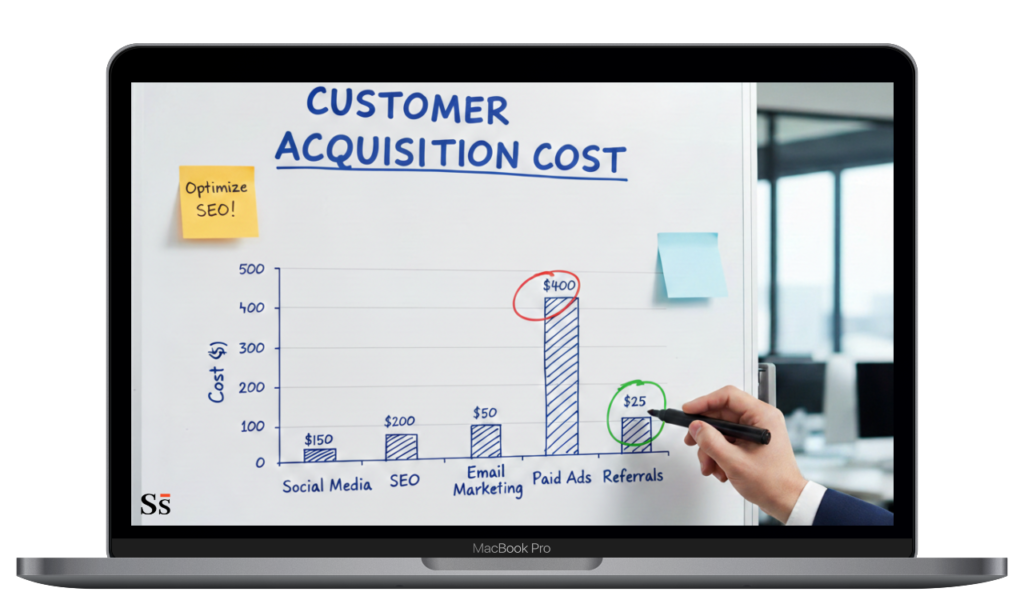
High customer acquisition cost is rarely a channel problem. It’s almost always a by-product of poor strategy.
Businesses throw more money at paid ads, hire growth agencies, or test new platforms.
Yet, their CAC keeps climbing.
The issue isn’t that they’re running campaigns wrong.
The core problem is that no one owns the strategic decisions that determine acquisition efficiency: positioning, target customer definition, channel prioritization, and marketing-sales alignment.
Tactical tweaks (better ad creative, A/B testing, landing page optimization) deliver 5-15% improvements.
In contrast, strategic fixes (repositioning, ICP refinement, channel reallocation) deliver 30-60% CAC reduction within 6 months.
A fractional CMO reduces CAC through executive-level strategic decisions (not tactical execution).
They fix the foundation (who you target, how you position, which channels you prioritize, and how marketing and sales work together) before optimizing individual campaigns.
Here’s how a fractional CMO reduces cac (customer acquisition cost) faster and more sustainably than isolated tactical optimization.
What is CAC Customer Acquisition Cost?
In simple terms, the customer acquisition cost (CAC) is what you pay to acquire a new customer.
The cost includes all resources and costs to acquire a new customer.
Customer acquisition cost and customer lifetime value (LTV) are key metrics to assess the value generated by a new customer.
Here is the cac customer acquisition cost formula:
Sales and marketing expenses / Number of new customers
Why CAC Gets Too High in the First Place?
This will help you understand why leadership fixes work better than tactical adjustments.
Poor Positioning
When your positioning is generic (“fast, easy, affordable” or “AI-powered, secure, scalable”), you compete only on price or features.
This forces high marketing spend to overcome weak differentiation.
The result:
- Prospects don’t immediately understand your unique value
- Sales cycles lengthen while you explain why you’re different
- Win rates drop because you’re compared to every competitor
- Marketing has to work harder to create awareness and consideration
Generic positioning inflates CAC by 40-80% compared to differentiated positioning.
Undefined ICP (Ideal Customer Profile)
Many companies target “everyone who might buy” instead of the highest-value, best-fit customers.
As a result:
- Marketing attracts low-quality leads that rarely convert
- Sales wastes time on prospects who aren’t good fits
- High acquisition cost because you’re targeting volume, not value
- Poor retention because customers aren’t ideal fits
Targeting everyone means acquiring no one efficiently.
Channel Misalignment
Your channels don’t match where your customers actually make buying decisions.
Examples:
- B2B enterprise software investing heavily in Facebook/Instagram (where buyers aren’t researching solutions)
- Consumer products over-investing in LinkedIn (wrong audience)
- Complex, high-consideration purchases relying only on paid search (insufficient nurture)
Wrong channels waste 30-50% of budget regardless of execution quality.
Weak Conversion Infrastructure
Even with good traffic, conversion suffers when:
- Landing pages don’t clearly communicate value
- Forms ask for too much information too early
- Website navigation confuses instead of guides
- Checkout or signup flows create friction
- No nurture systems for prospects not ready to buy immediately
Weak conversion infrastructure means you pay for traffic that doesn’t convert.
And CAC rises even as volume increases.
Sales and Marketing Misalignment
When marketing and sales operate independently:
- Marketing generates leads sales calls “unqualified”
- Sales doesn’t follow up quickly or appropriately
- No shared accountability for pipeline or revenue
- Finger-pointing instead of problem-solving
This wastes marketing budget on leads that never get properly worked.
Effective CAC is 2-3x higher than it should be.
Over-Reliance on Paid Acquisition
If 80-90% of customers come from paid channels:
- You have no cost buffer when CPMs increase
- No organic channels reducing blended CAC
- Platform changes (iOS privacy, algorithm updates) immediately hurt acquisition
- No brand equity building long-term efficiency
Paid-dependent acquisition models are fragile and expensive.
What a Fractional CMO Does Differently?
In order to fully grasp how a fractional CMO reduces CAC, you need to understand how they (fcmos) approach CAC.
Fractional CMOs work on CAC reduction strategically, not tactically.
Reframes Acquisition Strategy
Instead of “how do we get more leads cheaper,” they ask:
- Are we targeting the right customers?
- Does our positioning create natural demand or force us to convince people?
- Which channels match our customer buying journey?
- Where are we losing customers we’ve already attracted?
Strategic reframing identifies root causes, not symptoms.
Reprioritizes Channels
A fractional CMO analyzes channel performance by contribution margin (not just cost per lead):
- Which channels drive the highest-LTV customers?
- Where are we wasting the budget on leads that don’t convert or retain?
- Which underutilized channels could deliver better efficiency?
- What’s our optimal channel mix reducing platform risk?
Then they reallocate the budget ruthlessly.
Often 20-30% of spend moves from underperformers to winners.
Aligns Messaging with ICP
Generic messaging attracts generic (low-quality) leads. Specific messaging attracts ideal customers.
Fractional CMOs develop positioning that:
- Speaks directly to your best customers’ priorities
- Differentiates clearly from alternatives
- Justifies premium pricing through value, not features
- Shortens sales cycles by pre-qualifying prospects
Better messaging reduces acquisition cost and improves conversion simultaneously.
Improves Funnel Economics
FCMOs optimize the entire customer journey:
- Attract higher-quality traffic (not just more traffic)
- Improve landing page conversion through clarity and value communication
- Build nurture systems for prospects not ready to buy immediately
- Accelerate sales follow-up reducing lead decay
- Measure and fix conversion drops at each stage
Full-funnel optimization compounds. Note that a 10% improvement at 4 stages = 46% total improvement.
Establishes KPI Accountability
Fractional chief marketing officers implement tracking showing:
- CAC by channel, campaign, and cohort
- Conversion rates at every funnel stage
- Cost per acquisition vs. customer lifetime value
- Marketing’s contribution to pipeline and revenue
Clear metrics enable optimization.
What gets measured and owned gets improved.
Related Read: fractional CMO responsibilities and fractional CMO services.
How a Fractional CMO Reduces CAC: Strategic Levers
Here are the specific approaches a fractional CMO uses to lower customer acquisition cost.
ICP Refinement
Fractional chief marketing officers narrow your target to highest-value, best-fit customers.
The fcmo process:
- Analyze which customer segments have highest LTV and lowest churn
- Identify common characteristics (company size, industry, use case, budget)
- Build targeting criteria focusing on these ideal profiles
- Stop targeting everyone and focus on customers most likely to succeed
Narrower targeting paradoxically increases volume because conversion rates improve 2-3x when you target the right customers.
Positioning Overhaul
If positioning is weak, a fractional CMO rebuilds it from scratch.
Here is what the process looks like:
- Define the unique value (what do you do better than anyone?)
- Identify who cares most about your strengths
- Articulate clear differentiation from competitors
- Test messaging with target customers
- Implement consistently across all channels
Strong positioning typically reduces CAC 25-40% over 6-12 months by improving every conversion rate.
Channel Focus and Elimination
Fractional CMOs kill or reduce underperforming channels and double down on efficient ones.
The Approach:
- Calculate true contribution margin by channel (revenue minus all costs)
- Identify 2-3 channels with best unit economics
- Reallocate 70-80% of budget to these winners
- Use remaining 20-30% to validate 1-2 new channels
- Continuously test but maintain discipline
Most companies waste 30-40% of budget on channels that look okay on last-click attribution but don’t actually drive profitable customers.
Conversion Rate Optimization Alignment
A fractional CMO fixes conversion bottlenecks across the entire funnel.
What they optimize:
- Traffic quality: Attract right visitors (not just more visitors)
- Landing pages: Clear value communication, minimal friction
- Forms: Ask only for essential information
- Nurture sequences: Stay engaged with prospects over weeks/months
- Sales handoff: Immediate follow-up, clear qualification
- Trial/demo conversion: Optimize onboarding and activation
Each stage improvement compounds.
Fixing 3-4 bottlenecks often cuts CAC 30-50%.
Sales + Marketing Alignment
Fractional chief marketing officers align both teams around shared pipeline and revenue goals.
Here are the core things they do:
- Create shared pipeline targets (both teams own the same number)
- Define clear lead qualification criteria (agreed-upon definitions)
- Establish service-level agreements (response times, follow-up protocols)
- Build weekly sync meetings (pipeline reviews, lead quality discussions)
- Implement feedback loops (sales tells marketing what’s working)
Aligned teams reduce effective CAC 20-40% because leads get properly worked and both teams optimize for conversions, not volume.
Content and Demand Mix Shift
Fractional CMOs reduce expensive paid acquisition by building organic channels.
This includes:
- SEO and content strategy to grow organic search traffic
- Thought leadership to build brand awareness, which brings down cold acquisition cost
- Community and ecosystem partnerships
- Customer referral programs
- Product-led growth strategies (if applicable)
Shifting from 80% paid / 20% organic to 50% paid / 50% organic typically reduces blended CAC 30-40%.
Paid Media Restructuring
For paid channels, fractional chief marketing officers focus on efficiency:
- Better audience targeting based on LTV analysis (target customers who stay, not just those who convert)
- Creative testing frameworks to generate consistent winners
- Bid strategy optimization balancing volume and efficiency
- Platform diversification reducing dependence and CPM pressure
- Attribution modeling showing true channel contribution
Paid media restructuring often improves efficiency 20-35% without reducing volume.
Lifecycle Marketing Optimization
A fractional CMO improves the LTV side of the equation through retention and expansion.
Among other things, they:
- Build email/SMS nurture programs keeping customers engaged
- Create onboarding sequences improving activation and time-to-value
- Develop upsell and cross-sell campaigns
- Implement win-back campaigns for churned customers
- Build loyalty and referral programs
Higher LTV means you can afford higher CAC while maintaining healthy unit economics.
A 40% LTV improvement makes a $1,200 CAC as efficient as $850 CAC was previously.
Improving LTV:CAC Ratio (Not Just CAC Alone)
Smart executives optimize the ratio, not just one variable.
You have two levers:
- Reduce CAC: More efficient acquisition (what we’ve been discussing)
- Increase LTV: Better retention, expansion revenue, longer customer lifetimes
A fractional CMO focuses on both simultaneously because:
- LTV improvements are often faster than CAC improvements (retention programs show results in 30-90 days)
- Better LTV targeting naturally reduces CAC (you target customers who stay longer)
- The ratio matters more than absolute numbers (3:1 LTV:CAC is the minimum healthy threshold)
Many companies obsess over CAC while ignoring that 40% churn destroys unit economics.
Fixing retention often has bigger ROI than acquisition optimization.
Target ratio: 3:1 minimum, 4:1+ strong for healthy growth.
Suggested Read: Fractional CMO ROI.
CAC Payback Period and Cash Flow Impact
Don’t look at CAC as an efficiency metric alone.
It is a cash flow metric.
CAC payback period measures how many months it takes to recover acquisition cost through gross margin.
Why this matters:
- If payback is 18 months and you’re growing fast, you need significant working capital
- Shorter payback (under 12 months) enables faster growth with less capital
- Long payback periods (24+ months) can bankrupt otherwise profitable companies
How a fractional CMO improves payback:
- Reduce CAC: Obvious benefit-less capital required to recover
- Increase prices: Recover acquisition cost faster per customer
- Improve activation: Customers reaching value faster start paying/expanding sooner
- Shift to annual contracts: Recover more capital upfront
For SaaS and subscription businesses, target CAC payback under 12 months.
Under 6 months is excellent.
Cash-efficient growth matters as much as growth rate.
Many high-growth companies fail because cash timing doesn’t work.
Startup Context: Reducing CAC in Early-Stage Companies
CAC challenges differ by startup stage.
Pre-PMF (Product-Market Fit)
Before proving PMF (typically under $1M-$2M revenue):
- Don’t obsess over CAC yet-focus on finding customers who love the product
- Some customer acquisition will be expensive or manual (founder sales, networking)
- Validate that customers retain before optimizing acquisition cost
- Track CAC but don’t optimize prematurely
Optimizing CAC before PMF wastes time.
First prove people want your product.
Series A Scaling (Post-PMF)
Once you’ve proven PMF (typically $2M-$10M revenue):
- Now CAC becomes critical. Investors scrutinize unit economics heavily
- Establish baseline CAC tracking by channel and cohort
- Prove repeatable acquisition through 2-3 validated channels
- Target LTV:CAC ratio of 3:1 minimum to support Series B fundraising
Series A to B is when CAC optimization delivers the highest ROI.
This is peak fractional CMO value stage.
Paid vs. Organic Mix
Early-stage companies often over-rely on paid acquisition.
It’s fast and measurable. This appeals to founders wanting quick results.
However, it’s expensive and fragile (CPMs rise, platforms change).
Organic channels take 6-12 months to build but dramatically reduce CAC long-term.
A fractional CMO helps startups balance paid (for immediate volume) with organic investments (for long-term efficiency).
Founder-Led Marketing Inefficiencies
Founders often drive early marketing.
However, they lack the systematic approach (ad-hoc campaigns, inconsistent execution).
They also can’t scale beyond their personal capacity.
And they miss strategic opportunities (positioning, channel optimization, testing frameworks)
Fractional CMO leadership provides the strategic layer enabling efficient scale beyond founder-led acquisition.
Suggested Read: fractional CMO for startups
How Long Does It Take to Reduce CAC?
Here is the realistic timeline for CAC improvement:
30-60 days (Quick wins):
- Budget reallocation from obvious underperformers to winners
- Landing page conversion fixes (clarity, messaging, friction reduction)
- Improved lead routing and sales follow-up speed
These deliver 10-20% CAC improvement quickly.
60-90 days (Strategic foundation):
- ICP refinement and targeting improvements
- Messaging and positioning updates across channels
- Channel testing and validation
- Marketing-sales alignment initiatives
These bring another 15-25% improvement as they take effect.
90-180 days (Full impact):
- Repositioning fully implemented and resonating in market
- Organic channels starting to contribute (SEO, content, thought leadership)
- Systematic testing frameworks producing consistent winners
- Compounding improvements across all funnel stages
Total CAC reduction at 6 months: 30-60% from strategic approach.
Important Note:
Some improvements show immediately (budget reallocation).
Others take months (organic channel building, brand awareness).
Both are necessary for sustainable CAC reduction.
Tactical tweaks show results in weeks but hit limits quickly.
Strategic fixes take months but deliver lasting efficiency improvements.
When a Fractional CMO Won’t Fix High CAC?
It is important to set honest expectations. There are certain CAC problems a fractional CMO can’t solve.
No Product-Market Fit
If customers churn quickly (under 6-12 months) or retention is below 70%, the problem is product, not marketing.
You can’t market your way out of a bad product.
Fix retention before optimizing acquisition.
Pricing Misalignment
If your pricing is too low to support acquisition cost.
- CAC is $800 but LTV is only $1,200 (1.5:1 ratio-unsustainable)
- No amount of marketing optimization fixes pricing 50% below market
- You need to raise prices or reduce costs to deliver product
A fractional CMO can help optimize marketing, but they can’t overcome fundamentally broken business model economics.
Poor Retention
If 40-50% of customers churn in first year:
- Improving CAC makes the problem worse (you acquire more customers who leave)
- Fix retention first, then optimize acquisition
- Focus on why customers leave before investing in getting more
Good marketing accelerates a retention problem.
However, marketing can’t fix that issue.
No Execution Team
If you have no one to execute campaigns, create content, or manage channels:
Fractional CMO provides strategy but can’t personally run all execution.
You need agencies, contractors, or internal team members for implementation.
And the budget must support both strategy ($15K-$25K/month fractional CMO) and execution ($15K-$50K/month execution resources)
Leadership without execution capacity won’t reduce CAC.
Case Examples of CAC Reduction (High-Level)
Here are some real outcomes from fractional CMO engagements focused on CAC improvement.
B2B SaaS Company:
- Starting CAC: $4,200
- After 6 months: $2,800 (33% reduction)
- Key changes: Repositioning targeting mid-market vs. SMB, eliminating 3 underperforming channels, implementing sales-marketing SLAs
- Also improved: LTV increased 28% through better customer fit
DTC Ecommerce Brand:
- Starting CAC: $85
- After 8 months: $52 (39% reduction)
- Key changes: Shifted 40% of budget from paid social to organic + retention, improved landing page conversion 45%, implemented referral program
- Also improved: Blended CAC dropped further as repeat purchases increased
Fintech Startup:
- Starting CAC: $1,450
- After 9 months: $950 (34% reduction)
- Key changes: Compliance-aligned messaging reducing qualification time, account-based targeting for B2B segment, improved activation reducing early churn
- Also improved: CAC payback period shortened from 22 months to 14 months
For detailed case studies, visit fractional cmo case studies.
FAQs: How A Fractional CMO Reduces CAC
What is a good CAC?
It depends entirely on your LTV. The ratio matters more than the absolute number.
Good benchmarks:
- LTV:CAC ratio: 3:1 minimum, 4:1+ strong, 5:1+ excellent
- CAC as % of LTV: 25-33% (inverse of 3:1 to 4:1 ratio)
- CAC payback period: Under 12 months for SaaS/subscription, under 6 months ideal
A $5,000 CAC is excellent if LTV is $20,000+.
A $500 CAC is terrible if LTV is only $800.
Context also matters.
B2B enterprise SaaS might have $15,000 CAC with $200,000 LTV (healthy).
B2C ecommerce might have $40 CAC with $180 LTV (also healthy).
How much can CAC realistically be reduced?
With a strategic approach, 30-60% reduction within 6-12 months is realistic.
This assumes:
- You have reasonable starting point (not already optimized to perfection)
- You’re willing to make strategic changes (repositioning, channel shifts, ICP narrowing)
- You have execution resources to implement changes
- Your product has decent market fit
Tactical tweaks alone deliver 10-20% improvement.
And with the right strategy, you can realize 30-60% improvement.
If your CAC is already very efficient (top quartile for your industry), further improvement is harder.
Most businesses aren’t optimized, so significant improvement is achievable.
Should we focus on CAC or LTV?
Focus on both. Optimizing the ratio matters more than either variable alone.
Often LTV improvement is faster:
- Retention programs show results in 30-90 days
- Activation improvements compound quickly
- Upsell/cross-sell campaigns can launch within 60 days
CAC improvement takes longer (strategic repositioning needs 3-6 months to fully manifest).
Smart approach:
Work on both simultaneously.
Don’t obsess over CAC while ignoring that 40% annual churn destroys unit economics.
Does hiring a CMO lower paid spend?
Not necessarily, and that’s not always the goal.
Good fractional CMO leadership might:
- Increase paid spend in efficient channels while cutting inefficient ones (total budget stays similar but ROI improves)
- Shift spend mix from 80% paid to 50% paid / 50% organic (paid absolute dollars might stay flat)
- Reduce total spend if you’re overspending without return
The goal should be to improve efficiency than just to reduce spend.
Sometimes you should spend more on the right channels, less on wrong ones.
If paid channels deliver 3:1 LTV:CAC, you should spend more, not less. If they deliver 1.5:1, you should cut immediately.
Check out the Fractional CMO FAQ page to learn more.
Closing Thought: How a Fractional CMO Reduces CAC?
If you want to reduce CAC, strategic leadership is the key.
Don’t just focus on tactical optimization. You can A/B test ad creative forever and get marginal improvements.
Or you can fix positioning, target the right customers, align sales and marketing, and build organic channels; and reduce CAC 30-60% within 6 months.
Fractional CMO leadership provides the executive strategy that makes acquisition efficient at scale.
And this does not come by way or just hard work or more campaigns.
FCMO leadership delivers through smarter decisions about who you target, how you position, which channels you prioritize, and how your entire revenue engine works together.
If your CAC is rising despite increased marketing investment, the problem is strategic.
Tactical fixes won’t solve it.