

Private equity firms use fractional CMOs to build executive marketing leadership in portfolio companies without the cost, commitment, or search timeline of a full-time hire.
PE operating partners with multiple portfolio companies hire a fractional CMO for driving growth, redesigning GTM, handling marketing turnaround, or preparing for exit.
What this post covers:
- Why PE firms bring in fractional CMOs
- The most common portfolio company use cases
- How fractional and interim CMOs differ in PE contexts
- What operating partners look for in a fractional CMO
- How fractional CMOs support exit preparation

Why Private Equity Firms Bring in Fractional CMOs?
Private equity firms operate on compressed timelines and precise capital allocation. Every resource deployed into a portfolio company is measured against its contribution to value creation. And marketing leadership is no exception.
The fractional CMO model fits the PE operating model for three structural reasons.
Capital Efficiency
A full-time CMO in a PE-backed company costs $300K-$700K in total compensation, depending on market and stage.
For a portfolio company at $10M-$30M revenue, that single hire can represent 3-7% of annual revenue. This is a significant fixed cost before the marketing system has demonstrated its ability to generate returns.
A fractional CMO at $15K-$25K per month delivers the same executive capability at $180K-$300K annually. This preserves capital for the demand generation investment the value creation plan actually requires.
Speed to Impact
Private equity timelines of 3-5 years leave little room for long ramp periods. Hiring a full-time CMO often takes months. After that, onboarding usually requires another 60-90 days before real strategy and execution begin.
A fractional CMO starts faster. They take about 30 days to assess the business and spot growth gaps, with pipeline gains within 90 days. In a four-year hold, the gap between a six-month ramp and a 30-day diagnostic reduces the value creation window.
Executive Accountability Without Long-Term Commitment Risk
PE sponsors need marketing leadership that answers to the board, not only the CEO. Fractional CMOs work at the executive level and present directly to the board. They own KPI performance and report in metrics PE sponsors expect: CAC, LTV:CAC ratio, pipeline coverage, and EBITDA impact.
A 30-day exit clause on both sides also removes the severance cost and disruption of a full-time CMO mis-hire. This lowers risk in companies where leadership turnover is already common.

Common Marketing Problems in PE Portfolio Companies
PE firms acquire companies with strong products, defensible market positions, and often significant revenue. However, these businesses often have an underdeveloped marketing.
The marketing problems operating partners encounter most consistently fall into five categories.
Founder-Led Marketing With No Institutional System
Many PE acquisitions involve companies that grew to $10M-$30M revenue on founder-led sales and relationship-driven pipelines.
The founder is the brand. The pipeline is the founder’s network.
There’s no documented demand generation system, no repeatable channel strategy, and no marketing infrastructure that survives the founder stepping back.
Implementing scalable marketing systems in a founder-dependent business is one of the most common fractional CMO tasks in PE portfolios.
No Scalable Pipeline Generation
Portfolio companies often enter private equity ownership with a pipeline that cannot scale. Leads may come from one channel. Revenue may depend on one or two salespeople. Growth may rely on a single partnership that delivers uneven volume.
Operating partners who must show two to three times revenue growth in a four year hold period cannot rely on a pipeline that does not grow consistently.
Building a scalable demand generation engine becomes a core value driver. Fractional CMOs are brought in specifically to build that engine and make growth repeatable.
Poor Marketing Attribution and Data Governance
Private equity sponsors tie value creation to marketing KPIs. When those KPIs are not tracked, or when the data sits across disconnected tools with no reliable attribution, the operating partner is making decisions without clear visibility.
Portfolio companies with weak attribution cannot answer basic questions:
- Which channels generate pipeline?
- What is the customer acquisition cost by channel?
- How much closed revenue came from marketing?
Fractional CMOs build the data governance and reporting systems that make these questions clear and measurable.
Over-Reliance on Agencies Without Strategic Direction
Many portfolio companies enter private equity ownership with marketing run by external marketing agencies for content, performance, and SEO.
These agencies lack internal strategic leadership directing the work. They are good at executing tasks. But they do not own the GTM strategy, the ICP, the positioning, or revenue accountability.
Without a marketing executive setting direction, agency spend produces activity reports instead of pipeline. Fractional CMOs provide the strategic leadership that turns agency investment into real revenue contribution.
No Marketing Leadership in Seat
Acquisitions often disrupt marketing leadership.
CMOs who joined under the previous ownership structure do not always remain after the transition. The result is a marketing team without executive direction at the exact moment the private equity sponsor needs marketing to accelerate growth.
Fractional CMOs fill this gap immediately; and stabilize the team. They assess the current marketing systems, and start the diagnostic process without waiting for a full time hire.
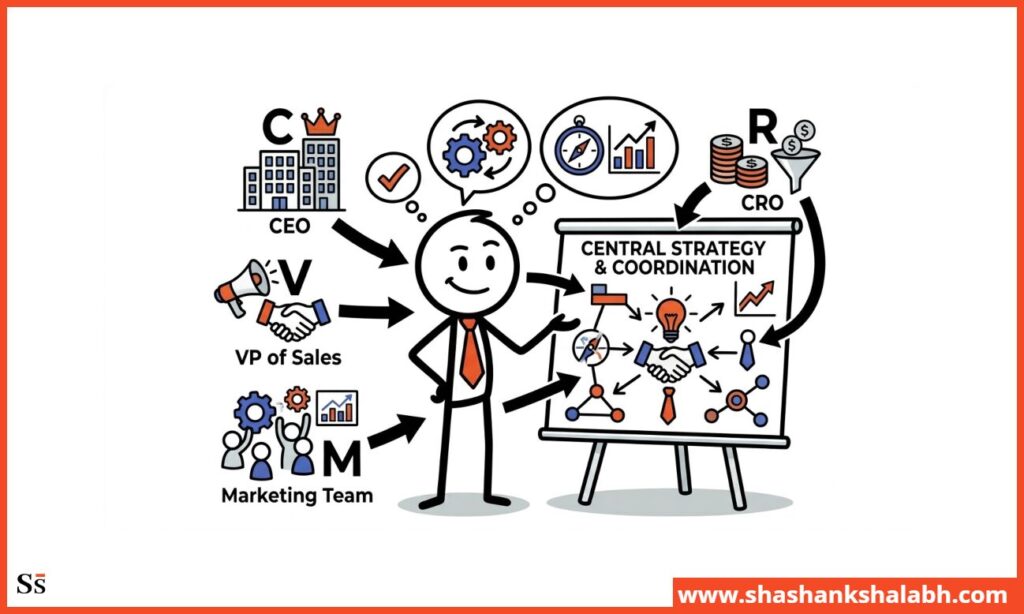
Where Fractional CMOs Fit Into the PE Operating Model
Understanding where a fractional CMO fits in the PE structure explains why the model works. It also shows where it can fail when reporting and accountability are not clearly defined.
Relationship With the Operating Partner
The fractional CMO reports to the portfolio company CEO. They also operate with visibility and accountability to the PE operating partner.
Operating partners bring pattern recognition across the portfolio. They have seen what works across many companies at similar stages. They use the fractional CMO to execute the marketing parts of the value creation plan.
The strongest fractional CMO engagements create a direct communication channel with the operating partner. Updates do not flow only through the CEO. This keeps expectations clear and progress visible.
Relationship With the CEO
The portfolio company CEO is the fractional CMO’s main working relationship. The fractional CMO owns marketing strategy, leads the team, and is accountable for marketing KPIs. They report to the CEO on execution and to the board on results.
In many PE backed companies, the CEO is more financially focused than commercially focused. This is common in industrial, manufacturing, and middle market B2B businesses.
The fractional CMO fills the commercial leadership gap. The CEO does not need to become a marketing expert for the company to grow.
Relationship With the CRO or VP of Sales
Marketing and sales must align for PE value plans that depend on pipeline growth. The fractional CMO sets shared pipeline definitions, lead qualification rules, and a joint forecasting cadence that links marketing activity to sales results.
When a CRO or VP of Sales is in place, the fractional CMO works as a peer. Both leaders share accountability for hitting revenue targets.
Relationship With the Marketing Team
Fractional CMOs in PE settings often inherit marketing teams that are underdeveloped, discouraged, or poorly aligned with the value creation plan. The fractional CMO evaluates the existing team, identifies capability gaps, stabilizes strong performers, and recommends role changes or new hires.
In many engagements, the fractional CMO also leads hiring for permanent marketing roles. They build the team structure that will remain in place after the engagement ends.

The Most Common Use Cases
Private equity firms use fractional CMOs in five unique ways. Each use case requires a different focus and a unique definition of success.
Growth Acceleration
This is the most common private equity use case. The portfolio company has a functioning business model and a strong market position, but marketing is falling behind the growth targets in the value creation plan.
The pipeline is uneven. Customer acquisition cost is rising. The marketing team executes tasks without strategic direction.
The fractional CMO builds the GTM system. They refine the ICP, define positioning, plan channel strategy, and design the demand generation engine. This gets marketing operating at the pace the investment thesis requires.
For B2B SaaS portfolio companies, the benchmark is a 4:1-5:1 LTV:CAC ratio with a CAC payback period under 12 months.
Marketing Turnaround
When a portfolio company shows poor marketing performance such as declining pipeline, rising CAC, leadership gaps, or a broken GTM strategy, the operating partner needs an immediate executive response.
A fractional CMO in turnaround mode works 20-35 hours weekly, at near interim intensity. They focus on rapid diagnosis, stabilizing revenue, and rebuilding the marketing system under pressure.
Early results target a 10-25% pipeline improvement within 90 days. Full stabilization takes 6-12 months.
Go-To-Market Redesign
Some PE acquisitions involve companies with strong products but broken or outdated GTM strategies. The ICP is too broad, positioning hasn’t kept pace with the competitive market, and channels are producing diminishing returns.
A GTM redesign begins by refining the ICP using closed-won data. It updates positioning for the current competitive landscape, resets channel strategy to improve CAC efficiency, and implements a demand generation system aligned with the new strategy.
These engagements typically last six to twelve months.
Scaling the Marketing Team
Many portfolio companies with $5 million to $30 million in ARR need to expand their marketing teams but lack the executive experience to hire effectively.
Hiring the wrong senior marketing leader at this stage, for example, a VP of Marketing too early, a CMO too soon, or a generalist instead of a specialist, can cost a full year of compensation and 12 months of lost growth momentum.
Fractional CMOs design the team structure, write role scorecards, lead the hiring process, and onboard new hires. They build the marketing organization the value creation plan requires while avoiding the risks of an unstructured hiring process.
Preparing for Acquisition
Exit preparation is the most underutilized use case for fractional CMOs in PE portfolios.
Marketing systems that are not institutionalized, or well documented, diversified, and independent of key-person risk, can lower company valuation during due diligence.
Fractional CMOs brought in 24 to 36 months before an anticipated exit build predictable revenue, KPI governance, diversified channels, and documentation that buyers value. Preparing marketing for exit also strengthens operating performance in the years leading up to the transaction.

How Fractional CMOs Improve Portfolio Company Performance?
The performance improvements PE firms expect from fractional CMO engagements are measurable and tied directly to the value creation plan. Here’s what the data supports:
Pipeline Growth
Systematic demand generation, which includes a properly targeted ICP, differentiated positioning, and optimized channel mix, produces pipeline growth of 50-150% with disciplined implementation over 6-12 months.
This is the primary metric operating partners track in growth acceleration engagements. Pipeline improvement of 10-25% within the first 90 days is the early signal that the system is working.
CAC Reduction
Fractional CMOs bring about 20-35% CAC reduction within 6-12 months, through channel optimization, ICP refinement, and positioning improvement.
For PE portfolio companies where marketing efficiency directly affects EBITDA margin, CAC reduction is a double value creation lever. Iit improves unit economics and reduces the capital required to sustain pipeline volume.
LTV Improvement
Part-time CMOs bring 30-50% LTV improvement through retention programs, pricing optimization, and expansion revenue strategies. These compound the value of every customer acquired.
In PE contexts, LTV improvement affects both the revenue trajectory and the valuation multiple- buyers apply higher multiples to businesses with stable or improving customer lifetime value.
Marketing Team Productivity
Portfolio companies that have been running marketing without executive direction frequently have teams producing high activity with low revenue contribution.
Fractional CMOs establish KPI ownership, clear role accountability, and strategic direction that improves team output without adding headcount. The same team, operating against a clear strategic framework with defined success metrics, consistently produces better results than the same team operating without direction.
ROI on the Fractional CMO Engagement
PE sponsors evaluate fractional CMO engagements against a direct ROI framework. At $15K-$25K per month, a 12-month engagement costs $180K-$300K. The improvements in pipeline, CAC, and LTV that a well-executed fractional CMO engagement produces typically generate 2-4x return within 9-12 months.
This is a favorable ROI against a $180K-$300K investment in any PE value creation context.

When PE Firms Use Interim vs. Fractional CMOs
The terms are used interchangeably in some PE contexts. They describe different engagement structures with different applications.
| Dimension | Fractional CMO | Interim CMO |
| Time commitment | 16-24 hours monthly | 20-35 hours weekly |
| Monthly cost | $15K-$25K | $20K-$35K |
| Engagement trigger | Growth, scaling, GTM build | Crisis, turnaround, leadership gap |
| Intensity | Moderate- part-time | High- near full-time |
| Board interaction | Monthly / quarterly | Weekly during crisis period |
| Team management | Advisory- supports existing leadership | Direct- owns the team |
| Duration | 6-18 months | 3-9 months |
| Value creation plan alignment | Strategy execution and growth acceleration | Stabilization and recovery first |
| Portfolio reporting cadence | Standard board cycle- monthly KPI dashboard | Accelerated- weekly crisis updates to operating partner |
| PE fit | Growth acceleration, exit prep | Turnaround, post-acquisition restructuring |
The decision framework is simple. If a portfolio company needs strategic marketing leadership to drive growth, a fractional CMO is the right choice. If the company is underperforming, has a marketing leadership gap, or needs near full-time executive support, an interim CMO is the better fit.
In practice, PE engagements often start as interim. This means high intensity in the first 90 days, and transition to fractional once the situation stabilizes and systems are in place.

What Operating Partners Look For in a Fractional CMO?
Operating partners evaluating fractional CMO candidates for portfolio company roles use a distinct set of criteria. These criteria differ from those in a typical full-time CMO search.
Revenue Accountability at the Executive Level
Operating partners need marketing leaders who are accountable for revenue outcomes, not just activity metrics.
A fractional CMO who highlights pipeline coverage, CAC payback, and LTV to CAC ratios immediately stands out. Candidates who focus on impressions, MQLs, or content output do not.
Private equity operating partners expect marketing leaders to link their work directly to revenue. They have no patience for those who cannot.
Board-Level Communication Capability
The fractional CMO presents to the board.
Operating partners look for candidates who can translate marketing performance into the financial terms private equity sponsors use, such as EBITDA contribution, capital efficiency, payback period, and pipeline coverage.
A fractional CMO who speaks only in marketing metrics, without connecting them to financial outcomes, creates friction in board reporting instead of providing clarity.
Pattern Recognition Across Multiple Scaling Companies
Operating partners value fractional CMOs who have faced the same challenges across multiple companies at similar stages.
This pattern recognition allows fractional CMOs to quickly identify a CAC issue or a positioning failure. And this shortens the diagnostic timeline and speeds recovery.
A fractional CMO who has rebuilt GTM strategies in three B2B SaaS companies with $10 million to $30 million ARR brings institutional knowledge that a first-time CMO at a single company cannot match.
Ability to Build and Lead Teams Under PE Pressure
PE environments have high-pressure, tight timelines, and clear expectations.
A fractional CMO must stabilize marketing teams uncertain about their future after an acquisition, hire quickly and correctly into open roles, and keep the team productive during organizational change. Operating partners look for proven team leadership under pressure.
How Fractional CMOs Help Prepare Portfolio Companies for Exit?
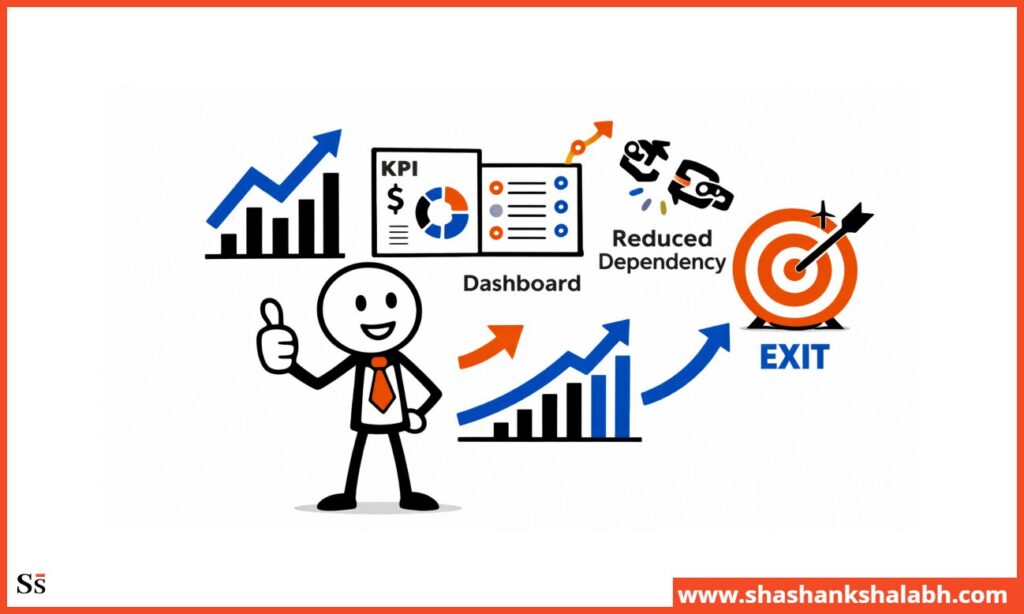
Exit preparation is where a fractional CMO’s impact on PE value creation is both direct and measurable. Marketing systems that are not acquisition-ready create due diligence risk. That risk directly translates into a lower company valuation.
Building Revenue Predictability
Acquirers pay higher multiples for predictable revenue than for the same revenue that is inconsistent or dependent on the founder. A marketing system with clear attribution, documented demand generation processes, and steady pipeline, proven over 12 to 18 months, reduces buyer risk and supports higher multiples.
Fractional CMOs create this predictability systematically, starting 24 to 36 months before the planned exit.
Establishing Clean KPI Governance
Marketing due diligence requires clean, auditable data, including CAC by channel, LTV to CAC trends, pipeline coverage history, and marketing-sourced revenue percentage. PE sponsors who have received board-level marketing reporting throughout the hold period enter the exit process with this data already organized.
Portfolio companies without systematic KPI governance spend weeks creating marketing data room materials that could have been built incrementally over years.
Reducing Key-Person Dependency
Marketing that relies on one or two individuals; a founder, a top salesperson, or a single content producer, create key-person risk during due diligence. Buyers discount businesses where marketing performance depends on people instead of systems.
Fractional CMOs reduce this risk systematically. They document processes, cross-train team members, and build demand generation infrastructure that works independently of any single individual.
Demonstrating Scalable Growth Levers
Strategic buyers and PE acquirers want proof that marketing can scale with capital investment after the acquisition. A documented channel strategy with CAC benchmarks, a clear ICP that supports expansion into new markets, and a demand generation system with a proven growth trajectory give buyers confidence in the business’s growth model.
Fractional CMOs build and document these growth levers, creating the marketing story that supports a higher exit valuation.
For more detail on exit preparation, see Exit-Ready Marketing Systems.
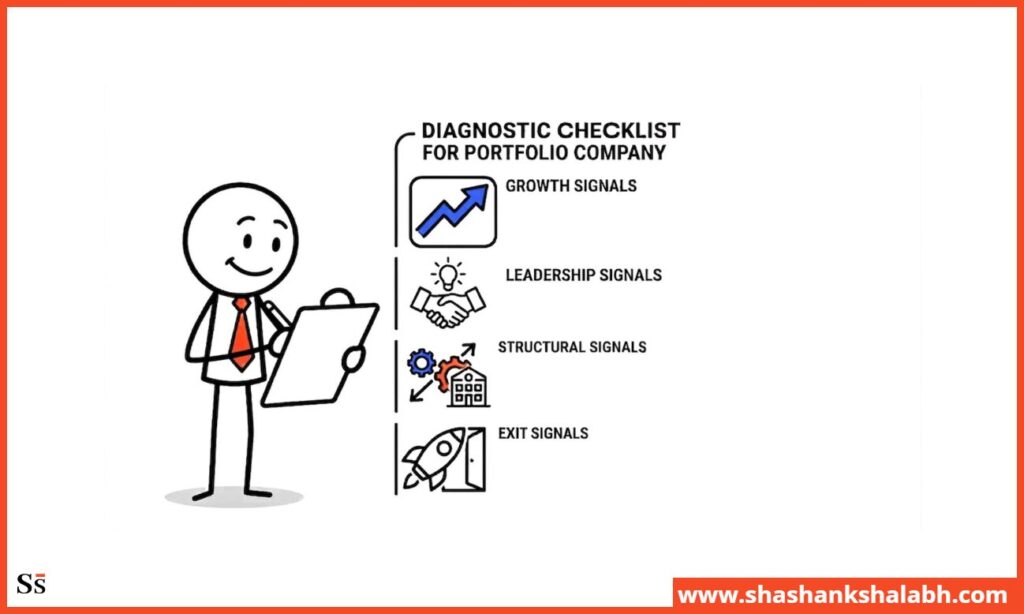
Checklist: When a Portfolio Company Needs a Fractional CMO?
Use this diagnostic to assess whether your portfolio company requires a fractional CMO:
Growth signals:
- Revenue growth is below the value creation plan target for two or more consecutive quarters
- Pipeline is inconsistent month-over-month, and there is no documented recovery plan
- CAC is trending upward, and there is not a clear optimization strategy
Leadership signals:
- No full-time CMO or VP of Marketing. Or, the current marketing leader lacks strategic GTM experience
- Marketing reports on activity metrics rather than revenue outcomes at board meetings
- Operating partner lacks confidence in the current marketing leadership’s ability to execute the value creation plan
Structural signals:
- Marketing and sales are misaligned on pipeline definitions or lead qualification criteria
- No attribution model connecting marketing spend to closed revenue
- Marketing budget allocation hasn’t been reviewed against channel performance in 12+ months
Exit signals:
- Transaction anticipated within 36 months and marketing systems aren’t institutionalized
- Due diligence would surface founder dependency, inconsistent pipeline, or weak data governance
- Marketing-sourced revenue percentage is not tracked or reported to the board
Scoring:
- 0-3 items: Monitor- no immediate action required
- 4-6 items: Assess- evaluate marketing leadership capability against value creation plan requirements
- 7-9 items: Deploy- fractional CMO engagement warranted
- 10-12 items: Deploy immediately- value creation plan is at risk
FAQ: How PE Firms Use Fractional CMOs?
Here are some common questions to help you understand how PE companies leverage fractional chief marketing officers.
Why do PE firms hire fractional CMOs?
PE firms use fractional CMOs to provide executive marketing leadership at a fraction of the cost and risk of a full-time hire.
At $15,000 to $25,000 per month compared with $300,000 to $700,000 in full-time CMO total compensation, the fractional model preserves capital for demand generation while delivering board-accountable marketing leadership.
The 30-day exit clause for both parties removes severance risk and limits organizational disruption from a poor hire. This is critical in PE environments where leadership changes are frequent.
What does a fractional CMO do in a portfolio company?
In a PE portfolio company, a fractional CMO owns the marketing strategy, team leadership, and KPI accountability. This includes building scalable demand generation systems, establishing ICP and positioning frameworks, implementing CAC and LTV:CAC governance, aligning marketing and sales around shared pipeline accountability, and reporting to the board on marketing’s contribution to revenue.
The role is executive in scope, focused on strategy, team, and results.
How is a fractional CMO different from an interim CMO in PE contexts?
A fractional CMO works 16 to 24 hours per month at $15,000 to $25,000. This works well for growth acceleration, GTM strategy, and exit preparation engagements.
An interim CMO works 20 to 35 hours per week at $20,000 to $35,000. This model is deal for turnarounds, post-acquisition restructuring, or leadership gaps that require near full-time executive presence.
PE operating partners typically use fractional CMOs to execute the value creation plan and interim CMOs to respond to crises. Some engagements start at interim intensity and transition to fractional as the situation stabilizes.
When should a PE firm bring in marketing leadership for a portfolio company?
If revenue growth misses value-creation plan targets for two or more quarters in a row, there’s no marketing executive after an acquisition, customer acquisition cost (CAC) is rising without a clear plan to improve it, or a sale is expected within 36 months but marketing systems aren’t well established, the PE firm should bring in a fractional CMO.
The most common mistake operating partners make is waiting until the problem becomes a crisis. Bringing in fractional marketing leadership at the first sign of underperformance (rather than after two missed quarters) preserves more of the available value creation window.
How do fractional CMOs improve portfolio company growth?
Fractional CMOs drive portfolio company growth through five measurable levers:
- Pipeline growth of 50-150% via systematic demand generation
- CAC reduction of 20-35% through channel optimization and ICP refinement
- LTV improvement of 30-50% through retention and expansion programs
- Higher marketing team productivity through clear strategy and KPI accountability
- Exit multiple support via predictable revenue systems and clean data governance
Together, these levers typically deliver 2 to 4 times ROI on the engagement cost within 9 to 12 months. This is a strong return in any private equity value creation framework.

Closing Thought
The fractional CMO model aligns with the PE operating model because it addresses the core challenge PE sponsors face.
Operating partners who bring in fractional CMOs early (at the first sign of growth underperformance rather than waiting for a crisis) capture more value from the engagement. The diagnostic timeline is shorter, the recovery window is longer, and marketing systems have time to show performance trends that support exit valuation.
The companies that benefit most treat marketing leadership as a strategic resource, not a cost center to minimize until the board demands a recovery plan.
Related Posts: