
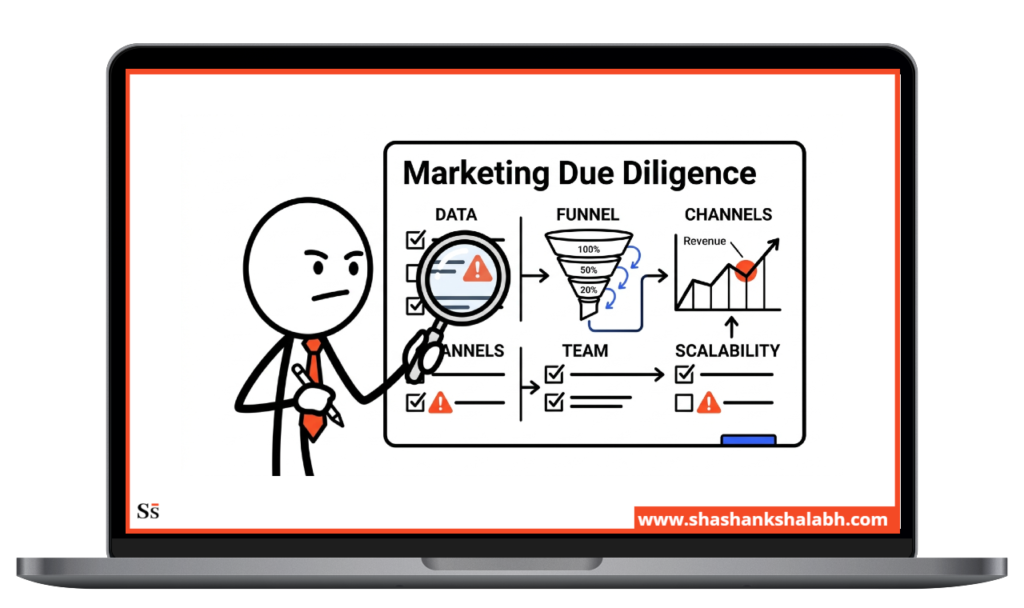
Marketing due diligence is how investors evaluate whether a company’s revenue growth is real, repeatable, and scalable.
It goes beyond revenue numbers. This process assesses the systems, data, and team behind those numbers.
What a marketing due diligence checklist covers:
- Positioning and market differentiation
- Demand generation systems and channel scalability
- Marketing data, attribution, and reporting accuracy
- Pipeline quality and conversion metrics
- Marketing team structure and capability
- Common risks investors discover too late
What Is Marketing Due Diligence?
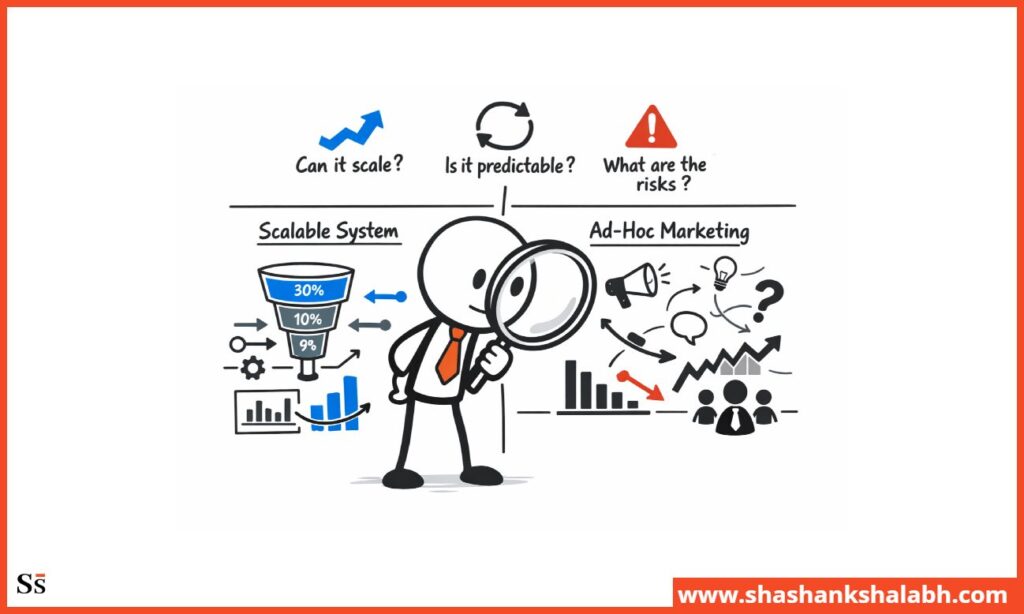
Marketing due diligence is the process of evaluating a company’s marketing before an acquisition or investment. It assesses whether the revenue growth is driven by a scalable, documented system, or by ad-hoc things.
Pay attention to these three questions as these drive the evaluation:
Can the revenue grow?
Does the marketing system have the infrastructure to generate more pipeline with additional capital investment?
Is the revenue predictable?
Is the pipeline consistent, attributable, and forecastable? Or is it dependent on the founder’s network and concentrated channels?
What are the risks?
Where is the marketing system weak? Is there a key-person dependency, channel concentration, weak data governance, or undocumented processes?
Note that financial due diligence validates what happened. And marketing due diligence evaluates what will happen next. Organizations that skip marketing due diligence often discover the risks after the transaction.
At that point, fixing them costs more and takes longer.
Why Marketing Due Diligence Matters in Acquisitions?
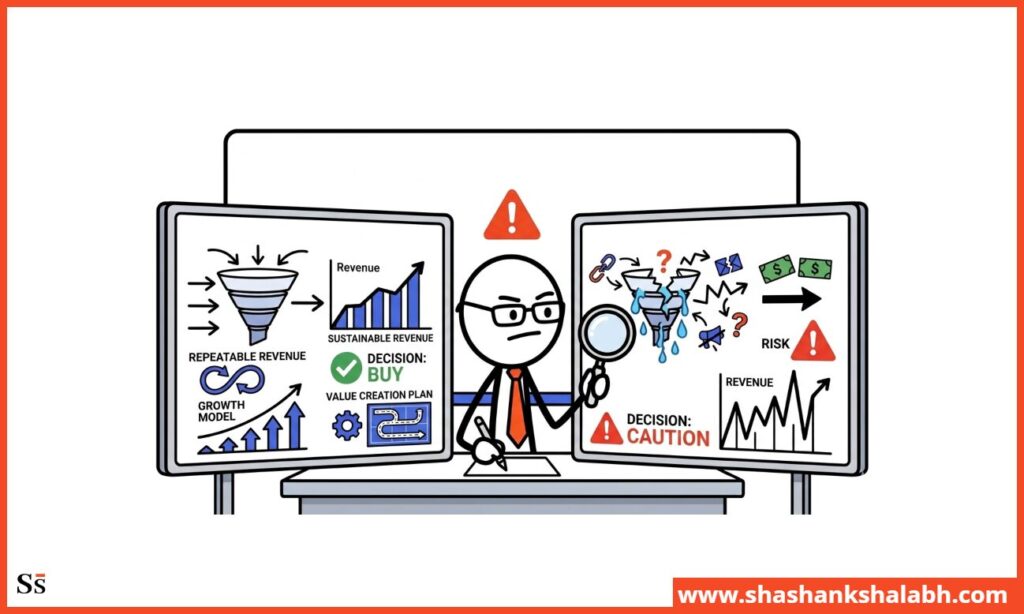
Revenue numbers tell investors what a business has done. Marketing due diligence tells them whether it can keep doing it, and whether capital investment will accelerate or slow down on a broken system.
It Separates Repeatable Revenue From One-Time Revenue
Not all revenue is equal.
Revenue driven by founder relationships, a single large customer, or a one-time campaign looks identical to revenue driven by a scalable demand generation system on a financial statement.
Marketing due diligence separates the two.
A company generating $20M ARR from a documented, diversified, system-driven pipeline is worth more than a company generating the same revenue from founder-dependent, concentrated, undocumented sources.
It Identifies Risks That Affect Valuation
Marketing gaps found during due diligence directly impact deal structure.
When the pipeline relies too much on the founder, it creates key-person risk. If most demand comes from one channel, it’s fragile. And if attribution data is unclear, forecasting becomes unreliable.
These risks affect valuation, escrow terms, or post-close costs. Spotting them early gives buyers leverage and a clearer post-close plan.
It Validates the Growth Model
PE firms and strategic buyers model post-close growth based on marketing assumptions.
If those assumptions aren’t realistic, if CAC isn’t supported by reliable attribution, or pipeline projections aren’t tied to proven demand, the model becomes unreliable.
Marketing due diligence confirms whether those assumptions are real; or flags where they aren’t.
It Informs the Value Creation Plan
Marketing due diligence shows where to invest first, which systems need rebuilding, and how quickly marketing can support growth targets.
Without it, the first 90 days after close are spent diagnosing what should have been clear before signing.
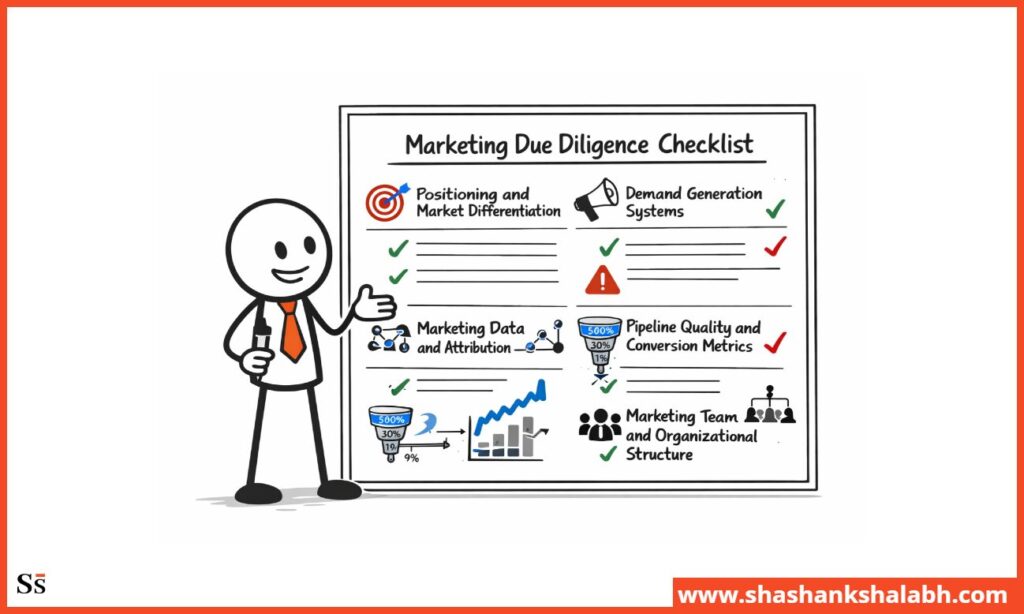
The Marketing Due Diligence Checklist
The checklist is organized into five categories. Each one includes key questions, what good looks like, and clear red flags.
Use it to structure marketing evaluation before an acquisition closes or to assess a portfolio company’s readiness after close.
Positioning and Market Differentiation
Positioning determines whether a company can consistently win in its market.
When it’s weak, you see higher CAC, longer sales cycles, and poor retention. When it’s strong, acquisition becomes more efficient and market share is easier to defend.
ICP Clarity
Is the ideal customer profile documented with specific firmographic criteria such as company size, industry, buying triggers, decision-making structure?
Check whether the ICP is based on closed-won data. Are these customers who converted fastest, paid reliably, and retained longest? And do marketing and sales use the same ICP when targeting prospects?
Ideally, there should be a written ICP document with specific criteria, built from closed-won analysis. And this document should be used consistently by marketing and sales.
On the flip side, if ICP is vague, marketing and sales target different customer types, or closed-won data does not support ICP definition, this means there is an issue.
Competitive Differentiation
Can the company articulate its differentiation clearly in one or two sentences? Is the differentiation based on something the target ICP values, and not just what the company believes is unique?
Does the differentiation hold up against the primary competitive alternatives the ICP is evaluating?
You should have a documented positioning framework with clear category definition, differentiation rationale, and competitive contrast specific to the ICP’s buying context.
Red flags:
- Differentiation based on features rather than buyer outcomes
- No documented competitive positioning for the sales process
- Positioning that matches competitor messaging closely
Messaging Consistency
Is the messaging consistent across the website, sales materials, and outbound communication?
Does the messaging address the economic buyer’s priorities (ROI, risk reduction, integration) or only technical buyers? Has the messaging been updated as the market and competitive landscape have evolved?
Ideally, there should be consistent messaging across all channels, updated within the past 12 months, tested against economic buyer feedback.
Red flags:
- Inconsistent messaging across website, sales deck, and outreach
- Messaging built for technical buyers in a company selling to economic buyers
- No record of positioning updates despite market evolution
Demand Generation Systems
Demand generation is the engine that fills the pipeline. The evaluation here focuses on whether the engine is reliable, scalable, and independent of any single person or channel.
Lead Generation Channels
Which channels are generating pipeline and at what volume? Is the pipeline distributed across two or more channels or concentrated in one? Are the channels documented with playbooks, process documentation, and performance history?
In an ideal scenario, there should be two to three active channels producing a consistent pipeline, each with documented processes and 12+ months of performance data.
Red flags:
- The majority of pipeline coming from a single channel
- Channels that depend on founder involvement to produce output
- No documentation of how any channel operates
Scalability of Acquisition Channels
Can the primary channels produce more pipeline with additional capital investment? Is there evidence of improving CAC efficiency as channels mature? Are there tested secondary channels ready to scale if the primary channel underperforms?
Red flags:
- Primary channel showing diminishing returns at current spend levels
- No secondary channels tested or developed
- Channel performance dependent on a specific team member’s relationships or skills
Pipeline Generation Reliability
How consistent is pipeline volume month-over-month? Can the company explain pipeline variance when it occurs? Does pipeline generation continue when the founder is not actively involved?
Red flags:
- Pipeline volume swings materially without documented explanation
- Pipeline declines when the founder is less active
- No forecasting model connecting demand generation activity to pipeline output
Marketing Data and Attribution
Marketing data quality determines how much investors can trust the revenue projections. Poor data governance means the CAC figures, pipeline projections, and growth assumptions in the CIM may not reflect reality.
Marketing Analytics Systems
Is there a connected marketing technology stack producing reliable data? Are marketing and sales using the same data definitions for leads, opportunities, and pipeline? Is there a single source of truth for marketing performance data?
Red flags:
- Marketing and sales using separate spreadsheets to track pipeline
- CRM data incomplete or inconsistently maintained
- No marketing automation connected to CRM
CAC Measurement
Is CAC calculated correctly? The correct formula for CAC is total marketing and sales cost divided by new customers acquired in the period.
Are you tracking CAC by channel, and not just in aggregate? Is CAC trending in the right direction over the past 12-24 months?
Red flags:
- CAC calculated without including sales costs
- No channel-level CAC visibility
- CAC trending upward without a documented recovery plan
Attribution Models
Can the company connect specific marketing activities to closed revenue? Is there a documented attribution model (first touch, last touch, or multi-touch)? Do win/loss records exist connecting closed deals to their originating marketing source?
There should be a documented attribution model with 12+ months of data connecting marketing spend to closed revenue by channel. Win/loss data available for analysis.
Red flags:
- No attribution model in place
- Marketing claims pipeline credit without data supporting the attribution
- Win/loss data not tracked or available
Pipeline Quality and Conversion Metrics
Pipeline quality shows whether revenue projections are realistic. A high-volume pipeline with low conversion rates can overstate future revenue, so investors need to evaluate both.
Lead-to-Opportunity Conversion
What percentage of marketing-qualified leads convert to sales-qualified opportunities? Has this conversion rate been stable or improving over the past 12 months? Do marketing and sales agree on the qualification criteria that define an MQL and an SQL?
Ideally, you should have a documented MQL and SQL definitions agreed by both marketing and sales. Also, there should be a stable or improving conversion rate with a clear explanation for any variance.
Red flags:
- Marketing and sales using different qualification definitions
- Conversion rate declining without a documented explanation
- No agreement on what constitutes a qualified lead
Opportunity-to-Close Rate
What percentage of sales opportunities convert to closed-won revenue? Is the close rate stable across deal sizes and customer segments? Do win/loss patterns reveal consistent reasons for lost deals?
Ideally, there should be a documented close rate by segment and deal size. And win/loss analysis showing clear patterns in what drives wins.
Red flags:
- Close rate declining without explanation
- No win/loss analysis available
- High variance in close rate across similar deal types
Sales Cycle Length
What is the average sales cycle length -and is it stable? Are there documented deal stages with clear exit criteria? Does sales cycle length vary significantly by ICP segment -and is the variance understood?
You should have a documented average sales cycle length by segment; deal stage definitions with exit criteria; and variance explained by deal size or complexity.
Red flags:
- Sales cycle length increasing without explanation
- No documented deal stage definitions
- High variance in sales cycle length across similar deals
Pipeline Velocity
How fast are opportunities moving through the pipeline? Are deals closing faster as the sales process matures? Is there a pipeline coverage ratio of at least 3:1 against revenue targets?
You should have a pipeline coverage of 3:1 against revenue targets, and a documented pipeline velocity trend showing stable or improving deal progression speed.
Red flags:
- Pipeline coverage below 2:1 against revenue targets
- Pipeline velocity declining without explanation
- No pipeline coverage tracking in place
Marketing Team and Organizational Structure
The marketing team evaluation assesses whether the people and structure behind the revenue numbers can sustain and grow performance post-close.
Marketing Leadership
Is there a marketing leader (CMO or VP of Marketing) with clear accountability for pipeline and CAC? Do they report on revenue outcomes (pipeline, CAC, LTV:CAC) or activity metrics? Is the marketing leader able to present performance data and defend strategic decisions to investors?
What good looks like: A marketing executive with documented KPI ownership, board-level communication capability, and a track record of connecting marketing investment to revenue outcomes.
Red flags:
- No marketing executive in seat -founder running marketing informally
- Marketing leadership reporting activity metrics to the board
- Marketing leader without PE or board reporting experience in an investor-backed context
Team Capabilities
Does the team have the functional depth the company’s growth stage requires? This should include demand generation, product marketing, content, and RevOps.
Are critical marketing functions covered by specialists or generalists? Does team capability match the channels and programs the company is running?
What good looks like:
- Functional specialists in the highest-priority growth areas.
- Team structure matched to the growth stage and channel strategy.
- Clear role scorecards with KPI ownership for each position.
Red flags:
- Team of generalists executing specialist-level programs without depth
- Critical functions outsourced to agencies without internal strategic oversight
- No documented role scorecards or KPI ownership
Marketing Operations Maturity
Are marketing processes documented well enough for a new team member to execute without institutional knowledge? Is there an onboarding process for new marketing hires that gets them productive quickly? Can marketing operations continue without the current team in place?
The Marketing Ops is mature when you have documented playbooks for every active marketing channel and program. There is an onboarding documentation that reduces time-to-productivity for new hires. And when operations can work independent of specific people.
Red flags:
- Marketing processes exist only in team members’ heads
- No documentation of how any marketing program operates
- Operations dependent on one or two individuals with no redundancy
Agency Dependencies
Which marketing functions are outsourced to agencies? Is there internal strategic oversight of agency work -or is the agency setting strategy? What happens to those functions if an agency relationship ends post-close?
Ideally, agencies should be executing against internally owned strategies. There should be clear contracts with defined deliverables and performance metrics. And an internal capability to replace agency functions if needed.
Red flags:
- Agencies setting marketing strategy without internal oversight
- Key marketing functions with no internal ownership or capability
- Agency relationships without defined deliverables or performance metrics
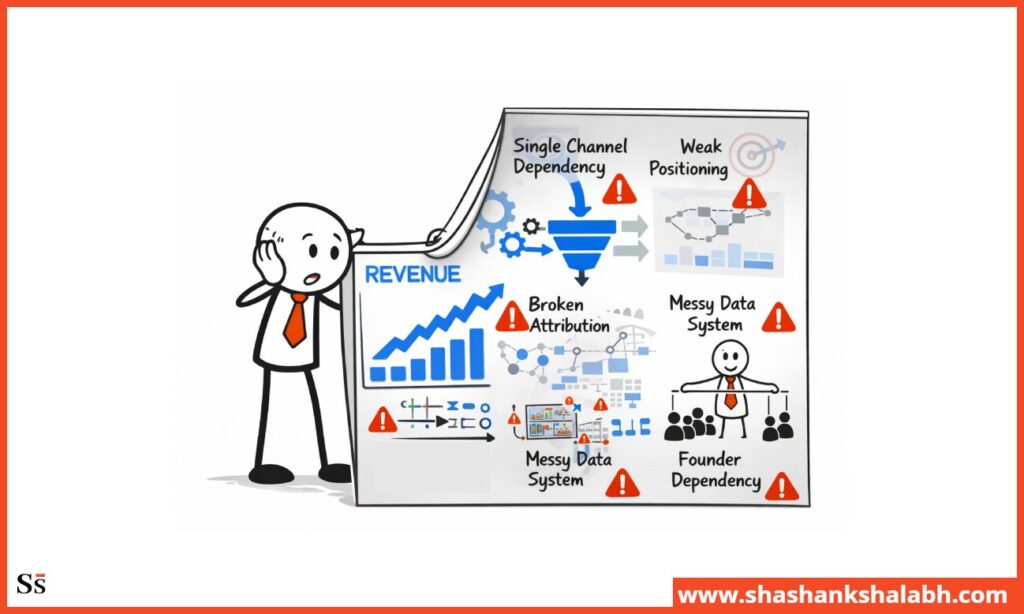
Common Marketing Risks Investors Discover
These are the risks that show up most often in marketing due diligence. Each one can impact valuation, deal structure, or post-close integration costs.
Overreliance on One Acquisition Channel
A business that gets most of its pipeline from a single channel (one content program, paid source, or referral network) carries concentrated demand risk. If that channel underperforms, changes pricing, or gets disrupted, the pipeline can collapse with no backup.
Financial due diligence often misses this risk, but it becomes clear in marketing due diligence when channel attribution data is available.
Weak or Outdated Positioning
Positioning designed for an earlier market or ICP stops converting as the company grows. It drives high CAC, long sales cycles, and poor retention because customers bought based on messaging that didn’t match the product.
Weak positioning is a systemic issue. It impacts every channel and metric at once—and is often mistaken for a channel or sales problem before the real cause is found.
Inconsistent Pipeline With No Attribution
Month-to-month swings in the pipeline without documented reasons signal a demand generation system that isn’t working systematically. When investors can’t link pipeline changes to causes, like seasonality, campaign performance, or channel shifts, revenue projections become unreliable.
Inconsistent pipeline with no attribution is one of the most common reasons deals get repriced.
Poor Marketing Data Infrastructure
Fragmented CRM data, disconnected marketing automation, and unreliable attribution make marketing metrics hard to trust. CAC may exclude sales costs, pipeline may include unqualified leads, and conversion rates may be calculated inconsistently.
Poor data infrastructure also affects the investor’s ability to manage the business post-close. It’s a risk that shows up in the offer.
Founder-Dependent Marketing
When the pipeline relies on the founder’s relationships, content, or personal brand, and there’s no system generating demand independently, investors face a key-person risk that’s hard to value.
The founder’s post-close involvement is uncertain, replacing them is costly and slow, and the marketing system that worked under their guidance may fail without them. This risk is often the biggest marketing red flag in founder-led businesses.
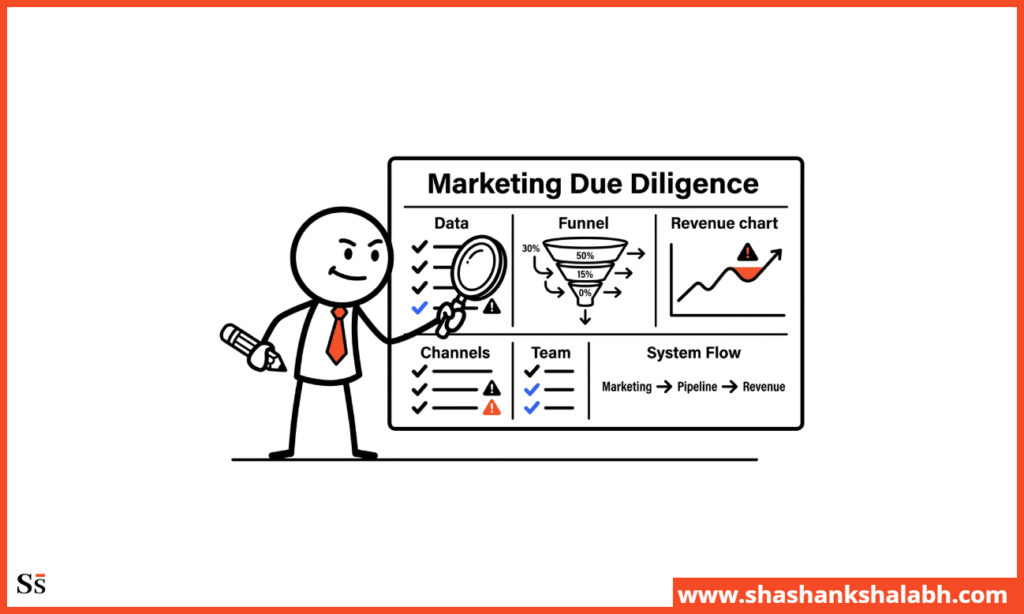
How Fractional CMOs Support Marketing Due Diligence
Fractional CMOs support marketing due diligence in two key ways: before the transaction and after it.
Performing Pre-Close Marketing Audits
A fractional CMO can lead the marketing assessment for investor due diligence. They review positioning, demand generation, attribution systems, pipeline quality, and team structure, producing a report that highlights risks, measures their impact, and recommends priorities for remediation.
This work is faster and more accurate when done by someone experienced with multiple scaling companies at similar stages.
Identifying Post-Close Growth Opportunities
Marketing due diligence isn’t just about identifying risks. It also identifies where capital investment will produce the highest return post-close. A fractional CMO assessment identifies which channels have room to scale, where positioning improvements will reduce CAC, and which team structure changes will improve marketing productivity.
This gives PE operating partners a marketing-specific input to the value creation plan before the transaction closes.
Rebuilding Marketing Systems Post-Acquisition
When due diligence reveals marketing weaknesses, and it usually does, a fractional CMO helps fix them post-close without a lengthy full-time CMO search.
The fractional CMO steps in, implements the remediation priorities identified in due diligence, and builds the marketing infrastructure the value creation plan requires. For PE portfolio companies at $5M-$30M revenue, this is the most capital-efficient path from marketing weakness to marketing strength.
Related Posts: Fractional CMO for Private Equity Portfolio Companies and Exit-Ready Marketing Systems
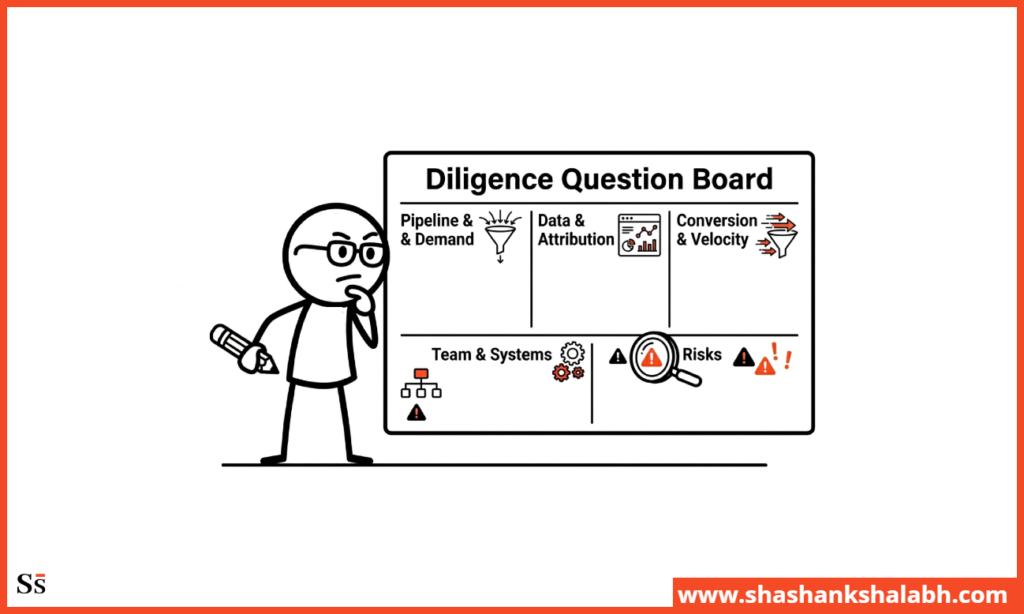
Questions Investors Should Ask in Marketing Due Diligence
Use these questions in management presentations, data room reviews, and executive interviews:
Pipeline and demand generation:
- How is the pipeline generated? Which channels, at what volume, with what consistency?
- What percentage of pipeline is founder-dependent versus system-generated?
- What happens to pipeline if the founder reduces involvement by 50% post-close?
Data and attribution:
- How is CAC calculated? Does it include sales costs?
- Can you show CAC by channel over the past 24 months?
- What attribution model is in place -and how reliable is it?
Conversion and velocity:
- What is the MQL-to-SQL conversion rate? Has it been stable?
- What is the average sales cycle length? Is it trending in the right direction?
- What does the pipeline coverage ratio look like against the next 12-month revenue target?
Team and systems:
- Who owns pipeline accountability in the marketing organization?
- Are marketing processes documented well enough to survive leadership transition?
- Which marketing functions are agency-dependent -and what’s the internal capability if those relationships end?
Risks:
- What is the single biggest marketing weakness this business has?
- What would a new CMO find in the first 30 days that the current team hasn’t fixed?
- What marketing investment would produce the highest return in the first 12 months post-close?
FAQ: Marketing Due Diligence for Investors
What is marketing due diligence?
Marketing due diligence evaluates a company’s marketing function before an acquisition or investment. The review covers positioning, demand generation, data and attribution quality, pipeline conversion, and team capability.
Why is marketing due diligence important for investors?
Marketing due diligence uncovers risks that financial statements can’t show. Founder-dependent pipelines, concentrated channels, poor attribution data, and undocumented processes all impact post-close performance. Yet, they don’t appear in revenue numbers.
Investors who skip this step often find these issues only after closing. And then fixing them is costlier, slower, and delays the value creation plan. Thorough marketing due diligence protects the investment and sets a realistic path for post-close growth.
What do investors evaluate in marketing systems?
Investors evaluate five areas in marketing due diligence:
- Positioning and market differentiation
- Demand generation systems
- Data and attribution
- Pipeline quality and conversion metrics
- Team structure
How do PE firms assess marketing performance?
PE firms assess whether the marketing system can produce capital-efficient growth post-acquisition. They evaluate CAC efficiency and payback period, LTV:CAC ratio and retention trends, pipeline predictability and forecast accuracy, channel concentration risk, and team structure and key-person dependency.
Such firms also benchmark marketing budget as a percentage of revenue against stage norms. For B2B SaaS companies at growth stage, 20-35% of revenue allocated to marketing is the typical range.
Who performs marketing due diligence during acquisitions?
The PE firm’s operating partner with marketing expertise, a fractional CMO, or a marketing advisory firm can handle marketing due diligence.
Of these, a fractional CMO with experience across multiple scaling companies at similar stages provides the most operationally grounded assessment.

Closing Thought
Marketing due diligence isn’t a checkbox. It’s the difference between acquiring a scalable revenue system and acquiring a revenue number that won’t hold.
Businesses that pass marketing due diligence cleanly have one thing in common. They built their marketing systems to be transparent, documented, and independent.
Investors who apply rigorous marketing due diligence make better acquisition decisions. They enter post-close with a clear plan. They deploy capital against documented growth levers rather than discovering risks they should have seen before signing.
Related Posts:

Shashank brings over 22 years of global omnichannel marketing experience. As a 4x Chief Marketing Officer, he has helped several organizations (Startups and Fortune 500) drive sustainable revenue growth through strategic marketing.