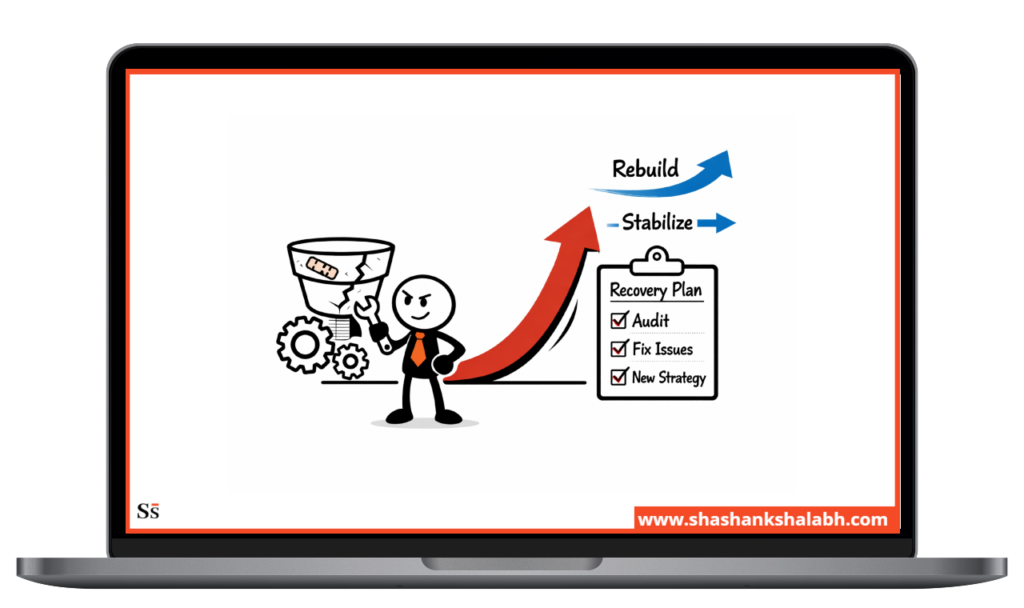
A marketing turnaround is the structured process of diagnosing, stabilizing, and rebuilding a company’s marketing function after performance decline, pipeline collapse, or leadership failure.
It is not the same as optimization. A turnaround starts with stopping the decline, not speeding up growth.
What this marketing turnaround playbook covers:
- How to diagnose a marketing turnaround situation
- The five-phase framework for recovery
- First 90 days broken down by stage
- PE portfolio company turnaround requirements
- When to bring in fractional or interim CMO leadership
What Is a Marketing Turnaround?
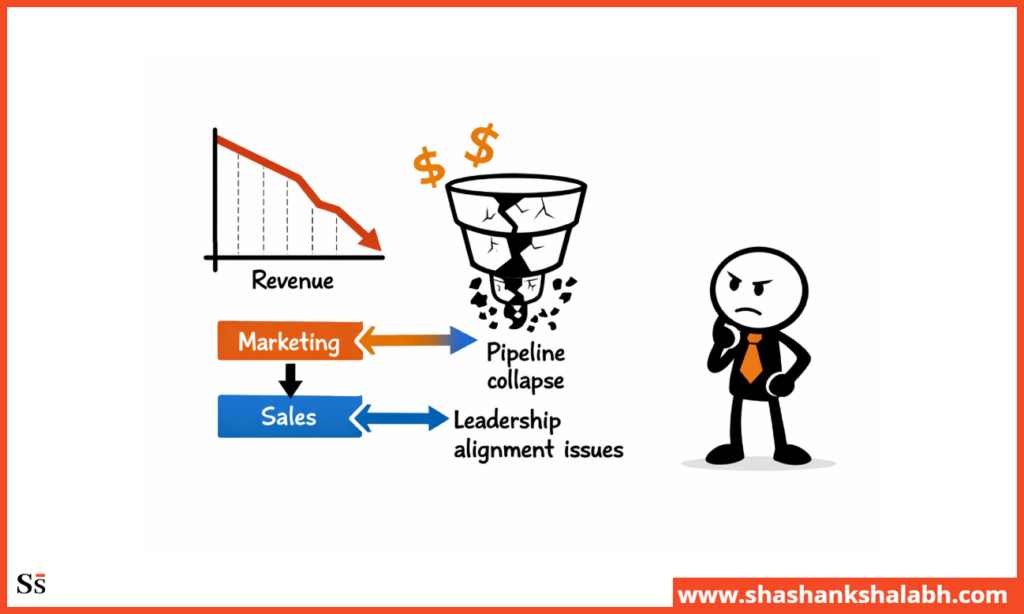
During the marketing turnaround process, a marketing leader (fractional CMO) assesses why the company’s marketing function is underperforming. Next, they stop the decline, and rebuild the systems that produce predictable revenue.
A turnaround generally comprises these four conditions:
- Performance decline: Revenue is declining quarter-over-quarter and marketing can’t explain or reverse the trend
- Pipeline collapse: Qualified opportunities are down materially. And there is no recovery plan in place
- Channel inefficiency: Marketing spend is producing diminishing returns with no clear diagnosis of why
- Leadership misalignment: Marketing and sales are operating without shared accountability. Or the marketing leader quit without leaving a strategic direction
It is important to understand the difference between underperformance and a turnaround situation. Underperformance is an optimization issue, as the results are below target. However, a turnaround situation is a structural problem, as the marketing system itself is broken.
Early Warning Signs Marketing Needs a Turnaround
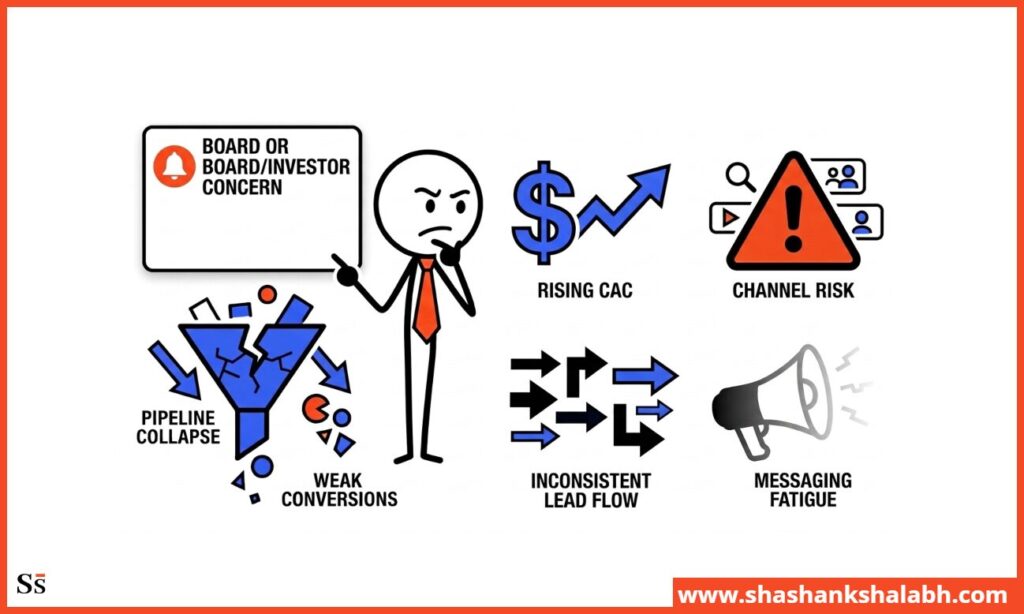
Turnaround situations don’t appear suddenly. They develop over 6-18 months while leadership interprets declining signals as temporary variance rather than structural failure. Here’s what the early warning pattern looks like:
Pipeline Declining for Two or More Consecutive Quarters
One quarter of a declining pipeline is a data point. Two quarters in a row, with no clear reason and no plan to recover, is a warning sign. It means something deeper is wrong. The signal is even stronger if marketing spend stays the same or increases while pipeline falls.
At that point the issue is not budget. The system itself is not working. Adding more money will not fix it. It will only make the problem more expensive.
CAC Rising Without Explanation
If customer acquisition costs keep rising quarter after quarter, something is wrong.
That is especially true if nothing else is improving. Lead quality is the same. The sales cycle is not getting shorter. Customer lifetime value is not increasing. This means your acquisition engine is becoming less efficient.
In a healthy marketing system, the opposite happens. As channels mature and positioning gets clearer, CAC should go down. When CAC keeps rising in a mature system, it usually points to one of three problems. Your channels are saturated. Your positioning is not working. Or you are targeting the wrong customers.
For most B2B SaaS companies, the goal is a CAC payback period under 12 months. When payback stretches to 18 to 24 months and there is no clear plan to fix it, growth becomes expensive and hard to sustain.
Inconsistent Lead Flow With No Attribution
If the pipeline swings more than 30% month to month, there should be a clear reason.
Maybe it is seasonality. Maybe it is a campaign. Or one channel performed unusually well or poorly. If no one can explain the change, or there is inconsistent performance without clear attribution, the problem is not the pipeline or campaign. You should be looking at the system itself.
Note that if you cannot see what is driving results, you cannot fix what is broken.
Channel Concentration Risk Becoming Visible
If most of your pipeline comes from one place, the system is weak. It might be one channel, one rep’s relationships, one content program, or one paid source.
While it might look great initially, it actually creates risk. If that single source slows down, the pipeline drops quickly. And there is no backup to replace it. When performance slips, the entire pipeline is exposed.
Messaging Fatigue in Core Markets
When conversion rates fall across channels at the same time, the cause is rarely the channel. Ads stop converting, emails get ignored, and sales decks lose impact.
The real problem is usually positioning. Messaging that worked with early adopters stops working as the market matures, competitors respond, and buyers become more informed. This creates messaging fatigue, which is one of the most misdiagnosed problems in growing companies.
Teams try to fix ads, emails, and campaigns instead of fixing the positioning underneath.
Board or Investor Escalation
When the board starts asking detailed marketing questions, the situation is already a turnaround. They ask why CAC is rising, why the pipeline is shrinking, and what the recovery plan is.
Boards step in when small explanations stop sounding credible. They want to know whether leadership has a clear plan to fix it.
Why Marketing Turnarounds Fail?
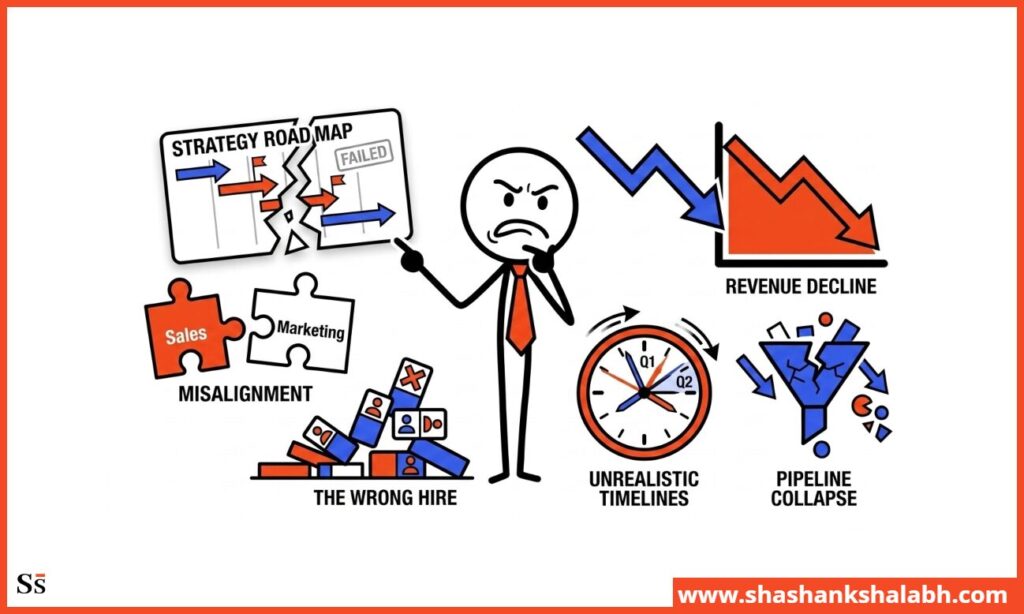
Most companies attempt a marketing turnaround before they bring in the right leadership to execute one. Here’s why the attempts fail:
Tactical Fixes For Strategic Problems
The most common failure pattern is treating a structural issue as a campaign problem.
When pipeline declines, teams launch a new campaign. When CAC rises, they test a new channel. When messaging stops working, they run a brand refresh.
These attempts do not fix the root cause. The real issues are usually broken positioning, the wrong ICP, misaligned sales and marketing, or no revenue accountability. All these temporary solutions (tactical) consume budget and time while the core problem keeps getting worse.
Wrong Hiring Decisions Under Pressure
I have seen this happen dozens of times in my career.
Every time performance declines, the instinct is to hire. A new VP of Marketing, a new demand generation leader, or a new agency.
Hiring before diagnosing the problem usually leads to the wrong hire. A demand generation leader brought into a positioning problem will optimize channels with messaging that does not convert. A new agency hired to fix the pipeline will run campaigns against the wrong ICP.
The order matters. Diagnose first, hire second. Hiring under pressure without knowing what the role must fix is one of the most expensive turnaround mistakes.
Misaligned Sales and Marketing
Businesses that attempt a marketing turnaround without fixing sales and marketing misalignment create better leads that sales still does not follow up on. Marketing improves part of the revenue system while the dysfunction that broke the pipeline in the first place continues.
Businesses with strong sales and marketing alignment grow 50-80% faster than those that are misaligned. In a turnaround, fixing alignment is not optional anymore. It is required for recovery.
Lack of Revenue Accountability at the Leadership Level
Marketing turnarounds fail when no one owns the revenue outcome.
Activity metrics keep showing progress while the business gets worse. Leads increase, content gets produced, and campaigns launch, but pipeline shrinks and CAC rises.
A successful turnaround requires one executive accountable for marketing’s revenue impact. That means owning pipeline volume, CAC trends, and marketing sourced revenue. Without clear accountability, teams stay busy while the real recovery never happens.
Insufficient Time Frames for Recovery
CEOs and boards in turnaround situations often expect recovery in 30-60 day for problems that took 12-18 months to develop. That timeline is unrealistic.
Pipeline improvement usually appears within 60-90 days of a structured turnaround, with a 10-25% increase in qualified opportunities as an early signal. Businesses see revenue growth only after months 4-8. And it takes up to 12 months to fully stabilize the revenue, with repeatable systems in place.
Setting expectations below this timeline leads to the false conclusion that the turnaround is failing, followed by another round of tactical changes that delay real recovery.
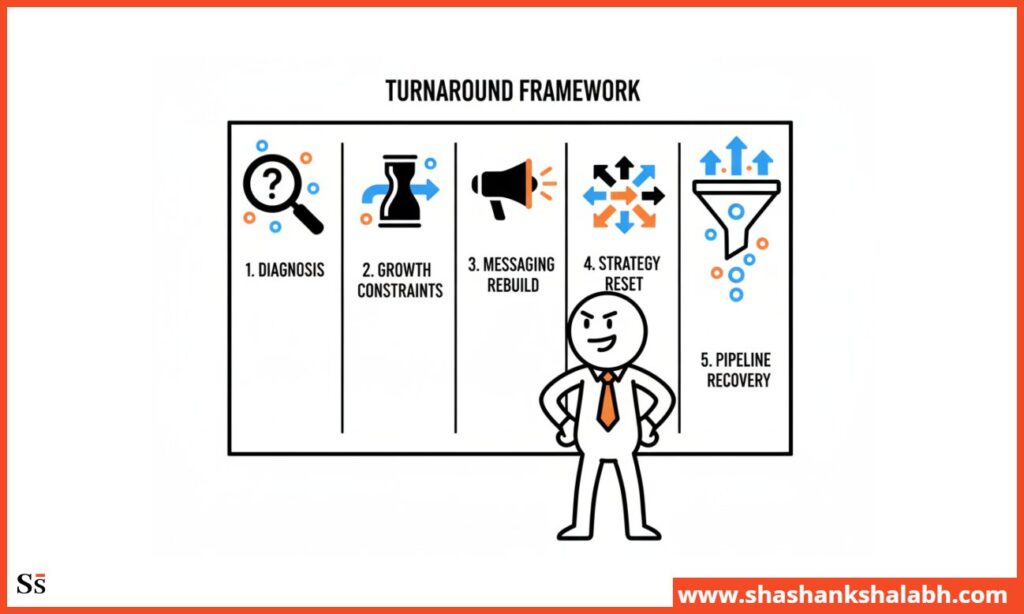
My Marketing Turnaround Playbook/Framework
I use a structured five-phase approach to diagnose and rebuild marketing systems in turnaround situations. Each phase happens in order.
Skipping steps leads to the same pattern of tactical fixes without strategy. And that causes failure.
Phase 1: Diagnose the Revenue System
Before anything else, I find and clarify what’s actually broken.
I review the marketing infrastructure, channel performance, budget allocation, pipeline data, CAC trajectory, positioning, competitive position, and team structure. Also, I interview the CEO, board members, sales leadership, and key customers.
Deliverable: Root cause diagnosis. This is not a list of what’s underperforming, but why it’s underperforming and which problem is primary.
Phase 2: Identify the Primary Growth Constraint
Most turnaround situations have multiple problems. Trying to fix them all at once spreads effort too thin and slows results.
In this phase, I identify the single constraint that, once solved, unlocks the fastest recovery.
Is the main constraint top-of-funnel volume, with too little qualified pipeline entering the system? Is it conversion, where the pipeline exists but delays in the funnel? Is it retention, with customers leaving before delivering healthy LTV? Or is it positioning, where messaging fails to connect with the right buyers?
Pinpointing the primary constraint focuses the recovery effort and delivers measurable results faster than trying to optimize everything at once.
Deliverable: Growth constraints- Primary and Secondary constraints (for subsequent phases).
Phase 3: Rebuild Messaging and Positioning
In most turnaround situations, positioning is either the primary constraint or a contributing factor to every other problem. Messaging built for an earlier version of the market, an earlier ICP, or an earlier competitive landscape stops converting, and every downstream metric reflects it.
CAC rises because ads aren’t resonating. Sales cycles lengthen because the value proposition doesn’t land with economic buyers. Retention suffers because customers bought based on a promise the product doesn’t fulfill for them.
Rebuilding positioning starts with refining the ICP. Who converts fastest, retains longest, and expands most? Then it defines the problem the product solves, how it’s different, and what the economic buyer must hear to act.
Deliverable: Repositioning framework. Refined ICP, updated positioning, messaging hierarchy for economic buyers.
Phase 4: Reset Channel Strategy
Now that we have rebuilt the positioning, I reset the channel strategy.
I evaluate every active channel or CAC efficiency, pipeline volume, and scalability with the refined ICP. Channels that worked before may underperform now, while new channels may become viable.
The reset cuts spend on underperforming channels, focuses investment on the two or three most efficient, and builds attribution systems to make channel performance measurable going forward.
Deliverable: Channel reset plan. Which channels to exit, and which channels to invest in; CAC benchmarks by channel, 90-day execution priorities.
Phase 5: Stabilize Pipeline and Forecasting
In this final phase, I create the infrastructure that makes recovery sustainable. This includes implementing the KPI framework, creating the reporting schedule that connects marketing activity to revenue outcomes, and aligning sales and marketing around shared pipeline definitions and handoff protocols.
The target is a 3:1 LTV:CAC ratio minimum, pipeline coverage of 3:1 against revenue targets, and forecast accuracy above 85%.
A turnaround is complete only when the organization has the systems to prevent the next decline.
Deliverable: KPI governance system. Metrics framework, reporting schedule, sales-marketing alignment.
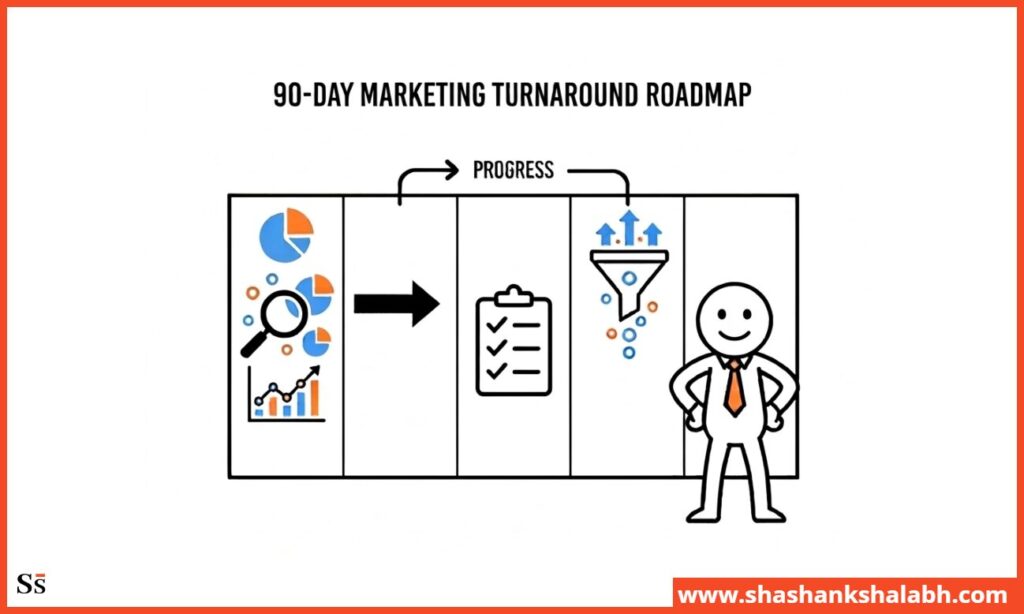
The First 90 Days of a Marketing Turnaround
The first 90 days of a turnaround engagement operate at higher intensity than a standard fractional CMO retainer. Here’s how the 90 days break down:
Days 1-30: Diagnosis and Board Alignment
During the first 30 days, I review every available data source to find out what broke, why it broke, and what recovery requires.
The board receives a clear picture of the situation and a credible recovery framework before any tactical changes are made. During this timeI tend to pause campaign-launch, hiring, channel addition/removal.
Milestone: Board-ready root cause diagnosis delivered by Day 30.
Days 31-60: Recovery Planning and Early Execution
During this time, I develop the recovery plan and kickstart highest-priority items. This includes positioning, reallocating budgets, sales-marketing alignment, and KPI framework.
Milestone: Recovery plan delivered and approved by board. Early execution underway on primary constraint by Day 60.
Days 61-90: Pipeline Recovery and System Stabilization
By Day 90, early results are measurable- 10-25% improvement in qualified pipeline. We have an operational attribution infrastructure, a CAC baseline, and aligned Sales and marketing teams.
Milestone: 10-25% pipeline improvement. KPI dashboard. Board progress report delivered by Day 90.

Marketing Turnarounds in PE Portfolio Companies
Private equity turnarounds operate under different constraints than founder-led company turnarounds. Speed, board accountability, and EBITDA discipline are non-negotiable from Day 1.
Agility
PE sponsors don’t have patience for six-month diagnostics. In a PE-backed turnaround, a credible diagnosis is expected within 30 days, and measurable pipeline improvement within 90. Investment time-frames of three to five years leave little tolerance for extended recovery.
An interim CMO in a PE portfolio company must deliver board-ready findings quickly and execute on a tighter timeline than in a founder-led situation.
Operating Partner Expectations
PE operating partners are active participants in the turnaround process.
They bring portfolio-level pattern recognition, specific performance expectations, and often a value creation plan that was developed before the turnaround became necessary.
A marketing leader needs to understand the operating partner’s framework, align the marketing recovery plan with the value creation plan, and report in the language PE sponsors use. Common metrics include pipeline coverage, CAC payback, LTV:CAC ratio, and EBITDA contribution.
EBITDA & Capital Efficiency
PE-backed turnarounds demand marketing recovery that drives EBITDA, not just revenue. Every dollar spent must link directly to pipeline and revenue.
Budget changes aren’t just about channel optimization. They must increase marketing’s contribution to EBITDA margin. Growth at any cost is not acceptable. The standard is capital-efficient growth with a clear payback timeline and improving CAC.
Growth Targets Tied to Exit Timeline
PE portfolio companies operate on an exit timeline. This falls between three and five years from acquisition. That is why marketing turnaround plans must align with that timeline.
What does marketing need to achieve in 12 months to support the exit story? What should the marketing system look like 24 to 36 months from now to ensure acquisition readiness?
In a PE portfolio company, a marketing turnaround is both a recovery effort and an exit preparation process.

When a Company Needs a Fractional or Interim CMO?
Not every marketing turnaround requires external executive leadership. But most do. Here’s the framework for assessing when to bring in a fractional or interim CMO:
Leadership Gap After CMO Exit
When a CMO exits during a period of underperformance, the organization faces a leadership gap and a performance issue.
Promoting internally without diagnosing the root cause just leads to a new leader following the same flawed playbook. An executive search takes months, and this worsens the performance problem.
A fractional or interim CMO steps in quickly, fills the leadership gap, stabilizes the team, and begins the diagnostic process without delay.
Board-Mandated Turnaround
When a board or PE sponsor mandates a marketing restructuring, they expect external accountability. An internal leader defending past decisions to the board isn’t a credible recovery plan.
An external interim CMO, with no connection to those previous choices, offers the independent assessment and leadership needed to drive the recovery that boards and investors are seeking.
Scaling Transition Requiring New Leadership Model
Some turnaround situations are transition-driven.
A company that has outgrown its current marketing leadership model needs a new approach without necessarily needing to terminate the existing team.
A fractional CMO can step in to provide the strategic direction the team needs while the organization determines whether to develop internal leadership, hire full-time, or continue the fractional model.
Post-Acquisition Marketing Restructuring
Acquisitions often create marketing turnaround situations. This means two teams with different systems, positioning, and pipelines that must be integrated without disruption.
Post-acquisition marketing restructuring requires executive leadership skilled in both turnaround and integration. A fractional or interim CMO with M&A marketing experience can lead the integration process, avoiding the cost and commitment risk of a full-time hire during an inherently uncertain period.
Check out these guides on Interim CMO for Turnaround Situations and Fractional CMO Services to learn more.
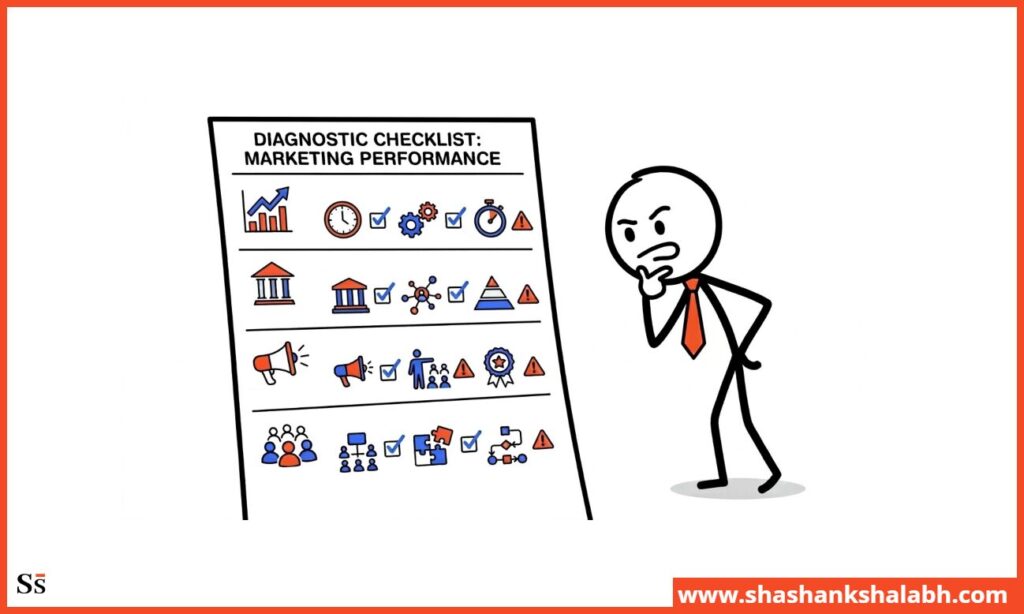
Checklist: Is Your Marketing Organization in Turnaround Mode?
Use this diagnostic to assess whether your marketing situation requires a turnaround intervention or optimization:
Performance signs:
- Pipeline has declined for two or more consecutive quarters without a documented recovery plan
- CAC is increasing quarter-over-quarter without a clear explanation or improvement trajectory
- Marketing-sourced revenue percentage is declining quarter-over-quarter
Structural signs:
- Marketing and sales are operating from different pipeline definitions or qualification criteria
- No single person in the organization owns CAC trajectory as a primary KPI
- Channel attribution is incomplete. The spend can’t be connected to closed revenue
Leadership signs:
- CMO or VP of Marketing has exited or been terminated in the past 6 months
- Marketing reports to the board on activity metrics rather than revenue outcomes
- The board has asked for a marketing recovery plan more than once
Organizational signs:
- Marketing team turnover has increased in the past 12 months
- Strategic marketing decisions are made reactively rather than from a documented framework
- The marketing budget allocation hasn’t changed despite declining channel performance
Scoring:
- 0-3 items: Optimization opportunity. No turnaround required
- 4-6 items: Performance risk. Assess root cause before committing to a recovery plan
- 7-9 items: Turnaround situation. External executive leadership likely required
- 10-12 items: Crisis. Address immediately
If you scored 7 or above, the right next step is a direct conversation, not another internal review cycle.
FAQ: Marketing Turnaround Playbook
What is a marketing turnaround?
A marketing turnaround is the structured process of diagnosing, stabilizing, and rebuilding a company’s marketing function after a period of performance decline, pipeline collapse, or leadership failure. Unlike marketing optimization, which improves an existing system, a turnaround rebuilds a broken one.
A successful turnaround delivers three key outcomes: a stabilized pipeline, improving CAC trajectory, and an organizational structure that sustains performance without constant crisis-level intervention.
When should a company initiate a marketing turnaround?
You should look into a marketing turnaround when you have one or more of these:
- Pipeline Decline: Two or more consecutive quarters
- Increasing CAC quarter-over-quarter
- Board wanting a formal recovery framework
Most companies wait too long and try tactical fixes for 6-12 months before acknowledging the problem is structural. The cost of delayed intervention compounds. Every quarter of the declining pipeline makes the recovery longer and more expensive.
The right time to initiate a turnaround is when the second consecutive quarter of decline becomes visible.
Who leads a marketing turnaround?
A marketing turnaround requires an executive leader like a CMO or VP of Marketing with turnaround experience, not just growth experience.
Turnaround leaders must diagnose broken systems, make tough organizational decisions, and rebuild accountability structures under pressure. Most internal marketing teams aren’t equipped to lead their own turnaround as they lack the necessary distance and authority to make the structural changes needed.
A fractional or interim CMO with turnaround experience brings the independent assessment and executive accountability essential for successful recovery.
How long does a marketing turnaround take?
A full marketing turnaround takes 6-12 months to achieve sustainable results. The first 30 days are for diagnosis. In the next 60 days (31-90), the recovery plan is put in place, and the pipeline improves by 10-25% with more qualified opportunities.
Revenue impact is seen between months 4-8. And full stabilization, including KPI tracking and team structure, takes 6-12 months. Expecting a turnaround in 60-90 days is unrealistic. Realistic timelines lead to better decisions and stronger board conversations.
What are the biggest causes of marketing failure?
The biggest causes of marketing failure are outdated positioning, an overly broad ICP that hurts acquisition efficiency, sales and marketing misalignment causing pipeline disputes, over-reliance on a single demand channel, and no clear revenue accountability in marketing leadership.
Closing Thought
Marketing turnarounds succeed when the organization accepts that incremental fixes won’t solve structural problems. And they bring in the leadership, diagnostic discipline, and recovery framework to address root causes rather than symptoms.
The companies that recover fastest are the ones that initiate the turnaround process before the board mandates it, bring in external executive leadership before the team is demoralized, and commit to a realistic recovery timeline rather than a 90-day fix for an 18-month problem.
If the diagnostic checklist above produced a score of 7 or higher, the turnaround process should begin now. And not after the next quarter’s results confirm what the data already shows.