

Businesses should hire a fractional CMO when they need executive-level marketing strategy but can’t justify a full-time hire.
Growth-stage companies ($5M-$30M revenue) experiencing strategic marketing gaps despite having execution resources benefit greatly from fractional chief marketing officer services.
Here are seven indicators or signs that clearly show you need a fractional CMO:
- Revenue has plateaued despite marketing activity
- Marketing team lacks strategic direction
- Sales and marketing aren’t aligned
- Customer acquisition costs keep rising
- Preparing for a funding round or exit
- Can’t justify a full-time CMO yet
- Scaling faster than marketing strategy
What Is a Fractional CMO?
A fractional CMO is a part-time chief marketing officer who provides executive marketing leadership without full-time commitment or cost.
They typically work 2-3 days per week (16-24 hours monthly) for companies that need strategic oversight but don’t require or can’t afford daily CMO presence.
As a fractional chief marketing officer, I work with growth-stage companies to own go-to-market strategy, align marketing and sales, optimize customer acquisition, and build marketing capabilities.
Note that isn’t consulting.
I take full accountability for marketing outcomes over 6-18 month engagements.
To understand what fractional CMOs deliver, see fractional CMO services.
Sign 1: Revenue Has Plateaued Despite Marketing Activity
This is the first sign you need a fractional CMO.
You have been running campaigns, publishing content, attending events, and spending money, and still revenue has stopped growing (or is growing unpredictably).
Marketing looks busy but doesn’t translate to pipeline or closed deals.
The underlying problem: Execution without strategy.
Your team optimizes individual channels (better ad copy, more blog posts, faster email cadence) but no one owns a comprehensive go-to-market strategy connecting tactics to revenue outcomes.
Diagnostic indicators:
- Marketing spend increased 30-50% over 12 months but revenue grew less than 15%
- Can’t explain which marketing activities actually drive revenue: attribution is broken or ignored
- Team celebrates marketing metrics (traffic, leads, engagement) while sales misses targets
- No clear positioning differentiating you from competitors-messaging is generic
As a fractional chief marketing officer, I see this constantly…
Talented marketers executing well but without a strategic framework showing which customers to target, how to position uniquely, which channels deserve investment, and how to measure true contribution to revenue.
If revenue plateaus, it doesn’t mean your team should start working harder.
First, diagnose the issue, and see if your team has an absence of executive marketing leadership connecting activity to business outcomes.
Sign 2: You Have a Marketing Team but No Strategic Direction
Your marketing team (2-8 people) executes capably.
They can run ads, create content, manage email, and coordinate events. But they operate tactically. Each person optimizes their domain without a cohesive strategy tying everything together.
The execution vs. leadership gap:
Marketing managers and directors excel at tactical execution but typically aren’t strategic executives. They optimize what they’re given.
However, they don’t establish positioning, prioritize target customers, determine channel allocation, or own revenue accountability.
What does this look like?
The team waits for you (the founder or CEO) to make all strategic decisions. This makes you the bottleneck. Different team members have conflicting views on target customer or messaging.
There is no quarterly or annual marketing plan. The team reacts to requests instead of executing strategy. They can’t answer “what’s our marketing strategy?” without listing tactics (“we do paid ads and content”)
Tactical teams need strategic leadership.
Without it, marketing becomes a chaotic activity rather than a systematic revenue engine.
Sign 3: Sales and Marketing Are Not Aligned
Sales complains marketing generates “bad leads.” Marketing claims sales doesn’t follow up properly or doesn’t understand the value proposition.
Both teams blame each other when revenue misses targets.
The misalignment problem:
Marketing and sales operate as separate functions with different incentives, metrics, and processes. There is no shared accountability for pipeline or revenue. And no one bridges the gap at executive level.
What are the symptoms of this marketing-sales misalignment?
First, marketing is measured by leads or MQLs; sales is measured by revenue-different scorecards create conflict. Lead handoff process is broken (slow response times, unclear qualification, no feedback loop).
Sales doesn’t use marketing content or claims it’s not helpful for actual conversations. And revenue forecasting is guesswork because no one tracks marketing contribution to pipeline accurately
I’ve fixed this dozens of times working as a fractional chief marketing officer. I establish shared pipeline targets, create clear lead definitions both teams agree on, implement service-level agreements, and build weekly sync cadence.
Aligned teams grow 50-80% faster than misaligned ones with identical resources. But alignment requires executive-level authority. Marketing managers can’t force sales alignment.
A fractional CMO can.
Sign 4: Customer Acquisition Costs Keep Rising
Your CAC increased 40-80% over 18 months without corresponding improvements in customer lifetime value (LTV). What used to cost $800 per customer now costs $1,400.
Unit economics are deteriorating.
Why does CAC rise without strategic oversight?
Tactical teams optimize channels in isolation without addressing structural issues. They test new ad creative or landing page variations (5-15% improvements). And they ignore that positioning is weak, targeting is broad, or you’re investing in wrong channels entirely.
Strategic CAC problems that require executive leadership?
When you have poor positioning, it forces you to compete on price rather than unique value. This attracts price-sensitive, high-churn customers. Undefined ideal customer profile means marketing targets everyone. This wastes the budget on poor-fit prospects.
Channel over-dependence (80-90% from paid ads) with no diversification strategy. There is no systematic approach to conversion optimization across full funnel
Reducing CAC by 30-50% requires strategic repositioning, ICP refinement, channel portfolio development, and funnel optimization. These are executive decisions, not tactical executions.
Check this post to learn more about marketing budgeting.
Sign 5: You’re Preparing for a Funding Round or Exit
Investors and acquirers scrutinize marketing heavily. Weak marketing creates valuation problems or prevents deals from closing.
Board and investor expectations:
Series A/B investors expect clear go-to-market strategy, predictable customer acquisition, improving unit economics (LTV:CAC ratio 3:1+), and accurate revenue forecasting.
If you can’t articulate marketing strategy or show systematic demand generation, it signals operational risk.
What do I help companies prepare?
- Clean attribution showing which channels drive actual revenue (not just leads)
- Documented go-to-market strategy investors can evaluate during diligence
- Revenue forecasting models based on pipeline coverage and historical conversion rates
- KPI dashboards showing marketing efficiency trends (CAC, LTV, payback period)
- Competitive positioning narrative explaining market opportunity and differentiation
I’ve prepared multiple companies for fundraising and exits working as a fractional chief marketing officer. Professional marketing preparation often improves valuations 15-25%. Often, that’s the difference between raising at $35M and $45M is $2M-$3M in dilution.
Sign 6: You Can’t Justify a Full-Time CMO Yet
You recognize the need for executive marketing leadership but can’t justify full-time CMO numbers or don’t want the commitment.
The economics gap:
Full-time CMO costs $300K-$600K+ annually (salary, benefits, equity, bonus). Most $5M-$20M companies can’t afford this or don’t need 40+ hours weekly of CMO attention.
Fractional CMO advantages:
- Cost efficiency: $180K-$300K annually (40-60% lower than full-time) for 16-24 hours monthly
- Speed: Start working in 30 days vs. 3-6 months to recruit full-time executive
- Flexibility: Adjust scope as needs change; exit with 30 days notice if not working
- Risk reduction: Test executive marketing leadership before committing to full-time hire
- Experience diversity: I’ve scaled marketing at multiple companies vs. single-company learning curve
When businesses hit $30M-$40M revenue and have 15+ person marketing teams, full-time CMO makes sense. Below that, a fractional marketing executive delivers the same strategic value at a fraction of cost.
For detailed comparison, see fractional CMO vs full-time CMO.
Sign 7: You’re Scaling Faster Than Your Marketing Strategy
You’ve achieved product-market fit and growth is accelerating. You’re hiring rapidly, entering new markets, or expanding product lines. But marketing hasn’t evolved from scrappy startup mode to systematic scale-up operations.
What worked getting to $5M (founder-led marketing, single channel, manual processes) doesn’t work scaling to $20M. Growth creates complexity; and that requires strategic thinking.
Symptoms of outpacing marketing maturity:
- Entering new customer segments or verticals without distinct positioning or go-to-market strategies
- Hiring sales team but marketing can’t generate enough qualified pipeline to support the team
- Product launches happen ad-hoc without proper positioning, enablement, or demand generation
- Marketing budget grows but you can’t explain if spending more actually improves results
I help companies build marketing capabilities for their next growth phase. This includes multi-channel demand generation, segment-specific positioning, systematic campaign planning, team structure and hiring, forecasting and accountability frameworks.
Scaling requires transitioning from founder heroics to repeatable systems. That’s the fractional CMO value.
Read how to scale a company to get a better idea.
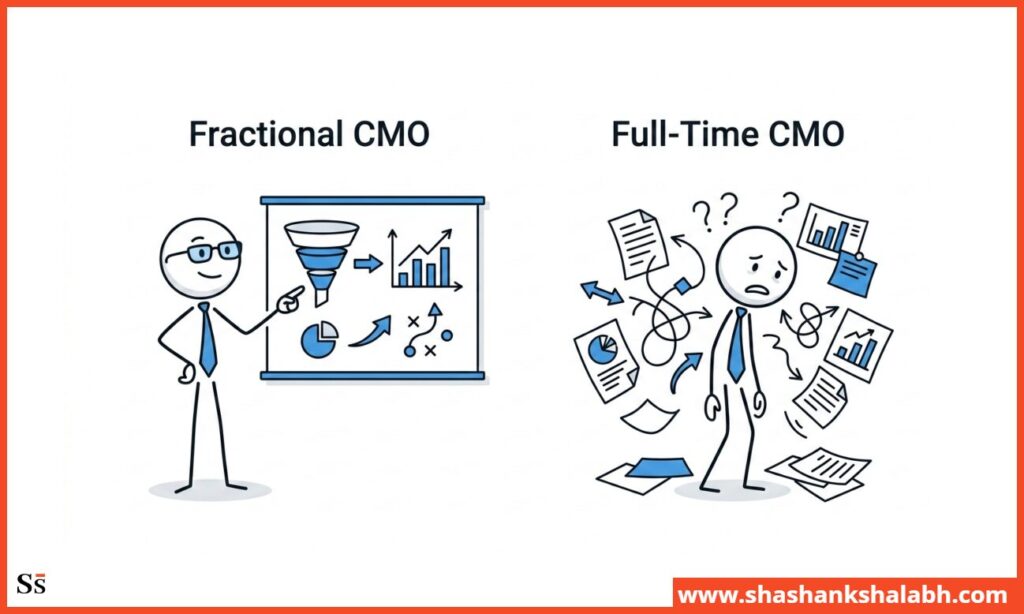
Fractional CMO vs Hiring Full-Time
Here is a quick comparison to help you understand the difference between a part time CMO and a full-time CMO:
| Full-Time CMO | Fractional CMO | |
| Annual cost | $300K-$600K+ | $180K-$300K |
| Time to start | 3-6 months recruiting | 30 days |
| Commitment risk | High (12-18 months minimum) | Lower (30-day exit) |
| Hours per week | 40+ hours | 16-24 hours monthly |
| Best for | $30M+ revenue, 15+ marketers | $5M-$30M revenue, 2-12 marketers |
| Strategic depth | Full executive scope | Same strategic scope, less operational involvement |
When fractional makes sense?
You need executive marketing strategy but don’t require daily CMO presence. Your team can execute with strategic direction. The budget doesn’t support full-time hire or the risk feels too high.
When full-time makes sense:
The company revenue is north of $30M-$40M. Your marketing team has 15+ people. The organizational complexity needs constant executive attention.
Most growth-stage companies benefit from the fractional model’s efficiency and flexibility. You can always transition to full-time CMO once company scale justifies it.
When Is It Too Early to Hire a Fractional CMO?.
Let’s look into stages when hiring a fractional CMO might not be effective.
Pre-product-market fit
If retention is below 70% or customers aren’t using the product regularly, fix the product before investing in marketing leadership. Marketing can’t solve product problems.
Under $2M revenue
Most companies below $2M need execution (someone running campaigns, creating content, building initial systems) more than executive strategy.
Hire marketing generalists or use agencies first.
No marketing budget
If total marketing spend is under $20K-$30K monthly, you can’t afford fractional CMO leadership ($15K-$25K/month) plus execution resources. Focus on founder-led marketing or single marketing hire until the budget supports the strategic layer.
Not committed to growth
If you’re bootstrapping profitably and happy with current trajectory, strategic marketing investment doesn’t match your goals. Save the money.
If these describe your situation, focus on product-market fit validation, building initial marketing capabilities, or hiring first marketing employee. A fractional CMO becomes valuable once you’ve proven market fit and need strategic sophistication to scale efficiently.
Understanding when you’re not ready is as valuable as working together when the timing is right.
FAQ: 7 Signs You Need a Fractional CMO
Do startups need a fractional CMO?
It depends on the stage and situation.
Pre-Series A startups (under $2M revenue) need execution more than executive strategy-better to hire marketing generalist or use agencies.
Post-Series A startups ($2M-$15M) often benefit significantly from fractional CMO if they’re scaling validated channels, preparing for next fundraise, or experiencing founder marketing bottlenecks.
The model works when product-market fit is proven (70-80%+ retention), marketing budget exceeds $30K/month total, and company needs strategic leadership but can’t justify full-time CMO cost.
Early-stage companies should focus on proving retention and initial traction before adding an executive marketing layer.
Is a fractional CMO better than an agency?
They have different roles.
A fractional CMO provides executive strategy and owns outcomes. Agencies execute specific tactics within their scope.
As a fractional CMO, I define what to build (positioning, target customers, channel priorities, budget allocation, revenue accountability). Then, the agencies execute specific components (paid media, content production, events, creative).
Without strategic leadership, agencies optimize for their metrics (impressions, clicks, cost per lead) rather than your business outcomes (revenue, CAC, LTV). Most growth-stage companies need both: fractional CMO ($15K-$25K/month) for strategic leadership plus agencies ($15K-$50K/month) for execution.
The combination delivers better ROI than either alone.
How much does a fractional CMO cost?
A fractional CMO costs $15K-$25K per month ($180K-$300K annually) on average, for 16-24 hours of work monthly (2-3 days per week).
Fractional CMO pricing depends on company revenue stage, marketing complexity, and scope. This represents 40-60% savings vs. full-time CMO total compensation ($300K-$600K+) while providing the same strategic value.
For most $5M-$30M companies, a fractional CMO monthly retainer is about 10-20% of total marketing budget.
This is a strategic investment that typically delivers 2-4x ROI within 9-12 months through improved CAC, better targeting, channel optimization, and revenue growth.
How long do engagements typically last?
Standard fractional CMO engagements run 6-18 months with 12 months being average.
This duration allows time to:
- Diagnose issues and develop strategy (first 60-90 days)
- Implement changes and optimize based on results (months 3-9)
- See full revenue impact (months 6-12+)
Shorter engagements (under 6 months) rarely deliver sustainable value-strategic work that requires context building and iterative optimization.
Most fcmo contracts include 30-day exit clauses allowing either party to end engagement if it’s not working, which reduces commitment risk while providing enough time for meaningful results.
Some companies transition to full-time CMO after fractional engagement; others continue fractional relationships for years as an appropriate model for their stage.
Can a fractional CMO build a marketing team?
Yes, team development is core responsibility.
As a fractional chief marketing officer, I guide the hiring strategy (which roles to hire when), write job descriptions, interview candidates, make hiring decisions, and onboard new team members. For companies with existing teams, I provide leadership, coaching, and performance management while building their strategic capabilities.
The goal is developing team sophistication so they become more strategic over time, eventually reducing dependence on fractional leadership. I also decide build-vs-buy (internal hires vs. agencies) and manage agency relationships.
Many companies hire their first VP Marketing or Marketing Manager with my guidance during engagement.
When should you transition from fractional to full-time CMO?
Here are a few scenarios when you should consider transitioning from a fractional to a full time CMO.
Revenue hits $30M-$40M+: This requires daily executive presence for organizational complexity
Marketing team grows to 15+ people: This needs constant management and coaching
Adequate budgets: The budget easily supports full-time investment and risk feels manageable.
Below these thresholds, fractional often remains more efficient. You’re paying for time you need rather than overhead you don’t. Some businesses maintain fractional relationships even at a larger scale if the model serves their needs.
The right timing depends on organizational complexity, budget comfort, and whether daily CMO presence would meaningfully improve outcomes vs. strategic oversight 2-3 days weekly.

Ready to Assess Your Marketing Leadership Needs?
If you recognize 2-3 of these signs, your company likely needs executive marketing leadership. The question isn’t whether marketing leadership would help.
it’s whether the fractional CMO model fits your stage, budget, and organizational needs.
Apply For A Strategy Call → to discuss:
- Your current revenue trajectory and growth challenges
- Marketing team structure and capability gaps
- Whether strategic marketing leadership would meaningfully improve outcomes
- If fractional CMO engagement is right fit or if other approaches (hire full-time, use agencies, wait until bigger) better serve your situation
I’ll honestly assess whether fractional CMO makes sense for your specific circumstances. If it doesn’t, I’ll tell you what alternative approaches would work better.