
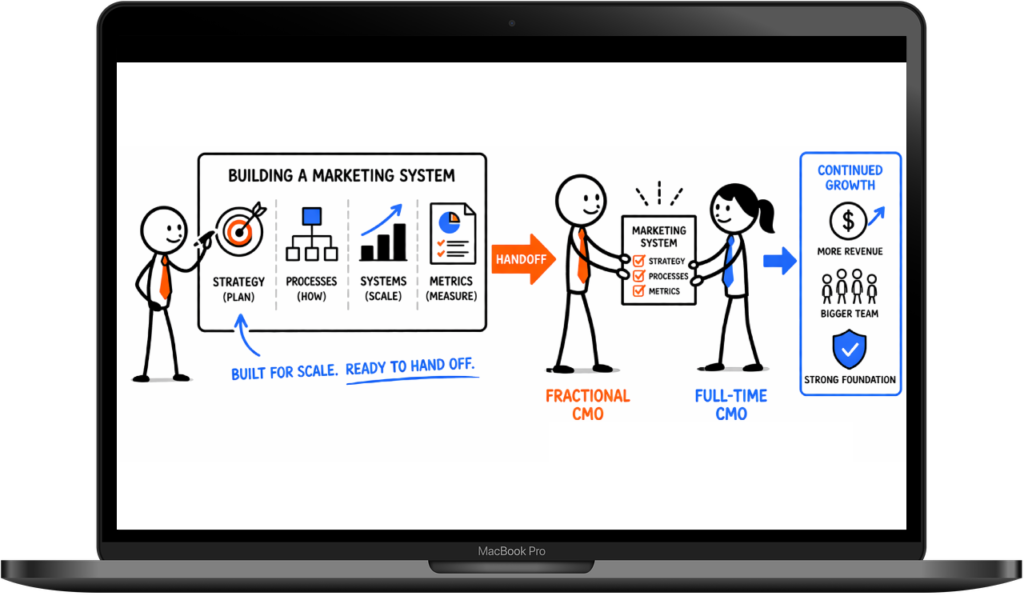
A business should transition from a fractional CMO to a full-time CMO when marketing complexity, team size, and revenue ($30M–$75M) require full-time executive presence. Below that, the fractional model delivers executive capability at a fraction of the cost; above it, growing teams and organizational complexity justify a full-time CMO.
Shashank Shalabh helps companies make that transition smoothly as a fractional CMO. He guides strategy, builds the marketing system, and prepares the team so a full-time CMO can step in and drive growth from day one.
Key transition signals:
- Revenue reaches ~$30M-$75M
- Team grows to 15-20 people
- Marketing gets more complex
- Investors want a full-time leader
- Business spans multiple products or markets
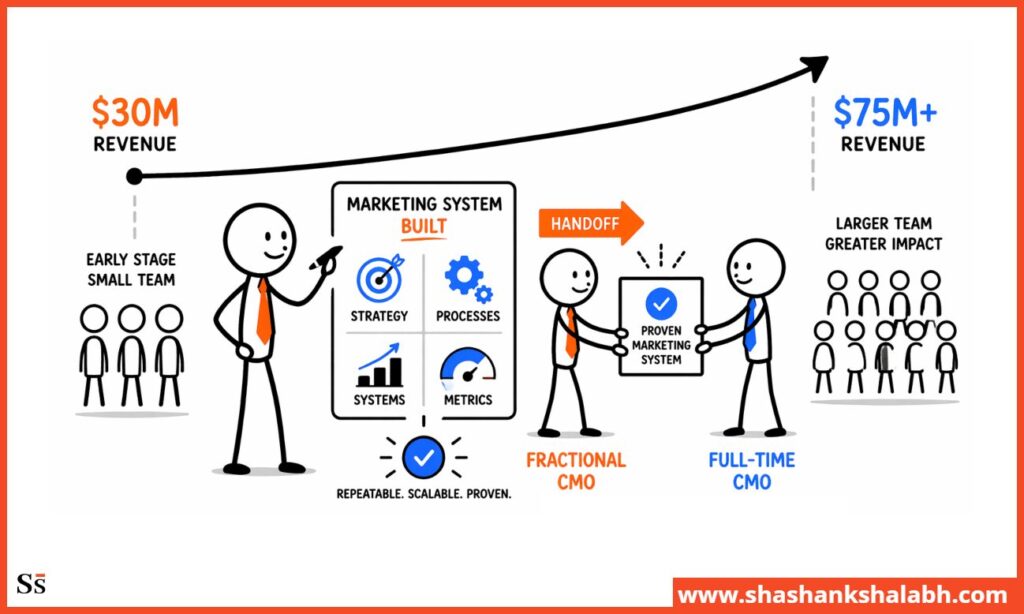
Why This Transition Is a Milestone?
Some companies see the shift from a fractional to a full-time CMO as a sign something didn’t work. This is the wrong approach.
The fractional model is built for an earlier stage. It gives you senior marketing leadership when your team is small, you’re still building your go-to-market, and a $250k + hire doesn’t make sense yet. It works best around $5M-$30M ARR.
The full-time CMO comes in at the next stage. That is, when the team is bigger, the system is more complex, and the business needs a full-time leader.
So the transition isn’t a failure. It’s proof the model worked; getting you to the point where a full-time leader actually makes sense.
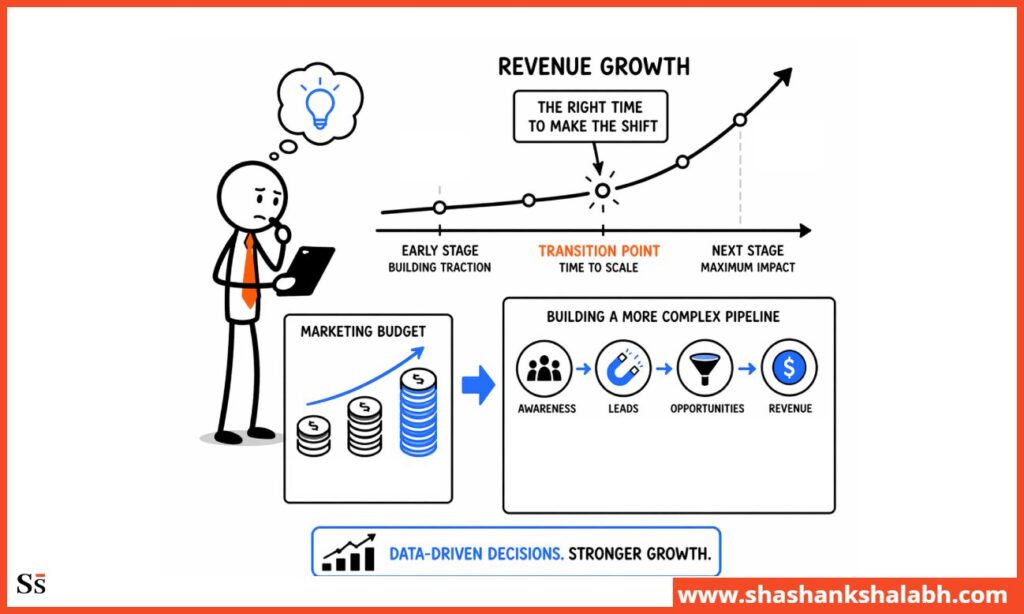
Revenue Signals: When to Hire a Full Time CMO
Revenue isn’t the only indicator of a transition from fractional to full time CMO. But it’s the most objective one.
Crossing $30M-$75M Revenue
The general transition threshold is $30M-$75M revenue. However, the right number varies by market, business model, and organizational complexity.
For Austin, TX, businesses might need a full-time CMO when revenue is between $30M-$40M. Here, the venture-backed SaaS market moves to full-time CMO earlier.
New York based businesses move to a full-time marketing leader when their revenue exceeds $50M. In this region, institutional capital and higher burn rates support longer fractional CMO engagement.
In the San Francisco Bay area, the venture density and engineering culture often extend the fractional window. The threshold here is $40M-$50M ARR.
And finally, PE-backed middle-market companies ($60M-$75M revenue) with EBITDA focus justify later transition in Chicago.
These are guides, not rules.
A $35M company with a 20-person marketing team across three product lines needs a full-time CMO. A $50M company with a lean team and a simple GTM model may not.
Marketing Budget Reaching Full-Time CMO Justification
When marketing spend reaches growth-stage levels (20-35% of revenue for B2B SaaS), the investment is large enough to require a full-time CMO.
A $30M company spending 25% on marketing is managing a $7.5M annual budget.
At that level, a part-time marketing leader increases risk around decisions, performance, and ROI. A full-time CMO brings tighter control, clearer priorities, and stronger ROI.
Revenue Growth Requiring Permanent Pipeline Architecture
When next year’s revenue goal depends on marketing to deliver a large, growing pipeline, the marketing function needs a full-time owner.
Fractional CMOs build the pipeline engine. Once that engine is mature and the target is big enough to demand daily oversight, a full-time CMO is the right move to run it and hit the number.
Team Size and Organizational Signals
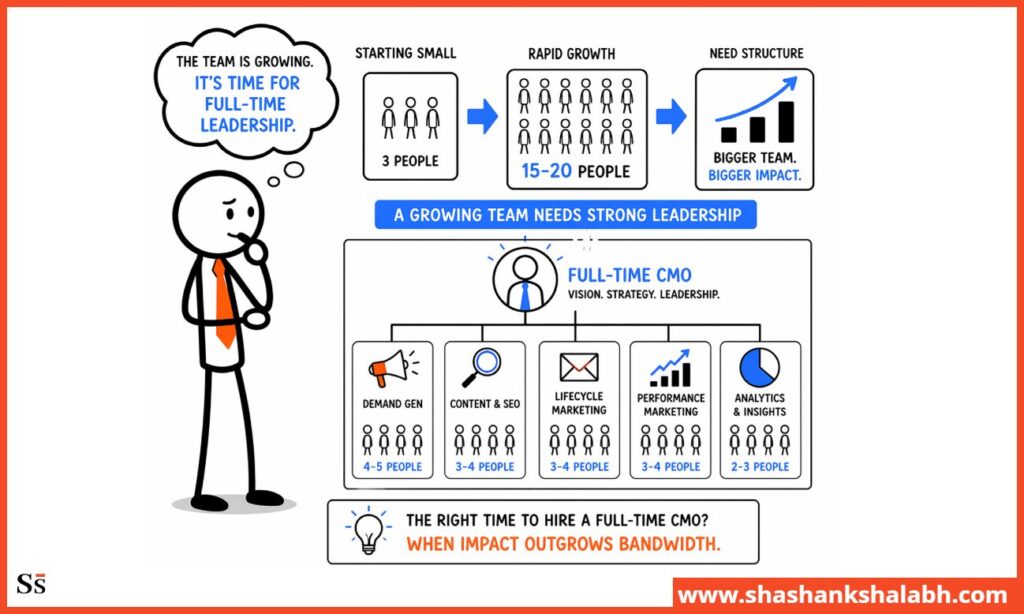
Revenue thresholds are helpful benchmarks. Team size is often a more reliable signal of when a full-time CMO is truly needed.
Marketing Team Reaching 15-20 People
A marketing team of 15-20 people is the clearest call for a full-time CMO.
At this size, the team spans demand generation, product marketing, content, brand, and RevOps, and part-time leadership leaves gaps.
People need career conversations. Priorities need daily decisions. Cross-functional work needs an executive present in real time.
A fractional CMO working 16-24 hours a month cannot support a team at this level consistently.
Multiple Functional Teams Requiring Full-Time Leadership
When marketing has multiple teams, a part-time marketing leader might not be the best fit to lead.
A demand generation team, a product marketing team, and a content team each need clear executive direction. They must stay aligned and accountable for results.
That level of leadership requires a full-time CMO.
Senior Marketing Hires Needing an Executive to Report To
When you hire a VP of Demand Generation or a Director of Product Marketing, they need a CMO to report to.
A senior leader reporting to a fractional CMO will quickly hit limits in growth and decision-making. Full-time leadership supports, develops, and retains strong senior talent.
Organizational Complexity: When to Hire a Full Time CMO
Some companies need a full-time CMO before they hit revenue or team size benchmarks, because the business is already too complex for part-time CMO to manage.
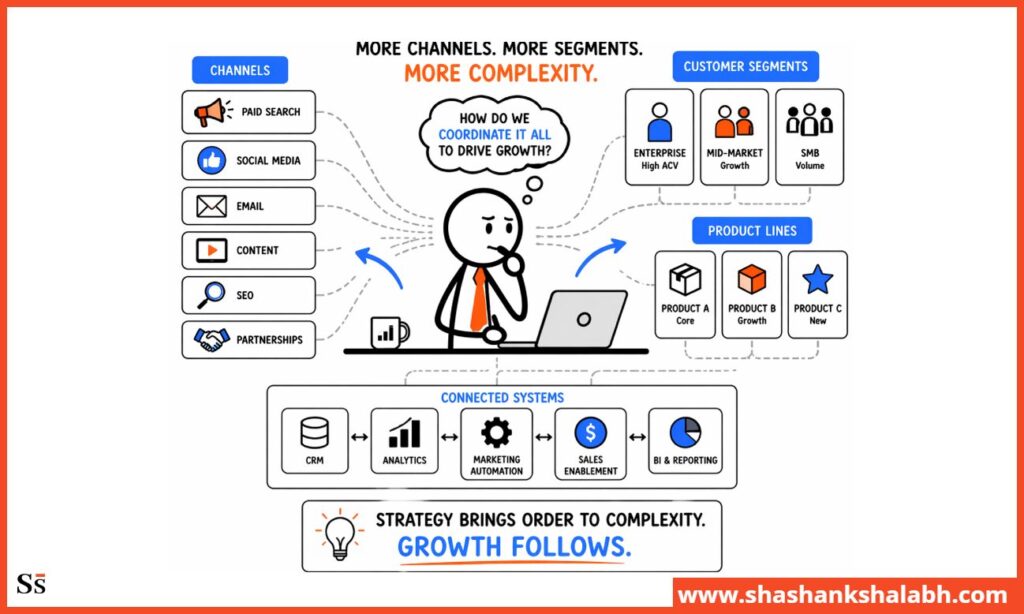
Multi-Channel GTM
When a company is running paid acquisition, organic, outbound, content, events, and partner channels at the same time; with budget decisions, performance optimization, and strategy shifts happening daily, the demands on marketing leadership become full-time.
Fractional support works when one or two channels drive growth. It becomes a constraint when six channels need active, coordinated management at once.
Multiple Products, Segments, or Markets
When a company sells multiple products to multiple segments or enters new markets, the go-to-market strategy becomes far more complex.
Each product-segment may need its own positioning, channel mix, and demand programs. Each new market requires a tailored GTM approach.
A part-time CMO can manage this complexity while the system is being built. Once the system is running at scale, you need a full time CMO.
Cross-Functional Dependencies
When marketing decisions affect product roadmaps, sales compensation, customer success, and financial planning, marketing needs a full-time executive at the leadership table.
A fractional CMO can set strategy and define quarterly priorities, but they can’t be present in every cross-functional meeting where marketing intersects with product, sales, and finance in real time.
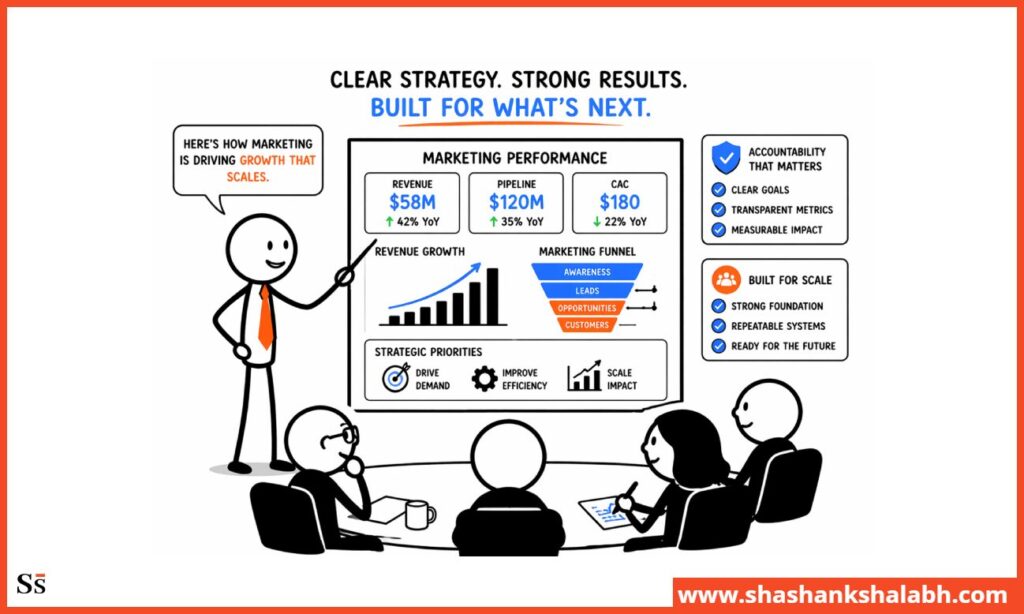
Board and Investor Expectations
Boards and investors can push the transition to a full-time CMO, even if internal signals haven’t yet reached the usual thresholds. Here’s when external pressure speeds up the shift.
Permanent C-Suite Marketing Presence
Institutional investors, PE sponsors, and post-Series C growth-stage boards expect permanent C-suite marketing representation.
They want a full-time CMO present at every board meeting, strategy review, and major business decision.
A fractional CMO can handle reporting and quarterly presentations, but boards that demand full-time involvement in strategic discussions will drive the transition, even if internal operational signals haven’t yet made it necessary.
Investor Reporting Complexity Increases
After Series B, and in PE-backed companies, marketing reporting demands increase sharply. Monthly operating reviews, quarterly board presentations, annual strategy sessions, and ad hoc investor requests all require executive input.
When the time needed for investor-level reporting and relationship management approaches or exceeds a fractional CMO’s monthly availability, hiring a full-time CMO becomes the more efficient solution.
Strategic Planning
Annual planning, budgeting, competitive strategy reviews, and marketing work tied to M&A all demand sustained executive attention over weeks or months.
A fractional CMO can lead these initiatives, but when they occur continuously rather than occasionally, part-time availability limits the depth and quality of strategic oversight.

How a Fractional CMO Prepares the Business for Transition?
The best fractional CMO engagements leave the company stronger and more ready for a full-time CMO than it would have been without the interim support.
Building the Marketing Systems
A full-time CMO joining a company with a documented GTM strategy, a working demand generation system, a KPI framework, and a capable team can drive growth from Day 1.
By contrast, a CMO joining an undocumented, ad hoc marketing function spends the first six months rebuilding basics. A fractional CMO’s role is to leave the company in the first scenario.
Defining the KPI Framework
Before a full-time CMO starts, the KPI framework should be in place and actively running. Metrics like pipeline coverage, CAC by channel, LTV:CAC ratio, forecast accuracy, and marketing-sourced revenue should already be tracked, reported, and understood by the board.
This allows the new CMO to step into an accountable system instead of building accountability from scratch.
Structuring the Team
The fractional CMO should design the team structure the company will need at the next growth stage.
Role scorecards, KPI ownership, reporting lines, and a hiring roadmap should all be documented before the full-time CMO search begins.
This lets the incoming CMO assess the team and plan the next hires immediately, without starting from scratch.
Documenting Strategy
Every strategic decision during the fractional engagement (ICP definition, positioning, channel selection, budget allocation) should be fully documented.
The fractional CMO’s institutional knowledge must be captured so the incoming CMO can read, understand, and build on it. When critical knowledge lives only in the departing CMO’s head, transitions can set the new CMO back months.

How to Hire the Right Full-Time CMO?
A well-run fractional CMO engagement sets the stage for a stronger full-time hire.
Define the Profile Before You Search
The full-time CMO profile should be based on the company’s existing marketing system.
What stage is the team at? What’s the primary growth challenge? Does the CMO need to be a demand generation expert, a brand builder, or a pipeline architect?
The fractional CMO should define this profile as they understand the system, the team, and the gaps better than anyone.
Look for Operators, Not Strategists Alone
The best full-time CMOs at the growth stage are operators. They own both strategy and execution.
A CMO who creates great strategy but can’t manage a 15-person team, lead a board presentation, or dive into CAC optimization is the wrong fit. Growth-stage companies need CMOs who are effective at both the strategic and operational level.
Avoid the Most Common Full-Time CMO Hiring Mistakes
Hiring for brand experience when demand generation is the priority, hiring someone too senior for the current team, hiring without clear KPIs and accountability, and hiring before the marketing system is ready to support a full-time leader are some common mistakes.
Each mistake can cost as much as a full CMO compensation cycle and delays growth while the search and onboarding process starts over. More on this a little later in this guide.
Use the Fractional CMO in the Hiring Process
The fractional CMO should play a key role in evaluating full-time CMO candidates.
They know the marketing system, team dynamics, and growth challenges better than the CEO or board. Their insights on strategic thinking, team leadership, and board communication are grounded in real operational experience, and is more reliable than any external recruiter’s assessment.
How to Structure a Smooth Transition?
A poorly managed transition can undo months of progress. Here’s how to get it right.
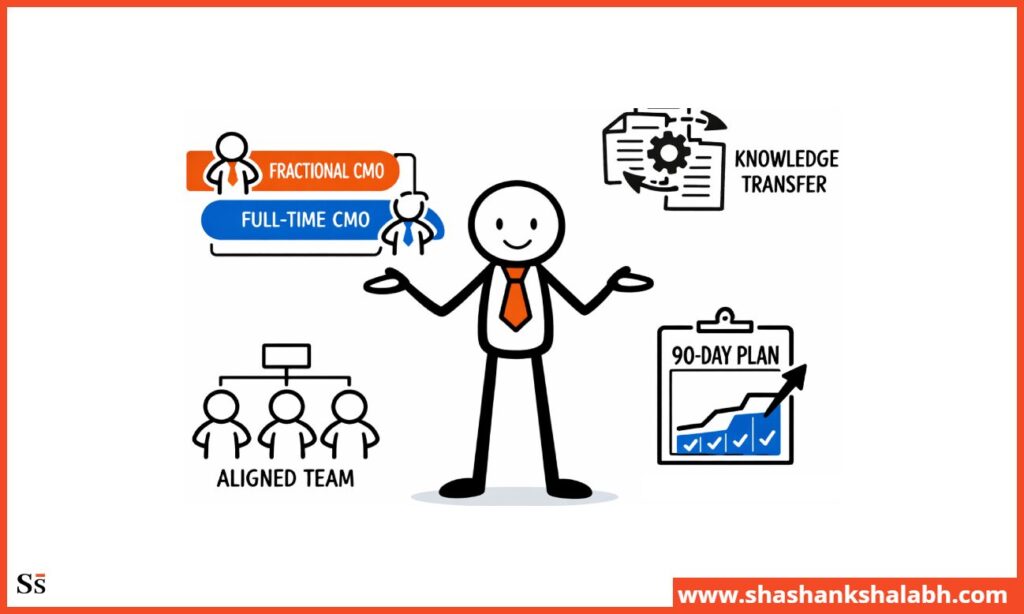
Build in an Overlap Period
The outgoing fractional CMO and incoming full-time CMO should collaborate for 30-60 days.
During this time, the fractional CMO transfers institutional knowledge, introduces the new CMO to key relationships, and reviews every active program, strategic priority, and team dynamic.
This overlap is the single most important factor in a successful transition.
Transfer Knowledge Through Documentation, Not Conversation
Knowledge transfer that happens only through conversation doesn’t last.
The fractional CMO should create a transition document the incoming CMO can reference after the overlap ends. It should include GTM strategy, channel performance history, team assessments, open priorities, and board reporting context.
Clear documentation is what turns a transition into a smooth handoff.
Align the Team Before the Transition Is Complete
The marketing team needs clarity why it’s happening, what it means for them, and the incoming CMO’s priorities.
The fractional CMO should communicate this clearly to preserve momentum, maintain confidence, and set up the new CMO for a strong start.
Teams that are confused or unsettled during leadership changes lose productivity at exactly the moment when momentum matters most.
Give the New CMO a 90-Day Ramp Before Evaluating Performance
Even in a mature marketing system, a new full-time CMO needs 60-90 days to learn the nuances such as team dynamics, board relationships, competitive landscape, and channel performance patterns.
Evaluating performance before this ramp period ends leads to premature conclusions. Set clear 30-, 60-, and 90-day milestones, and measure progress against those.
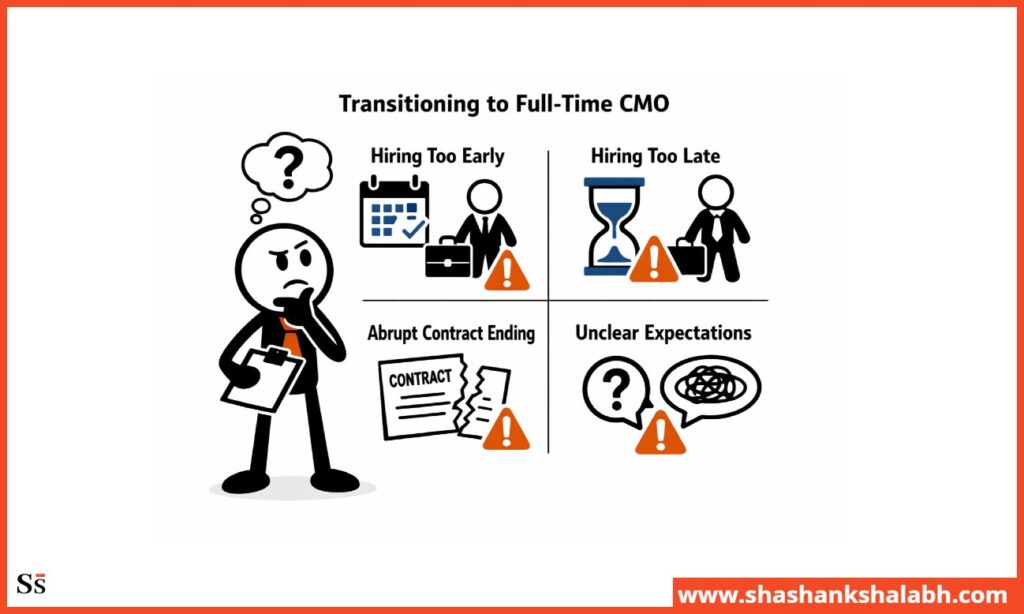
Common Transition Mistakes
I talked about this briefly earlier. Let’s dive into the details.
Hiring the Full-Time CMO Too Early
Hiring a full-time CMO before the marketing system is in place (ICP, GTM, team depth) forces the new CMO to rebuild what the fractional CMO should have established.
They spend the first 6-12 months on foundational work instead of accelerating growth. The result is a slow, costly start that undermines confidence on both sides.
Hiring the Full-Time CMO Too Late
Waiting until the marketing team hits 25 people and operational chaos is obvious creates an equally costly problem.
The team has been running without consistent full-time leadership. Senior marketers may have left for lack of development.
The new CMO inherits a team accustomed to operating without executive accountability. This situation is far harder to fix than guiding a team that never experienced it.
Ending the Fractional Engagement Abruptly
Ending the fractional CMO engagement the day the full-time CMO signs the offer creates a knowledge gap that can cost months.
The fractional CMO should stay on through the 30-60 day overlap period. The cost of this overlap is small compared with the value of preserving institutional knowledge and ensuring a smooth transition.
Unclear Expectations for the Incoming CMO
A full-time CMO hired without defined KPIs, a clear team structure, and explicit board expectations spends the first 90 days figuring out what success looks like.
That’s 90 days lost to ambiguity. The transition should give the new CMO a clear accountability framework, not a blank canvas.
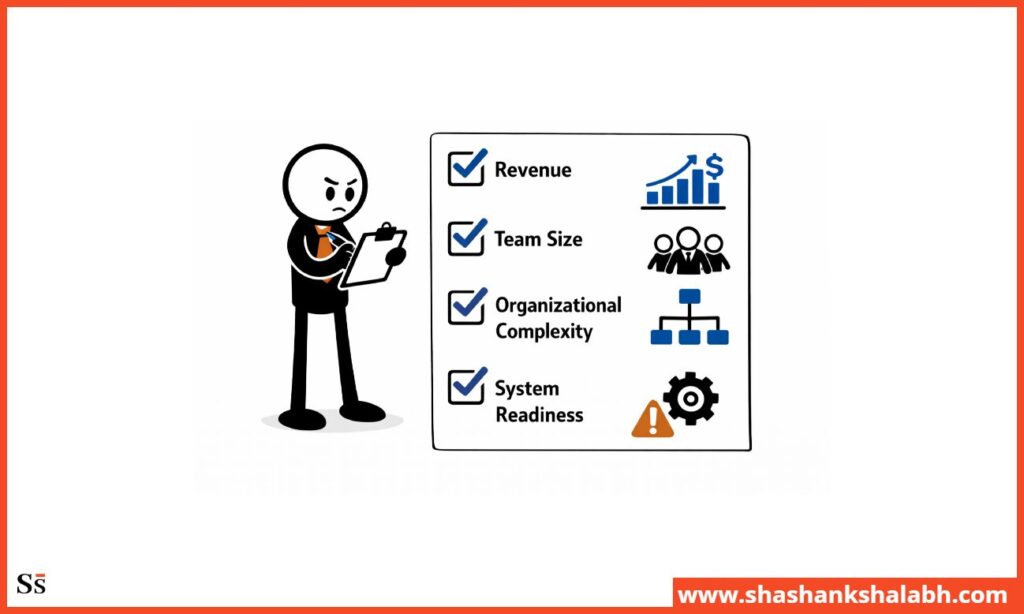
Checklist: Are You Ready for a Full-Time CMO?
Use this to assess whether your business needs a full-time CMO or it’s too early.
Revenue and budget:
- Revenue ≥ $30M or soon to be
- Marketing budget justifies full-time oversight
- Board/investor expects C-suite marketing
Team size and structure:
- Team size 15–20+
- Multiple functions: demand gen, product marketing, content, RevOps
- Senior leaders need full-time executive oversight
Organizational complexity:
- Multiple channels need full-time strategic management
- Multiple products, segments, or markets need distinct GTM approaches
- Cross-functional decisions require daily executive presence
System and readiness:
- GTM strategy documented and marketing system running
- KPI framework active: CAC, LTV:CAC, pipeline coverage
- Full-time CMO profile defined based on current system and team
Scoring:
- 0-3 items: Premature. The fractional model still fits
- 4-6 items: Approaching transition. Monitor and start planning
- 7-9 items: Transition warranted. Begin full-time CMO search
- 10-12 items: Transition overdue. Act now to avoid costly delays
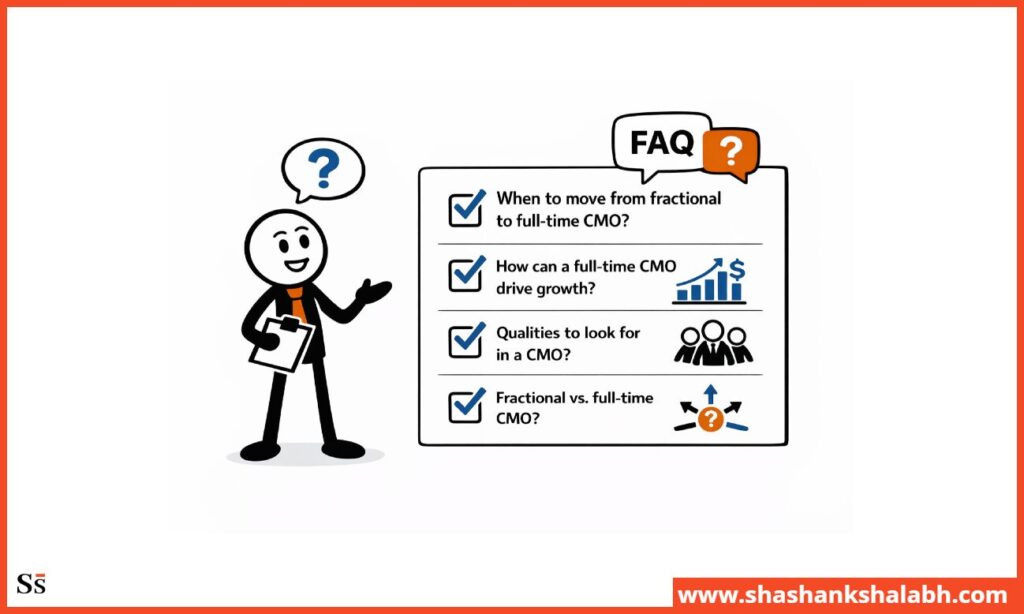
FAQ: When to Hire a Full-Time CMO?
Here are the most common questions about moving from a fractional CMO to a full-time CMO.
When should a company hire a full-time CMO?
Hire a full-time CMO when revenue hits $30M–$75M, the marketing team grows to 15-20 people, and marketing complexity exceeds part-time leadership. Below that, a fractional CMO delivers a similar impact at $10K-$25K/month versus $300K+ for full-time.
What revenue stage requires a full-time CMO?
Revenue thresholds vary by market: Austin $30M-$40M, NYC $50M+, SF $40M-$50M ARR, Chicago PE-backed $60M-$75M.
Revenue alone isn’t enough. The team size and complexity matter. A $35M company with 20 marketers needs a full-time CMO; a $50M company with a lean team may not.
Can a fractional CMO replace a full-time CMO permanently?
A fractional CMO works well between $5M-$30M ARR, but the model has limits.
Teams of 15-20 people, complex multi-channel GTM, or boards requiring full-time C-suite presence need a full-time CMO. Fractional leadership is a phase. It is not a permanent solution once the company exceeds these thresholds.
How long should you use a fractional CMO?
Fractional CMO engagements average 12 months.
Companies $5M-$30M ARR with lean teams and clean GTM processes may extend beyond 18 months, as the model remains efficient. Duration depends on revenue, team size, complexity, and board expectations.
How do you transition from a fractional CMO to a full-time CMO?
First, create a 30-60 day overlap for the fractional and full-time CMO to transfer knowledge, relationships, and strategic context.
Next, build a transition document covering GTM strategy, channel performance, team assessment, and open priorities. Talk to your marketing team about the change.
And set clear 30-, 60-, and 90-day milestones instead of judging performance by long-term KPIs during the ramp.

Closing Thought
The move from fractional to full-time CMO is one of the most critical leadership decisions for a scaling company. Timing matters and getting it wrong is costly.
Too early, and the CMO spends a year building what the fractional CMO should have already established. Too late, and the team drifts without full-time direction, making the transition harder.
The fractional CMO model lays the foundation for a successful full-time CMO.
Once that foundation is in place, the team is at scale, and revenue supports the investment, the transition to a full time marketing leader is the right next step.
→ Fractional CMO vs. Full-Time CMO →Fractional CMO ROI

Shashank brings over 22 years of global omnichannel marketing experience. As a 4x Chief Marketing Officer, he has helped several organizations (Startups and Fortune 500) drive sustainable revenue growth through strategic marketing.