
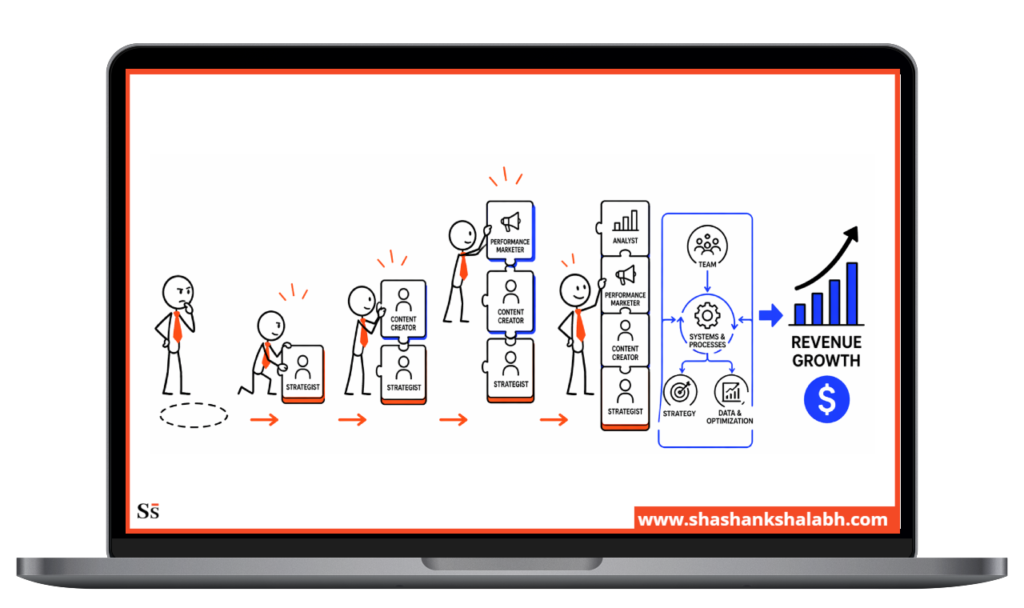
Building a marketing team from scratch requires defining revenue targets first, identifying the specific growth constraint the team needs to solve, and hiring in the right sequence based on company stage.
In my marketing career, I have come across several businesses hiring before they have strategic clarity. And as expected, they end up with capable people executing the wrong priorities.
My goal, through this guide, is to help you understand the hiring sequence, role structure, and accountability framework that builds a team around revenue outcomes.
Here’s what you will learn:
- The most common team-building mistake and how to avoid it
- How to define revenue targets before making the first hire
- Marketing team structure by revenue stage: $2M to $30M ARR
- How to choose the right first marketing hire
- How to onboard marketing hires in the first 90 days
- A complete team building checklist
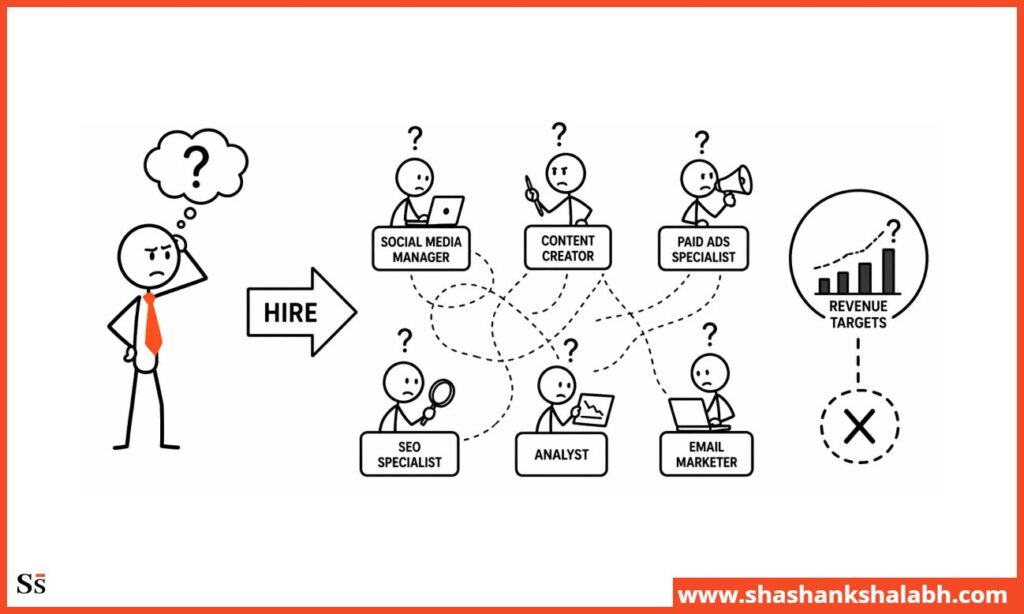
The Most Common Mistake: Hiring Before Strategy
If you have hired marketing folks or been a witness to that, let me know if this sounds familiar.
The decision-maker identifies a gap such as “we need more leads” or “we need someone to run content”, and then starts hiring. And this works for some time, until it does not.
Premature Hiring Before Revenue Clarity
If you don’t set revenue targets first, you will build a marketing team around opinions.
For example if you hire a content marketer because “content matters,” you’ll get content. But this will not help you move the needle (pipeline, revenue.)
Start with the number.
What pipeline do you need to hit your revenue goal? What must marketing produce?
Then define each role by its output. Pipeline. Qualified leads. Revenue contribution.
You want hiring to be part of strategy, and not guesswork.
Roles Built Around Activities, Not Outcomes
Most marketing job descriptions describe activities.
For example, “manage social media,” “write blog posts,” “run email campaigns.”
They don’t describe outcomes such as “increase MQL-to-SQL conversion by 20%,” “reduce CAC payback to under 12 months,” “grow marketing-sourced pipeline to 40% of total.”
Activity-based roles attract activity-focused candidates. On the other hand, outcome-based roles attract revenue-focused candidates.
Hiring for the Company You Are
A team built for $3M ARR will not carry you to $10M.
A lot of businesses hire a senior marketer to fix today’s problem. Twelve months later, growth slows down. The same hire is not equipped for the next stage.
Marketing needs change as you scale. What works at $3M often breaks at $10M.
Hire for where the business is going, and build a team that can support the next stage of growth.
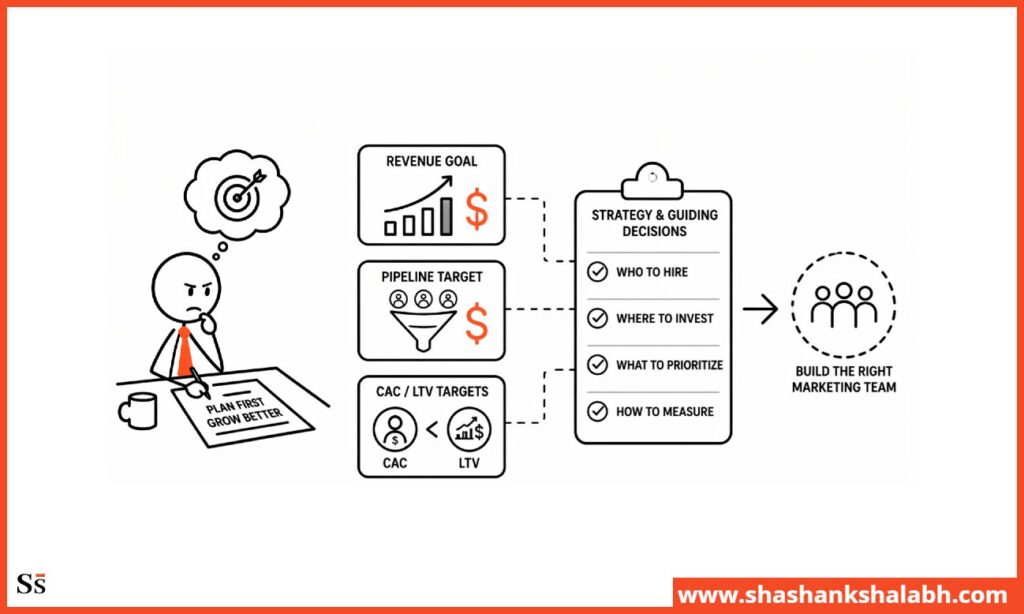
Step 1: Define Revenue Targets First
Before you write a job description, define marketing’s revenue contribution.
Set the Pipeline Target
Marketing’s job is to produce a healthy pipeline, aka, qualified opportunities that turn into revenue.
Define that number before you hire.
How to calculate pipeline target:
Pipeline Volume = Revenue target ÷ average deal size × (1 ÷ win rate)
Let’s use an example of a business with a $5M revenue target, $50K average deal size, and 25% win rate.
In this case, you need $20M in pipeline. That is 100 deals at a 25% close rate.
If marketing is responsible for 40%, the target is $8M in marketing sourced pipeline.
That number determines how many MQLs, at what quality, from which channels, at what CAC, the marketing team needs to produce.
Every hire should map back to this number.
Define Marketing’s Revenue Contribution Percentage
At the growth stage, marketing’s share of pipeline is predictable.
Series A: 25% to 40%; Series B: 40% to 60%
Set your target before you hire. The number shapes the team.
If marketing owns 20% of the pipeline, you need a lighter team. And if it owns 50%, you need scale, systems, and stronger demand generation.
Different targets require different teams.
Establish CAC and LTV:CAC Targets
CAC targets set the efficiency bar.
For growth stage B2B SaaS, aim for CAC payback under 12 months. LTV to CAC should be at least 3 to 1.
Strong teams reach 4 to 1 or 5 to 1.
These numbers define how much you can spend to acquire a customer. That spend sets your budget, and your budget sets your team size.
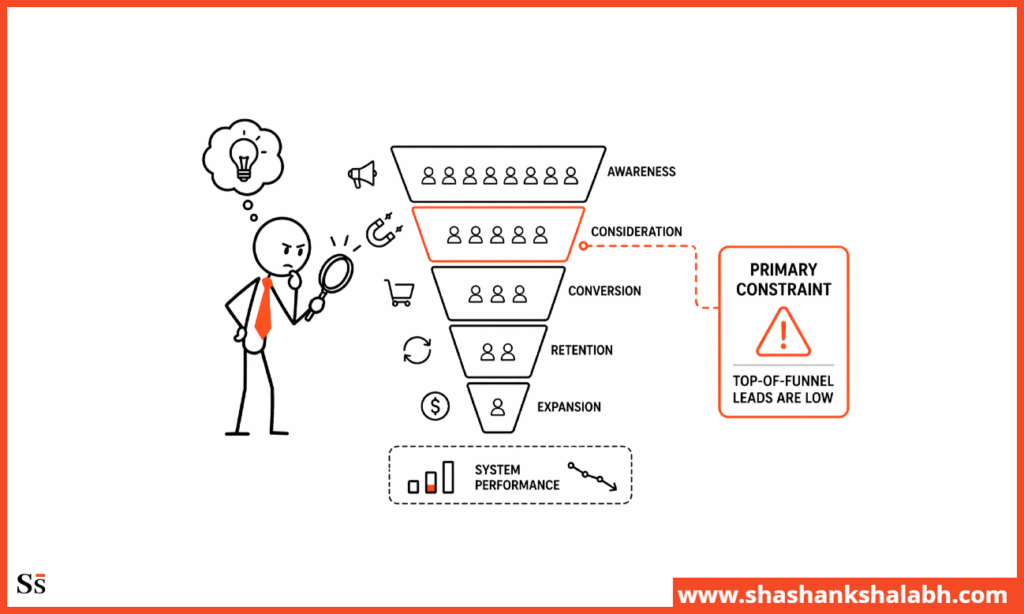
Step 2: Identify Your Growth Constraint
Revenue targets tell you what marketing must produce. And the growth constraint tells you where to focus first.
Is it pipeline volume? Conversion rates? Sales cycle length? CAC?
If you do not define the constraint, you will build a balanced team that rarely moves the needle. Focus the team on the bottleneck to drive real growth.
Top-of-Funnel Constraint
This means there are not enough qualified opportunities entering the funnel.
Sales may have capacity, but there is not enough pipeline to keep them busy. The rest of the revenue process can be working, but growth is still limited by volume.
The primary hire for a top-of-funnel constraint is a demand generation specialist. This person would build and run the programs that produce consistent MQL volume from the defined ICP.
Here are some indicators:
- Sales capacity is underused.
- Pipeline coverage is below 2 to 1.
- Marketing sourced pipeline is below growth benchmarks.
Fix the top of the funnel first.
Conversion Constraint
In this case, you have enough pipeline, but it is not turning into revenue.
MQLs are not becoming SQLs. SQLs are not becoming opportunities. You are dealing with quality and conversion issues.
At this stage, you need a product marketer or sales enablement specialist to improve positioning/messaging, and equip sales to close better leads.
If you have a healthy MQL volume but low MQL to SQL conversion, poor lead quality, and declining win rates without changes in ICP or deal size, you have a conversion constraint.
Fix conversion before adding more pipeline.
Retention Constraint
A retention constraint means customers are leaving too early to support healthy growth.
You are acquiring customers, but they do not stay long enough to recover CAC or grow LTV. This often comes from weak ICP fit or unclear positioning.
The solution here is a better fit and stronger retention.
The right hire is product marketing or customer marketing. You need someone who tightens ICP and messaging, and improves expansion and retention.
Here’s how to know you are dealing with retention-issues:
- LTV:CAC is declining with stable CAC.
- Annual retention below 70-80%.
- Net revenue retention under 100%.
- New customers are growing, but ARR is not keeping pace.
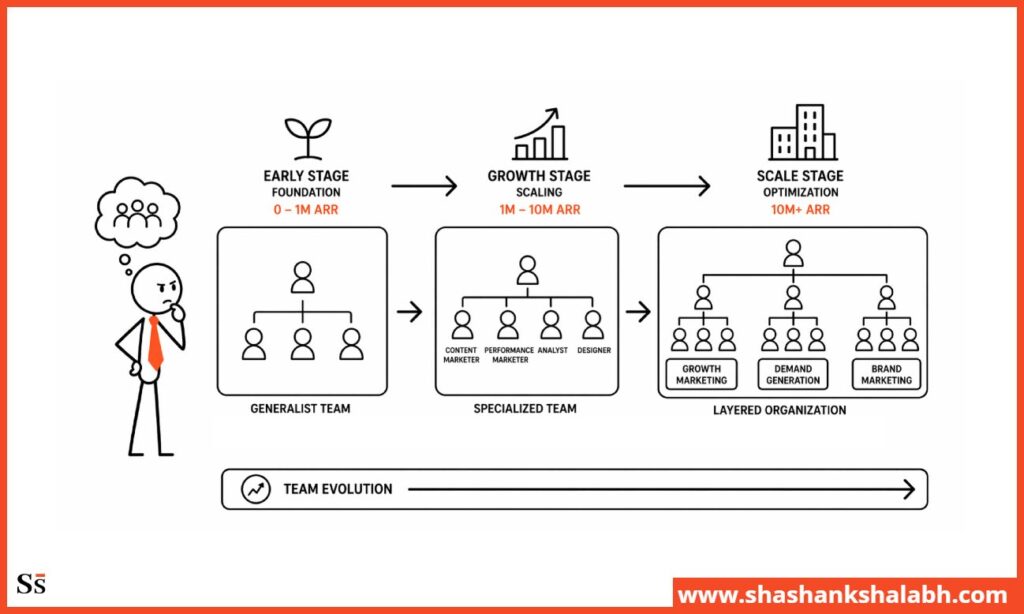
Step 3: Marketing Team Structure by Revenue Stage
When thinking of a team structure, pay attention to the revenue stage.
A team built for $3M ARR might be wrong for $10M ARR. Likewise, a team built for $10M ARR might not work for $25M ARR.
$2M-$5M ARR: Lean, Generalist, Founder-Supported
At this stage, the founder is still the primary marketing leader. Marketing is predominantly founder-directed.
The team, if it exists at all, is one or two marketing generalists who execute against founder priorities. And the founder uses external vendors for paid acquisition, design, content etc.
Here, you should prioritize the foundational infrastructure such as CRM, basic attribution, email platform. Focus on building the ICP from the earliest closed-won data. Finalize 2-3 demand generation channels for early CAC signals.
At this stage, you should not hire a VP of Marketing or CMO.
Avoid building a large team before the GTM motion is clear. And don’t invest heavily in brand or content before demand generation channels are proven.
$5M-$15M ARR: Specialization Begins, Demand Generation Focus
Post-Series A, the marketing team starts to take shape as a functional organization.
At this stage, marketing should be small (3-6 members), focused, and accountable to revenue.
What the team looks like:
- Fractional CMO or VP of Marketing leading strategy and performance
- Demand generation lead: pipeline volume and CAC
- Content marketer: organic pipeline and sales enablement
- Product marketer: if conversion rate or win rate is the constraint
Define your ICP using closed won data, then document it so marketing and sales are targeting the same accounts.
Build a demand generation system around one or two core channels with repeatable processes. Put attribution in place so you can track CAC by channel and improve it over time.
Most importantly, align marketing and sales with a shared definition of a qualified lead and a clear handoff process.
At this stage, don’t hire a full time CMO. Another mistake I see is building a team of generalists instead of role specific specialists, or adding headcount without clear ownership of pipeline, CAC, or conversion metrics
$15M-$30M ARR: Functional Teams, Leadership Layers
At $15M-$30M ARR, marketing needs real depth.
Demand generation, product marketing, content, and revenue operations each need a clear owner.
At this stage, a fractional CMO is still useful. Most companies switch to a full time CMO later, usually between $30M and $75M ARR.
What the team looks like:
- Team size: 6-15 led by Fractional CMO or VP of Marketing
- Demand generation lead: with a few channel specialists
- Product marketing lead: positioning, win rate, and competitive intelligence
- Content lead: organic pipeline and thought leadership
- Marketing operations or RevOps function: CRM, attribution, reporting
Here, your priority should be channel depth in the 2-3 highest-performing demand generation channels.
And focus on product marketing, RevOps infrastructure, reliable attribution, and board-ready reporting (pipeline, CAC, LTV:CAC, marketing-sourced revenue).
A common mistake businesses make is expanding to six channels before mastering one. Or, hiring channel specialists without a strategic leader to direct them. And lastly, they delay RevOps investment.
Remember, attribution and pipeline data quality become critical at this stage.
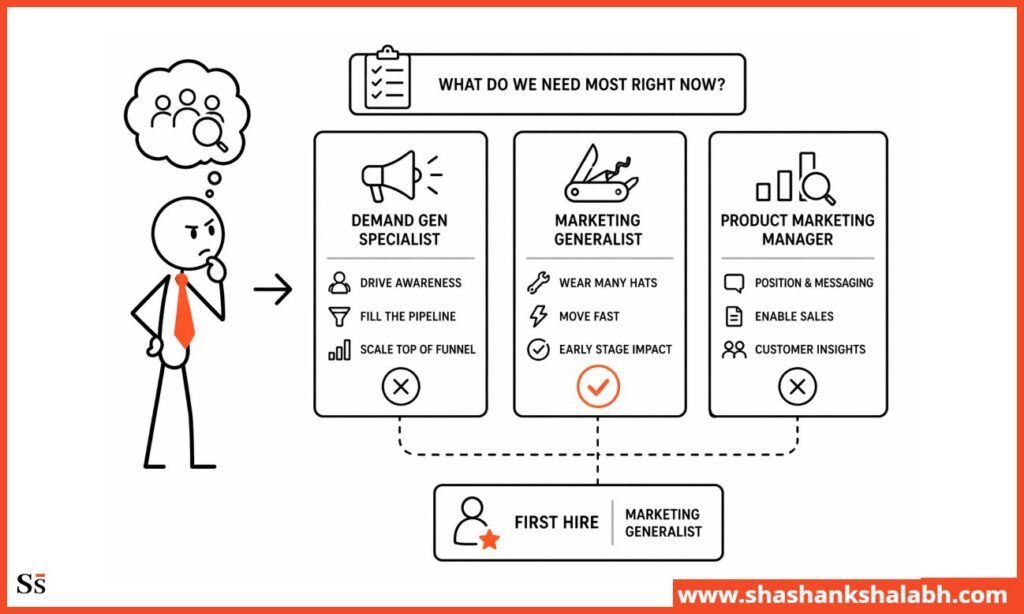
The First Marketing Hire: Demand Gen vs Generalist vs Product Marketing
Your first marketing hire is a high stakes decision.
It shapes how the team performs and how it operates for the next twelve to eighteen months. Choose carefully.
When to Hire a Demand Generation Specialist
Hire a demand generation specialist first when the primary growth constraint is top-of-funnel.
| Right fit when | Wrong fit when |
| Pipeline coverage is under 2:1 and needs a repeatable system | ICP is not defined |
| Sales has capacity but not enough qualified leads | Positioning is unclear |
| A few channels are already working and need to be scaled | Messaging does not convert traffic into pipeline |
When to Hire a Generalist Marketer
At $2M-$5M ARR, marketing spreads across content, social, email, events.
Here, you might lack enough budget for specialists. This is why start with a marketing generalist first
Note that a generalist isn’t a permanent solution.
| Right fit when | Wrong fit when |
| Revenue is under $5M ARR. You need one person to cover many areas | Revenue is over $5M ARR. You need specialist depth |
| Founder needs help across multiple marketing tasks | You need strong demand gen, product marketing, or RevOps |
| Budget allows only one hire | One generalist is not enough anymore |
When to Hire a Product Marketer First
Hire a product marketer first when conversion is the problem.
This means you have a pipeline, but deals are not closing at the rate you expect.
A product marketer sharpens positioning, builds the sales enablement content that supports conversion, and owns win rate and competitive displacement.
However, if top-of-funnel volume is the primary problem, a product marketer won’t fix insufficient pipeline.
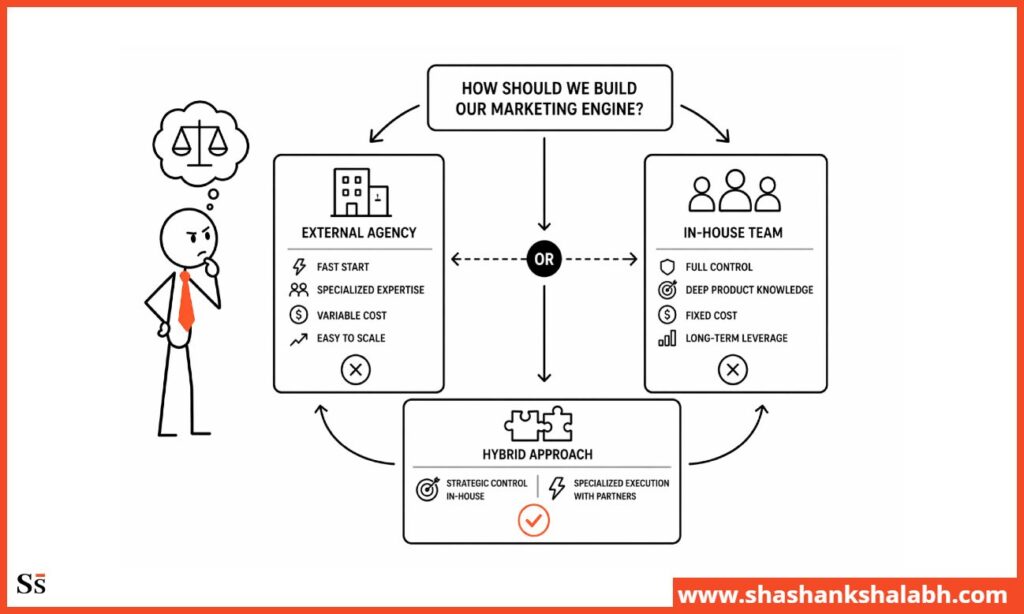
Agency vs In-House Hiring Decisions
Every marketing team faces the build vs. buy decision at some point. Here’s the framework for making it correctly.
When to Use an Agency
Agencies work best for execution such as content production, paid ads, SEO, and design.
Use them when you need output, but not enough consistent volume to justify a full time hire.
Use an agency when:
- The work needs specialized skills you cannot justify hiring full time
- Workload is uneven with spikes during campaigns
- You are testing a channel before hiring in house
- Strategy is in place but you need more execution capacity
An agency needs clear direction from inside the company. A senior marketer or executive should own the strategy and guide the work.
Without that, the agency is just filling time and delivering tasks. With a senior marketing leader, they become an execution partner that supports real pipeline growth.
When to Hire In-House
Hire in-house when the function is strategic, ongoing, and central to the company’s competitive differentiation.
- The role needs deep company knowledge, like product marketing or demand generation strategy
- The work is steady and needs daily ownership
- The capability is core to your competitive advantage and should stay internal
- Agency results have plateaued and you need stronger strategic control internally
The Hybrid Model
Most companies at $5M-$15M ARR use a hybrid model. They have two to four in house marketers who set strategy and own results, and agencies that handle execution in specific channels.
The in house team owns ICP, positioning, channel strategy, and performance metrics. Agencies focus on execution with clear deliverables tied to those goals.
The hybrid model fails when the in-house team is too junior to provide strategic direction.
Agencies then end up making strategic decisions, and accountability for outcomes disappears.
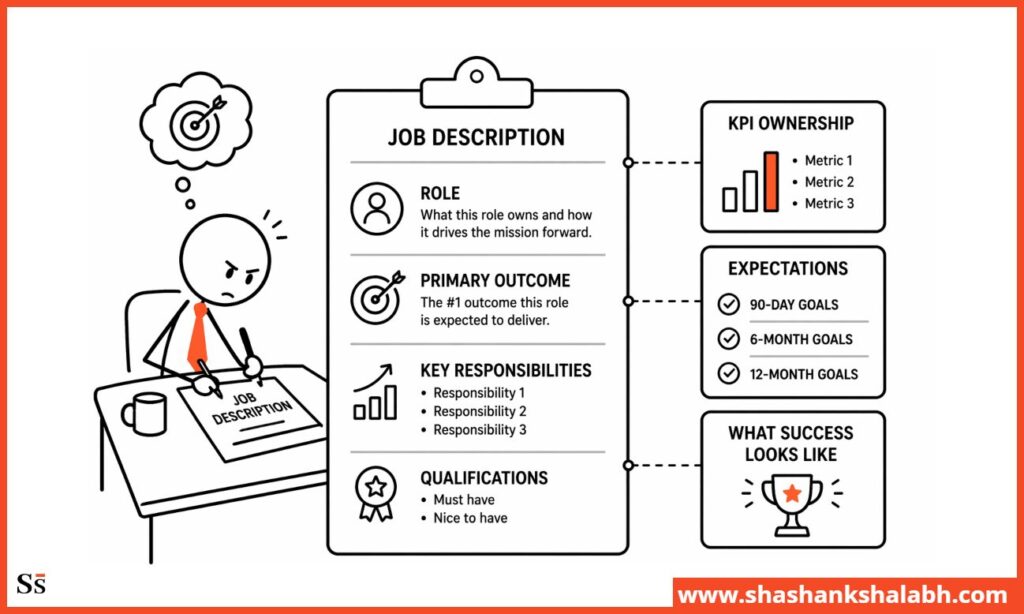
How to Write Job Descriptions That Attract the Right Talent
Most marketing job descriptions attract the wrong candidates, because they describe activities rather than outcomes and seniority rather than fit.
Define Outcomes, Not Tasks
The job description should describe what the role needs to produce in the first 90 days, 6 months, and 12 months.
Don’t focus on what activities the person will perform.
Let me give you an example.
Activity-based (wrong): “Manage social media channels, write blog posts, support email campaigns, coordinate with sales on lead quality.”
Outcome-based (right): “Own marketing-sourced pipeline as a primary KPI. Build two systematic demand generation channels with documented CAC tracking. Achieve 3:1 pipeline coverage ratio within six months.”
The second version attracts candidates who think in revenue terms. The first attracts candidates who think in task terms.
Be Specific About Stage
A VP of Marketing who excels at $50M ARR is often wrong for a $10M ARR company, and vice versa.
Job descriptions should specify the revenue stage the company is at and the growth challenge the hire needs to solve.
Candidates who’ve been in this exact situation before recognize themselves. And the rest are more likely to pass.
The JD should include current ARR, growth rate, team size, and the specific growth challenge.
Define KPI Ownership Upfront
Every marketing role should have two or three KPIs they own from Day 1.
State them in the job description. This attracts candidates who are comfortable with accountability, and filters out candidates who want to define success after they arrive.
Here are some KPIs:
- Demand generation: pipeline volume, CAC, MQL-to-SQL conversion rate.
- Content: marketing-sourced organic pipeline, content-influenced opportunity rate.
- Product marketing: win rate, competitive displacement rate, sales cycle length.
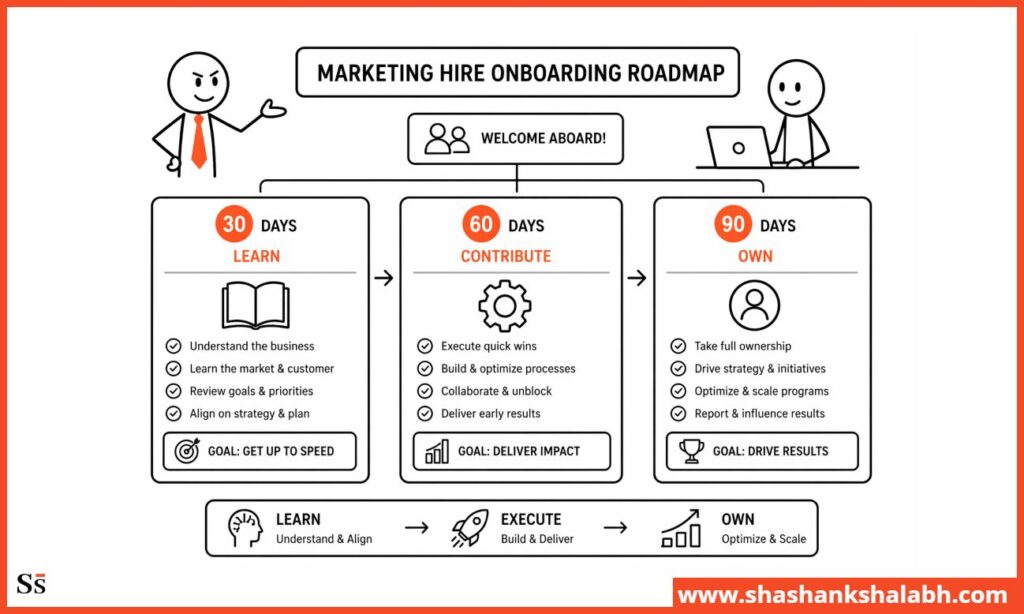
How to Onboard Marketing Hires in the First 90 Days
A marketing hire who isn’t producing clear outputs by Day 90 will likely never perform to standard.
Onboarding determines whether the hire succeeds, and most companies underinvest in it.
Days 1-30: Context and Diagnosis
The first 30 days are for learning.
The new hire should talk to customers, review win and loss data, study channel performance, and map the funnel from first touch to close.
Their job is to understand how growth actually happens in the business.
By Day 30, they should deliver a clear written assessment of what is working, what is not, and what to focus on next.
Days 31-60: Strategy Alignment and Early Execution
By Day 30, the new hire should have a clear diagnosis of the business and how marketing is performing.
Days 31 to 60 are for alignment and action.
They present priorities to leadership, agree on what matters most, and begin early execution on the highest impact work. KPIs are defined and signed off. Reporting cadence is set.
By Day 60, there should be a clear strategy, agreed KPIs, and at least one or two demand generation programs in motion.
If those are not in place, the onboarding is behind.
Days 61-90: Accountability and Early Results
By Day 90, you should see early signs of pipeline impact.
Not full pipeline yet, but clear leading indicators that things are working.
Ideally, you should see better MQL volume and CAC by channel. Think of the 90 day review as a checkpoint, not a performance review.
Are KPIs being tracked? Are early results heading the right way? Does the hire need more support or resources to succeed?
If there is no measurable progress, no clear ownership of KPIs, and no defined priorities by this point, you need a direct conversation.
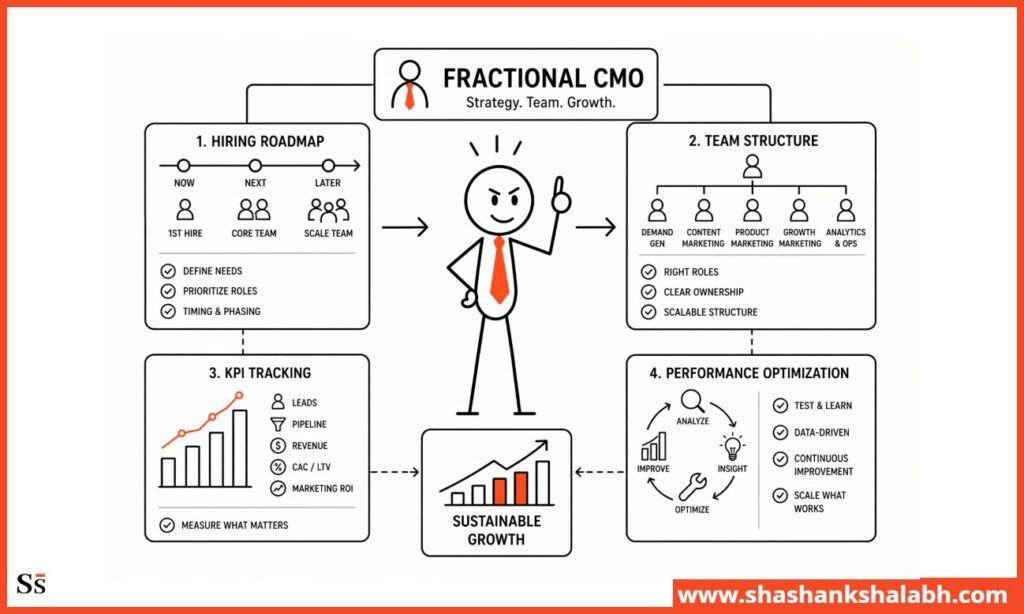
How a Fractional CMO Builds and Scales the Team
Building a marketing team well takes executive judgment.
You need to know what to hire first, what to keep in house, and what to outsource.
The goal is a structure where each hire has clear ownership and clear metrics. When that is in place, team growth leads to real revenue growth.
Designing the Hiring Roadmap
A fractional CMO sets the hiring plan before any recruiting starts.
The sequence is based on the main growth constraint. Each role is tied to a clear outcome and a trigger for the next hire.
For most companies at $5M–$15M ARR, the order is demand generation, content, product marketing, and RevOps.
Writing Role Scorecards With KPI Ownership
Before hiring starts, a fractional CMO defines a clear scorecard for the role.
It outlines responsibilities, the KPIs the role owns, the targets for those KPIs, and what success looks like in the first 90 days.
This removes guesswork. Candidates know exactly what they are being hired to do, and the company knows how to measure success.
Without a scorecard, the role becomes vague. The hire ends up defining success themselves, which often does not match what the business actually needs.
Building Team Structure for the Next Stage
The marketing team at $10M ARR is not the same as at $20M ARR.
A fractional CMO designs the structure ahead of time so it can scale. The goal is to make sure today’s hires can grow into tomorrow’s needs, or that new hires can be added without a full reorg.
This avoids constant reshuffling and keeps execution stable as the company grows.
Tracking Performance and Addressing Gaps
A fractional CMO holds the team to clear KPIs from day one, thus measuring performance against revenue impact from the start.
They run monthly pipeline reviews, quarterly performance check ins, and direct conversations when someone is not meeting their scorecard.
Without this level of leadership, teams default to reporting activity instead of outcomes.
Check out this post on Marketing Organizational Design for Scaling Companies to understand how marketing org design evolves with growth stage.
Also, explore this guide on Fractional CMO for Growth-Stage Companies.
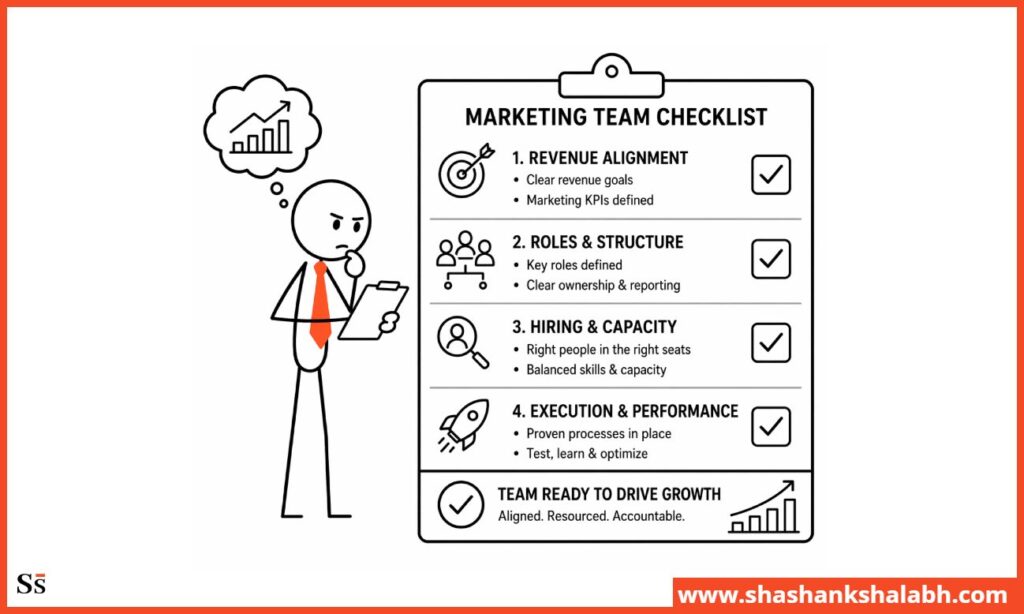
Checklist: Building a Marketing Team from Scratch
Use this before any first hire, and before every new marketing hire after that.
Revenue and strategy
- Revenue target set (pipeline, CAC, marketing contribution)
- Growth constraint clear (top of funnel, conversion, or retention)
- Hiring roadmap defined (who comes first, what triggers the next hire)
Role clarity
- Job is defined by outcomes
- KPIs assigned before recruiting starts
- 90-day success criteria written
- Scorecard agreed before interviews begin
Hiring decisions
- First hire matches the main growth constraint
- Agency vs in-house decision made by function
- No hiring without ICP and positioning in place
Execution and accountability
- 30/60/90 onboarding plan ready before start date
- KPI dashboard live and reviewed monthly
- Sales and marketing pipeline review cadence set
- 90-day milestone review scheduled upfront
Scorecard
- 0-4: Not ready. Stop and fix the foundation
- 5-8: Partially ready. Fill the gaps before next hire
- 9-12: Ready. Structure is sound
- 13-16: Strong setup. Hiring will compound results
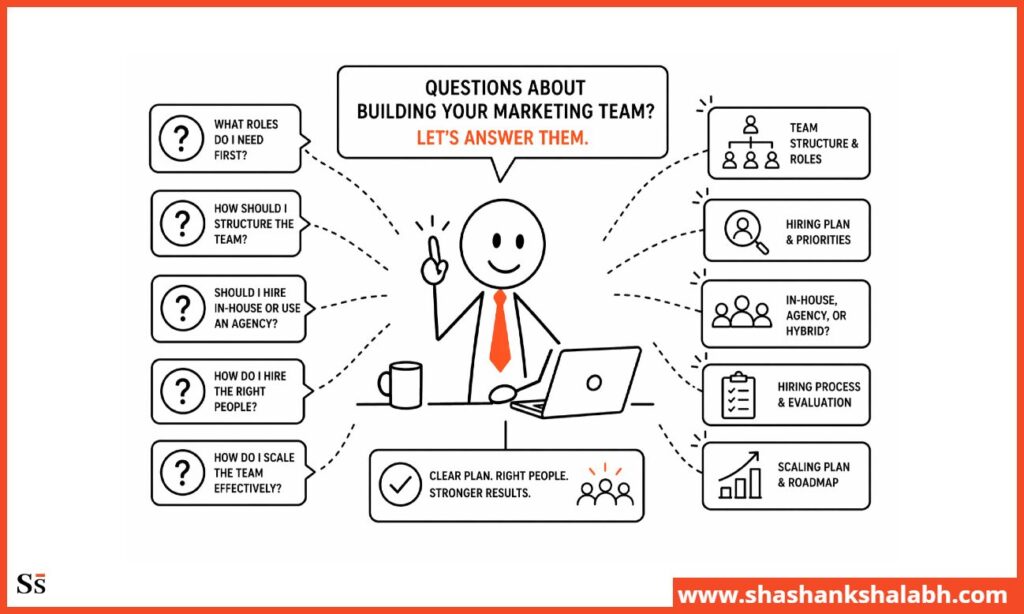
FAQ: How to Build a Marketing Team from Scratch
How do you build a marketing team from scratch?
Start with revenue targets and marketing’s pipeline goals before hiring.
Identify the main constraint first: top of funnel, conversion, or retention. And then design each role around outcomes and KPIs. Hire the specialist that solves the biggest constraint first.
Use a 30/60/90 plan and set KPIs from day one. Set a regular pipeline review with sales before scaling the team.
What is the first marketing hire for a startup?
The first marketing hire depends on the main growth problem.
If top of the funnel is the issue and pipeline is too low, hire a demand generation specialist. However, if you are dealing with conversion and deals are not closing, hire a product marketer.
If the company is at $2M–$5M ARR and needs coverage across multiple areas, hire a generalist to handle the basics until specialist roles are justified.
How should a startup structure its marketing team?
Marketing team structure follows the revenue stage.
- $2M-$5M ARR: zero to two generalists, founder-led strategy.
- $5M-$15M ARR: 3-6 specialists. demand generation lead, content marketer, and fractional CMO or VP of Marketing
- $15M-$30M ARR: 6-15 marketers across demand generation, product marketing, content, and RevOps with functional team leads
When should you hire a marketing team?
Hire the first marketing person when the founder can’t keep up with marketing anymore and pipeline starts dropping because of lack of time.
Build a specialist team after $5M ARR, once ICP and go-to-market strategy are clear. Don’t hire specialists before that.
What roles are needed in a marketing team?
The roles depend on stage and the main growth constraint.
At $5M-$15M ARR, you need a demand gen lead for pipeline and CAC, a content marketer for organic growth and sales support, and a product marketer for positioning and win rate. A fractional CMO sets direction.
At $15M-$30M ARR, you move to functional leads across demand gen, product marketing, content, and RevOps, led by a VP of Marketing or CMO.
Every role should own clear numbers. Demand gen owns pipeline and CAC. Product marketing owns the win rate and sales cycle. RevOps owns attribution and forecasting.

Closing Thought
A marketing team built around revenue goals, hired in the right order, and measured on outcomes produces awesome results over time.
The sequence is the strategy.
Set the revenue target. Identify the constraint. Hire to solve that constraint. Set KPIs from day one. Repeat for the next hire.
Teams built this way produce more pipeline per person, lower CAC, and stronger results because every hire solves a real business problem..
→ Go-To-Market Strategy for Scaling Companies

Shashank brings over 22 years of global omnichannel marketing experience. As a 4x Chief Marketing Officer, he has helped several organizations (Startups and Fortune 500) drive sustainable revenue growth through strategic marketing.