
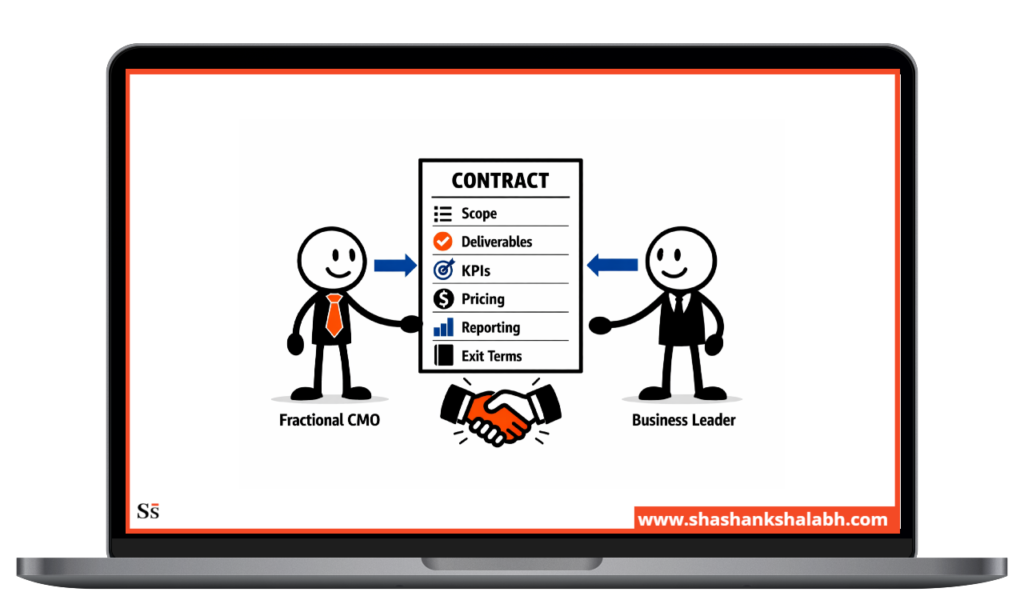
A fractional CMO contract is the agreement that protects both sides of the engagement.
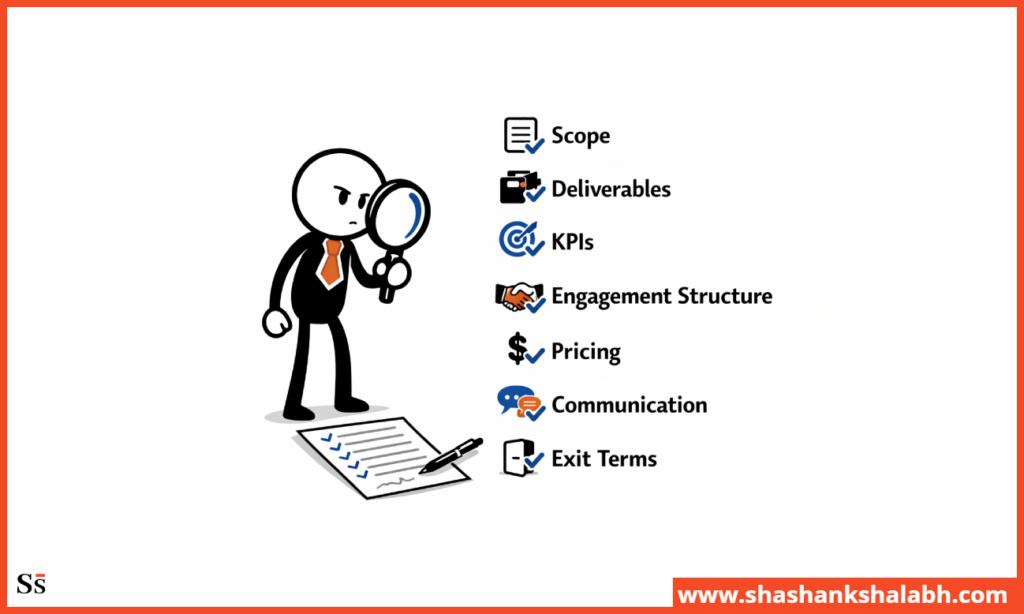
It defines scope, deliverables, KPIs, pricing, reporting, and exit terms.
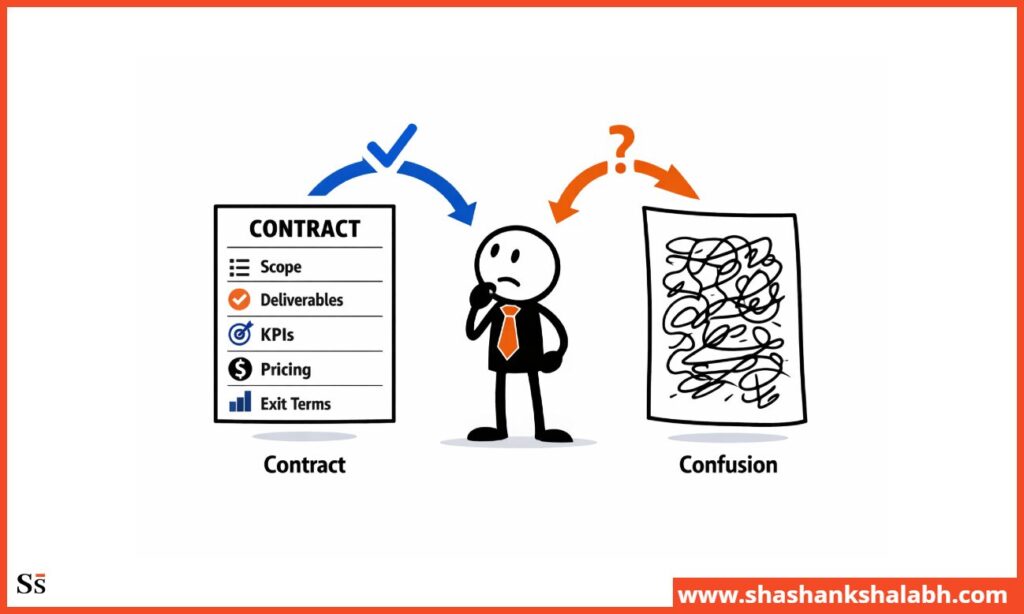
A weak contract creates misaligned expectations, scope creep, and disputes over success. A strong contract creates clarity before the engagement starts, so both sides can focus on results instead of renegotiating terms mid-engagement.
What this post covers:
- The core components every fractional CMO contract needs
- Common contract mistakes that cause engagements to fail
- How a strong contract aligns marketing with revenue
- A practical checklist before you sign
What is a Fractional CMO Contract?
A fractional CMO contract is a formal agreement between a company and a fractional CMO.
It governs the engagement…What the CMO is responsible for, how success is measured, what it costs, and how either party can exit.
It’s different from an employment contract. The fractional CMO is typically engaged as an independent contractor or through a consulting entity. The contract reflects that structure.
A strong fractional CMO contract does three things:
- Sets expectations before the engagement starts: The scope, deliverables, and KPIs are defined upfront.
- Creates accountability on both sides: The CMO is accountable for defined outcomes. The company is accountable for providing access, resources, and decision-making authority.
- Protects both parties if the engagement changes: The contract covers exit terms, scope changes, and payment disputes before they happen.
Why a Clear Fractional CMO Contract Matters?
A vague contract doesn’t just create legal risk. It creates operational problems from Day 1. Here’s what happens without one.
Misaligned Expectations Slow Everything Down
Without a defined scope, the company expects one thing and the CMO delivers another.
The company thinks the CMO is running campaigns. The CMO thinks they’re setting strategy. Both are doing their jobs, but not the same job.
Misalignment like this wastes the first 30-60 days sorting out what the engagement actually is.
Scope Creep Erodes Value
Without defined boundaries, scope expands.
One extra request becomes two. Two become a pattern. The fractional CMO ends up doing work that wasn’t agreed on, at the same price. Either the CMO underdelivers on the core work because they’re stretched, or the relationship becomes strained when they push back.
A clear contract prevents this before it starts.
Vague KPIs Make Success Invisible
In the absence of defined success metrics, the company can’t tell if the engagement is working. The CMO can’t demonstrate value.
And when it’s time for renewal, both sides end up negotiating based on feelings rather than data. That is why specific KPIs such as pipeline growth, CAC trajectory, and LTV:CAC ratio make success visible and measurable.
Exit Terms Protect Both Sides
Sometimes by design or by necessity, the company hires a full-time CMO.
Without clear termination terms, exits become messy. Who owns the work produced? How much notice is required? What transition support is included? These questions are much harder to answer after the fact than before.

Core Components of a Fractional CMO Contract
Every fractional CMO contract should cover seven components. Each one prevents a specific type of problem.
Scope of Work
The scope of work defines what the fractional CMO is responsible for. And more importantly, what they’re not.
- Strategic responsibilities: GTM strategy, positioning, ICP definition, channel strategy
- Leadership role: managing the internal marketing team, directing agencies, making hiring recommendations
- Execution oversight: reviewing and approving campaigns, holding the team accountable to KPIs
- What’s excluded: tactical execution, campaign management, agency work the CMO isn’t overseeing
Without a defined scope, both parties interpret the role differently. The scope of work is the single most important section of the contract. Get it wrong and everything else is harder.
Ideally, the scope should describe the CMO’s executive responsibilities clearly. It should read like an executive job description, not a project brief.
Deliverables
Deliverables are the specific outputs the engagement produces. They’re different from responsibilities. While responsibilities describe what the CMO does, deliverables describe what the company receives.
First 30 days:
- Marketing infrastructure audit
- Root cause diagnosis of current growth constraints
- Board-ready findings presentation
Days 31-60:
- GTM strategy document
- Channel prioritization and budget allocation framework
- KPI dashboard and reporting structure
Deliverables Days 61-90:
- Active demand generation programs
- Sales-marketing alignment protocol
- Initial pipeline improvement data
Ongoing:
- Monthly board marketing report
- Quarterly strategy review
- Team performance assessments
Deliverables create accountability checkpoints. They make it easy to assess whether the engagement is on track; and give both sides a shared definition of progress.
KPIs and Success Metrics
KPIs are the numbers the engagement is accountable to. They connect the CMO’s work to the company’s revenue outcomes.
Standard KPIs to include:
| KPI | Benchmark | Tracking Cadence |
| Pipeline growth | 50-150% improvement over engagement | Monthly |
| CAC | 20-35% reduction within 6-12 months | Monthly |
| LTV:CAC ratio | Minimum 3:1, target 4:1-5:1 | Quarterly |
| CAC payback period | Under 12 months (B2B SaaS) | Quarterly |
| Pipeline coverage ratio | 3:1 against revenue targets | Monthly |
| Marketing-sourced revenue | % of closed revenue from marketing | Monthly |
| Forecast accuracy | Above 85% | Monthly |
Avoid vanity metrics such as impressions, social followers, email open rates. These don’t connect to revenue. A strong contract measures outcomes, not activity.
KPIs are the most important accountability mechanism in the contract. In their absence, the engagement can be busy without being effective. With the right KPIs, both sides know exactly what success looks like.
Engagement Structure
The engagement structure defines how the fractional CMO works. This should include:
- Time commitment: standard retainer (16-24 hours monthly) or turnaround or interim engagements (20-35 hours weekly)
- Working model: remote, on-site, or hybrid. Include expected on-site days per month if relevant
- Reporting lines: who the CMO reports to (typically the CEO) and who they have authority over (marketing team, agencies)
- Decision-making authority: what the CMO can decide independently versus what requires CEO approval
- Meeting cadence: weekly team meetings, bi-weekly CEO check-ins, monthly board reporting
Ambiguity about time commitment and authority creates friction. The team doesn’t know who to listen to. The CMO doesn’t know what they can decide.
A clear structure prevents both issues.
Pricing and Payment Terms
Pricing terms cover cost, payment structure, and any variable components of the fractional CMO engagement. This section should include:
- Retainer model: $8K+ per month for standard fractional engagements (16-24 hours monthly)
- Interim model: $10K+ per month for higher-intensity turnaround or transition engagements (20-35 hours weekly)
- Payment timing: Monthly, in advance
- Contract length: Minimum 6 months. Average 12 months
- Rate review: Annual rate review built into multi-year engagements
Avoid pure performance-based compensation without a base retainer. Marketing outcomes take 4-8 months to show fully. A CMO compensated only on early results is incentivized to take shortcuts that produce short-term metrics at the expense of long-term system building.
Clear payment terms prevent disputes. They also indicate whether the engagement is structured for short-term activity or long-term value creation.
Communication and Reporting
The communication section defines how the fractional CMO keeps the company informed, and how the company keeps the CMO aligned. It should include the following:
- Weekly: Team operating meeting – priorities, blockers, execution progress
- Bi-weekly: CEO check-in for strategic alignment, decision-making, priority adjustments
- Monthly: Board marketing report covering pipeline, CAC, LTV:CAC, marketing-sourced revenue, forward projections
- Quarterly: Strategy review encompassing GTM performance, channel assessment, budget reallocation, 90-day roadmap
Reporting format
Board reports should be in financial language, such as pipeline coverage against target, CAC trend versus prior period, LTV:CAC ratio, marketing-sourced revenue percentage. It should not be about campaign summaries.
Reporting cadence keeps the engagement accountable. Without it, the CMO works in isolation and the company loses visibility. With the right cadence, both sides stay aligned and problems surface early.
Termination and Exit Clauses
Exit terms define how the engagement ends, on good terms or otherwise. Here’s what it should cover:
- Notice period: 30 days written notice by either party
- Reasons for termination: With cause (non-performance, breach of contract) and without cause (business change, role elimination)
- Transition support: What the CMO provides during the notice period; handover documentation, team briefings, strategy transfer
- Work ownership: All strategy documents, frameworks, and marketing assets produced during the engagement belong to the company
- Confidentiality: The CMO doesn’t share proprietary business information, customer data, or competitive strategy with third parties
- Non-solicitation: Neither party solicits the other’s key employees during and for a defined period after the engagement
Clean exit clauses protect both sides. The company retains all work produced. The CMO has a clear transition process. Neither side is surprised by the terms when the engagement ends.
Common Mistakes in Fractional CMO Contracts
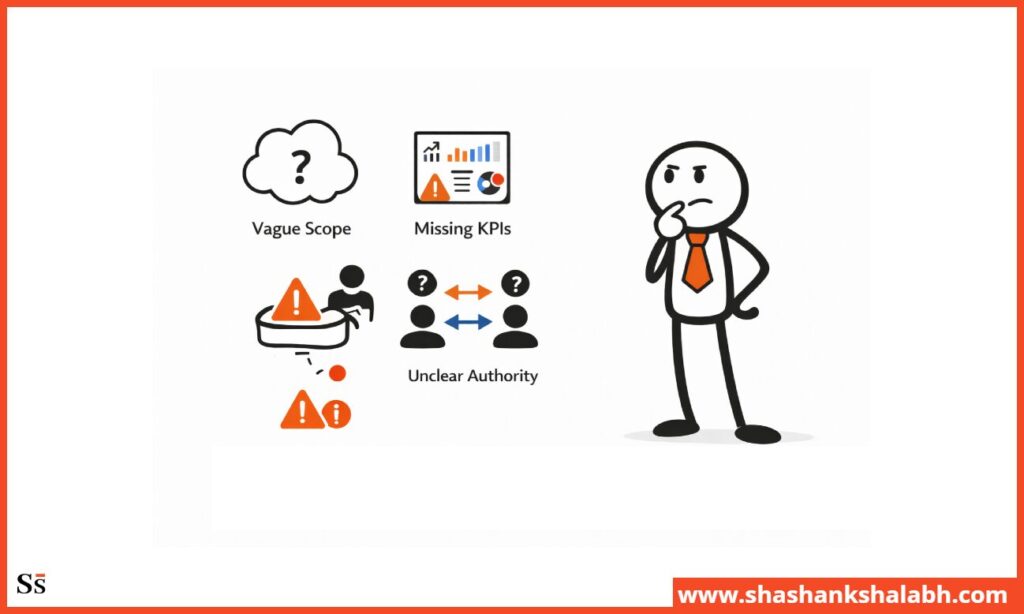
These mistakes show up repeatedly in fractional CMO contracts. A well-structured contract can easily address these.
Vague Scope That Covers Everything
“Lead all marketing activities” sounds comprehensive. It’s actually useless.
Without specific strategic responsibilities defined, the CMO either does too much (stretching into execution), or too little (staying at strategy level while execution falls through the cracks). Specific scope prevents both.
No KPIs in the Contract
Some contracts define deliverables (documents, presentations, plans) without defining the outcomes those deliverables should produce.
A GTM strategy document is a deliverable. A 25% improvement in qualified pipeline is a KPI. Both matter. Deliverables without KPIs create activity without accountability.
Unclear Decision-Making Authority
Who can the CMO hire? Who can they fire? What budget can they approve without CEO sign-off?
When decision-making authority is undefined, the CMO can overreach. That is, they would make decisions that need CEO involvement. Or the CMO might underreach. They can defer decisions that should be theirs.
Both slow the engagement down.
Focusing on Deliverables Instead of Outcomes
A contract that lists 15 deliverables but no revenue outcomes measures the wrong things. The company cares about pipeline, CAC, and revenue growth, and not the number of strategy documents produced.
A strong fractional CMO contract defines both. Deliverables are checkpoints. Outcomes are the goal.
No Minimum Engagement Length
Fractional CMO engagements take time to produce results.
It takes 30-60 days to develop strategy, 60-90 days for pipeline improvement, and 4-8 months for revenue growth.
A contract with no minimum length or a 30-day break clause pushes the CMO to show quick wins instead of building systems that last.
A fractional CMO contract should have 6 months as the minimum effective engagement length.

How a Strong Fractional CMO Contract Aligns Marketing With Revenue
A well-structured fractional CMO contract does more than protect both sides legally. It creates the conditions for the engagement to actually work.
KPIs Connect Marketing Activity to Revenue
When pipeline coverage, CAC trajectory, and LTV:CAC ratio are built into the contract, every marketing decision connects to a revenue outcome.
The team isn’t just running campaigns. They’re focused on hitting real targets. Instead of marketing updates, the board is looking at revenue.
Putting KPIs in the contract turns marketing from a cost center into a revenue function.
Defined Authority Enables Fast Execution
When the contract defines what the CMO can decide independently, the engagement moves faster.
The CMO doesn’t wait for CEO approval on every channel decision. The team knows who sets strategy and who sets tasks.
Speed is a competitive advantage in marketing. And defined authority makes speed possible.
Reporting Cadence Creates Shared Accountability
Monthly board reporting built into the contract keeps both sides accountable.
The CMO brings the numbers. The board reviews them. Problems show up early, before they turn into bigger issues.

When to Formalize a Fractional CMO Contract
Timing matters. Here’s when each stage of formalization should happen.
After Evaluation, Before Engagement Starts
The contract should be signed before the fractional CMO starts any paid work.
The evaluation should already be done, including experience, frameworks, references, and fit. Scope, KPIs, and pricing should be aligned in principle before drafting begins.
Don’t start on a handshake and sort it out later.
During Scaling or Leadership Transition
When a company is scaling fast, whether after funding, an acquisition, or a leadership change, a fractional CMO contract brings stability.
It defines who owns marketing, what success looks like, and how the function reports to leadership. During times of change, clarity matters more than flexibility.
When Renewing or Extending an Engagement
Renewing a fractional CMO engagement without updating the contract is a missed opportunity. The company’s needs change, and the scope should change with them.
A renewal is the right time to revisit KPIs, adjust time commitment, update reporting structure, and revisit the rate if needed.
Treat the renewal like a new contract, because the company’s situation is often genuinely different.
Checklist: What to Include in a Fractional CMO Contract
Use this before signing any fractional CMO agreement:
Defined Scope and responsibilities:
- Strategic responsibilities: GTM, positioning, ICP, channel strategy
- Leadership authority: team, agencies, hiring recommendations
- Execution boundaries: what’s in scope and what’s not
Clear Deliverables:
- Phase-based deliverables: Days 30, 60, 90
- Ongoing deliverables: board reports, strategy reviews
- Work ownership: all assets belong to the company
Defined KPIs and success metrics:
- Pipeline growth target
- CAC reduction target
- LTV:CAC ratio target
- Reporting cadence: monthly KPI reviews
Clear Engagement structure:
- Time commitment: hours per month or week
- Reporting lines: who the CMO reports to
- Decision-making authority: what requires CEO sign-off
Defined Pricing and payment:
- Monthly retainer amount
- Payment timing: monthly in advance
- Minimum engagement length: 6 months minimum
- Rate review terms for multi-year engagements
Communication:
- Weekly, bi-weekly, monthly, and quarterly meeting cadence
- Board reporting: revenue metrics
Defined Exit terms:
- 30-day notice period: both parties
- Transition support
- Confidentiality and non-solicitation terms
How to use this checklist?
If you have up to 5 items missing, it’s a minor gap. Address these before signing the contract. However, if you observe 6-10 items missing in the checklist, it indicates there are significant gaps. Redraft the fractional CMO contract.
More than 11 items missing suggests you need to start over.

FAQ: Fractional CMO Contract
What should be included in a fractional CMO contract?
A fractional CMO contract should cover seven core components.
These are the scope of work (strategic and leadership responsibilities), deliverables with phase-based milestones, KPIs connecting marketing to revenue outcomes, engagement structure (time commitment and authority), pricing and payment terms, communication and reporting cadence, and termination and exit clauses.
The most important sections are scope and KPIs.
Do fractional CMOs work on retainers or contracts?
Most fractional CMO engagements use both.
The retainer sets the monthly fee and time commitment. The contract covers the full engagement, including scope, KPIs, deliverables, reporting, and exit terms. The retainer is how you pay. The contract is how the work runs.
How long is a typical fractional CMO contract?
On average, a fractional CMO engagement lasts 6 to 18 months, with 12 months being the average. Six months is the minimum to be effective. Anything shorter doesn’t leave enough time to build systems and show real revenue impact.
What KPIs should be included in a marketing contract?
The most important KPIs to include are pipeline growth, CAC, LTV:CAC ratio, CAC payback period, and marketing-sourced revenue as a percentage of total closed revenue.
Avoid vanity metrics such as impressions, followers, and email opens. They don’t connect to revenue and they don’t hold anyone accountable for business outcomes.
Can a fractional CMO contract be flexible?
Yes. Time commitment can increase during busy periods like after funding or a product launch. And scope can expand with agreement and adjusted pricing. Also, the engagement length can extend through a renewal.
However, components such as KPIs, pricing, and exit terms should not change without updating the contract.

Closing Thought
A fractional CMO contract is about clarity.
The best fractional CMO engagements start with both sides agreeing on exactly what success looks like, before anyone does any work. Scope, KPIs, authority, reporting, and exit terms are the operating conditions that make the engagement effective.
Get the contract right and the engagement can focus entirely on results. Get it wrong and the first few months become a negotiation about what was agreed.
→ Fractional CMO Services → Fractional CMO Cost → Fractional CMO ROI

Shashank brings over 22 years of global omnichannel marketing experience. As a 4x Chief Marketing Officer, he has helped several organizations (Startups and Fortune 500) drive sustainable revenue growth through strategic marketing.