
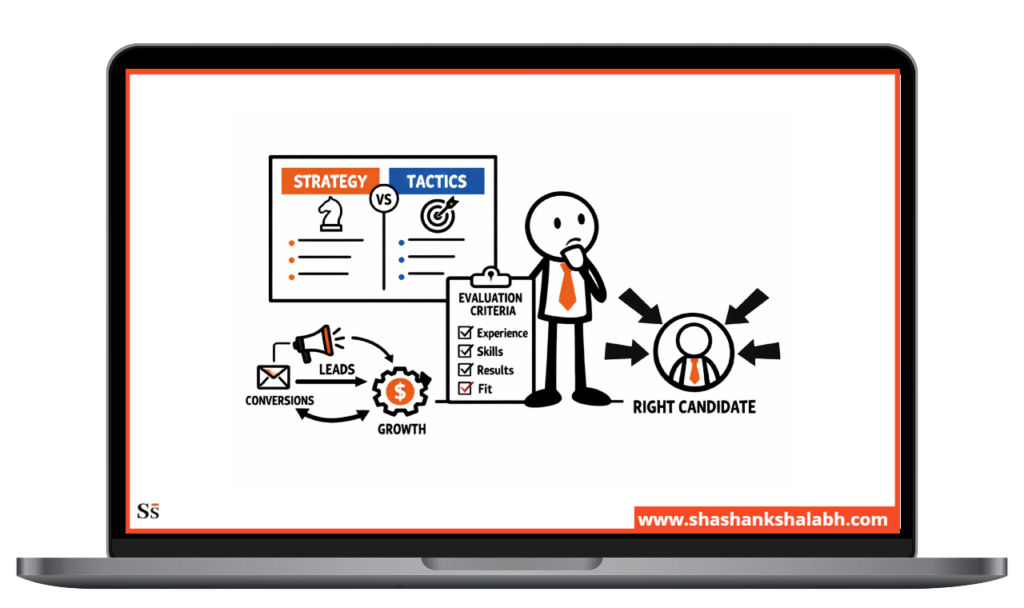
Most companies hire the wrong fractional CMO because they evaluate the wrong things.
They check channel experience instead of strategic thinking. They assess tactics instead of systems.
This guide gives you a practical framework for evaluating a fractional CMO before you hire. This will help you bring in the right leader for your growth stage.
What this guide covers:
- What a strong fractional CMO actually looks like
- Why most companies choose the wrong one
- A five-dimension evaluation framework
- Key questions to ask before hiring
- Red flags to watch for
- A practical hiring checklist

What Does a Strong Fractional CMO Actually Look Like?
This part is important to understand. A strong fractional CMO is not a senior marketer doing part-time work.
Think of a fractional chief marketing officer as an executive-level growth leader who owns strategy, drives revenue accountability, and leads the marketing team, without being on the payroll full time.
These four things separate strong fractional CMOs from the rest:
Strategic ownership
They build the GTM strategy, define the ICP, and own positioning. A strong fractional CMO doesn’t wait to be told what to do. They diagnose the problem and bring a plan.
Revenue accountability
They report on pipeline, CAC, and LTV:CAC ratio, not campaigns and content output. They connect marketing spend to revenue outcomes.
Leadership capability
They manage the internal team, direct agencies, and hire into open roles. They build the organization, not just the strategy.
Execution oversight
They don’t run campaigns themselves. Instead, they build the system and hold the team accountable for running it.
If the person you’re evaluating can’t clearly describe how they do all four, keep looking.
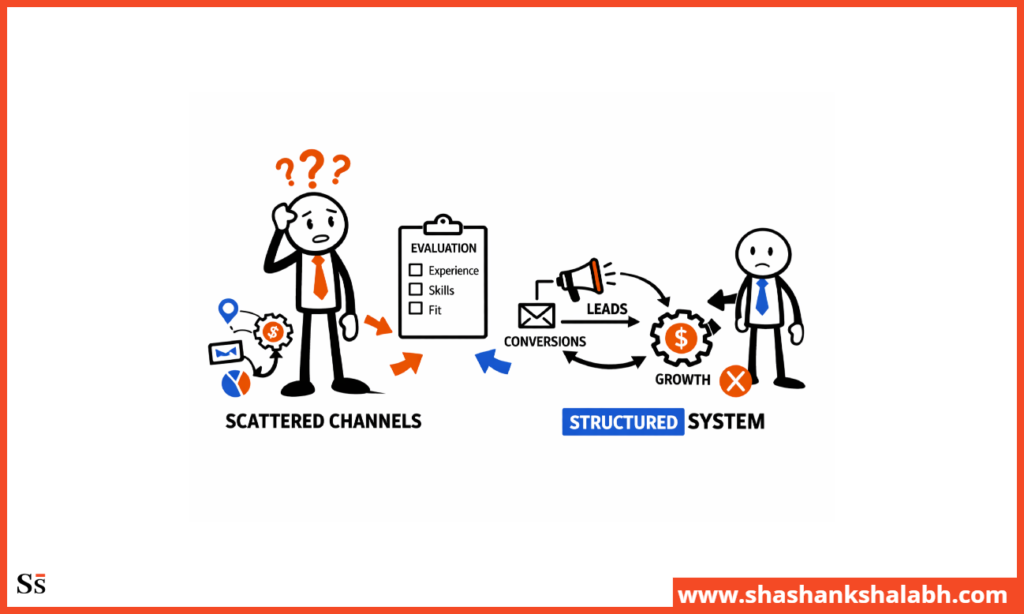
Why Most Businesses Choose the Wrong Fractional CMO?
Most hiring mistakes happen before the first interview. Companies start evaluating without a clear picture of what they actually need. Here’s where it goes wrong.
They Hire a Tactician Instead of a Strategist
This is the most common mistake.
A tactician is good at running campaigns, managing channels, and executing programs. A strategist builds the system those campaigns run inside.
Companies hire tacticians because they’re easier to evaluate. You can see their work. Strategists are harder to evaluate because their output is a framework, a revenue trajectory, and a team that executes well.
But tacticians don’t fix broken GTM systems. Strategists do.
They Focus on Channel Experience Instead of Growth Systems
“Do you have SaaS experience?” is the wrong first question.
Channel expertise matters. But the question that matters more is: “How do you build a system that generates a consistent pipeline?”
A fractional CMO who has deep paid acquisition experience but no framework for diagnosing growth constraints will optimize one channel while the broader revenue problem goes unsolved.
They Don’t Set Clear Expectations Before Hiring
Many fractional CMO engagements fail because of unclear (and undefined) expectations.
What does success look like in 90 days? Who does the fractional CMO report to? What authority do they have over the team and the budget?
Without clear answers to these questions before hiring, the engagement would not work. The CMO delivers something. The company expected something different.
They Have No Evaluation Framework
Most companies evaluate fractional CMOs the way they evaluate agencies. They focus on portfolio, clients, references. That’s not enough for an executive hire.
A fractional CMO is joining the leadership team. They need to be evaluated like one. Without a structured framework, decisions default to gut feel and whoever interviewed best.
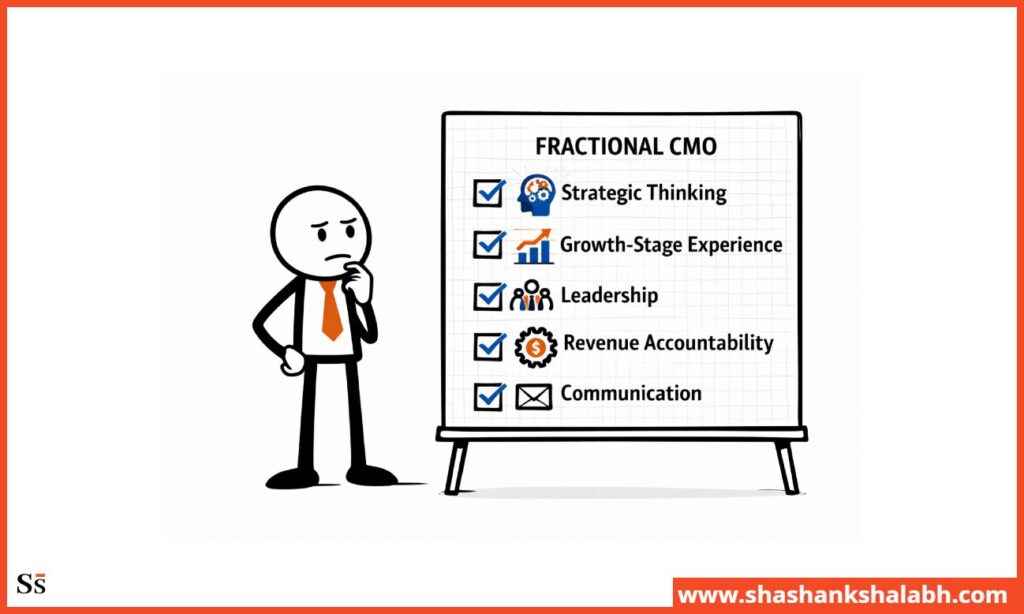
The Fractional CMO Evaluation Framework
This Strategic CMO Selection Framework will help understand how to evaluate a fractional CMO candidate before hiring. Each dimension has a clear standard and specific signals to look for.
Strategic Thinking
What to evaluate
Can this person diagnose a growth problem and build a plan to fix it? Do they think in systems or in campaigns?
Success Criteria:
The fractional CMO asks about your revenue data before recommending anything. They identify the primary growth constraint before pitching solutions.
And they describe their work in terms of revenue outcomes such as pipeline growth, CAC reduction, and LTV improvement.
Test question
Walk me through how you’d diagnose a company where revenue growth has slowed down.
A strong answer starts with data; funnel conversion rates, CAC trends, pipeline coverage. It identifies the primary constraint before prescribing a solution. It doesn’t start with “we’d run a brand audit” or “let’s look at your content strategy.”
Red flag
They jump to channel recommendations before understanding the business.
Growth-Stage Experience
What to evaluate
Have they worked with companies at your revenue stage and growth complexity? Pattern recognition only comes from repetition.
Success Criteria
The fractional CMO has direct experience with companies between $5M-$50M revenue. They can describe specific problems they’ve solved at your stage. And they understand what breaks at Series A that worked pre-Series A.
They know what a board expects from marketing at your funding stage.
Test question
What’s the most common marketing mistake you see in companies at our stage?
A strong answer is specific. It names a pattern. For example, a positioning that worked for early adopters but broke with mainstream buyers, founder-dependent pipeline that couldn’t scale, a team of generalists executing specialist-level programs.
Vague answers about “alignment” and “strategy gaps” signal surface-level experience.
Red flag
They describe experience that’s all early-stage or all enterprise. Neither translates cleanly to a $5M-$30M scaling company.
Leadership and Team Management
What to evaluate
Can they lead, develop, and hold accountable a marketing team they don’t manage full time?
Success Criteria
A strong fractional CMO can describe how they structure working relationships with internal teams on a part-time basis. They explain how they establish authority, set priorities, and maintain accountability without being present every day.
Also, they have a clear approach to assessing existing team capability and addressing gaps.
Test question
How do you manage a marketing team when you’re only engaged 16-24 hours a month?
A strong answer covers how they set the strategic direction the team executes against, how they run a weekly or bi-weekly operating rhythm with the team, and how they establish clear KPI ownership so the team isn’t waiting for the fractional CMO to make every decision.
Red flag
They describe doing the work themselves rather than building the team to do it. That’s a senior contractor, not a CMO.
Revenue Accountability
What to evaluate
Do they own revenue outcomes, or just marketing activity?
Success Criteria
The fractional chief marketing officer describes their work in terms of pipeline sourced, CAC trajectory, LTV:CAC ratio, and marketing-sourced revenue percentage. They set up KPI dashboards before launching any programs, and report to boards on revenue metrics.
Also, they point to real numbers from past work. For example, CAC down 20-35%, pipeline up 50-150%, LTV improved 30–50%.
Test question
How do you measure whether your engagement is working?
A strong answer names specific metrics with specific targets. It describes the reporting cadence they establish with the CEO and board. It explains how they connect every marketing investment to a revenue outcome.
An answer that focuses on “brand awareness,” “content output,” or “team morale” is the wrong answer.
Red flag
They can’t describe their impact in revenue terms. And they rely on activity metrics to demonstrate value.
Communication and Board Reporting
What to evaluate
Can they communicate marketing performance to a CEO and board in financial language?
Success Criteria
The fractional CMO can describe board presentations in terms of pipeline coverage, CAC payback, LTV:CAC ratio, and marketing-sourced revenue.
They translate marketing activity into business outcomes without needing the CEO to interpret the data.
And they’ve presented to PE sponsors, institutional investors, or boards before, and they understand what that audience needs from marketing.
Test question
Walk me through what a board marketing report looks like when you build it.
A strong answer covers pipeline sourced versus target, CAC trend versus prior period, LTV:CAC ratio trend, and a forward projection with specific assumptions. It doesn’t include impressions, social followers, or email open rates.
Red flag
Their board report is a marketing update. Boards need a revenue update that happens to include marketing.

Key Questions to Ask Before Hiring
Use these questions in the evaluation process. They’re designed to surface strategic thinking.
How Do You Diagnose a Growth Problem?
This question reveals their diagnostic process.
Strong fractional CMOs start with data such as funnel conversion rates, CAC by channel, pipeline coverage, win/loss patterns. They identify the primary constraint before recommending any solution. They don’t start with the solution and work backwards to the diagnosis.
Listen for: data-first thinking, constraint identification, root cause analysis before recommendations.
What Does Your First 90 Days Look Like?
This question helps assess their operating model. The first 90 days should be structured.
For example, assessment in the first 30 days, strategy development in days 31-60, early execution in days 61-90. A fractional CMO who describes launching campaigns in week one is skipping the diagnosis. That produces the same result as treating the wrong bottleneck.
Listen for: a structured phase approach, a diagnostic period before execution, specific deliverables by Day 30, Day 60, and Day 90.
How Do You Measure Success?
This question shows their accountability framework.
Strong fractional CMOs describe pipeline growth, CAC reduction, and LTV improvement as their primary success metrics. They set specific targets before the engagement starts. They describe the reporting cadence they establish with the CEO and board.
Listen for: specific revenue metrics, target-setting before execution, board-level reporting capability.
How Do You Work With Internal Teams?
This question explains their leadership model.
A strong fractional CMO describes how they establish strategic direction the team executes against. They explain how they run operating rhythms on a part-time basis. Moreover, they describe how they assess team capability and address gaps. They don’t describe doing the work themselves.
Listen for: team direction without micromanagement, KPI ownership assigned to team members, operating cadence that works part-time.
What’s the Biggest Marketing Mistake You’ve Seen at Our Stage?
This question reveals their pattern recognition.
A strong fractional CMO gives a specific, credible answer drawn from direct experience. It names a real problem, such as, founder-dependent pipeline, positioning built for early adopters, a team of generalists executing specialist programs.
It shows they’ve seen this before and know how to fix it.
Listen for: specificity, pattern recognition, direct experience; not generic observations about “alignment” or “strategy.”

Red Flags to Watch For
Pay attention to these warning signs.
Overly Tactical Focus
They talk about channels, campaigns, and content before they ask about your revenue system. They’re talking more about what they’ll create, like content calendars, paid campaigns, and email sequences, than the results those things are meant to drive, like growing pipeline, lowering CAC, or improving conversion rates.
Tacticians are valuable. They’re not CMOs.
No Clear Diagnostic Framework
They can’t describe how they identify the primary growth constraint. They go straight to recommendations without a diagnostic process.
Every company they’ve worked with apparently needed the same solution. That’s not pattern recognition.
Vague Metrics and Undefined Success
They describe success as “improving marketing performance” or “building a stronger brand.” They can’t name specific metrics they’ll own or specific targets they’ll be held to. Vague metrics protect the CMO. They don’t protect the company.
Agency Dependency Without Strategic Oversight
They describe their model as “managing your agencies.” Managing agencies is part of the job. It’s not the job.
If their primary value proposition is agency coordination rather than strategic leadership and revenue accountability, you’re hiring an account manager, not a CMO.
Can’t Explain Their Revenue Impact
They’ve worked with impressive companies.
The fractional CMO can’t describe what improved because of their work. Strong fractional CMOs own outcomes. They track CAC before and after. They measure pipeline improvement, and document LTV:CAC trajectory.
If they can’t point to specific numbers from past engagements, their accountability model is weak.
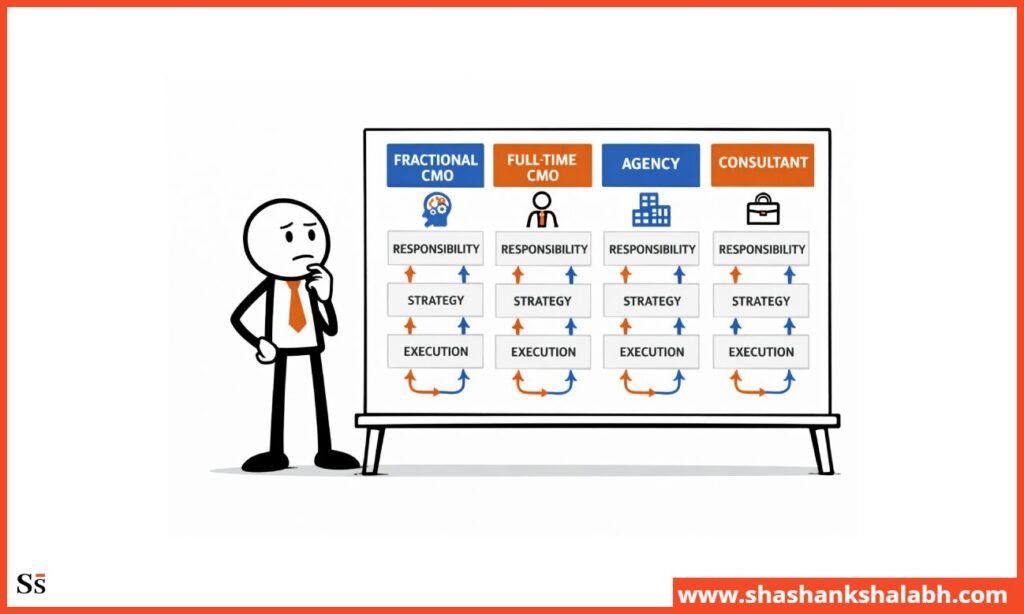
Fractional CMO vs. Other Options
A fractional CMO is not the right solution for every situation:
| Dimension | Fractional CMO | Full-Time CMO | Agency | Consultant |
| Monthly cost | $8K-$25K | $25K-$33K+ monthly | $10K-$67K+ | $5K-$17K+ project |
| Strategic ownership | Full | Full | None | Limited |
| Revenue accountability | Yes – owns outcomes | Yes – owns outcomes | No – owns deliverables | No – owns recommendations |
| Team leadership | Yes | Yes | No | No |
| Time commitment | 16-24 hours monthly | Full time | Varies | Varies |
| Stage fit | $5M-$30M ARR | $30M-$75M+ revenue | Any | Any |
| Speed to impact | Days 1-30 diagnostic | Several months | Campaign launch | Recommendation delivery |
| Flexibility | High – 30-day exit | Low – severance risk | Medium | High |
The fractional CMO model fits companies that need executive marketing leadership but aren’t yet at the revenue stage or team size that justifies a full-time hire. For most companies between $5M-$30M ARR, the fractional model delivers the right capability at the right cost.
For a detailed breakdown, see Fractional CMO vs. Full-Time CMO, Engagement Models, and Fractional CMO Cost.
When a Fractional CMO Is the Right Fit?
A fractional CMO is the right hire when:
Company profile:
- Revenue between $5M-$30M ARR
- Post-product-market fit
- Marketing team (3-15 people) needing strategic direction
- Board or investor expectations for accountable marketing KPIs
Marketing situation:
- Founder-led marketing reaching bandwidth limits
- Growth plateau with no clear diagnosis
- Post-Series A or B with board-level reporting expectations
- Rising CAC without a clear explanation
- Inconsistent or founder-dependent pipeline
Leadership situation:
- No full time CMO or VP of Marketing
- Marketing team strong at execution but lacking clear strategic direction
- Not yet ready for a full-time CMO given current revenue and team size
What’s not a fit:
- Pre-revenue or under $2M ARR: too early for this model
- Companies needing execution only: an agency serves that need better
- Teams where the founder isn’t ready to delegate marketing strategy
Check out Fractional CMO for Growth-Stage Companies to understand how the engagement works.
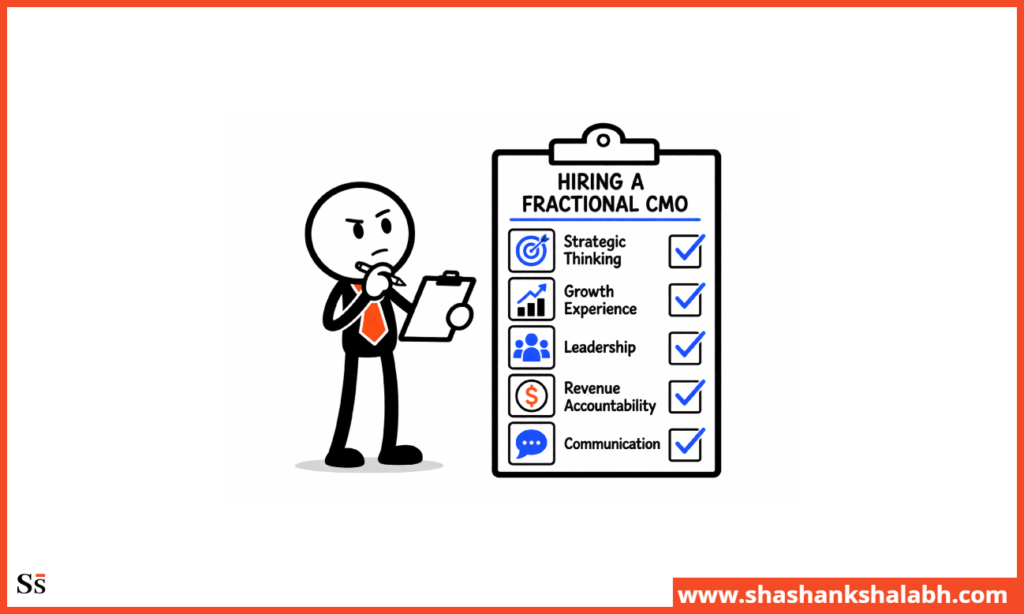
Checklist: How to Evaluate a Fractional CMO
Use this before hiring a fractional CMO:
Strategic thinking:
- They diagnose before recommending; data first, solutions second
- They describe their work in revenue terms such as pipeline, CAC, LTV
- They can identify the primary growth constraint without a full audit
Growth-stage experience:
- They have direct experience with companies at your revenue stage
- They can name specific problems they’ve solved at your stage
- They understand what boards expect from marketing at your funding stage
Leadership capability:
- They describe leading teams part-time with clear operating rhythms
- They have a process for assessing team capability and addressing gaps
- They build teams to execute; they don’t do the execution themselves
Revenue accountability:
- They set specific metric targets before the engagement starts
- They describe board-level reporting in financial language
- They can point to specific revenue improvements from past engagements
Communication and fit:
- They ask more questions than they answer in the first conversation
- They describe a structured first 90 days – diagnosis before execution
- They’re direct about what they can and can’t deliver
Scoring:
- 0-4 items: Keep looking; this isn’t the right candidate
- 5-9 items: Promising; probe the gaps before deciding
- 10-13 items: Strong candidate; move to reference checks and engagement terms
- 14-15 items: Exceptional fit; move quickly
FAQ
These questions and answers will help you understand how to evaluate a fractional CMO.
How do you evaluate a fractional CMO?
You should evaluate a fractional CMO across strategic thinking, growth-stage experience, leadership and team management, revenue accountability, and board communication capability.
The most important is revenue accountability. Can they describe their impact in pipeline, CAC, and LTV terms?
The biggest mistake companies make is evaluating channel expertise instead of growth system thinking. A fractional CMO who can’t connect their work to revenue outcomes isn’t operating at the executive level the role requires.
What should you look for in a fractional CMO?
Look for someone who diagnoses before recommending, leads teams without micromanaging, and reports on revenue outcomes.
They should have direct experience with companies at your growth stage, a structured first 90 days, and specific metrics they’ll own from Day 1.
The clearest signal of a strong fractional CMO is specificity; specific problems they’ve solved, specific improvements they’ve produced, specific metrics they’ll be accountable to in your engagement.
What questions should you ask before hiring a fractional CMO?
These five questions matter most.
- How do you diagnose a growth problem?
- What does your first 90 days look like? How do you measure success?
- How do you work with internal teams on a part-time basis?
- What’s the biggest marketing mistake you’ve seen at our stage?
Listen for data-first thinking, structured operating models, revenue metric accountability, and specific pattern recognition from companies at your stage.
How do you know if a fractional CMO is good?
Strong fractional CMOs describe their past engagements in revenue terms such as pipeline growth, CAC reduction, LTV improvement.
They can name specific improvements they produced and the metrics that tracked them. They have a structured diagnostic process, a clear first 90 days, and a board reporting model that communicates in financial language.
The clearest negative signal is an inability to connect their work to revenue outcomes. If they can’t describe what improved and by how much, their accountability model is weak.
When should you hire a fractional CMO?
Hire a fractional CMO when revenue is between $5M-$30M ARR, founder-led marketing has hit its ceiling, and the board requires marketing KPI accountability the current team can’t produce.
For most companies at this stage, the fractional model delivers the right executive capability at a cost that preserves runway for demand generation investment.

Closing Thought: How to evaluate a fractional CMO
Hiring a fractional CMO is an executive decision. It deserves an executive evaluation process.
Most companies that get it wrong focus on the wrong criteria such as impressive client lists, channel expertise, polished presentations.
The right signals are harder to see but more important. Does this person diagnose before recommending? Do they own revenue outcomes or marketing activity? Can they lead a team they’re not with every day?
The companies that get the most from fractional CMO engagements are the ones that hired with clarity such as clear expectations, clear metrics, clear authority.
The evaluation framework in this post is designed to give you that clarity before you commit.
Check out Fractional CMO Services to learn more.

Shashank brings over 22 years of global omnichannel marketing experience. As a 4x Chief Marketing Officer, he has helped several organizations (Startups and Fortune 500) drive sustainable revenue growth through strategic marketing.