
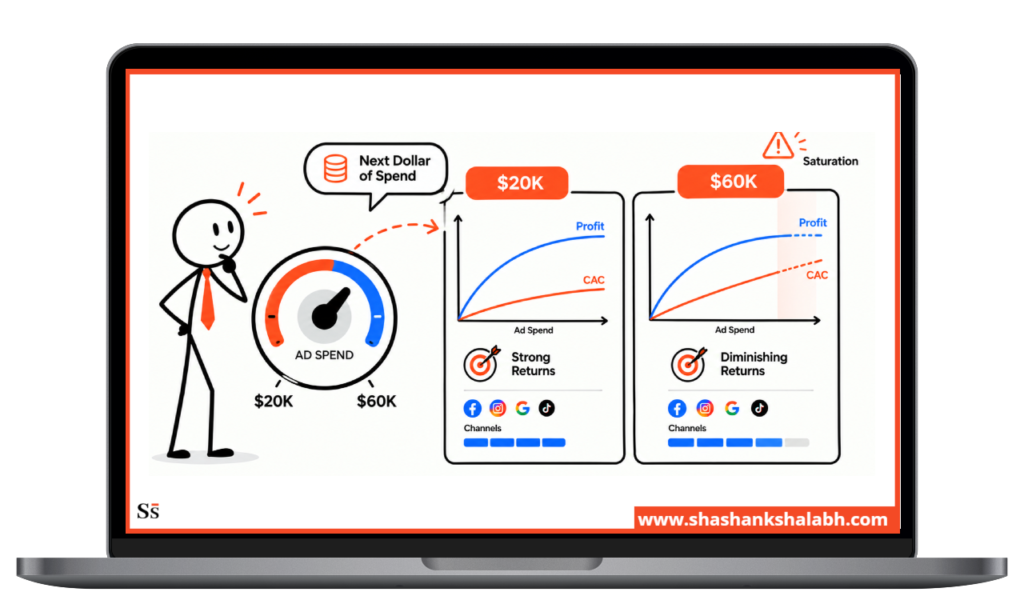
In DTC, a high-performing channel at $20K a month, might fall apart at $60K.
And this can happen without any change in your product or brand.
As a Fractional CMO for DTC & Ecommerce, I have observed that a DTC ad channel can work well at one spend level and get worse as you scale.
Each new dollar may bring in less return than the last, and most founders do not notice until CAC has already climbed too high.
You want to know that the next dollar you spend is still going to make you money.
The Difference Between Average ROAS and Marginal ROAS
Average ROAS is your total attributed revenue ÷ total ad spend.
Marginal ROAS shows how much extra revenue you get from increasing your ad spend.
Why Marginal ROAS Matters When Scaling
Here’s a simple example:
- $20K spend → $100K revenue (5x)
- $40K spend → $170K revenue (4.25x average)
- $60K spend → $225K revenue (3.75x average)
At first glance, things still look good. Revenue is going up and the average ROAS is still solid.
But look at what each additional $20K actually brought in.
The second $20K generated $70K in revenue, a 3.5x marginal ROAS. The third $20K generated just $55K, a 2.75x marginal ROAS.
That’s the part the average ROAS hides. Your total revenue can keep growing while the return on your latest spend gets worse.
The First Sign You’ve Hit a Scaling Ceiling
Watch for CAC and CPMs going up.
Keep an eye on marginal ROAS and conversion rates going down.
Also watch for frequency, audience quality, contribution margin, and how revenue grows as spend increases.
Revenue can keep growing while profit from each new customer gets smaller. You are still making money, but each extra dollar of ad spend is doing less.
That is a scaling ceiling. It is easy to miss because revenue still looks good.
→ Our DTC Revenue Is Growing But We’re Making Less Money
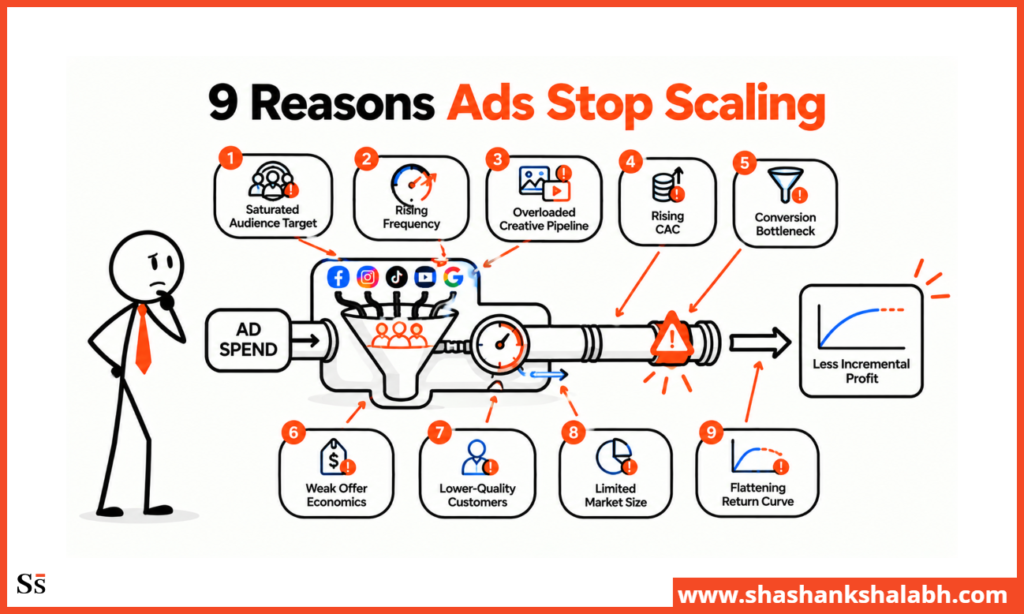
Issue 1: You’ve Saturated Your Highest-Intent Audience
At lower spend, ads reach the people most likely to buy first. They are already interested and closer to making a purchase.
As you spend more, that audience gets smaller. Your ads have to reach people who are less likely to buy, so conversion rates fall and CAC rises.
Your retargeting audience is finite. Once you have reached most of your warm visitors, extra spend has to go toward cold audiences, where performance is usually very different.
Issue 2: Frequency Is Increasing
This matters especially on auction based platforms like Meta. Watch frequency, CPM, CTR, conversion rate, and CAC together.
Higher frequency only matters if those extra impressions stop bringing in profitable customers.
Creative Fatigue Makes It Worse
If the same people keep seeing the same ads, performance can drop faster. Frequency goes up while CTR and conversion rates fall.
Issue 3: Your Creative System Can’t Support More Spend
Scaling spend means you need more creative too. Watch for creative fatigue, too few concepts, weak hooks, and a slow production pipeline.
A Winning Ad Does Not Scale Forever
An ad that works at $20K in spend may not hold up at $60K. More spend means more impressions, which can wear out the same creative faster.
Creative Output Can Limit Growth
When a brand hits a scaling ceiling, look at how much new creative it is actually producing.
If you are spending more without producing enough new concepts, performance will eventually suffer.
Issue 4: CAC Is Rising Faster Than Customer Value
Look at profit from the first order, customer value over 60, 90, and 180 days, and how long it takes to recover CAC (Payback period).
A campaign can still be profitable while becoming harder to scale if CAC rises faster than customer value.
Issue 5 : Your Conversion Rate Is the Bottleneck
Before spending more, check your landing page, product page, add to cart, checkout, and new vs. returning customer conversion rates.
More traffic will not fix a site that does not convert. Even a small lift in conversion rate can lower CAC and make higher spend profitable again.
Issue 6: Your Offer Can’t Support Higher CAC
Look at your pricing, bundles, AOV, shipping threshold, subscriptions, and upsells.
A higher AOV gives you more room to spend on customer acquisition while keeping the same margin.
But be careful with discounts. They can keep conversion rates up while eating into the margin that makes scaling profitable.
I have covered this trap in my other post: Our DTC Revenue Is Growing But We’re Making Less Money
Issue 7:You’re Scaling Into Lower-Quality Customers
Compare repeat purchase rate, refunds, returns, AOV, and LTV at different spend levels.
The customers you get at $20K in spend may look very different from the ones you get at $100K. As you reach broader audiences, you may see lower LTV, more returns, and fewer repeat purchases.
→ Why Your DTC ROAS Looks Great But You Are Not Profitable
Issue 8: Your Market May Not Be Large Enough
Not every brand has enough potential customers to support unlimited growth.
Look at your audience size, purchase frequency, category demand, and competition.
Sometimes there simply are not enough qualified buyers to justify another $40K in monthly spend.
Expanding into new audiences can help. However, going after people who do not want the product will only hurt performance.
Issue 9: The Channel Is Hitting Diminishing Returns
As you spend more, you still get new customers. But each dollar brings in fewer of them.
Diminishing returns are normal. What matters is knowing when the next dollar is no longer worth the cost.
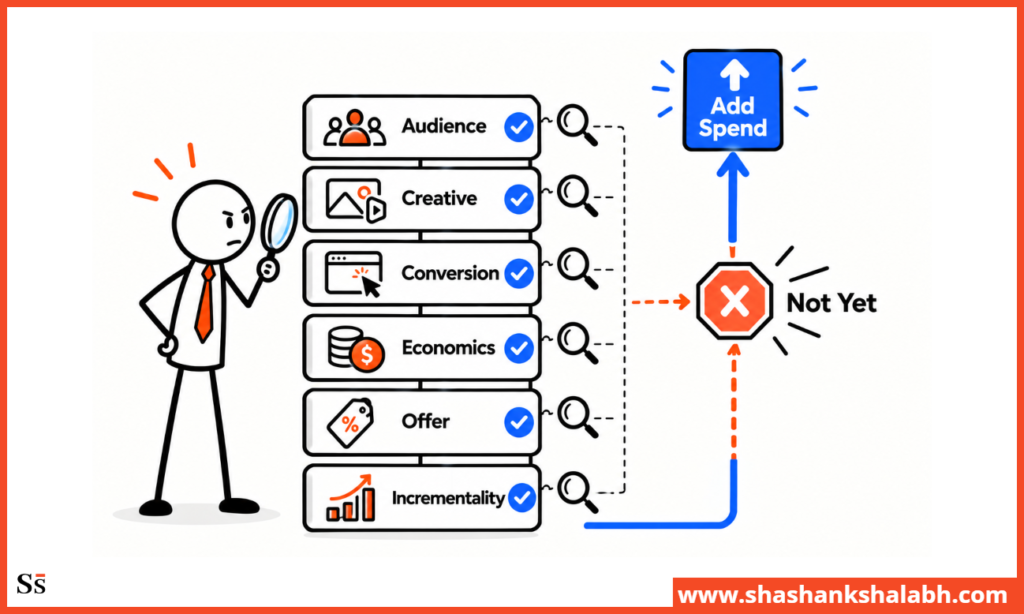
The DTC Ad Scaling Diagnostic
I check six things, in order:
- Audience: Can you reach more qualified customers?
- Creative: Can your ads keep working as you reach more people?
- Conversion: Can your site convert the extra traffic?
- Economics: Can CAC still work with your customer value?
- Offer: Can your AOV and margin support the acquisition cost?
- Incrementality: Is the extra spend actually bringing in more customers and revenue?
The first thing that starts to break is what’s holding back your growth. And it may have nothing to do with the ad account.
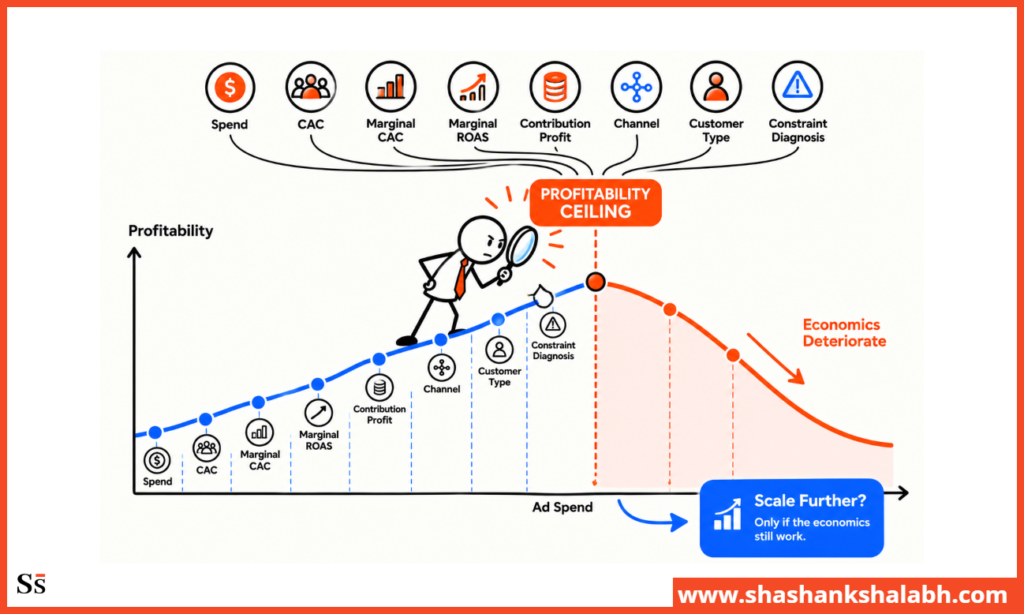
How to Find Your Profitable Spend Ceiling
Here’s what I would do to find your profitable spend ceiling.
- Plot spend against new customers acquired
- Calculate CAC at each spend level
- Calculate marginal CAC between levels
- Calculate marginal ROAS between levels
- Calculate contribution profit at each level
- Segment by channel
- Segment new vs. existing customers
- Identify the spend level where economics start deteriorating
- Diagnose which of the six layers is the constraint
- Fix it, then test incremental spend again before scaling further
Don’t just focus on how much you can spend. Think about how much you can spend while keeping your target contribution margin.
What to Fix Before Increasing Ad Spend Again
Look at audience saturation, creative fatigue, conversion rate, AOV, margins, CAC, LTV, repeat purchases, returns, offer economics, incrementality, and channel mix.
Fix what is holding growth back. Test again, measure how the new spend performs, then scale.
Why Scaling Revenue and Scaling Profit Are Different
You can spend more, grow revenue, and acquire more customers while making less profit from each new customer.
Real scaling means spending more, bringing in more customers, keeping CAC and margins healthy, and generating more profit.
If the numbers stop working, you are just spending more.

When Your DTC Brand Needs a Broader Growth Strategy
If CAC keeps rising, paid media is getting harder to scale, growth depends too much on one channel, or creative cannot keep up, it may be time to look beyond paid ads.
The same goes for brands that have optimized the funnel but still see weaker economics. At that point, you need to look at the bigger picture across the audience, creative, offer, and customer economics.
FAQ: Why Your DTC Can’t Scale Ads
Let’s look at the most common questions you might experience when scaling your DTC brand.
Why can’t my DTC brand scale ads?
Six things can hold you back.
Audience saturation, creative fatigue, a conversion bottleneck, rising CAC, an offer that cannot support higher acquisition costs, or a market that is too small.
Why does CAC increase when ad spend increases?
As you spend more, platforms reach broader audiences with lower buying intent. Once the highest intent audience is tapped out, conversion rates fall and CAC rises.
What is diminishing returns in advertising?
It is the point where each extra dollar brings in less revenue or fewer customers than the one before it.
How do you scale DTC ads profitably?
Find what is holding growth back, whether it is audience, creative, conversion, economics, offer, or incrementality.
Fix it, then increase spend gradually and watch how the new spend performs.
What is marginal ROAS?
This is the return from the latest increase in ad spend, rather than the average return across your entire budget.
What is the difference between ROAS and marginal ROAS?
Average ROAS shows the return across your total spend. Marginal ROAS shows what the latest increase in spend actually brought in. That is the number to watch when deciding whether to spend more.
How do you know when to stop increasing ad spend?
Stop scaling ad spend when marginal ROAS or marginal contribution profit drops below what your business needs. You do not have to wait until the whole channel becomes unprofitable.
How much should a DTC brand spend on advertising?
There is no universal threshold. It depends on your margins, AOV, LTV, category, and stage of growth. The right spend level is where each additional dollar still meets your profit target.

Shashank brings over 22 years of global omnichannel marketing experience. As a 4x Chief Marketing Officer, he has helped several organizations (Startups and Fortune 500) drive sustainable revenue growth through strategic marketing.