
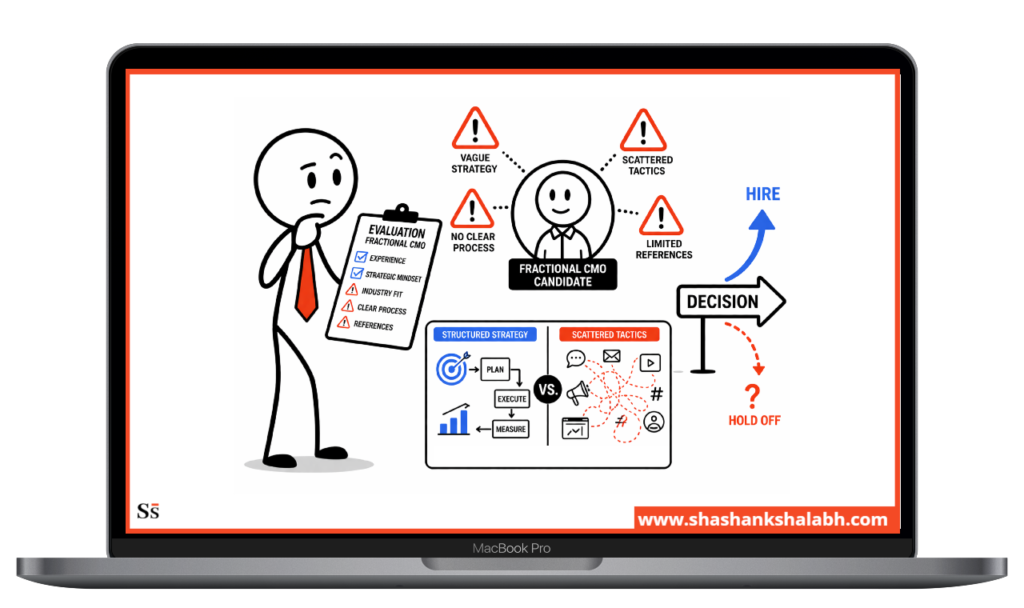
Fractional CMO red flags or warning signs indicate poor strategic fit, lack of executive depth, or misalignment with your business goals.
Hiring the wrong fractional CMO costs time, budget, and growth momentum. The red flags usually appear before the contract is signed, if you know what to look for. Here’s what to watch.
The most common red flags:
- Promises results before understanding your business
- Pushes tactics, skips strategy
- No clear past results
- Too many clients, not enough focus
- Vague scope, KPIs, deliverables
- No flexible or easy exit terms
These red flags come from Shashank Shalabh’s 22 years in marketing and as a fractional CMO, evaluating dozens of marketing leaders and seeing firsthand what separates successful engagements from costly mistakes.
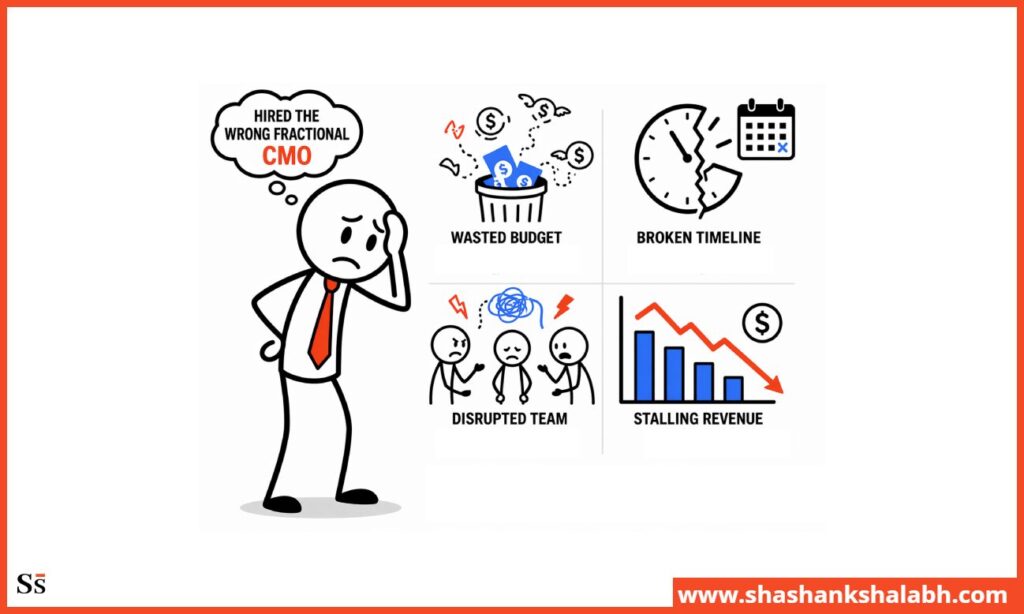
Why Choosing the Wrong Fractional CMO Is Costly?
A bad fractional CMO can be a costly mistake.
Wasted Budget on the Wrong Work
A fractional CMO running the wrong strategy for six months not only misses results, but also burns budget on the wrong channels, campaigns, and priorities.
At $10K-$25K a month, that’s $90K-$150K gone. And this does not factor in agency costs, time, and missed opportunities.
Lost Time You Can’t Get Back
Fractional CMO roles usually last 6-18 months. If you spot a bad fit in month four, you’re restarting the search in month five, thus losing 6-8 months of momentum.
For a post-Series A company with board targets, that is a real financial setback.
Internal Team Disruption
In addition to underperforming, a fractional CMO without clear strategy, priorities, or communication creates confusion across the entire team
Marketing teams without clear direction lose confidence, lose high performers, and lose momentum. The damage to team culture takes longer to repair than the engagement itself.
Delayed Revenue Growth
Every month without strong marketing leadership is a lost month of pipeline.
Demand generation programs that should’ve launched are still being debated.
CAC creeps up with no clear owner. The board asks questions no one can answer. The real cost isn’t just what you spent; it’s the revenue you missed.
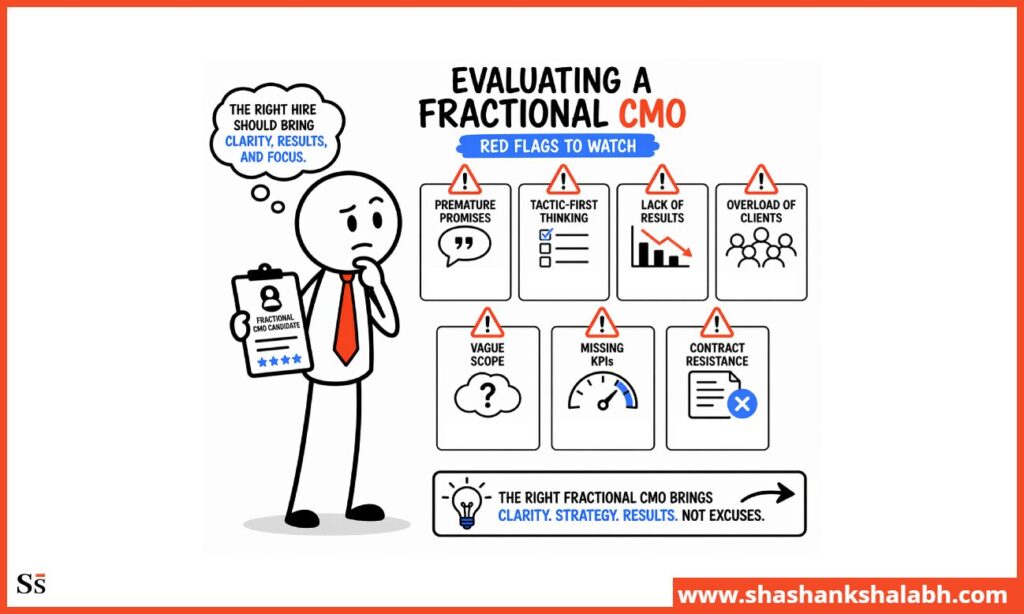
Top Fractional CMO Red Flags
These are the most common warning signs. Some show up in the first call, others in the proposal, and a few at the contract stage.
All are avoidable.
Red Flag 1: They Promise Specific Outcomes Before Understanding Your Business
You haven’t shared your funnel. They haven’t asked about your ICP. And they’re already promising 40% pipeline growth in 90 days.
This does not show confidence. It is just a pitch.
A strong fractional CMO won’t promise outcomes before diagnosing the business. Early gains (10-25% in 90 days) can be realistic, but only after understanding the root problem.
If they’re giving numbers upfront, they’re guessing, or telling you what you want to hear.
A strong fractional CMO would say something along these lines: “I need to see your pipeline data, CAC, and channel performance before setting targets.”
Red Flag 2: They Talk About Tactics Before Strategy
Weak fractional CMOs start by asking about channels, ad spend, and content. But they haven’t asked about your ICP, LTV:CAC, or where the pipeline breaks.
Tacticians fix channels. Strategists fix revenue. Lead with tactics, and you’ll optimize the wrong thing; faster and more expensively.
A strong fractional CMO would ask questions about revenue, pipeline, CAC trends, and growth constraints, before giving any channel advice.
Red Flag 3: They Can’t Show Measurable Results From Past Work
Strong fractional CMOs know their numbers. They can tell you what CAC was before and after, how much the pipeline grew, or what change shortened the sales cycle.
If you ask “what did you improve?” and hear a list of activities such as website, content, sales deck, that’s a red flag. Activities are inputs. Results are outputs.
If they can’t speak to outcomes, they’re not accountable.
A strong fractional CMO would have clear metrics from past work (CAC down, pipeline up, LTV improved, sales cycle shorter). Maybe not perfect metrics, but real results.
Red Flag 4: They’re Juggling Too Many Clients
A fractional CMO juggling eight retainers isn’t going deep for any of them.
The math doesn’t work.
16-24 hours per client × 8 clients = 128-192 hours a month. This is over a full-time job and a half; before admin or business development.
The result is shallow strategy, templated board reports, and advisory-only team leadership.
Ask them how many active retainer clients they have.
A strong fractional CMO would have a small number that allows real focus, with a clear plan for time allocation. Transparency about capacity is a green flag.
Red Flag 5: Scope of Work Is Vague
If the proposal only says things like “Lead marketing strategy” or “Drive growth initiatives,” that’s a warning. No clear responsibilities, deliverables, or ownership.
Vague scope causes three problems:
- Expectations mismatch: company wants one thing, CMO delivers another.
- Scope creep: CMO’s time fills with whatever comes their way.
- No way to measure success because success was never defined.
A strong fractional CMO provides a clear scope framework: strategic responsibilities, execution oversight, team leadership, and phase-based deliverables (Days 30, 60, 90).
They would give you a detailed scope document separating strategy from execution, with deliverables defined by phase.
Red Flag 6: No Defined KPIs or Reporting Framework
If they’re eager to start but don’t care how success will be measured, that’s a red flag.
Without defined KPIs, a fractional CMO isn’t accountable.
Reviews turn subjective: “I feel things are improving,” or “We’re building momentum”.
A strong fractional CMO sets KPIs upfront. They focus on pipeline growth, CAC, LTV:CAC, reporting cadence. These are the accountability framework for a productive engagement.
Red Flag 7: They Resist Exit Clauses or Flexible Terms
A fractional CMO demanding a 12-month lock-in with no exit clause can mean one of the two things.
One, the results will take longer than they can guarantee, or two, they lack confidence in the value they’ll deliver.
Strong fractional CMOs are fine with 30-day notice periods. They aren’t worried about exits because they’re confident in results. A 30-day exit clause is standard and protects both sides.
If they resist it, ask why. The answer reveals how they operate.
A strong fractional CMO would propose a 30-day exit clause, is open to performance-based renewal, and want you to stay for the work’s value, not the contract.
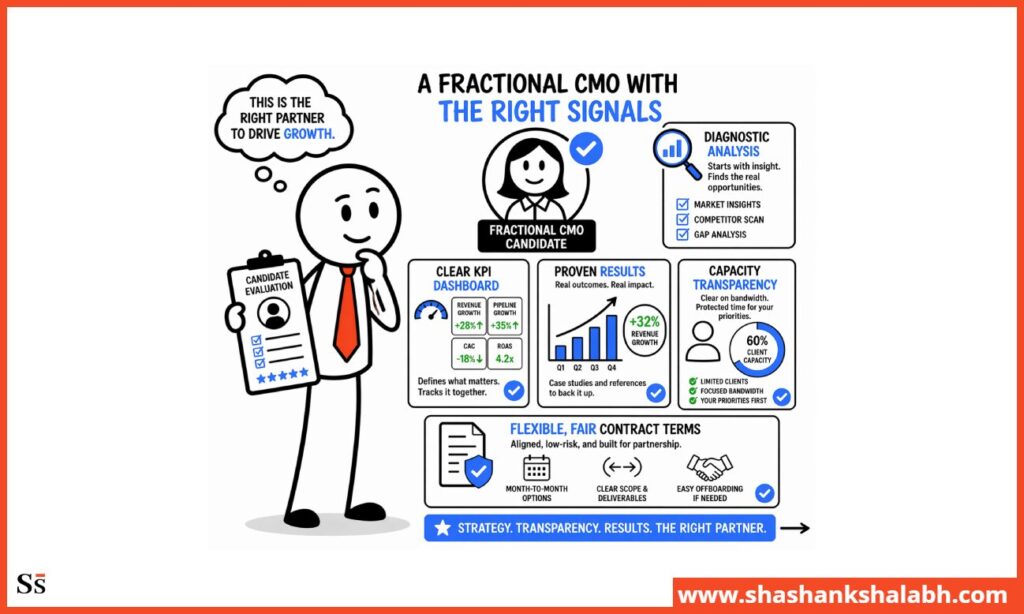
Green Flags to Look For in a Fractional CMO
Earlier, we talked about the red flags when hiring a part-time CMO. Red flags tell you who to avoid. Green flags tell you who to hire.
They Diagnose Before They Recommend
The first conversation is mostly questions.
They want to understand your pipeline data, CAC trajectory, ICP definition, team structure, and board expectations before they say anything about strategy.
Diagnosis before prescription is the hallmark of an executive who has done this before.
They Define KPIs Before the Engagement Starts
They don’t wait until onboarding to define success.
A strong fractional CMO sets KPIs such as pipeline growth, CAC, reporting cadence, before the contract is signed.
Defining them upfront ensures accountability from Day 1 and protects both sides.
They Have Relevant Case Studies With Real Numbers
They can walk through three or four past engagements at companies like yours; similar stage, growth challenges, and industry dynamics. They remember the numbers: CAC before and after, pipeline changes, LTV:CAC improvements.
Specific recall shows true ownership of results.
They’re Transparent About Capacity
They tell you how many clients they currently serve.
They explain how time is allocated across engagements. They’re honest about what they can and can’t take on, and they’d rather decline a fit that doesn’t work than overcommit and underdeliver.
They’re Comfortable With a 30-Day Exit Clause
They propose it themselves. They don’t need a long-term lock-in to feel secure in the engagement. They’re confident the value will be visible quickly enough that exit clauses aren’t a concern.
Confidence in exit terms is confidence in results.
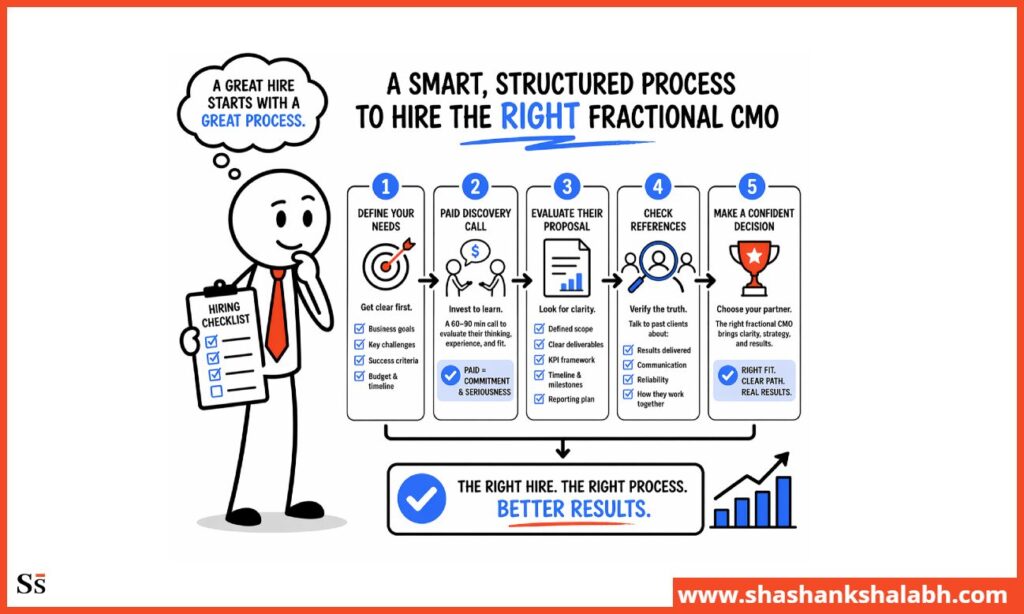
How to Avoid Hiring the Wrong Fractional CMO?
Knowing the red flags is step one. The next step is structuring the hiring process to surface them.
Run a Structured Evaluation (Not Just Interviews)
Most companies vet fractional CMOs like agencies (portfolio, a few calls, gut feel).
That’s not enough for an executive hire.
Use a structured framework to assess strategic thinking, growth-stage experience, leadership, revenue accountability, and board communication.
→ How to Evaluate a Fractional CMO Before You Hire
Ask for a Paid Discovery Engagement First
Before a 6-12 month retainer, try a 30-day paid diagnostic. The CMO reviews your pipeline, channels, team, and positioning, then delivers a board-ready report.
You see how they think, communicate, and work before committing. A strong diagnostic makes the retainer an easy decision; a weak one costs just one month instead of six.
Define Scope and KPIs Before Signing
Don’t sign a contract with vague scope or undefined success metrics. The scope should clearly outline strategic responsibilities, execution boundaries, phase-based deliverables, and KPI targets. Both sides should agree to this in writing.
This is the foundation that makes the engagement work.
→ Fractional CMO Contract: What to Include
Check References From Similar Engagements
Ask for references from companies like yours; similar revenue, growth stage, and team structure. Success at an enterprise doesn’t guarantee fit for a $10M ARR Series A, and vice versa.
Ask references: What did they improve? How did they communicate with the board? How did they handle strategies that weren’t working?
FAQ: Fractional CMO Red Flags
Here are the most common questions related to fractional CMO red flags.
What are red flags when hiring a fractional CMO?
Some of the most common red flags are when a fractional CMO promises results before understanding your business, leads with tactics instead of strategy, lacks measurable past results, juggles too many clients, offers vague scope or KPIs, has no reporting framework, or resists a standard 30-day exit clause
How do you evaluate a fractional CMO?
Evaluate a fractional CMO on strategic thinking, growth-stage experience, leadership, revenue accountability, and board communication.
Revenue accountability is key here. Can they show past impact on pipeline, CAC, and LTV? The biggest mistake is overvaluing channel expertise over strategic and diagnostic skills.
What should a fractional CMO provide?
A fractional CMO should deliver a clear scope with defined strategic responsibilities, phase-based deliverables (Days 30, 60, 90), and an agreed-upon KPI framework.
They should set a reporting cadence linking marketing to revenue; pipeline, CAC, LTV:CAC, and marketing-sourced revenue.
How many clients should a fractional CMO have?
A focused fractional CMO typically serves 3-4 active retainers. Beyond that, strategic depth suffers. I personally maintain a maximum of 4 active clients to ensure each engagement gets genuine executive focus.
What should be confirmed before hiring a fractional CMO?
Before hiring a fractional CMO, confirm clear scope with strategic responsibilities and phase-based deliverables, agreed-upon KPI targets, reporting cadence with CEO and board, current client load and time allocation, relevant case studies with measurable outcomes, and a 30-day exit clause.
Closing Thought: Fractional CMO Red Flags
Most fractional CMO red flags show up in the first call, proposal, or contract if you know what to look for.
Successful hires assess how the CMO thinks, measures, communicates, and whether their accountability is real or performative. This takes more than two calls, but it’s worth the time.
A bad hire costs far more than the retainer: lost growth months, team disruption, and shaken board confidence.
Check Fractional CMO Services to understand what a well-structured engagement actually looks like.
Apply below for a strategy session to discuss whether fractional CMO leadership fits your stage


Shashank brings over 22 years of global omnichannel marketing experience. As a 4x Chief Marketing Officer, he has helped several organizations (Startups and Fortune 500) drive sustainable revenue growth through strategic marketing.