
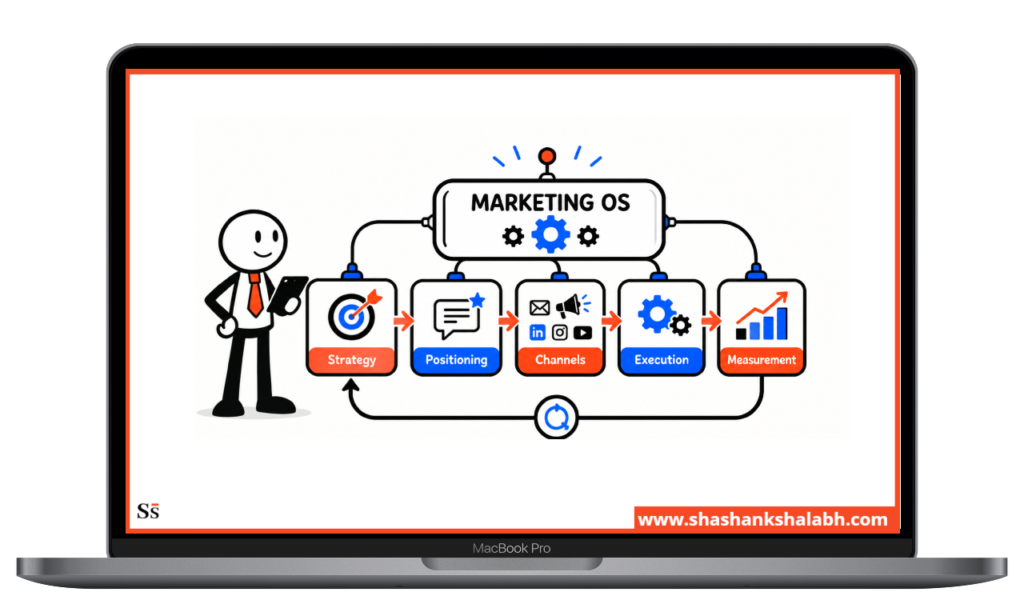
A marketing operating system connects every marketing function into a single, coherent system rather than treating them as separate initiatives.
The OS defines how strategy translates into positioning, how positioning informs channel selection, how channels drive execution, how execution gets measured, and how measurement feeds back into strategic decisions.
It’s the operational infrastructure making marketing predictable rather than reactive.
When you don’t have this connection (marketing operating system), most tactics fail.
Your campaigns would run without clear strategic purpose, and channels would operate in isolation. Moreover, your KPIs would have a disconnect from revenue outcomes.
Businesses scaling past $5M revenue need this OS as marketing complexity exceeds what ad-hoc coordination can manage.
PS: in this post I will use the terms Operating System and OS interchangeably.
Understanding Marketing OS
Think of the Marketing Strategy of the “what”, and the OS as the “how”.
A marketing strategy defines what you’re trying to achieve and the general approach. The operating system defines how that strategy actually operates day-to-day.
The “how” covers who owns what, how we make decisions, how we measure progress, and how the system self-corrects based on results.
You can have a brilliant strategy. But without a robust system underneath, you can’t scale the business.
The Core Components
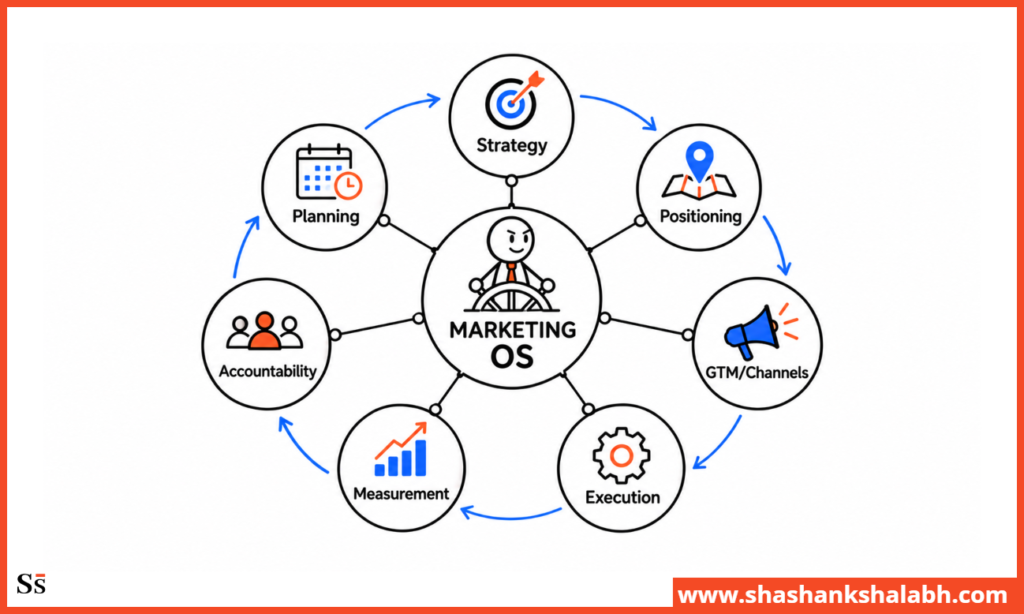
A Marketing OS comprises seven interconnected components:
Strategy: Business objectives, revenue targets, and ideal customer profile driving all downstream decisions.
Positioning: Clear differentiation and messaging framework guiding how you communicate value.
GTM/channels: Specific acquisition strategy and channel prioritization based on where target customers actually are.
Execution: Clear ownership, accountability, and deliverables ensuring strategy translates into action.
Measurement: KPIs and dashboards connecting marketing activity to business outcomes.
Accountability: Defined decision rights and responsibility ensuring nothing falls through gaps.
Planning cadence: Regular rhythm (annual, quarterly, monthly, weekly) keeping the system operating consistently rather than reactively.
How a Marketing Operating System Works
Since marketing isn’t a one-and-done process, the OS operates as a continuous cycle.
Here is the core framework:
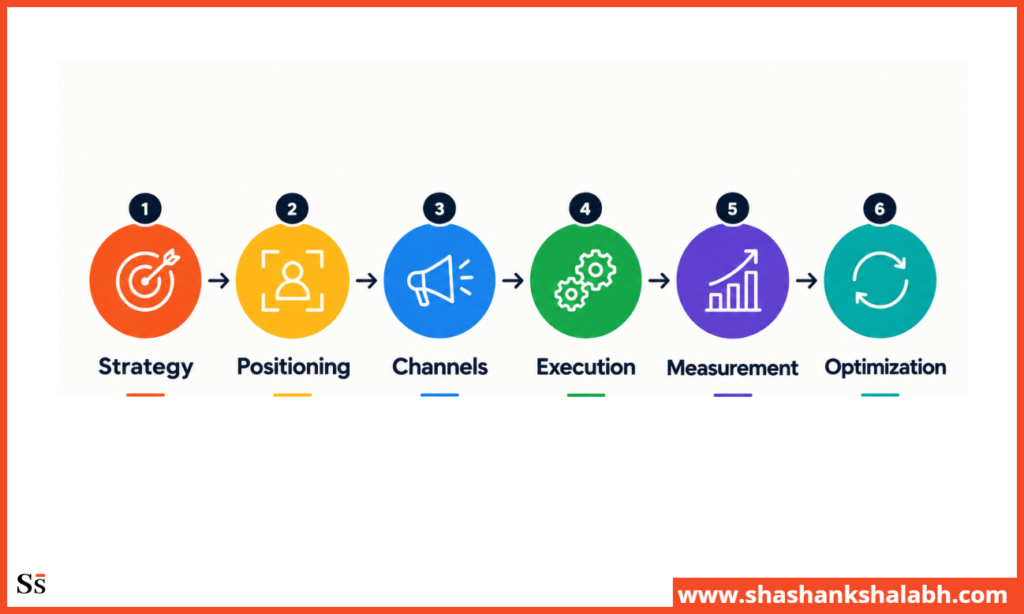
Strategy → Positioning → Channels → Execution → Measurement → Optimization
You set a strategy, figure out how you want to position the brand, choose the right channels, and put the plan into action. Then you look at the results, learn what worked, make adjustments, and go back to the strategy.
It’s an ongoing process of testing, learning, and improving.
And this is the feedback loop:
Measurement → Insights → Strategy → Execution
This is what makes the system work as a whole instead of as a collection of disconnected tactics.
Don’t mistake measurement for reporting results. It shows you what needs to change.
Those learnings then shape what you do next, so campaigns improve over time instead of simply being repeated.
Without this feedback loop, businesses repeat the same tactics even when they aren’t working. There’s nothing connecting the results back to the decisions that shaped the work in the first place.
When that loop is working, the business can learn from what happens and make better decisions over time.
That’s the basic idea behind a marketing operating system: strategy guides the work, the work produces results, and those results help shape what happens next.
Step 1: Build the Marketing Strategy Layer
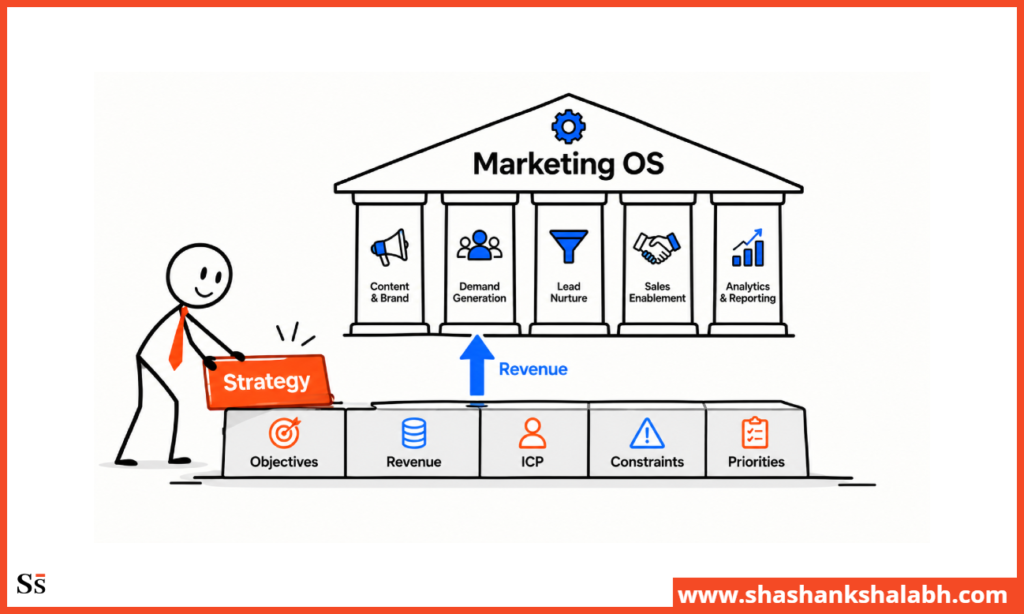
The first thing to do is build the foundation, aka, Strategy.
Business objectives
Marketing strategy must connect directly to business objectives-revenue growth, market expansion, category leadership, or exit preparation.
Without this connection, marketing activities happen in isolation from what actually matters to the business.
Revenue targets
Specific, quantified targets (not “grow revenue” but “increase ARR from $8M to $15M”) give marketing clear direction.
If the objective is vague, the strategy will be too. Clear, specific targets make it easier to see what marketing actually needs to achieve.
Ideal customer profile (ICP)
Precise definition of who you’re targeting-company size, industry, use case, buying authority-determines everything downstream: positioning, channel selection, messaging, and content strategy.
Remember, unclear ICP creates unfocused marketing trying to appeal to everyone.
Growth constraints
Your budget, team capacity, sales cycle, and market size all shape what’s realistic.
Ignore them, and you can end up with a strategy that looks great on paper but falls apart when it’s time to execute.
Strategic priorities
Given limited resources, what matters most this year?
Is it new customer acquisition, or expansion revenue, or market share in a specific segment? Priorities force you to choose what matters most instead of trying to do everything at once.
Marketing’s role in revenue
Being clear about how marketing contributes to revenue, whether through pipeline, brand awareness, or expanding existing accounts, creates accountability and keeps marketing, sales, and leadership aligned on the same goals.
This strategy layer becomes the foundation informing every subsequent decision in the operating system.
Step 2: Connect Positioning to Demand Generation
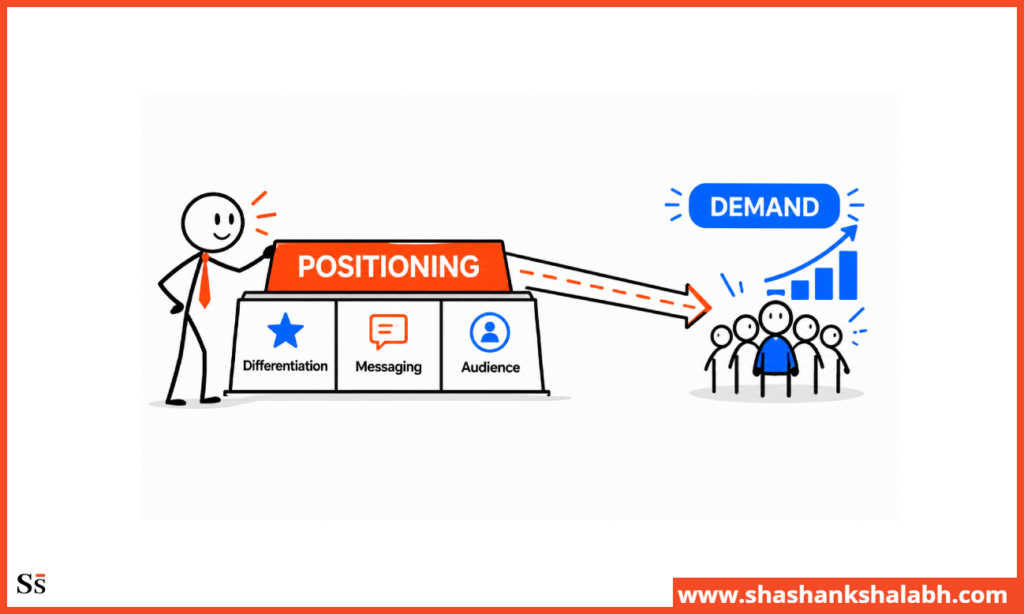
Positioning only matters if it helps generate demand. And demand generation falls flat when the message isn’t clear or differentiated.
Positioning is about how you want customers to see you compared to other options. It defines the problem you solve, who you solve it for, and why you’re the better choice.
I want to emphasize here that positioning is not about coming up with a tagline.
The goal here is to be clear on what sets you apart.
Differentiation
What makes you meaningfully different from competitors?
Saying you’re “better,” “easier,” or “more powerful” doesn’t give customers much reason to choose you. The difference needs to be specific and tied to an outcome customers actually care about.
Messaging
Positioning shapes the messaging that follows.
You need a clear value proposition, proof to back it up, answers to common objections, and messaging that speaks to different use cases. The core message should stay consistent wherever customers encounter your brand.
Target Audience alignment
Your positioning should match the ICP you defined in Step 1.
Trying to appeal to everyone will weaken your messaging. It’s better to speak directly to the audience you want to reach and address what matters most to them.
Channel implications
Your positioning should help determine where you reach your audience.
An enterprise B2B company may need a very different channel mix than a product led growth company. Start with how you want to compete and who you’re trying to reach, then choose the channels that fit.
Demand creation
Good positioning makes it easier for people to understand the problem you solve and why your solution matters.
When the message is clear, customers are more likely to see the value without needing a lot of explanation.
When positioning is weak, businesses often try to make up for it by spending more on acquisition. Weak positioning makes customer acquisition more expensive because customers don’t have a clear reason to choose you.
Step 3: Build the Channel and Demand Generation Layer
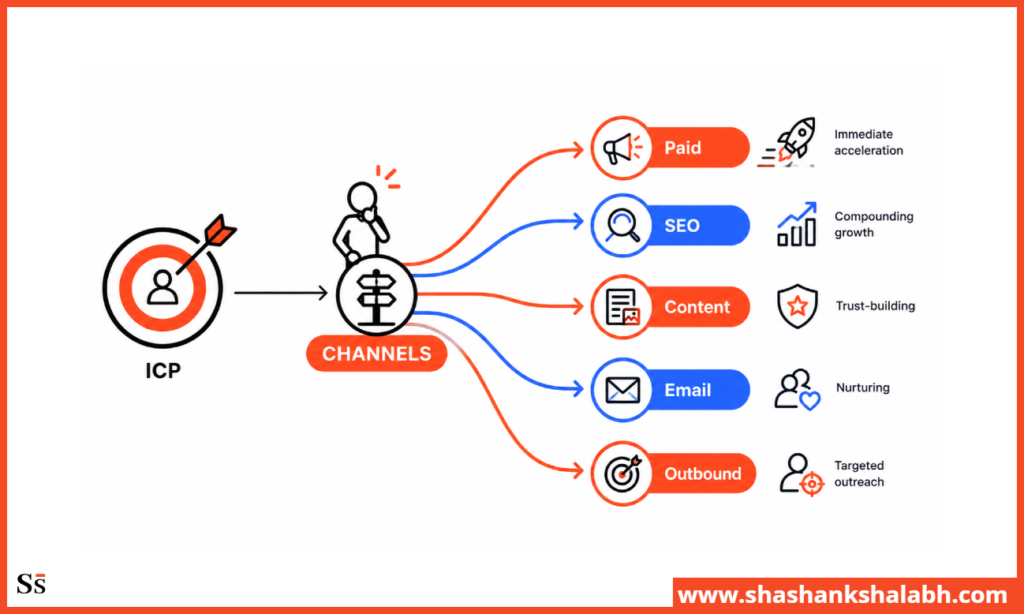
Channels bring the demand generation strategy to life, but they only work when you focus on the right ones.
Channel selection:
Choose channels based on where your ICP actually spends time and how they research solutions. Don’t choose them because they’re trendy or because competitors use them. Enterprise B2B buyers behave differently from SMB buyers who prefer to research and buy on their own.
Different channels serve different purposes:
- Paid advertising: Immediate, scalable demand generation with clear attribution
- Organic search (SEO): Long-term, compounding demand generation with lower ongoing cost
- Content marketing: Trust-building and education supporting longer sales cycles
- Email: Nurture and retention driving expansion and reducing churn
- Outbound: Direct, targeted approach for high-value enterprise accounts
Most companies are better off putting 70 to 80% of their resources into 2 or 3 main channels. Focusing on fewer channels gives you more room to learn what works and improve.
The idea is to choose the right channels, tie them back to your strategy, and put more resources behind what works. This keeps each channel from operating on its own.
Step 4: Create Execution and Accountability
Strategy and channels mean nothing without clear execution ownership and accountability.
Every initiative needs one person responsible for it. Not a committee or the marketing team as a whole. When ownership is unclear, things get missed and initiatives can fall apart.
Be clear about who handles demand generation, content, product marketing, marketing operations, and leadership. Too much overlap causes confusion, while gaps leave work undone. Clear roles help prevent both.
Be clear about who makes the key decisions.
Who controls the budget? Who approves messaging changes? Who decides which channels get priority?
Clear decision rights keep decisions from getting stuck or pulled in different directions.
Agency vs. internal responsibilities
If you work with agencies, be clear about what they handle and what stays in house.
Agencies can focus on specialized execution while the internal team owns strategy and coordination. Clear boundaries help avoid both micromanaging agencies and letting them work without direction.
Deadlines/Deliverables
Set clear deadlines and deliverables. “Publish 8 optimized articles by the end of the quarter” is much clearer than “improve SEO.” Vague expectations lead to vague results.
Accountability mechanisms
Regular check-ins and progress reviews keep people accountable. When commitments are missed, address them and make adjustments. When things go well, recognize the progress. The goal is to keep work moving.
Step 5: Establish the Marketing Planning Cadence
Without a regular planning rhythm, marketing becomes reactive instead of planned.
Annual planning → Quarterly planning → Monthly reviews → Weekly execution → Campaign reviews → Pipeline reviews
Set the year’s goals, major initiatives, and budget around the business priorities. Have a plan, but leave room to change tactics as you see what works.
Review the last quarter, use what you learned to adjust the strategy, and set priorities for the next 90 days. This gives you enough time to make progress while still allowing room to change direction.
Check progress against quarterly goals, flag issues early, and adjust as needed. Monthly reviews help catch problems before they turn into bigger misses.
Keep the team aligned on current work, clear blockers, and keep active campaigns and projects moving.
Review each campaign after it ends. Look at what worked, what didn’t, and why. Use those lessons to improve the next campaign.
Review pipeline health, conversion rates, and forecast accuracy every week or two. This keeps marketing and sales aligned and helps catch issues early.
This keeps the team from constantly reacting while still leaving room to adjust when things change.
Step 6: Build the Marketing KPI and Dashboard Layer
Measurement shows whether the work is actually producing results or just keeping everyone busy.
| Business metrics | Marketing metrics | Executive metrics |
| Revenue: Total and marketing-influenced revenue contribution | Leads: Volume and quality by source | Marketing-sourced pipeline: Percentage of pipeline marketing directly generates |
| Pipeline: Coverage ratio and pipeline value by stage | Conversion rates: Performance at each funnel stage | Marketing-influenced revenue: Broader contribution including assisted conversions |
| CAC: Customer acquisition cost by channel and blended | Channel performance: ROI and efficiency by channel | CAC efficiency: Trend over time showing improving or declining efficiency |
| LTV: Customer lifetime value showing retention and expansion | Pipeline contribution: Marketing’s specific contribution to pipeline | Forecast vs. target: Accuracy of predictions vs. actual results |
| Payback period: How quickly acquisition costs get recovered |
Decision-making over vanity metrics.
Focus on metrics that actually change what you do. Website traffic means little without conversion data. Social followers mean little if they have no connection to the pipeline.
Ask of every metric: “What does this tell us?” If it doesn’t lead to a decision or action, it probably doesn’t need much attention.
Step 7: Align Marketing and Sales
Marketing and sales need to work together. If they have different priorities or operate separately, the whole system breaks down.
Shared definitions:
Marketing and sales need to agree on what a qualified lead is, when a lead is ready for sales, and how deals move through the pipeline. If they use different definitions, they’ll quickly get out of sync.
ICP alignment:
Sales and marketing should target the same ICP. If marketing brings in leads sales doesn’t want, or sales goes after customers marketing isn’t focused on, the system breaks down.
Lead qualification:
Set clear rules for when a lead is ready for sales. Marketing should send leads Sales can actually work, and Sales should share feedback so marketing can improve its targeting.
Pipeline ownership:
Marketing owns Demand Gen, while sales owns turning qualified opportunities into closed deals. The handoff should be clear, with both teams accountable for the health of the overall pipeline.
Handoffs:
Document specific handoff process: when marketing passes leads to sales, what information transfers, expected response time, and follow-up protocol. Unclear handoffs cause leads to fall through gaps.
Feedback loops:
Sales should regularly tell marketing which leads turn into customers, which ones don’t, and why deals are won or lost. What sales hears from customers can also help improve marketing’s targeting and messaging.
Revenue reporting:
Marketing and sales should report on revenue together, not as two separate sets of numbers. Looking at the full picture makes it easier to see what’s working and where the business needs to improve.
When both teams share the same goals and numbers, they work together instead of pointing fingers.
How Agencies and Internal Marketing Teams Fit Into the Operating System
Different resources serve different roles within a functioning marketing operating system.
| Model | Role in System |
| Internal team | Ownership and execution of core strategic functions |
| Agency | Specialized execution requiring specific expertise (paid media, PR, design) |
| Consultants | Project-based expertise or advice on specific challenges |
| Fractional CMO | Strategy, leadership, and accountability across entire system |
In most cases, internal teams handle strategy, coordination, and work that depends on deep company knowledge, such as product marketing, customer insights, and sales alignment. Agencies are often brought in for specialized work like paid media, creative, or PR.
The Marketing OS helps define how they work together. Most growing companies use a mix of both, with the internal team setting the direction and agencies handling specific areas of execution.
Without a clear system, agencies can end up running their own campaigns without much connection to the rest of the business. Everyone should be working from the same strategy, positioning, and KPIs.
Here, the goal is to make sure everyone is working toward the same goals.
Common Marketing Operating System Failure Points
Here is what causes a Marketing OS to break down:
PS: You can also use this as a checklist to assess whether your current marketing operates as a system or disconnected activities.
- Strategy and execution don’t line up: The strategy says one thing, but the campaigns go in another direction. People struggle to explain how the work connects to the company’s priorities.
- Too many channels: The team tries to cover everything instead of focusing on the few channels that matter most.
- No clear ownership: Work gets stuck because no one clearly owns it.
- Marketing metrics don’t connect to revenue: The reports look positive, but the business isn’t seeing the same results.
- Marketing and sales aren’t aligned: The teams disagree on lead quality, follow up, priorities, or even what a qualified lead means.
- No regular planning: The team keeps reacting to whatever comes up instead of working from a clear set of priorities.
- Agencies operate on their own: Outside partners run campaigns without enough connection to the company’s strategy or the rest of the marketing team.
- Too much activity, not enough progress: The team stays busy launching campaigns and creating content, but the results don’t improve.
These problems come from a lack of connection between the different parts of marketing.
When You Need Executive Marketing Leadership
As companies grow, marketing gets more complex, and most teams eventually outgrow a purely tactical approach.
More channels, bigger teams, larger budgets, unclear ownership, and inconsistent pipeline all create a need for stronger strategic leadership.
That’s where a fractional CMO can help. They build a marketing operating system that connects strategy, execution, measurement, and improvement, then make sure the team actually uses it.
For comprehensive service scope, see fractional CMO services.
And to assess how I approach this work specifically, see how I work as a fractional CMO.
FAQ: Marketing Operating System
What is a marketing operating system?
A marketing operating system connects strategy, positioning, channels, execution, measurement, and accountability so they work together.
Instead of running disconnected campaigns, it gives your team a clear way to plan, execute, measure results, and adjust. As companies grow, that structure becomes more important because marketing gets harder to coordinate.
Why does a company need a marketing operating system?
You need a marketing operating system when marketing starts getting too complex to manage informally. Maybe you’re juggling multiple channels, growing the team, spending more without seeing better pipeline, or dealing with marketing and sales working in different directions.
Without a system, strategy often stays on paper, teams work in silos, and results depend too much on individual tactics or people.
What are the components of a marketing operating system?
A complete marketing operating system has seven parts: strategy, positioning, channels, execution, measurement, planning cadence, and sales alignment.
Each one supports the next. Strategy sets the direction, positioning shapes the message, channels reach the right people, execution gets the work done, and measurement shows what’s working. Planning keeps everything moving, while sales alignment keeps marketing connected to revenue.
How do you build a marketing operating system?
Set the strategy, define the positioning, choose your channels, assign ownership, set a planning rhythm, connect KPIs to business results, and align marketing with sales. Each step builds on the last, so start with strategy and work through the full system.
You can build the initial framework in 60 to 90 days, then keep refining it as you learn what works.
What is the difference between a marketing strategy and operating system?
Marketing strategy defines where you want to go and how you plan to get there. The operating system makes that strategy work day to day.
It sets ownership, decision making, measurement, and how the team adjusts when things change. A good strategy matters, but without a system behind it, execution often depends on individual people instead of a repeatable process.
How does a fractional CMO build a marketing operating system?
I start by looking at what’s actually happening in the business.
That is, what’s working, what isn’t, and where strategy and execution have drifted apart.
Then I build the pieces the business needs, from strategy and positioning to channels, ownership, KPIs, planning, and sales alignment. The initial work usually takes 60 to 90 days, then the system keeps evolving as the team learns what works.
When should a company implement a marketing operating system?
Most businesses need a marketing operating system once the team, channels, and budget become too much to manage informally.
That often happens around $5M to $10M in revenue, but the real indicator is complexity. If the team keeps running into unclear ownership, inconsistent results, wasted spend, or friction between marketing and sales, it’s probably time.
The goal is to put the structure in place before those problems become harder to fix.

Ready to Build a Marketing System That Actually Works?
If you’re still piecing marketing together yourself, chasing results from one tactic to the next, or wondering why more activity isn’t producing more growth, it may be time to change how marketing operates.
More marketing is not going to help. The solution is to build a system that helps the right work happen, shows you what’s working, and gets better over time.
Schedule a strategy call to discuss:
- Your current marketing operations and where disconnection exists
- Which components of the operating system are missing or broken
- How building a functioning system would change your results
- Whether fractional CMO engagement fits your stage and needs
I’ll honestly assess your current marketing operating system (or lack thereof) and outline what building a functioning system would require for your specific situation.
Want to learn more?
Explore my fractional CMO services, see how I work with companies as a fractional CMO, or read how a fractional CMO can help you scale.

Shashank brings over 22 years of global omnichannel marketing experience. As a 4x Chief Marketing Officer, he has helped several organizations (Startups and Fortune 500) drive sustainable revenue growth through strategic marketing.