
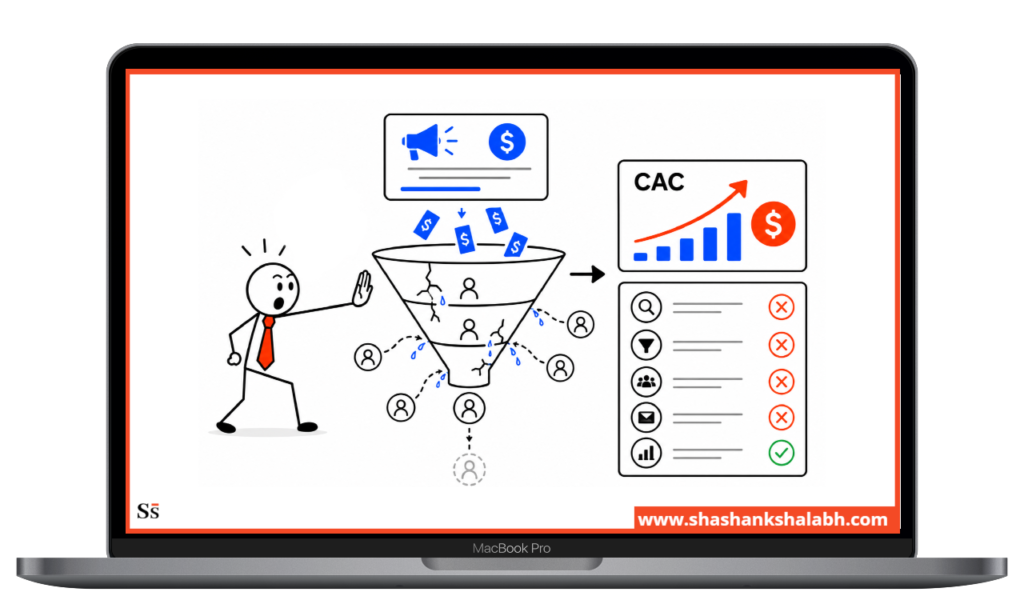
Paid advertising is the fastest way to scale a working marketing system.
It is also the fastest way to burn a budget on a broken one.
Why am I criticizing Paid when I have overseen media buying north of $30 Million annually?
In the capacity of both a CMO and a fractional CMO, I have seen several B2B organizations launch paid acquisition before the prerequisites exist.
Then they watch the CAC climb; and end up concluding paid doesn’t work for their business. So they either keep spending out of inertia or stop entirely.
None of these solves the core issue.
What this post covers (tl;dr)
- Why do paid ads fail most B2B companies?
- The 5 prerequisites for running paid
- A diagnostic to check whether you have them
- What to do while building the prerequisites?
- When to pause paid ads entirely?
Why Paid Ads Fail Most B2B Companies?
In my experience, there are two core reasons why Paid (as a channel) fails to meet the expectations in the B2B setting.
Let’s discuss these.
Demand vs Amplification
Paid acquisition works by putting a message in front of a defined audience at a defined moment.
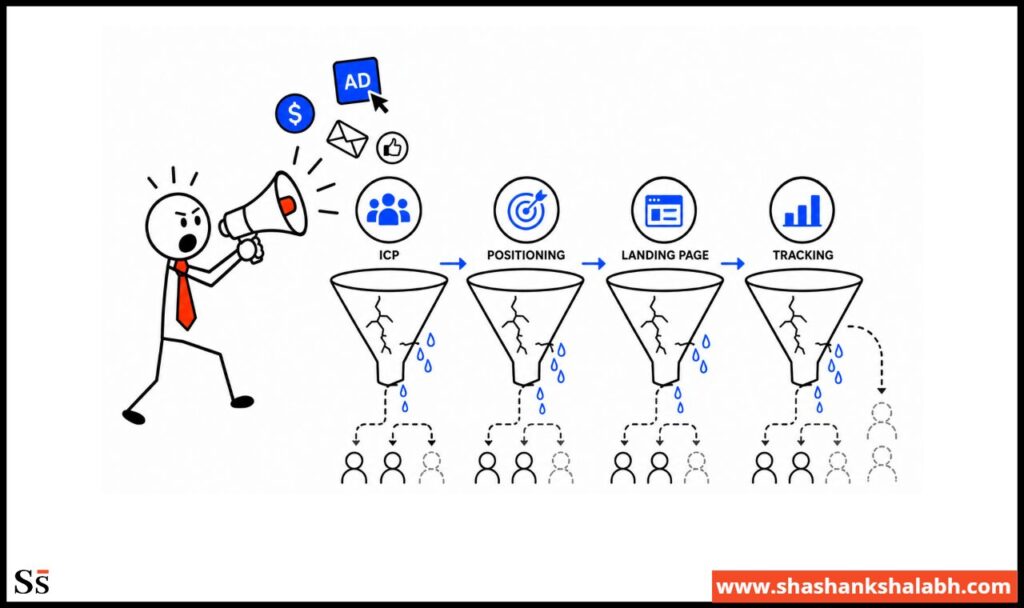
But if the message, audience, or the moment is wrong, this channel amplifies the problem.
Here, the primary variables are the message, the audience definition, and the conversion infrastructure.
Blaming paid ads for poor results is like blaming a megaphone for a bad speech.
Dozens of businesses respond to poor paid performance by changing the channel. They switch from Google to LinkedIn, from display to search, from search to social.
These do not fix the core issue.
The Premature Scaling Trap
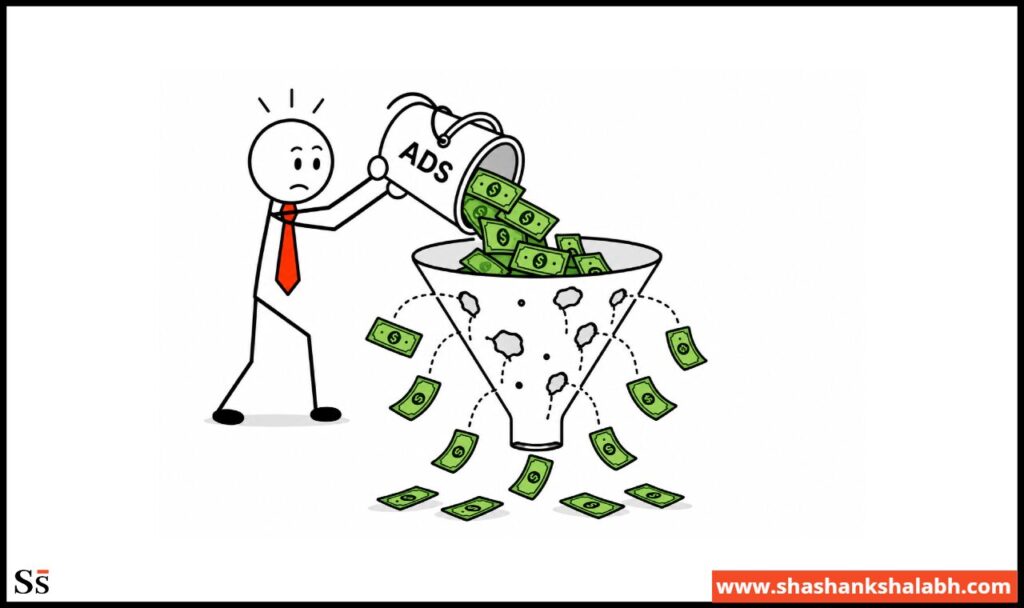
I have seen businesses launching paid before they know precisely who to target, what to say, or what happens after a click.
They end up spending money to drive traffic to a page that doesn’t convert to an audience that isn’t ready to buy.
While you might blame the channel for this, the underlying issue is different.
The channel is functioning exactly as designed. It is reaching an audience and driving clicks. However, the marketing system receiving those clicks isn’t designed to convert them.
What Paid Ads Actually Require to Work
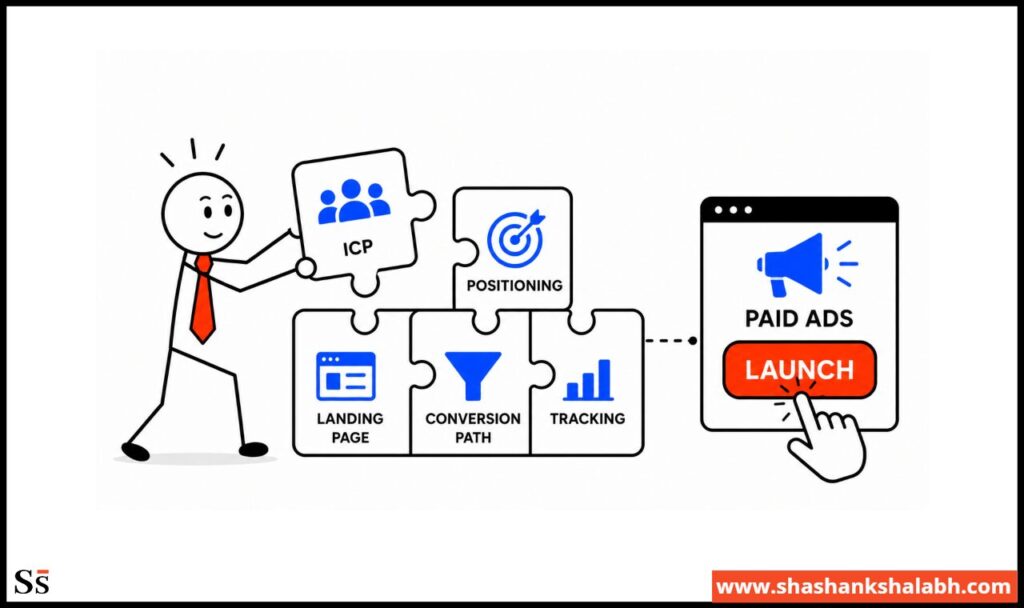
As promised, here are those five things that must exist before paid acquisition produces ROI in B2B:
- A defined ICP specific enough to target precisely
- Positioning sharp enough to stop the right buyer mid-scroll and let the wrong buyer keep scrolling
- A landing page that converts ICP-fit visitors at 3-5% or higher for demo requests and high-intent B2B offers
- A conversion path from click to pipeline (not just from click to lead)
- Tracking that attributes CAC to specific campaigns.
Let’s discuss these in detail. Note, this is all in the context of Paid as a channel.
A Defined ICP With Targeting Criteria
If you say your ICP for Paid is “mid-market B2B companies”, you are mistaken.
That is not specific.
You need an ICP specific enough to build a targeting audience in Google, LinkedIn, or Meta without significant overlap with people who will never buy.
Here is what the ICP should cover, at the very least:
- Company size range
- Industry vertical
- Technology stack
- Funding stage
- Geography
- Job titles of both the buyer and the internal champion
For LinkedIn specifically, the ICP needs to be specific enough to build a target audience of under 300,000.
This is large enough to generate volume, and small enough to minimize waste.
Why paid fails without it?
Broad targeting means paying to reach people who will never buy.
At $50 cost-per-click in competitive B2B categories, a broad ICP burns significant budget in days without producing a single qualified lead.
Every irrelevant click inflates CAC and produces zero revenue.
You might blame paid channel for this. But, in reality, your ICP is broken, and the channel is executing perfectly against the wrong audience.
Make sure you have a definitive yes to these questions before committing to a paid budget.
- Can you build a LinkedIn audience of under 300,000 using only ICP criteria, without using broad job category filters that include non-buyers?
- Can you list the five firmographic criteria that describe 80% of closed-won customers from the trailing 12 months?
- Can you name the buying trigger that activates the ICP to start evaluating solutions?
Check out my post on Go-To-Market Strategy for Scaling Companies to understand the ICP rebuild process.
Positioning That Stops the Right Buyer
A paid ad headline has three to five seconds to do one job…
Stop the right buyer mid-scroll and let the wrong buyer keep scrolling.
Generic positioning fails this job.
“More pipeline for B2B companies” is a statement that applies to every B2B company, which means it’s meaningfully relevant to none of them.
Strong paid positioning is specific enough to feel almost too narrow.
“How Series A SaaS companies with a new VP of Sales reduce CAC in 90 days” is not for everyone.
It’s precisely for the company that matches that profile; and those are the only people who need to click.
Why paid fails without it?
Weak positioning produces high click-through rates from the wrong audience and low conversion from the right one.
People who liked the headline because it was vague click and discover the product isn’t for them. The landing page continues the weak positioning and the visitor bounces.
As a result, your CAC climbs because paid spend is funding a lot of activity that produces no revenue.
The spend looks productive (high impressions or clicks), but the pipeline output doesn’t match.
How to know if you have it?
Show the ad headline to ten people outside the company.
Ask one question: who is this for?
If you get vague or varied responses, your positioning is too generic for paid.
Here’s a positioning test for paid specifically:
A paid headline must accomplish three things simultaneously in ten words or fewer:
- Identify the specific buyer
- Name their specific problem
- Imply a specific solution
Let me give you an example.
“More pipeline for B2B companies” fails all three because it identifies no one, names nothing specific, implies nothing specific.
On the other hand, “How Series A SaaS companies reduce CAC by 30% in 90 days” passes all three.
This is because it identifies a specific buyer (Series A SaaS), a specific problem (high CAC), and a specific implied solution (a defined approach with a defined timeline).
If the headline can’t pass this test, fix positioning before funding Paid.
A High-Converting Landing Page
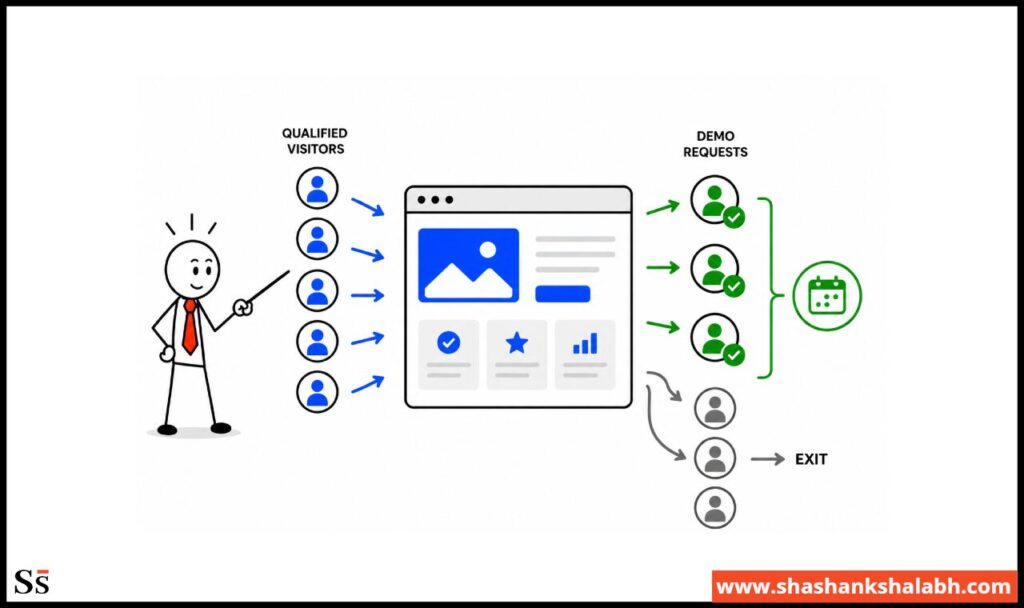
A high-converting landing page attracts visitors who match the ICP, submit the form or take the next step at 3-5% or higher for demo requests and high-intent B2B offers.
Below that threshold, the page is destroying most of the value the ad created.
The homepage or a blog post (like this one) is not a landing page.
A landing page is a single-purpose page: one audience, one message, one action, no navigation. Every element on the page exists to advance the visitor toward one specific next step.
Why paid fails without it?
Sending paid traffic to the homepage produces 1-2% conversion at best.
Essentially, you are paying premium CPCs for homepage bounces.
Every percentage point of landing page conversion improvement reduces CAC proportionally. Moving from 2% to 4% landing page conversion halves the cost per lead from the same ad spend; without changing the ad, the audience, or the budget.
Most companies optimize the ad and ignore the page. The page is where most of the money is being lost.
Make sure you have a definitive yes to these four questions before paid traffic hits the landing page.
- Is there a dedicated page for each paid campaign with no navigation and one CTA?
- Does the page headline match the ad headline exactly? same language, same promise, same specific offer?
- Does the page load in under three seconds on mobile?
- Is the form above the fold with fewer than five fields?
Let me give you the minimum viable landing page for B2B paid:
- Headline that mirrors the ad copy exactly
- Three bullet points addressing the buyer’s primary evaluation objections
- One proof point: a specific result
- One form with 3-4 fields: name, email, company, one optional qualifier
- Zero navigation: no header menu, no footer links, no exits other than form submission
- Mobile load time under 3 seconds. This is non-negotiable for paid traffic where mobile is the primary delivery device
A Conversion Path From Click to Pipeline
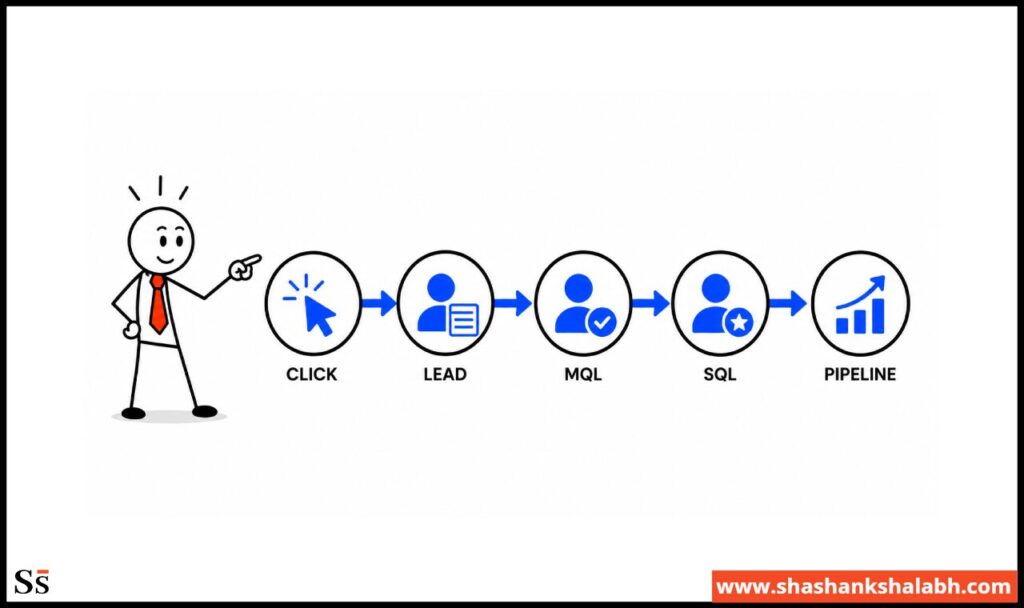
A lead is not a pipeline, and a click is not a lead.
The conversion path is the defined sequence of steps between someone clicking an ad and becoming a qualified sales opportunity.
Most B2B paid campaigns generate leads (not pipeline) because the path from lead to pipeline is undefined.
A lead enters the CRM and waits for someone to notice or follow up, or for some sequence to eventually trigger.
Businesses measure this “wait time” in days; while the conversion probability drops by the hour.
Why paid fails without it?
A lead that enters the CRM and sits for four days is not going to become the pipeline.
Lead contact rates drop dramatically within the first 24 hours of inquiry, and continue declining each day after.
By day four, most leads have moved on; evaluated a competitor, been reached by a different vendor, or simply lost the urgency that prompted the click.
The ad produced the lead, but the broken conversion path destroyed it.
Most businesses measure Paid ROI in leads because that’s where measurement stops.
Think about this. Leads don’t pay revenue targets.
How to know if you have it?
Use these questions to assess what happens after form submission.
- What happens in the first 60 minutes after someone submits a paid ad form?
- Is there an automated acknowledgment that sets expectations?
- Is there a defined SLA for human follow-up?
- Is there a qualification process that separates sales-ready leads from nurture candidates?
For the detailed handoff and conversion fix sequence, see Why Your Lead Gen Isn’t Turning Into Pipeline.
Alright, so what does a working B2B paid conversion path look like?
As soon as someone submits a form, they get an automated confirmation, and your CRM instantly scores the lead against your ideal customer profile (ICP).
High-fit leads are flagged for same-day follow-up, while sales reaches out through the channel most likely to get a response via phone, email, or LinkedIn.
Leads that aren’t ready to buy enter a tailored nurture sequence that keeps them engaged without pushing for a meeting.
And if they go cold, they’re automatically re-engaged later, because today’s “not now” often becomes tomorrow’s opportunity.
This works because every step is defined, every step is documented and automated where possible.
The conversion path should work the same way whether or not anyone is watching.
Baseline Conversion Data to Optimize Against
Paid acquisition optimization requires data…
Which audiences convert, which messages produce pipeline, which campaigns produce CAC that justifies the spend.
Without baseline conversion data, paid optimization is guesswork with budget.
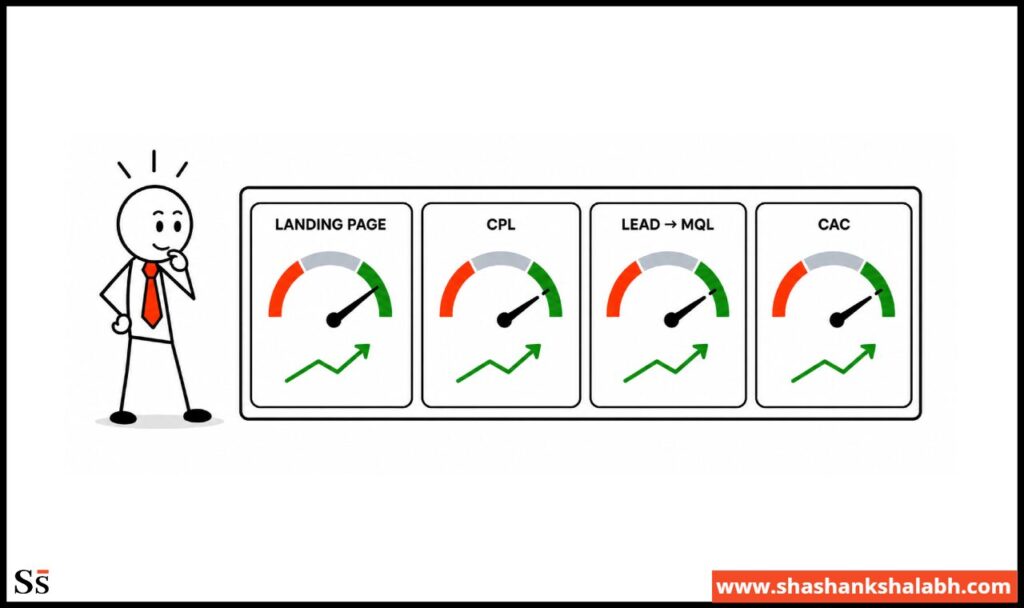
Have these before optimizing Paid
- Landing page conversion rate by audience segment
- Cost per lead by campaign
- Lead-to-MQL conversion by source
- CAC by channel
Why paid fails without it?
Without conversion data, there’s no way to know whether a campaign is working or failing until the budget is spent.
Without CAC by channel, you will end up making budget allocation decisions on volume metrics (which campaign produced more clicks) rather than efficiency metrics (which campaign produced revenue at what cost).
Most companies run paid for three to six months before realizing they have no reliable way to connect spend to results.
The tracking fix costs nothing in additional spend.
It’s a setup and attribution configuration, but it must exist before the budget is committed.
How to know if you have it?
Here are my four tracking questions.
- Is Google Analytics or equivalent tracking every landing page conversion with source attribution- specifically which campaign produced which conversion?
- Is the CRM tagging every lead with the specific campaign and ad that produced it?
- Can cost per MQL be calculated by campaign?
- Can a closed-won deal be traced back to the specific paid ad that generated the first marketing touch?
Check out this post on B2B Marketing Attribution Setup to understand this better.
The Order to Build Prerequisites If They’re Missing
Here is the right sequence before you launch Paid.’
ICP -> Positioning ->Lading Page -> Conversion Path -> Tracking
Build ICP first.
Everything else depends on knowing exactly who is being targeted.
You cannot write positioning, design landing pages, or set targeting criteria without the right ICP.
Build positioning second.
The landing page and ad copy both require positioning that’s specific enough to self-select. Positioning can’t be tested until ICP is defined.
Build the landing page third.
Paid traffic needs somewhere to convert. The landing page can’t be built without positioning.
Build the conversion path fourth.
Leads need a defined path to pipeline.
You can’t optimize the conversion path until landing page conversion is producing a consistent lead volume.
Set up tracking fifth.
Every conversion needs attribution before you scale the budget.
Launch paid last.
Now, you have a system designed to convert it.
What Happens When All Five Prerequisites Exist
When you meet all these five conditions, here is what happens.
CAC Drops Immediately
It starts with reaching the right buyers instead of paying for the wrong clicks.
Better messaging brings in more qualified leads, a stronger landing page converts more of them, and an optimized funnel turns more leads into pipeline.
With the right tracking in place, you can confidently invest more in what works and stop wasting budget on what doesn’t.
Working vs Broken Paid System
The difference between paid without prerequisites and paid with prerequisites is structural.
| Metric | Before | After |
| Customer acquisition cost (CAC) | $31,000 | $6,800 |
| Landing page conversion rate | 0.8% | 4.1% |
| MQL-to-SQL conversion | 6% | 28% |
For a detailed case study on how these improvements drive pipeline growth, explore How We 3X’d Pipeline in 6 Months.
Paid starts working because the foundation is finally in place.
Paid works best when the fundamentals are already in place.
With the right targeting, messaging, and conversion path, every dollar goes further because it’s amplifying a system that already converts.
Too many B2B companies expect paid ads to create growth from scratch.
Paid almost always performs better once the rest of the go-to-market engine is working
When to Pause Paid Ads Entirely?
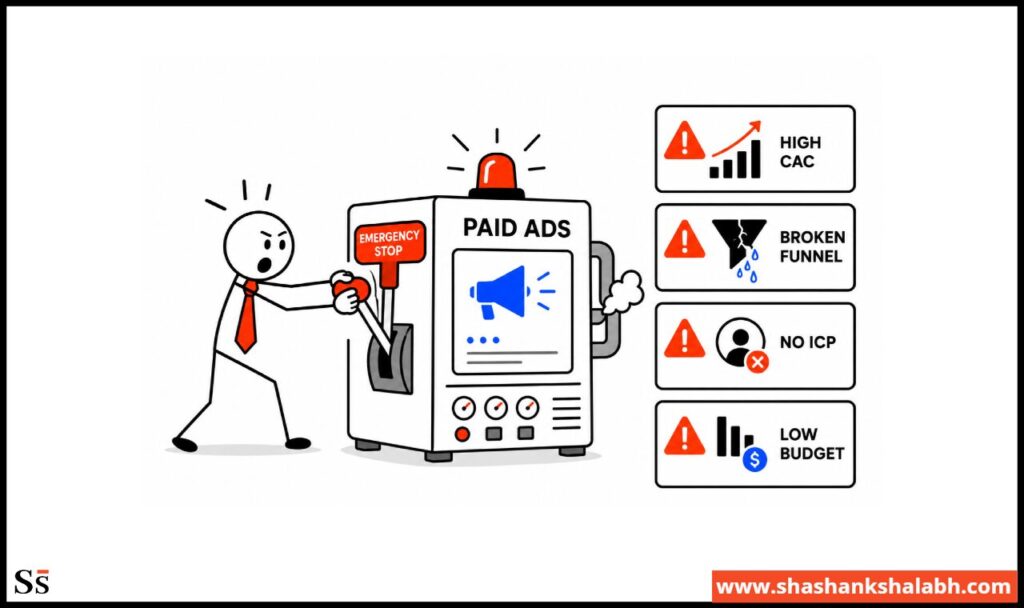
There are times when you can pause Paid channel.
When CAC From Paid Exceeds LTV
If it costs more to acquire a customer than that customer is worth, stop spending.
There’s no reason to scale a campaign that’s losing money.
It sounds obvious, but many companies keep investing because they don’t want to give up on paid. The better move is to fix the fundamentals, then relaunch.
Once the targeting, messaging, and conversion path improve, CAC usually comes down.
As a rule of thumb, aim for an LTV:CAC ratio of at least 3:1.
That is, about three dollars in lifetime value for every dollar spent acquiring a customer.
When the Conversion Path Is Completely Broken
If paid is generating leads but almost none become pipeline, the problem is everything that happens after the click.
If you keep adding more budget here, you will get more leads that never turn into revenue.
Pause the campaigns, fix the conversion path, then relaunch.
Tighten your follow-up process, automate the CRM, align sales and marketing, and make sure lead qualification is clear.
Once those pieces are in place, the same ad budget has a much better chance of producing pipeline instead of just leads.
When ICP Is Undefined
Running paid without a clear ICP means spending money on an audience you don’t fully understand.
You may get impressions, clicks, and form fills, but not the insights needed to optimize. You’re learning what a broad audience does, not what your best buyers do.
The result is months of spend without a clear signal to improve performance.
Pause paid, build your ICP from closed-won customers, then relaunch with targeting specific enough to generate useful data and better results.
When Budget Is Below Minimum Viable Threshold
B2B paid campaigns need enough budget and volume to learn.
Without enough conversions, platforms like Google and LinkedIn don’t get the data they need to improve targeting and performance.
For many B2B companies, that means roughly $5K+/month in paid spend, depending on CPCs and conversion volume.
If the budget isn’t high enough to generate a useful signal, paid will struggle no matter how strong the strategy is.
In that case, focus on channels that don’t require scale to work.
For example, you can look into SEO, content, and outbound, until paid has enough fuel to perform.
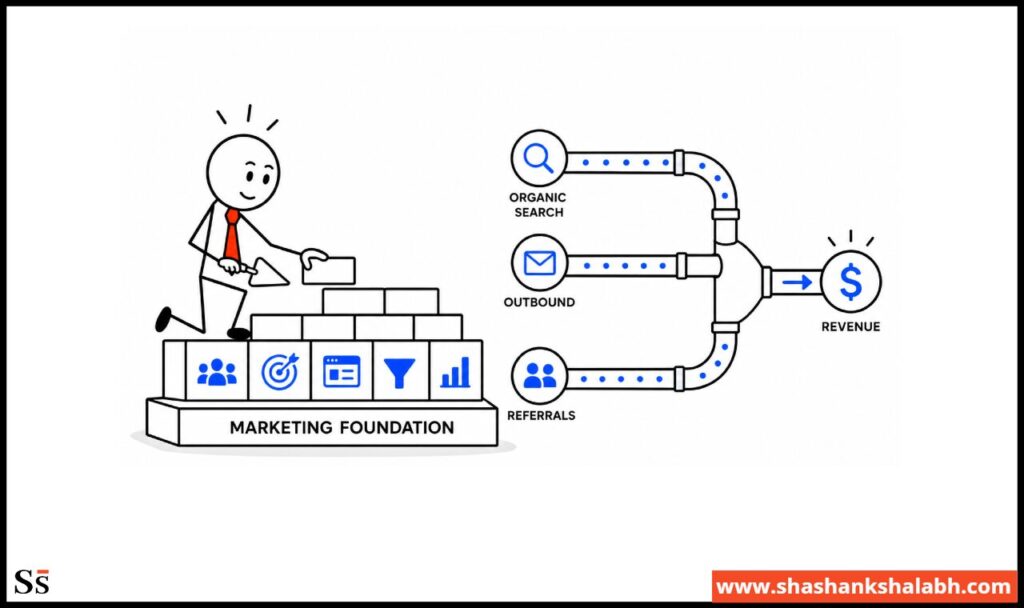
What to Do While Building the Prerequisites
Building the five prerequisites takes 30–60 days, but revenue still needs to move during that time.
These three channels can generate pipeline without waiting for the full paid system to be in place.
Organic Search: The Channel That Rewards the Wait
ICP-focused content builds pipeline that grows over time without paying for every click.
The tradeoff is speed.
On average, SEO takes 3-6 months to show meaningful results. But the upside is that returns grow over time.
It also helps validate your messaging before spending on ads.
Content that attracts and converts the right buyers organically is more likely to work with paid traffic too.
If it doesn’t resonate organically, paid spend won’t fix it.
For more on organic-first GTM architecture, check out Go-To-Market Strategy for Scaling Companies.
Outbound Targeting Known ICP Companies
Once the ICP is clear, outbound can reach the right companies with a targeted message.
It costs less than paid, delivers higher-quality conversations than broad inbound, and can launch faster than organic.
Outbound only needs two foundations: a clear ICP and strong positioning.
It doesn’t require a complete landing page, conversion path, or tracking setup, making it the ideal bridge while the paid system is being built.
Referral and Partner Channels
Partner and referral channels often deliver the lowest CAC because they rely on relationships, not ad spend.
They take time to build, but they can produce results faster and more efficiently than paid channels.
The best partners are usually already hiding in your ICP data.
I am referring to the tools, vendors, and service providers your best customers already use. Building those relationships early can become a major growth advantage, especially at the $2M-$10M ARR stage.
How a Fractional CMO Handles Paid Acquisition?
Here is how I approach Paid Acquisition.
I start by diagnosing before spending.
I look at what’s missing, whether it’s the ICP, positioning, conversion path, landing page, and tracking.
Paid usually underperforms when the foundation isn’t there.
My first 30 days focus on building a system that converts. The metric I care about is CAC by channel. I am not too concerned about clicks, impressions, or lead volume.
For more on the fractional CMO engagement model, see Fractional CMO Responsibilities and Fractional CMO Services.
FAQ: Stop Running Paid Ads
Here are the most common questions (and their answers) related to using Paid Channel for B2B.
Why aren’t my paid ads generating leads?
B2B paid ads usually fail because the foundation is weak.
Broad targeting, generic messaging, poor landing pages, or too little budget prevent campaigns from finding and converting the right buyers.
Switching platforms won’t fix those issues. Build the prerequisites first, then scale the channel.
What should I have before running paid ads?
B2B paid needs five things to work: a clear ICP, sharp positioning, a focused landing page, a defined sales follow-up process, and campaign-level CAC tracking.
When these pieces are in place, paid can scale efficiently. Without them, performance usually breaks down no matter which platform or ad format you use.
How much should a B2B company spend on paid acquisition?
Most B2B paid channels need around $5K/month to generate enough conversion data for platforms to optimize. Below that, there isn’t enough signal to improve performance.
Once the foundation is working, scale based on CAC and LTV. Increase spend while CAC payback stays healthy. If payback stretches beyond 18 months, fix the system before spending more.
When should I pause paid ads?
Pause paid when the economics don’t work, the conversion path is broken, the ICP is unclear, or the budget is too low for the platform to learn. Fix the specific gap, then relaunch with a stronger foundation.
What is a good CAC for B2B paid acquisition?
There’s no universal “good” CAC for B2B paid acquisition. It depends on what a customer is worth.
A $10K CAC could be great for a $50K ACV product and a problem for a $12K one. The numbers that matter are payback period and LTV:CAC.
A healthy benchmark is getting your CAC paid back within 12 months with at least a 3:1 LTV:CAC ratio. If you’re pushing past 18 months or the economics don’t work, don’t spend more.
Closing Thought: Stop Running Paid Ads
Paid ads usually aren’t the issue. The bigger problem is what happens before and after someone clicks.
When the ICP, positioning, landing page, conversion process, and tracking are in place, paid works. When they’re missing, performance suffers no matter how much you spend.
Build the foundation first, then scale paid into a system that’s ready to turn clicks into customers.

Shashank brings over 22 years of global omnichannel marketing experience. As a 4x Chief Marketing Officer, he has helped several organizations (Startups and Fortune 500) drive sustainable revenue growth through strategic marketing.