
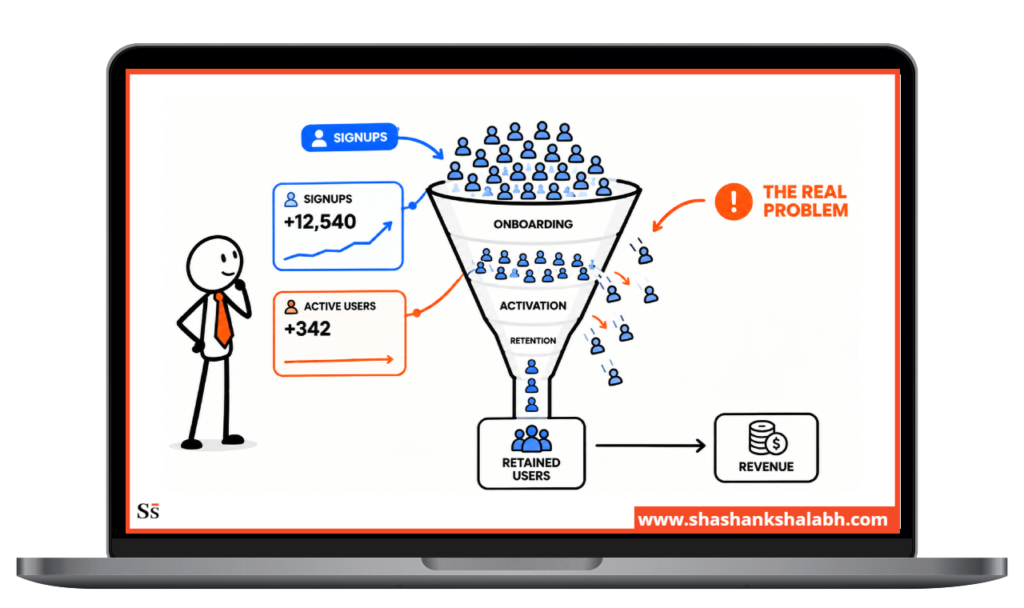
A fintech can generate thousands of signups and still have very few active users.
That’s because signup is an acquisition event.
And filling out a form is not the same as adopting a product!
Instead, here’s the funnel that you should look into:
Visitor → Signup → Onboarding → Activation → Active User → Retained User → Revenue
As a Fractional CMO for Fintech, I have observed that most fintechs track the first step obsessively and lose track of everything after it.
The marketing dashboard shows signups climbing every week, which makes the CEO feel good.
However, active users are flat, and nobody’s connecting the two numbers.
And that gap hides the real issue.
Signup Vs. Activation
A signup means someone created an account.
It doesn’t tell you why they signed up, whether they see value in the product, or if they’ll ever come back.
Activation tells you whether someone actually started using the product. It’s the action that shows they’ve moved beyond signing up and begun adopting it.
For fintech products, that might mean:
- Funding an account
- Making a transaction
- Completing identity verification
- Connecting a bank account
- Making a first investment
- Sending a payment
- Creating a financial plan
- Using a core feature
Why the Activation Event Matters
Don’t define an active user as someone who simply logs in.
Note that a login shows interest or curiosity.
Someone might log in five times and still never fund an account, connect a bank, or take the action that makes them a real user.
Instead, choose the action that shows the user is getting real value from your product.
If you can’t identify that action, your activation problem may start with the definition itself.
→ Why Is Your Marketing Not Driving Revenue
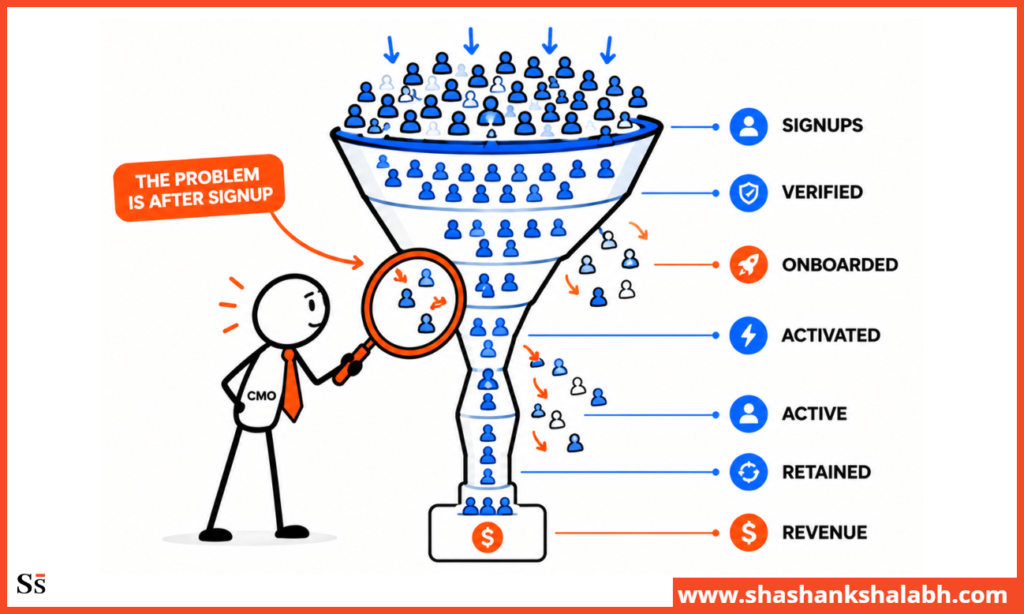
The Fintech User Activation Funnel
Here is the funnel:
Signups → Verified Users → Onboarded Users → Activated Users → Active Users → Retained Users → Revenue
Where the funnel ends depends on the business model; transactions, assets under management, deposits, payment volume, and more. But the basic shape is similar across most fintechs, and most of the drop-off happens in the middle.
In a nutshell, signups aren’t the problem in most cases.
Most fintechs have gotten good at generating signups because that’s the metric teams have been focused on for years.
The bigger blind spot is what happens next.
From verification through activation, many fintechs still lack a clear view of where users drop off and why.
Let me throw light on the core issues why your fintech attracts signups but not active users.
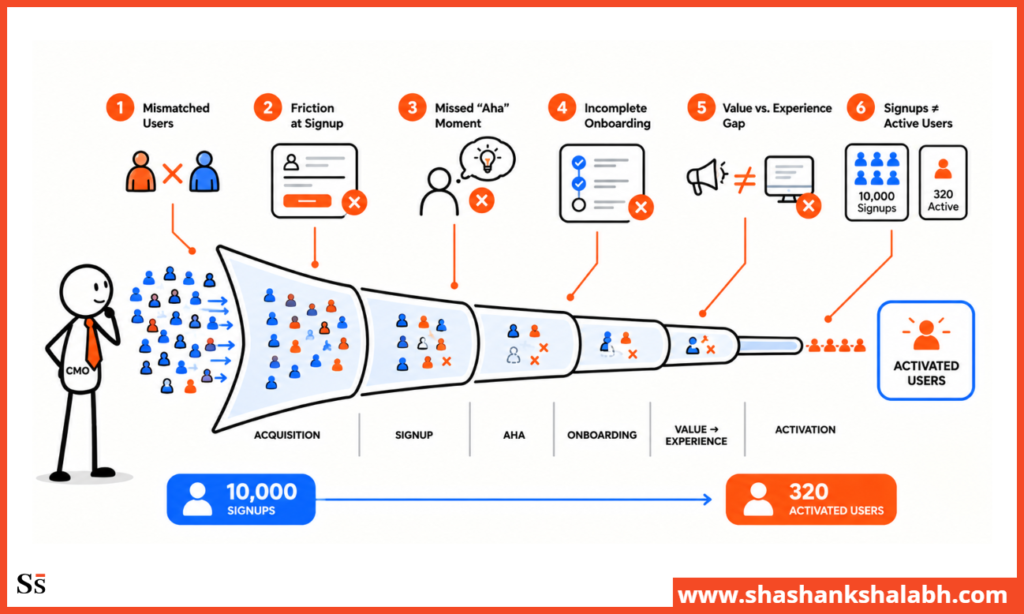
You’re Attracting the Wrong Users
A big signup number can hide a bad fit problem.
Look at acquisition source, customer intent, use case, segment, geography, and product eligibility.
Compare activation rates by acquisition channel, not just signup volume.
A channel that brings in fewer signups can still drive far more activated users.
For example, a paid channel might generate three times as many signups as organic, while organic produces twice as many activated users because those users already know what they’re looking for.
The same applies to customer segments. Some segments may sign up easily because the offer is appealing. But they never activate because the product doesn’t fit their needs.
If you’re not breaking down signups by who users are and where they came from, you’re optimizing blind.
Your Signup Process Creates Friction
Fintech has friction that other products don’t.
I am talking about identity verification, KYC, bank connections, security checks, documentation, and funding requirements.
While none of these are optional, they can still be designed well, or badly.
Measure every step of the funnel.
Signup → Verification → Approval → Account setup → Funding → First core action
Find exactly where users drop off.
In my experience, most fintechs can tell you their overall signup-to-funded conversion rate. However, far fewer can tell you which specific step is causing the biggest loss.
You don’t need to remove necessary compliance steps. In a regulated business, that’s often not possible. Focus on making the required steps clear, predictable, and easy to complete.
A KYC process that takes three minutes and clearly explains what’s happening can lose far fewer users than the same process presented as a confusing black box.
Users Don’t Reach the “Aha” Moment
Someone can create an account and still never understand why they should keep using it. It happens more often than most teams want to admit.
Define your activation event precisely. Instead of going for the first thing that’s easy to measure, choose the first outcome that actually matters to the user.
Then measure how long it takes users to reach that point. If time to activation is long or varies widely, it means the path to value isn’t clear.
Your Onboarding Doesn’t Lead to Activation
Look at your welcome sequence, product walkthrough, emails, push notifications, in-app prompts, and funding guidance.
The goal of every touchpoint should be to get users to the activation event as quickly as possible.
A common problem is a disconnect between marketing and onboarding, which can kill activation. Marketing promises one outcome, then onboarding immediately asks users to do something unrelated.
If someone signs up because you promised faster payments, don’t make them sit through five unrelated setup screens before they experience that benefit.
They signed up with a specific expectation. Onboarding should deliver on it quickly.
The bigger the gap between the promise and the experience, the more likely users are to drop off before they ever see the product’s value.
The Value Prop Doesn’t Carry Through
Sometimes the problem starts before onboarding.
The marketing gets people through the door, but the product doesn’t give them the value they expected once they’re inside.
Here is what you should be thinking:
- Why did this person sign up?
- What were they hoping to accomplish?
- How quickly does the product help them do it?
Signup intent and product value should line up. When they don’t, you end up with people who were interested enough to sign up but never find a reason to keep using the product.
This is different from having too much onboarding friction. The issue is the gap between the promise and the actual experience.
If your marketing sells one outcome but the product leads users somewhere else, activation will suffer.
You’re Optimizing for Signup Volume
This is one of the biggest issues in fintech, and a lot of teams still overlook it.
If your team is measured on cost per signup, you’ll get cheap signups, but not necessarily customers.
The campaign with the lowest cost per signup can easily have the worst activation rate. You may be getting people who signed up because the offer caught their attention, but never had much reason to use the product.
Cheap signups can end up costing more than they seem. You spend less to acquire them, but more to support users who never activate.
Measure Cost per Activated User
Cost per activated user = acquisition spend ÷ activated users
Once you start looking at this number, your channel economics can look very different.
Cost per signup can make the wrong channels look good. But, cost per activated user shows which ones actually perform.
Activation Rate Varies Dramatically by Channel
| Channel | Signups | Activation Rate | Active Users | Cost / Activated User |
| Paid Search | 1,500 | 11.70% | 176 | $68 |
| Paid Social | 3,000 | 6.20% | 186 | $81 |
| Organic | 1,000 | 15.20% | 152 | $33 |
| Referral | 500 | 24.10% | 121 | $50 |
| Partnerships | 400 | 20.00% | 80 | $63 |
This is just an example. Plug in your own numbers. Don’t allocate budget based on signup volume alone.
The channel bringing in the most signups may not be bringing in the most activated users.
Referral and partnership channels often bring in fewer signups but higher activation because users already trust the source. Paid channels can bring in much more volume while attracting people with lower intent.
Run the numbers before deciding where the next dollar should go.
Users Activate But Don’t Become Regular Users
Activation isn’t the finish line. Someone can fund an account or make a first transaction and never come back.
Signup → Activation → Repeat Usage → Retention
Break retention down by signup month. Users who signed up this month may behave very differently from users who signed up three months ago, especially if your targeting or offer has changed.
Find where users stop coming back. Using the product once and coming back regularly are different problems. The first is about onboarding and getting users to value. And the second is about retention and giving them a reason to keep coming back.
How to Diagnose Your Activation Funnel
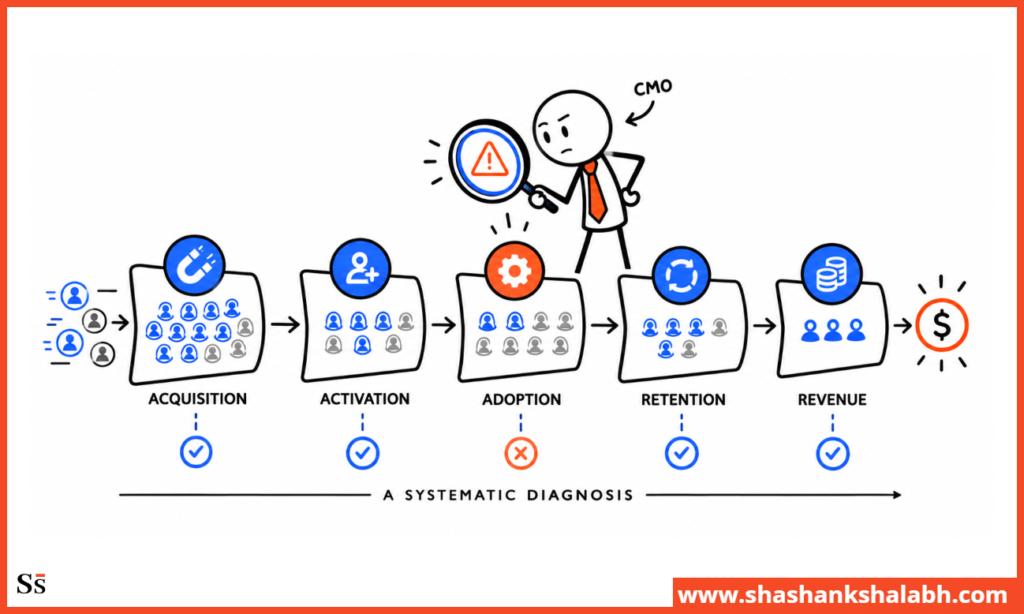
This is the framework I use to diagnose the issue in a fintech funnel:
- Acquisition: are we attracting the right users?
- Onboarding: can they actually get into the product?
- Activation: do they complete the first meaningful action?
- Adoption: do they keep using the core product?
- Retention: do they stay active long enough to create real value?
Acquisition → Activation → Adoption → Retention → Revenue
Start with the first stage that’s breaking. Fix that before moving further down the funnel. If acquisition is bringing in the wrong users, improving retention won’t solve the underlying problem.
Which Fintech Metrics To Track
Track the basics; signup rate, verification completion, onboarding completion, activation rate, time to activation, cost per activated user, activation-to-retention rate, cohort retention, and revenue per active user.
Depending on your business model, you may also track transaction volume, assets under management, deposits, payment volume, lending volume, or subscription conversion.
You don’t need every metric. A lending business and a payments business will care about different numbers. Focus on the metrics that show how your business actually makes money.
→ Marketing KPIs Every CEO Should Track
How to Diagnose This in 30 Minutes
You should not have to spend days and weeks diagnosing the issue in your fintech funnel.
Here are the exact steps you can follow to find the core issue in under 30 minutes .
- Define your activation event precisely
- Map the signup-to-activation funnel, step by step
- Find the largest drop-off point
- Segment by acquisition source
- Segment by user type or use case
- Review actual onboarding behavior, not just completion rates
- Compare activated vs. non-activated users : what’s different about them?
- Calculate cost per activated user, by channel
- Check retention by cohort
- Fix the single biggest constraint before touching anything else
This takes less time than most teams expect, because the data usually already exists. It’s just never been pulled together in this specific order.
Which Issue To Tackle First?
Don’t automatically spend more on acquisition. Start by finding where the funnel is breaking.
| Problem | What to Fix |
| Wrong users signing up | Targeting |
| High signup friction | Onboarding |
| Low activation | First-value experience |
| Good activation, low repeat usage | Adoption and retention |
| Good activation and retention, weak economics | Monetization |
The solution depends on where users are dropping off. Spending more on acquisition before addressing the problem will bring more users into the same leaky funnel.
When More Signups Make the Problem Worse
If acquisition keeps growing while activation stays flat, you’re mostly adding cost.
Support volume rises as more users get stuck in onboarding. And your CAC goes up without much additional value.
Signups can make the numbers look good, but if active users aren’t growing, the business isn’t getting much from that growth.
Don’t scale acquisition faster than your product can turn signups into active customers. Otherwise, you’re just building a bigger backlog of users who never activate.

When It’s Time to Rethink Your Fintech Marketing
If signups are growing but active users aren’t, your marketing strategy needs a closer look. The same applies when activation varies by channel, or no one knows where users are dropping off.
A fractional CMO can connect acquisition to activation, find the biggest leaks, and focus marketing on the metrics that matter.
FAQ: Fintech User Activation
Let me address the core questions when it comes to fintech user activation.
Why do fintech companies get signups but not active users?
A signup only tells you someone created an account. The gap is due to poor fit, onboarding friction, or slow time to value.
What is fintech user activation?
This is the key action that shows the user got real value from the product, such as funding an account, making a transaction, or connecting a bank.
What is a good fintech activation rate?
There’s no universal number. It depends on the product and what you count as activation. A payments app and a lending platform will have very different benchmarks.
How do you improve fintech user activation?
Define activation clearly, find the biggest drop-off, fix the friction, and make sure users quickly get what they signed up for.
What is the difference between signup and activation?
A signup means someone created an account. Activation means they took the key action that shows they’re actually using the product.
How do you measure fintech onboarding?
Track completion at every step, from verification and approval to account setup, funding, and the first core action. Find where users drop off.
How can fintech companies reduce signup-to-activation drop-off?
Address the friction first. Then make sure onboarding delivers what marketing promised as quickly as possible.
What metrics should fintech companies track?
Activation rate, time to activation, cost per activated user, and cohort retention should be your core metrics. Signup volume alone tells you very little about whether the business is actually growing.

Shashank brings over 22 years of global omnichannel marketing experience. As a 4x Chief Marketing Officer, he has helped several organizations (Startups and Fortune 500) drive sustainable revenue growth through strategic marketing.