
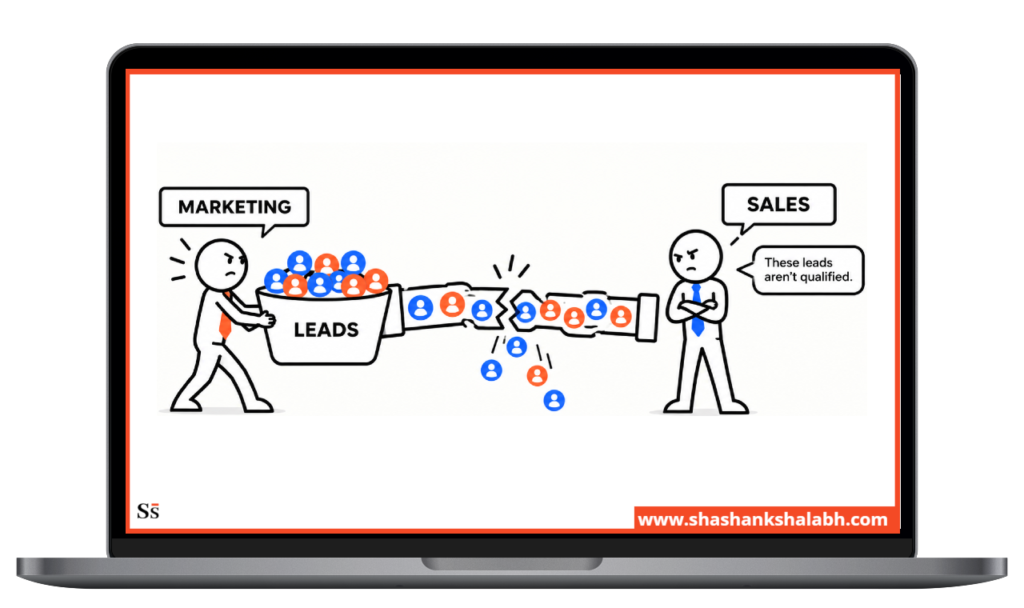
I have seen friction between Sales and Marketing dozens of times.
Sales teams lose faith in marketing leads when volume and quality stop matching what sales expects.
And this could be due to wrong ICP, weak qualification, misleading messaging, a sloppy handoff, slow follow-up, or just two teams measuring different things.
Often, businesses assume it’s automatically a marketing problem.
Sometimes it is, sometimes it is not. The only way to know is to diagnose the handoff itself.
What Are “Bad Leads”?
The term “bad leads” is subjective to a large extent.
When a sales rep uses that term, it could mean a wrong company, wrong role, no budget, no need, no urgency, or no authority to buy.
And from the marketing camp, a “bad lead” is about form fills, content downloads, demo requests. That is, someone hit an MQL threshold, so by marketing’s definition, the lead qualified.
Both are right by their own definition, and that’s exactly the problem.
Lead vs. MQL vs. SQL vs. Opportunity
Lead → MQL → SQL → Opportunity → Pipeline → Closed-Won
Each stage should reflect buyer behavior and fit, giving more weight to a demo request with a clear problem than to a form fill or content download.
Here are the core reasons why your SaaS sales team doesn’t trust marketing leads.
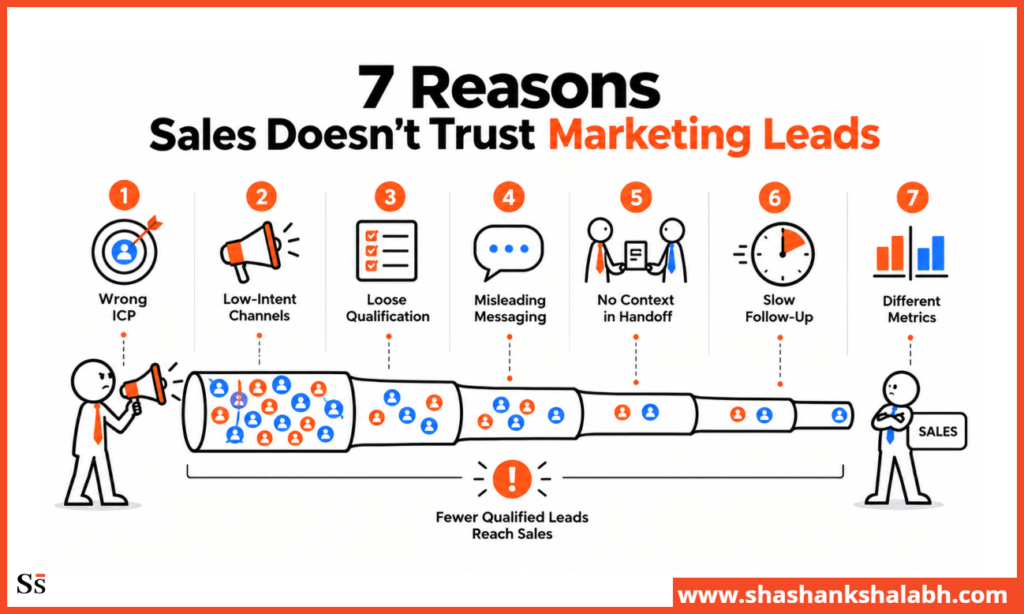
Issue 1: You’re Targeting the Wrong ICP
This should be the first thing you check, every time.
Are your leads in the right industry, at the right company size, and dealing with a problem your product solves?
And are you talking to someone who influences the buying decision, or someone who simply filled out a form?
High Lead Volume Can Hide Poor Fit
Marketing can hit every lead target and still attract companies sales can’t sell to. The numbers look good, but the pipeline tells a different story.
→ Why Your Lead Gen Isn’t Turning Into Pipeline
Analyze Lead Quality by ICP Segment
Look beyond lead volume. Track how many leads become opportunities, how many deals you win, and how much revenue each segment brings in.
A segment with fewer leads but a higher conversion rate can deliver more value than one generating lots of leads.
Issue 2: Your Acquisition Channels Produce Low-Intent Leads
Compare lead quality across paid search, paid social, organic, content, webinars, events, partnerships, outbound, and referrals. They rarely perform the same, even when they produce similar lead counts.
Don’t Optimize Channels for MQL Volume
A channel generating 1,000 MQLs a month may deliver less value than one generating 100 qualified opportunities. If you only track MQL volume without measuring pipeline impact, you’re focusing on the wrong metric.
Measure Pipeline and Revenue by Source
This is the number that actually tells the truth.
MQL count tells you activity, while pipeline and revenue by source tell you value.
Issue 3: Your Qualification Definition Is Too Loose
This is usually where the real conflict starts.
Marketing often qualifies leads based on engagement, such as content downloads, page visits, form fills, and lead scores. Sales looks at fit and intent; whether the company, contact, problem, and timing are right.
Create a Shared Qualification Definition
Agree on one qualification standard that both teams use, covering ICP fit, use case, buying intent, timing, decision-making authority, and engagement.
Build it around how your company actually sells instead of forcing a framework like BANT that may not fit.
Issue 4: Your Marketing Messaging Attracts the Wrong Buyer
A campaign can bring in plenty of leads and still deliver nothing sales can work with.
Maybe the messaging attracts students instead of buyers, or small businesses when you’re selling to enterprise.
Sometimes the problem is the promise itself. Marketing sets one expectation, but sales has to explain what the product actually does. That gap costs trust, wastes time, and leaves sales cleaning up the mess.
Issue 5: Marketing Hands Off Leads Without Context
A notification that says “New MQL: John Smith” gives sales little to work with.
A good handoff includes the company, role, lead source, campaign, content they engaged with, fit, and any signs of buying intent or urgency. Sales needs to know why this lead is worth contacting now, not just who they are.
Issue 6: Sales Follow-Up Is Too Slow or Inconsistent
Not every lead quality issue starts with marketing.
Check how quickly sales follows up, how often they reach out, which channels they use, and whether their messages feel personal.
Also look at lead ownership, CRM accuracy, and routing. A good lead can go cold after three days without contact.
Poor follow-up can make a strong lead look like a bad one, and the two shouldn’t be confused.
Issue 7: Sales and Marketing Use Different Success Metrics
In most organizations, marketing tracks MQLs, cost per lead, and conversion rates.
And Sales focuses on qualified leads, opportunities, pipeline, and win rates. Leadership looks at revenue and growth.
Everyone needs to see the same funnel, from lead to revenue, in one shared dashboard.
Lead → MQL → SQL → Opportunity → Pipeline → Revenue
That makes it easier to spot where leads drop off and fix the problem, instead of blaming marketing for poor leads or sales for poor results.
What’s The Issue: Marketing or Sales?
| Symptom | Investigate |
| Many leads, few qualified | ICP / targeting |
| Good ICP fit, low engagement | Messaging / offer |
| Good leads, poor qualification | Qualification process |
| Good SQLs, few opportunities | Sales discovery |
| Good opportunities, low close rate | Sales execution / offer |
| Good leads, slow conversion | Follow-up / sales cycle |
| One channel produces poor leads | Channel quality |
| Marketing and sales disagree on lead status | Definitions / handoff |
I am sure this table will greatly help you assess and address the core issue(s).
The SaaS Lead Quality Diagnostic Framework
I use six steps to pinpoint where lead quality issues start and what needs to change.
Fit : is this the right company and buyer?
Intent : does the prospect have a real problem or buying signal?
Qualification : do they meet the agreed opportunity criteria?
Handoff : does sales have enough context to act on it?
Follow-Up : did sales actually work the lead properly?
Conversion : does it eventually create pipeline and revenue?
Fit → Intent → Qualification → Handoff → Follow-Up → Revenue
The first step that fails is where you need to look, regardless of who’s getting the blame.
Which Metrics You Should Use to Measure Lead Quality?
Track conversion rates from MQL to SQL, SQL to opportunity, and opportunity to closed-won.
Measure pipeline and revenue per lead, win rate, sales cycle, and average deal size by source. Also track cost per opportunity and customer acquisition cost (CAC) for each channel.
Why Cost Per Lead Can Be a Misleading Metric?
A cheap lead isn’t always a good deal.
If it never converts, the low cost means nothing. You’ve still spent money on a lead that brought in no business.
How to Audit Your Marketing Leads
Follow these steps (in order) to analyze your marketing leads. Don’t skip any step.
- Pull the last 90–180 days of lead data
- Define your ICP clearly, in writing
- Segment leads by source
- Examine lead-to-opportunity conversion
- Examine opportunity-to-close
- Review rejected leads specifically
- Categorize rejection reasons : wrong company, wrong person, no need, no budget, no timing, duplicate, competitor, unqualified use case
- Compare marketing’s and sales’s definitions side by side
- Audit follow-up speed and consistency
- Fix the single biggest leakage point first
What Marketing and Sales Should Agree On
Both teams need to agree on the ideal customer profile, buyer personas, qualification criteria, MQL and SQL definitions, what counts as an opportunity, lead routing, follow-up expectations, rejection reasons, pipeline reporting, and revenue attribution.
Put it all in writing where both teams can find it. Otherwise, you’ll keep having the same argument every quarter.
Don’t Fix Lead Quality by Just Generating Fewer Leads
Success means bringing in the right buyers and turning more of them into real opportunities. Marketing shouldn’t cut lead volume just to keep sales happy, and sales shouldn’t dismiss leads because they take more work.
Both teams need to focus on building pipeline and generating revenue.
When A Fractional CMO Can Help?
When marketing and sales keep blaming each other, you need someone to own the full funnel. A fractional CMO for B2B SaaS brings both teams together, sets clear goals, and connects marketing activity to sales pipeline and revenue.
Instead of spending time arguing over lead quality, both teams can focus on bringing in the right buyers and closing more deals.
FAQ: Why sales doesn’t trust marketing leads?
Why does sales reject marketing leads?
Sales often rejects leads because they’re the wrong fit, the wrong contact, or not ready to buy. They may have engaged with marketing content but have no real buying intent.
What makes a good SaaS marketing lead?
A good SaaS lead comes from the right company, has a relevant role, and needs a problem your product solves. They also show signs they’re ready to buy, not just interested in your content.
How do you improve SaaS lead quality?
Focus on your ideal customer, agree with sales on what makes a lead qualified, and find where leads drop off. Check targeting, buying intent, qualification, handoff, and follow-up to see what needs fixing.
What is the difference between an MQL and SQL?
An MQL meets marketing’s criteria, usually based on engagement. An SQL has been reviewed by sales and is considered worth pursuing.
Why aren’t marketing leads converting to sales?
Leads may be a poor fit, lack buying intent, or get the wrong message. Slow follow-up and poor handoffs can also hurt conversion. Check where leads drop off to find the cause.
How should sales and marketing define a qualified lead?
Sales and marketing should agree on a shared definition based on company fit, the problem they need to solve, buying intent, timing, and decision-making authority. The criteria should reflect how your business actually sells.
How do you measure SaaS lead quality?
Track how many MQLs become SQLs, how many turn into opportunities, and how many deals close. Measure pipeline and revenue per lead by source, not just lead volume or cost.
How can sales and marketing improve alignment?
Agree on what makes a lead qualified, track the same numbers, and review how leads move from marketing to sales. Look at the data together and fix problems instead of pointing fingers.

Final Thoughts
Lead quality improves when marketing and sales stop working toward different goals.
Both teams need to agree on what makes a good lead, track what happens after the handoff, and take responsibility for the results.
Start by finding where leads drop off, then fix that part of the process. If no one owns the full funnel, a fractional CMO can help connect marketing efforts to sales pipeline and revenue.

Shashank brings over 22 years of global omnichannel marketing experience. As a 4x Chief Marketing Officer, he has helped several organizations (Startups and Fortune 500) drive sustainable revenue growth through strategic marketing.