
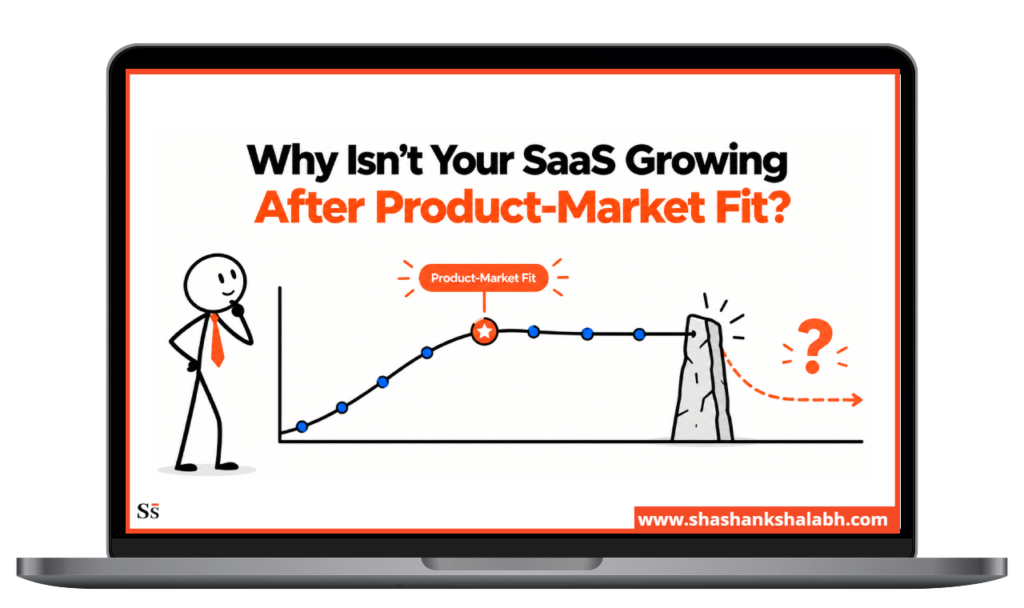
A SaaS business can have product-market fit and still stop growing.
Early demand doesn’t turn into a repeatable acquisition engine on its own. For most SaaS startups, the first customers come from founder relationships, referrals, a narrow audience, or one channel that happened to work.
As the organization grows, those sources run out. Acquisition costs rise, sales gets more complex. And the model that got you here stops working.
Here’s the chain I use to think about it:
Early traction → Repeatable acquisition → Predictable pipeline → Efficient growth → Scalable revenue
Most SaaS startups get the first step right. The goal is to find out what they missed.
Product-Market Fit Doesn’t Guarantee Scalable Growth
Product-market fit means people want your product. It doesn’t mean you have a working business.
Many founders confuse the two.
When a founder tells me growth has slowed, the product is rarely the problem. Customers are happy and they stick around. The problem is finding the next 100 customers.
What Product-Market Fit Actually Proves
PM fit helps you understand
- A defined group of customers has a real problem.
- The product gives them value.
- There’s evidence of demand, adoption, or retention.
That’s a lot. It’s also where the proof ends.
What It Doesn’t Prove
PMF doesn’t prove that:
- Acquisition can scale predictably
- You can reach enough customers at a cost that works
- Sales can grow past founder-led selling
- You have repeatable demand generation
- Customer acquisition costs will stay sustainable
Each one is a separate question, and that’s why, each needs its own answer.
The Shift From Early Traction to Repeatable Growth
Early growth comes from personal connections and referrals.
However, you can realize repeatable growth comes from a system, which includes, clear customer targets, messaging, channels, sales process, and measurement.
SaaS startups often fail to build the system due to which their growth slows down.
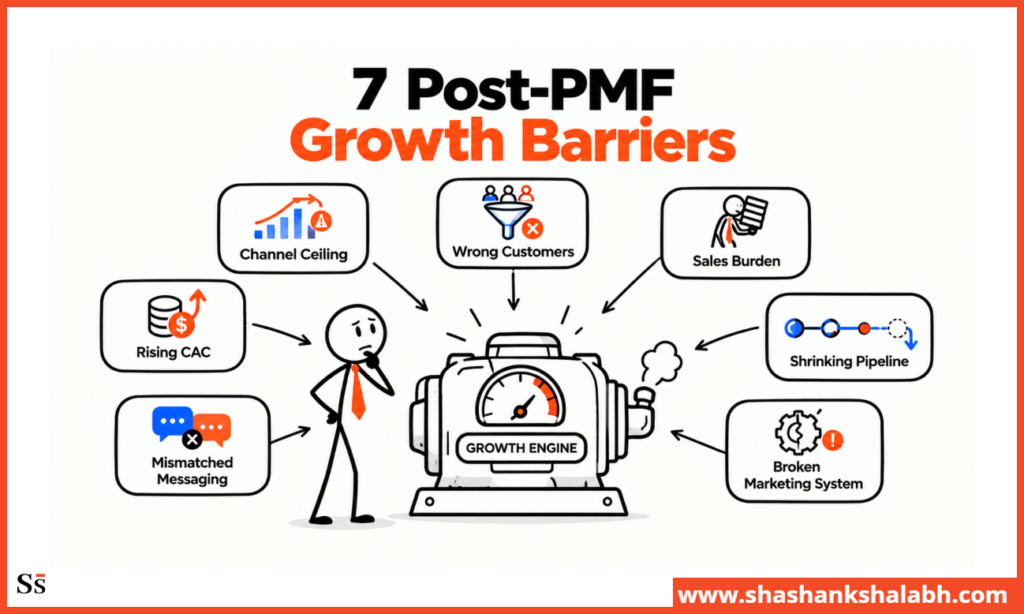
Your First Channels Hit a Ceiling
Early growth comes from a narrow set of sources.
While they work well, they just don’t work forever.
When I start working with a SaaS startup as a Fractional CMO, I start here because it’s the easiest thing to check. Pull pipeline by source for the last year and see how concentrated it is.
Founder Networks and Referrals Run Out
Every founder eventually runs out of people in their network to call. Referrals are unpredictable, and you can’t control how many come in.
Your First Channel Has Limited Reach
Maybe one ad channel or content topic drove early growth. It worked because it reached the easiest buyers first. Once they’re gone, growth gets harder and more expensive.
You Never Built a Second One
Relying on one channel puts growth at risk. When it slows, so do you. A second channel gives you another way to grow.
More Spend Gets You Less Growth
A channel that works on a small budget may not work at a larger one. As you spend more, each dollar brings in less until the cost is no longer worth it.
The Customers Who Got You Here Aren’t the Ones Who Get You Next
Early customers aren’t always typical. They may have a specific need or be easier to win than most buyers.
I’ve seen companies broaden their targeting without checking who they should sell to. Pipeline grows, win rates drop, and nobody connects the two.
Early Adopters Don’t Represent the Whole Market
Early adopters are willing to try new products. Mainstream buyers want proof, references, and less risk. The pitch that won your first 20 customers may not win the next 20.
Your ICP Reflects Who Bought, Not Who Is Profitable
Your first ICP is often based on who said yes.
That’s a start, but you also need to know which customers stay, generate profit, and spend more over time. Look at retention and margins by customer segment, not just sales.
New Segments Need a Different Playbook
Selling to a new segment may mean changing your messaging, pricing, channels, or sales process. The goal is to find nearby markets with real demand and good margins, then build a plan to reach them.
The Founder Can Sell But The Team Isn’t There Yet
This is common in SaaS companies that struggle to grow.
Founders know the product, adjust the offer, and build trust with buyers. Other reps can’t easily replicate that.
The Process Lives in the Founder’s Head
Ask how the founder qualifies leads or handles pricing objections. Often, there’s no clear process to follow.
Start with the deals the founder wins consistently.
Document who was involved, what mattered to the buyer, and which objections came up. Use that to build a sales playbook.
New Hires Don’t Produce Predictable Results
Businesses hire salespeople and hope for better results. Some take too long to ramp. Others never get there.
If you do not have a tested and documented process, more reps will not help. Instead, they will add to the cost. Fix the process first. Then hire.
Pipeline Stopped Keeping Up
Revenue depends on pipeline. When pipeline slows, the problem is either demand or conversion. And those have different solutions.
Lead Volume Is Flat, or Up Without Qualified Opportunities
If leads are flat, you may need more demand. If leads increase but opportunities don’t, you may be targeting the wrong people or attracting poor fits.
Check how many leads become opportunities before spending more.
Marketing Activity Isn’t Creating Pipeline
If you are pushing campaigns/content, but the pipeline is not moving, the activity isn’t paying off.
Marketing and Sales Disagree on Lead Quality
This often comes down to unclear definitions, a poor handoff, or a mismatch between your target customers and the leads coming in.
I cover this in my post Why Your SaaS Sales Team Doesn’t Trust Marketing Leads.
Conversion Is Slipping
Win rates drop. Sales cycles get longer. Deals keep getting stuck at the same stage.
For the full breakdown of where leads fall out, check my post on Why Your Lead Gen Isn’t Turning Into Pipeline.
The Math Got Worse
Revenue can grow while profits shrink. That’s a quieter kind of problem.
CAC Rises as You Move Past Early Adopters
The first customers were easy to win. The next ones take more time and money. As you reach new buyers, your CAC tends to rise.
Sales Cycles Get Longer
Larger companies involve more decision makers, security reviews, and procurement steps. Deals take longer to close and cost more to win.
Deal Size Doesn’t Keep Pace
If acquisition costs rise but deal sizes don’t, margins shrink. You’re spending more to win the same revenue.
Payback Gets Longer
You’re waiting longer to earn back what you spent to acquire each customer. Retention and expansion can help offset that. If they don’t, growth gets more expensive over time.
Revenue growth alone doesn’t tell you if the business is healthy.
Look at what it costs to bring in each new customer. I’d rather see slower growth with healthy payback than fast growth that loses money on every new customer.
→ How to Improve LTV:CAC Ratio
Your Message Was Written for Someone Else
The message that won your first customers may not win the next ones.
Your Message Doesn’t Resonate With New Buyers
Early adopters bought on potential. Mainstream buyers buy on proof and outcomes. If your message is still about what the product could do, newer buyers won’t see why it matters to them.
Buyers See the Product but Not the Value
They like the demo but can’t explain to their boss why they should buy. Focus on business results, not just features.
Customers Can’t Explain Why You’re Different
Ask five customers why they chose you. If you get five different answers, your positioning isn’t clear. Fix that before spending money on new messaging.
Your Story Misses What Bigger Buyers Care About
Larger companies want to know about security, integrations, implementation, and customer references. If your website and sales pitch don’t cover these, buyers may hesitate.
You may not need a full rebrand. Sometimes, clearer messaging and better proof are enough.
You Outgrew Your Marketing System
This is the problem I see most often. What works for a small team breaks as the company adds channels, hires people, and faces more pressure to grow.
Tactics Without a Plan
The team sends emails, runs webinars, and launches ads. Each activity makes sense on its own, but they don’t work together toward a clear goal.
Nobody Owns the Full Funnel
Marketing brings in leads, sales closes deals, and product handles onboarding. Nobody takes responsibility for the entire customer journey, from first contact to revenue.
The Wrong Metrics
The team tracks leads, impressions, and content published. These numbers show activity, but they don’t tell you whether the business is growing. Pipeline, win rate, CAC, and retention give you a clearer picture.
Teams Work Toward Different Goals
Marketing, sales, and product each focus on their own priorities. Without shared goals, they struggle to work together.
No Regular Planning or Review
The team has no clear quarterly plan or regular review process. Decisions happen when problems come up instead of before they do.
These problems need a clear marketing system and someone with the authority to make sure it works.
→ How to Build a Marketing Operating System
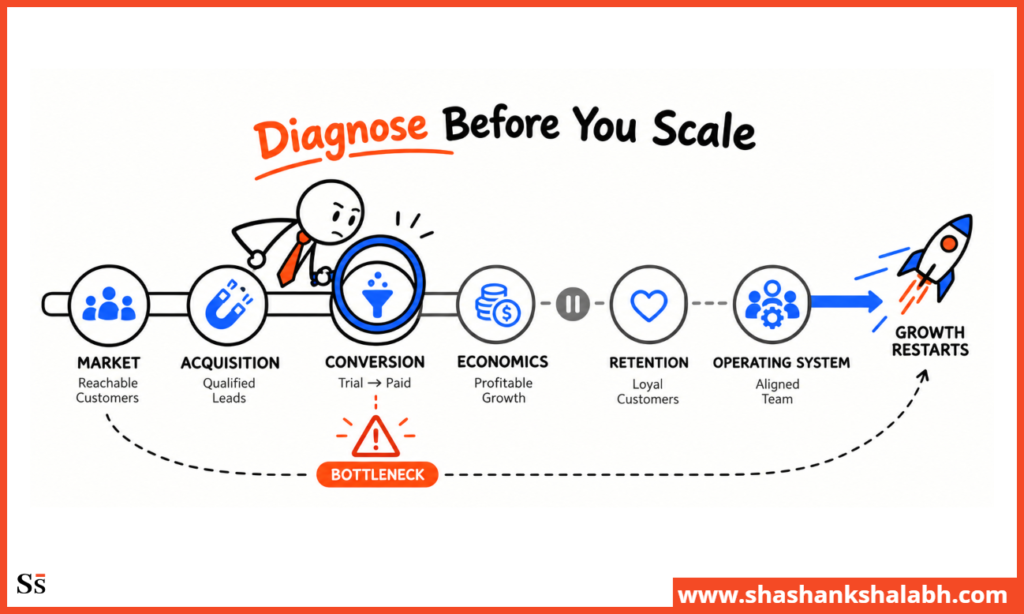
How to Diagnose Why Your SaaS Growth Has Slowed Down?
Use these clues to identify the likely problem. Check the data before deciding what to fix.
| Symptom | Potential constraint | What to investigate |
| Leads have stopped growing | Acquisition ceiling | Qualified pipeline by channel |
| Leads grow, opportunities don’t | ICP, qualification, or conversion | Lead-to-opportunity rate |
| Opportunities grow, revenue doesn’t | Sales conversion | Win rate, sales cycle, deal progression |
| Revenue grows, CAC rises sharply | Acquisition economics | CAC, payback, contribution economics |
| New customers don’t stay | Retention or product value | Cohort retention, churn, expansion |
| Founder closes deals, team can’t | Sales repeatability | Win rate by rep, process consistency |
| New segments don’t convert | ICP or positioning | Conversion and win rate by segment |
| Activity up, growth flat | Operating system or measurement | Pipeline and revenue contribution |
The Post-PMF Growth Diagnostic Framework
I use these six questions when a founder tells me growth has slowed.
- Market: Are there enough attractive customers in the reachable market?
- Acquisition: Can we consistently reach qualified buyers?
- Conversion: Can we turn demand into opportunities and customers?
- Economics: Can we acquire and keep customers at a sustainable cost?
- Retention: Do customers keep getting value and keep paying?
- Operating System: Do we have the team, process, accountability, and measurement to repeat growth?
Find the problem, check the data, fix it, and measure the results. Then move to the next problem.
You don’t need to follow these steps in order. Start with the biggest problem the data reveals. It may not be what the founder expects.
Fixing a problem before confirming it wastes time and money. You could end up adding new channels when the real issue is somewhere else.
What to Address First
Address the right constraint.
- Acquisition: Reassess channel reach, ICP targeting, and demand generation.
- Conversion: Improve qualification, messaging, sales execution, or the handoff.
- Economics: Look at CAC, pricing, deal size, retention, and payback.
- Retention: Examine onboarding, time to value, adoption, and customer success.
- Positioning: Test your value proposition and differentiation with target buyers.
- Operating system: Set clear ownership, shared KPIs, a planning cadence, and executive oversight.
Adding channels, hiring salespeople, or increasing spend before you know what’s wrong wastes money. I’ve seen SaaS startups do all three and end up with the same growth and higher costs.

When a SaaS Company Needs a New Growth Strategy
If growth depends on one channel or the founder, pipeline is inconsistent, acquisition costs are rising, or marketing and sales aren’t aligned, your current approach may have run its course.
You need a repeatable go-to-market model and someone accountable for making it work.
That’s the work I do as a fractional CMO for growth-stage SaaS companies.
Suggested Read:
→ Go-To-Market Strategy for Scaling Companies
FAQ
Can a SaaS company have product-market fit but still stop growing?
Yes. Product-market fit means customers want your product. It doesn’t mean you know how to find more of them. Growth slows when early channels stop delivering and new ones aren’t ready.
What causes SaaS growth to slow down after product-market fit?
Growth often slows when acquisition channels stop delivering, the target market is too narrow, founder-led sales can’t scale, conversion drops, or customer acquisition costs rise. Sometimes, the company never built a repeatable marketing system.
How do you scale a SaaS company after finding product-market fit?
Define your ideal customer, build reliable acquisition channels, document your sales process, track the right metrics, and put someone in charge of turning leads into revenue.
How can you tell whether SaaS growth is limited by marketing or sales?
Look at where leads drop off. Too few qualified opportunities points to a marketing or targeting problem. Plenty of good opportunities but few closed deals points to a sales or offer problem.
Why does SaaS customer acquisition become more expensive as a company grows?
The easiest customers are usually the first to buy. Reaching new ones takes more time and money, sales cycles get longer, and competition for their attention increases.
Should a SaaS company expand its ICP when growth slows down?
Not always. Expand into new segments when there’s clear demand and good margins. Broadening your targeting without a plan can lower conversion rates.
What metrics should a SaaS company review when growth slows?
Track qualified pipeline by channel, lead conversion, win rate, sales cycle, CAC, payback period, and retention. Break the numbers down by customer segment to see where growth is slowing.

Shashank brings over 22 years of global omnichannel marketing experience. As a 4x Chief Marketing Officer, he has helped several organizations (Startups and Fortune 500) drive sustainable revenue growth through strategic marketing.