
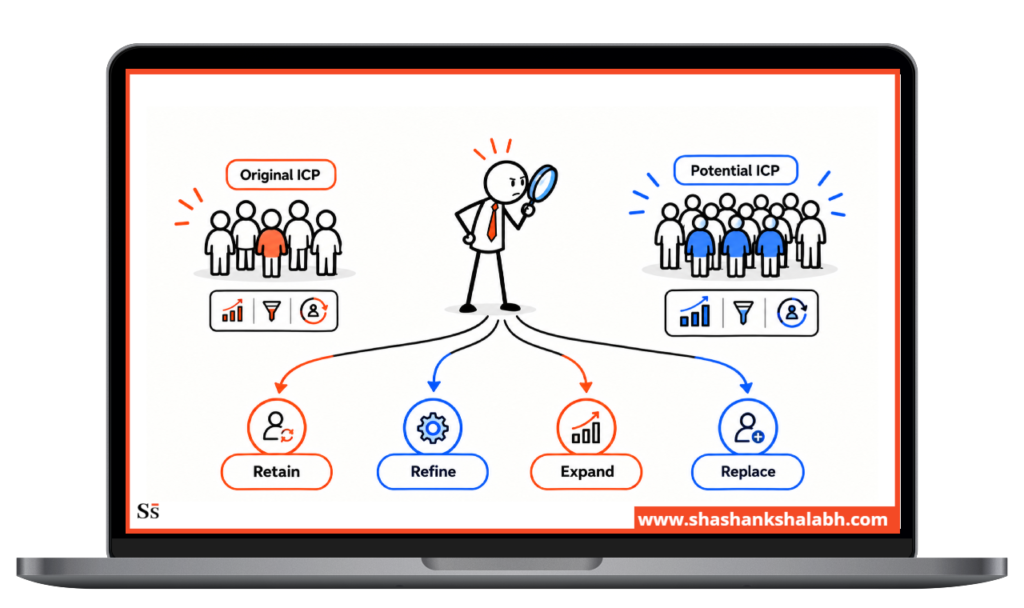
Your SaaS business may have outgrown its original ICP when the best growth opportunities, retention, or profitability start coming from a different customer segment.
The original customers helped prove the product works. But now, acquisition is harder, conversion is slowing, or the business needs more predictable growth than that segment can deliver.
That doesn’t mean the original ICP was wrong. It may simply be too narrow or no longer fit the company’s next stage of growth.
Now that raises an important question.
Should you keep, refine, expand, or replace your ICP?
And you should rely on customer and revenue data (instead of gut feel) to answer that.
Let’s dive into this.
What Does It Mean to Outgrow Your ICP?
Let’s first define three important terms here.
- ICP: The type of customer you can win and serve most profitably.
- Customer segment: A group of customers who share traits like industry, company size, or use case.
- Adjacent market: A related customer segment with a problem your product could solve.
In my experience, a SaaS can outgrow its ICP in one of three ways.
It still works, but the market is too small
The segment is profitable, but there aren’t enough qualified buyers to meet your next growth target.
It’s no longer as profitable
Customers still buy, but rising acquisition costs, longer sales cycles, churn, or support demands make the segment less attractive.
Another segment looks more promising
A related segment may have bigger budgets, more urgent needs, better retention, or a greater willingness to pay.
I want you to understand that outgrowing your ICP doesn’t mean abandoning it. You should look into the data, the economics, and your long-term strategy to make the right decision.
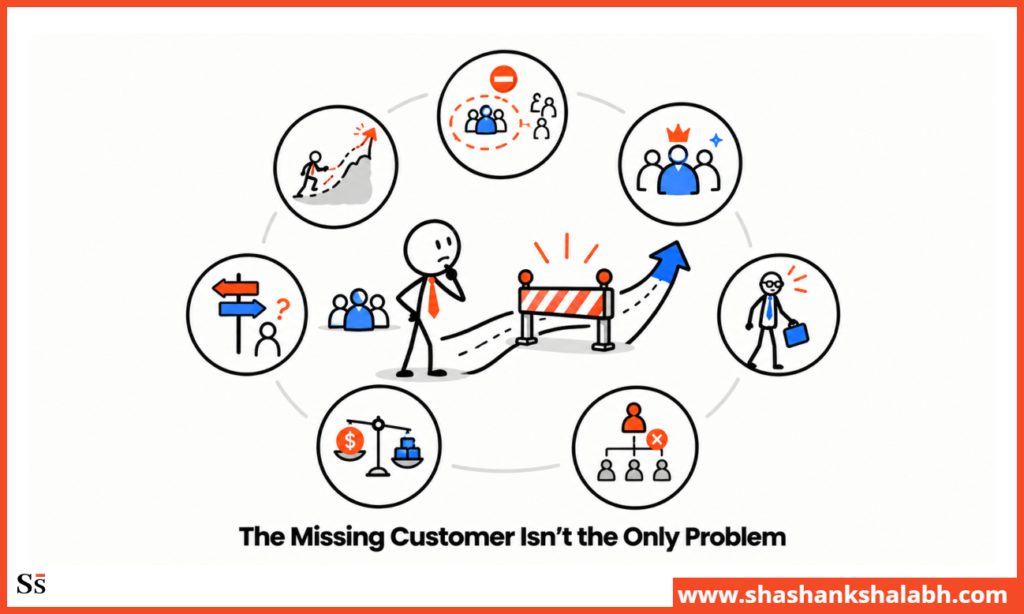
Seven Signs You’ve Outgrown It
A word of caution. Use these as clues. No single sign proves the ICP is wrong.
Your target market is too small
Look beyond total market size.
Count the prospects who actually fit your buying criteria. If there aren’t enough to meet your growth targets, you’ll eventually hit a ceiling.
Acquiring customers keeps getting harder
Qualified leads cost more, channels deliver less, and sales cycles get longer as you reach less suitable prospects.
But rising CAC alone doesn’t mean you’ve outgrown your ICP. Channel saturation, stronger competition, or poor execution can cause the same problem.
Rule those out first.
→ Why Your CAC Is Too High (And How to Fix It)
Your best customers look different from your first
Look at retention and expansion revenue.
If your most valuable customers share traits that differ from your early adopters, your best market may have changed.
A different type of buyer keeps showing up
Larger businesses or adjacent industries are asking for different features, bringing new buying committees, or using your product in unexpected ways.
These patterns may point to a stronger market opportunity.
Sales depends too much on the founder’s network
Early customers came through personal relationships, but the same pitch doesn’t translate into repeatable sales.
The problem could be your ICP, or an immature sales process. Find the cause before changing your target market.
Your pricing and packaging no longer fit
Smaller customers may cost more to serve than they generate. Larger customers may need features or service levels you don’t offer.
If willingness to pay varies by segment but your pricing doesn’t, you may be leaving revenue on the table.
Your positioning attracts the wrong buyers
Your message resonates with early adopters but misses the buyers you need next.
Leads may fit your target industry but lack budget, urgency, or decision-making authority. Sales calls reveal a consistent gap between what prospects expect and what your product delivers.
→ Why Your Lead Gen Isn’t Turning Into Pipeline
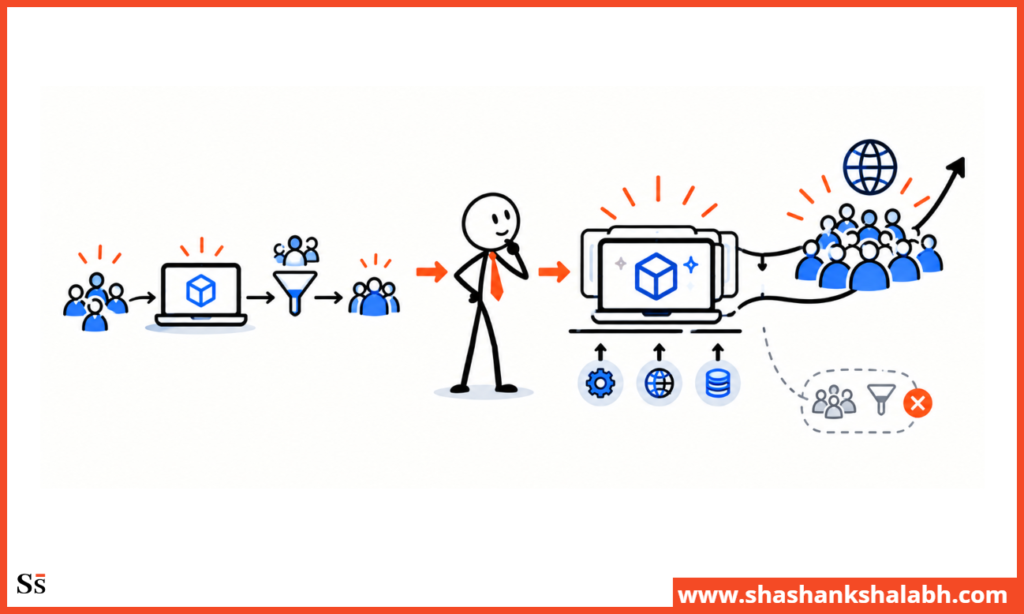
Why the Original ICP Worked Then and Doesn’t Now
In the previous section, I covered the symptoms. Now, let’s look into the underlying causes. Here are the four I see most.
Early adopters aren’t always your best long-term customers
They tolerate product gaps, need less proof, and may buy through personal connections. The broader market often has different expectations.
The product has outgrown the ICP
New features may solve problems for buyers who weren’t relevant at launch. The product evolved, but the ICP didn’t.
→ Why Isn’t Your SaaS Growing After Product-Market Fit?
Your go-to-market strategy was built around a narrow segment
One founder network, channel, or use case can drive early traction without proving there’s a scalable market behind it.
The economics change as you move into new segments
Larger accounts can bring bigger contracts, but also longer sales cycles, more implementation work, and higher support costs.
Bigger customers aren’t automatically better customers. What matters is whether the economics work.
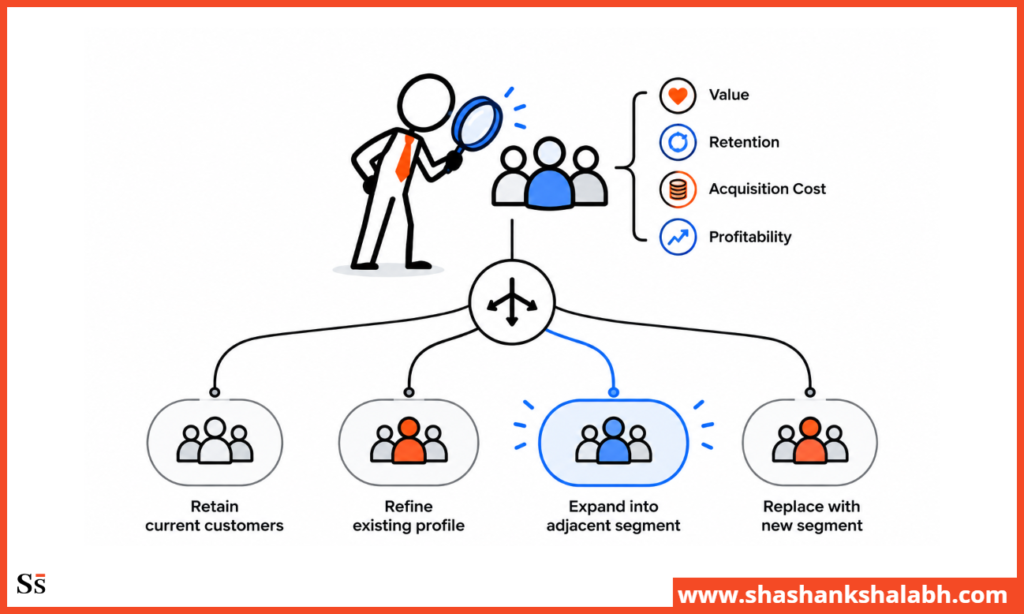
Should You Expand or Replace Your ICP?
It is often more difficult to change your ICP that to define it.
Step 1. Study your best customers, not your biggest
Compare customer groups on:
- Acquisition cost and sales cycle
- Contract value and gross margin
- Retention, churn, and expansion
- Adoption and support needs
- Time to value and implementation effort
Step 2. Segment by more than size
Group customers by industry, use case, buyer role, urgency, and business model. Company size alone hides too much.
Step 3. Find the segments with the best economics
Look for the mix of real demand, sustainable acquisition cost, strong retention, and enough market to matter.
Step 4. Validate before you commit
Don’t change company-wide strategy on a hunch. Interview customers and lost prospects. Review win/loss patterns.
Test segment-specific messaging. Run small acquisition experiments. Judge by conversion and customer economics, not lead volume.
Step 5. Decide what to keep
Don’t drop the original segment just because a new one looks exciting. Score both with the same criteria and the same evidence.
How many customers do you need to validate a new ICP?
There’s no universal number. It depends on deal volume, sales cycle length, and how much segments vary.
The Retain, Refine, Expand, or Replace Matrix
I use these signals as a starting point when founders ask if it’s time to rethink their ICP. They help guide the decision, but no single metric tells the whole story.
| What the evidence shows | Likely decision | What to do next |
| Strong retention and economics, but limited market size | Expand | Test adjacent segments |
| Strong demand, weak conversion | Refine | Revisit qualification, positioning, buyer fit |
| High revenue, poor margins or retention | Reassess | Investigate customer economics and product fit |
| New segment has better retention and willingness to pay | Validate expansion | Test demand and acquisition economics |
| Segments need different products or sales motions | Segment deliberately | Consider separate positioning, packaging, or GTM |
| Neither segment shows good economics | Replace or rethink | Investigate product value, demand, and business model |
Retain your ICP when the data shows it can still drive growth. Don’t change it just for the sake of change.
What Changes When the ICP Changes
Changing your ICP isn’t just a marketing decision. It affects the entire business.
- Positioning and messaging: Translate the product into the new segment’s problems, priorities, and desired outcomes.
- Demand generation: Find where the new buyers research and buy software. It’s often not where your old ones did.
- Sales process: Update discovery questions, proof points, materials, and qualification rules.
- Product, pricing, and success: Look for gaps in features, implementation, packaging, onboarding, and support.
- Measurement: Report by segment. Strong aggregate numbers can hide weak unit economics in the new market.
→ Why Your SaaS Sales Team Doesn’t Trust Marketing Leads
Where ICP Changes Go Wrong
The biggest mistake is trying to do too much too soon. A few big deals don’t mean you’ve found your next market.
Before changing your messaging or chasing new customers, make sure there’s real demand. And don’t give up on the customers you already have until you know the new segment is worth it.
When to Revisit Your ICP
Don’t change your ICP just because it’s time for a review.
Revisit it when you’re preparing for the next stage of growth, acquisition costs rise, customer retention varies by segment, your product changes, you’re eyeing a new market, or sales keeps struggling to find the right buyers.

When an ICP Change Needs Leadership
Changing your ICP affects marketing, sales, product, and finance. Without clear ownership, the decision gets stuck or falls through the cracks.
That’s where a B2B SaaS fractional CMO can help by bringing the data together, aligning teams, and making sure someone owns the decision and its results.
FAQ
What is an ideal customer profile for SaaS?
An ICP is the type of customer your SaaS business can win, serve profitably, and keep. It considers factors like company size, industry, use case, buyer, and what drives them to buy.
How do you know when your SaaS ICP needs to change?
It may be time to rethink your ICP when growth slows, acquisition gets harder, or your best customers look different from your early ones. Check customer and revenue data before deciding what needs to change.
Should a SaaS company target a broader market as it grows?
Not necessarily. Expand when there’s clear demand and the numbers make sense. Targeting too broadly without evidence can hurt conversion and waste resources.
What’s the difference between changing an ICP and expanding into a new segment?
Changing your ICP means shifting your focus to a different type of customer. Expanding means adding a new segment without giving up your current one. Expansion is often the safer first step because you can test demand before making a bigger change.
How many customers do you need to validate a new SaaS ICP?
There’s no magic number. It depends on your sales cycle, deal volume, and how much customers differ. Look for consistent patterns, not just a few good deals.
Should SaaS companies move upmarket to increase revenue?
Not always. Bigger deals can mean longer sales cycles, more implementation work, and higher support costs. Look at margins and payback, not just contract value, before moving upmarket.
How does changing an ICP affect SaaS go-to-market strategy?
Changing your ICP affects more than targeting. You may need to rethink your messaging, channels, sales process, pricing, onboarding, and how you measure success.

Shashank brings over 22 years of global omnichannel marketing experience. As a 4x Chief Marketing Officer, he has helped several organizations (Startups and Fortune 500) drive sustainable revenue growth through strategic marketing.