
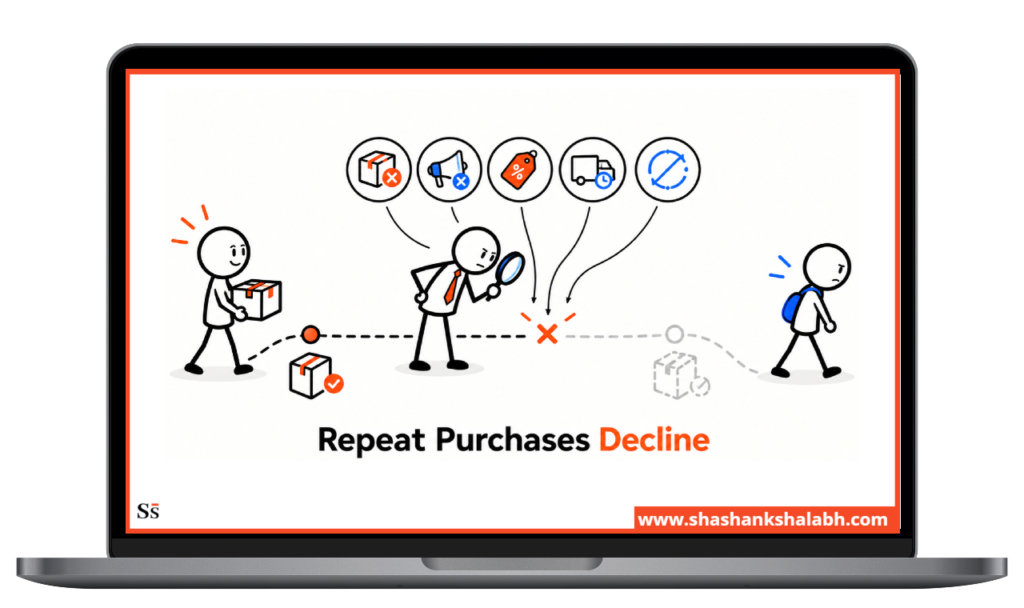
Your DTC brand can get new customers every week and still not have a business.
The first order is easy to celebrate.
But the second order tells you whether people actually wanted what you sold.
In most cases, when customers buy once and disappear, DTC founders and marketers try harder to win customers through discounts, ads, and email flows.
This does not work because nobody figured out why people left in the first place.
Customers don’t come back because the product, marketing, offer, or experience fell short, or simply gave them no reason to return.
Why One-Time Customers Are a Business Problem
Low repeat purchases hurt your business in two ways.
First, you struggle to make a profit. If the first order barely covers your acquisition cost, you need customers to buy again. If they don’t, you lose money.
Second, you’re stuck chasing new customers every month. As traffic gets more expensive, so does keeping revenue up.
→ Why your DTC revenue is up, but profits are not?
Low Repeat Rates Tell Us Something’s Wrong
Not every product is meant to be bought again and again. People reorder coffee often, but buy a sofa or mattress only every few years.
Before you try to fix retention, understand how often customers normally buy in your category. Otherwise, you might waste time fixing something that isn’t broken.
Ecommerce Customer Retention: Underlying Issues
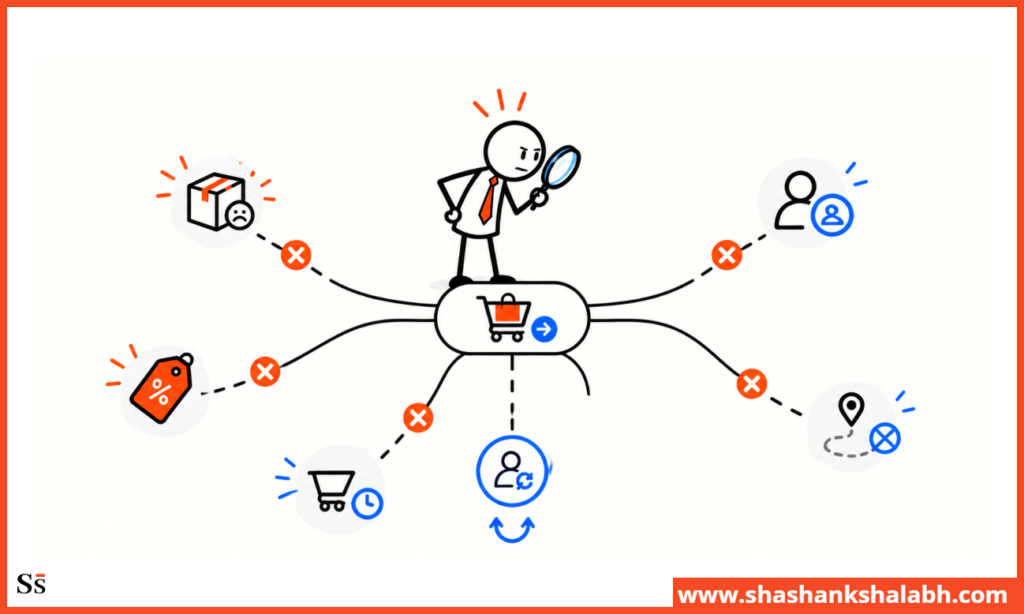
I run every “customers don’t come back” problem through the same sequence:
Product → Positioning → Offer → Experience → Retention
Start at the left.
Product
Sometimes, the product just doesn’t live up to expectations. It doesn’t fit, last, taste, or work as promised.
Now, most unhappy customers won’t complain. They just won’t buy again.
Check reviews, returns, support tickets, and refunds.
Then compare repeat purchases by product. If some products bring customers back and others don’t, that’s a clue.
A retention campaign is not going to help you if the issue is with your product.
Positioning
Your ads might be attracting people who were never likely to buy again.
These could be discount hunters, curious browsers, or people expecting benefits your product can’t deliver.
Compare repeat purchases by channel and campaign. Then compare your ad copy with customer reviews.
Do customers describe the product the way you promised?
If you’re attracting the wrong people, focus on your targeting.
And if you are bringing in the right people with the wrong expectations, work on your messaging.
Offer
A big first-order discount can attract one-time buyers.
Large bundles can leave customers stocked up for months. And subscriptions can lock people in before they’ve tried the product.
Compare repeat purchases from discounted and full-price customers. And look at your profit after the discount.
While discounts can work, make sure those customers come back and you’re still making money.
Experience
Late deliveries, confusing instructions, difficult returns, slow support, or no follow-up after the package arrives can all stop customers from coming back.
Check delivery issues, support tickets, and negative reviews.
Then compare repeat purchases between customers who had a smooth experience and those who didn’t.
You might find the reason they’re not coming back is what happened after they placed the order.
Retention
Some customers are happy with your product but have no reason to buy again yet.
It lasts longer than expected, they don’t know what to try next, or your reminder comes too early or too late.
Not every customer who hasn’t returned is unhappy. They might just not need another order yet.
Check how long products last and how much time usually passes between purchases before deciding there’s a retention problem.
Ecommerce Customer Retention: How to Figure Out What’s Going Wrong?
This is the part most retention articles skip. They hand you tactics.
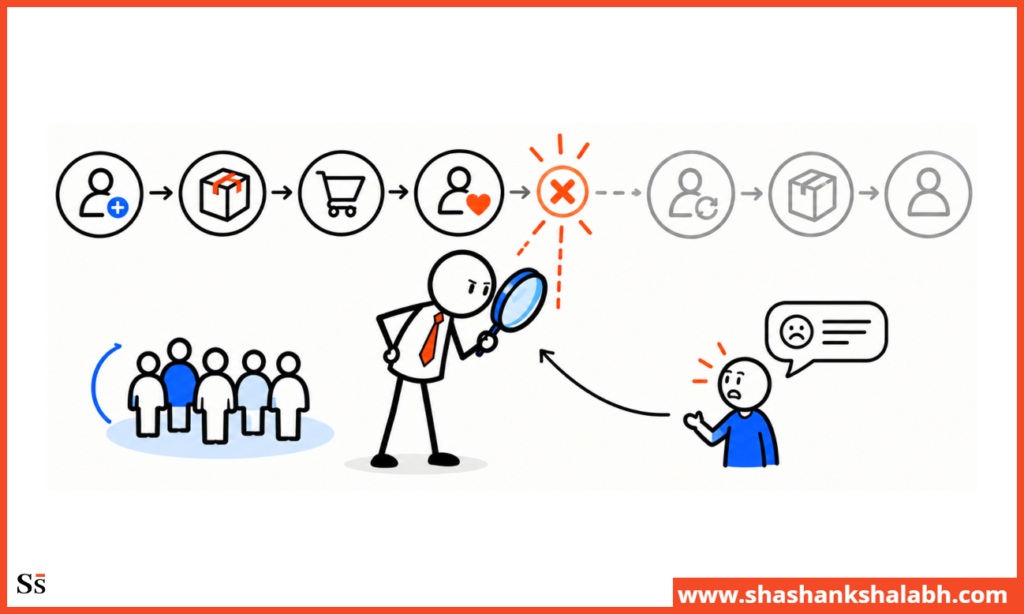
That is why I wanna give you the order I work in as a Fractional CMO for DTC and Ecommerce.
Define What Counts as a Repeat Purchase
Set a realistic repurchase window based on how your product is used.
A 60-day window makes sense for a supplement. It’s wrong for a backpack.
Don’t borrow a number from another brand.
Group Buyers Into Cohorts
Break first-time buyers down by the month they bought, where they came from, what they bought, and which offer they used.
This helps you see if the problem is new or has been there all along.
If only recent customers aren’t coming back, something changed. But if it’s happening across every group, the problem runs deeper.
Find Where Customers Drop Off
Track how many customers make a second purchase, how long it takes, which products and channels bring them back, and how often orders are returned or refunded.
Use the same metrics and definitions each time so you can compare cohorts fairly.
Ask Customers
Talk to repeat buyers and one-time buyers. Read reviews and support threads. Run a post-purchase survey.
Don’t rely on surveys alone. What people say and what they do often differ. Use what they tell you to explain what the data already shows.
Fix the Biggest Problem First
Pick the cause with the strongest evidence and the biggest impact. Don’t start with a loyalty program because it’s the obvious move.
Repeat Purchase: What the Data Tells You
These patterns point you in the right direction, but check the data before making changes.
| What you see | Likely cause | Check first |
| High first-order returns or complaints | Product doesn’t match expectations | Reviews, returns, support data |
| Strong first orders from discounts, weak repeats | Offer attracts low-intent buyers | Repeat rate and margin by offer |
| Repeat rate swings by channel | Audience or positioning mismatch | Cohort behavior by source |
| Customers are happy but don’t reorder | Weak repurchase trigger or long product life | Replenishment timing |
| Customers want to return but hit friction | Experience problem | Delivery, support, checkout, returns |
| Repeat buyers cluster in a few products | Retention potential is product-specific | Repurchase and cross-sell by SKU |
| Repeat is falling across recent cohorts | Something changed | Compare cohorts and recent changes |
Ecommerce Customer Retention: What to address?
A common mistake here is using the marketing channel as a root cause.
Instead, organize the solution around the problem.
→ Why Your DTC Brand Can’t Scale Ads Past a Certain Spend Level?
Earlier, I talked about the issues. Let me share how to solve those.
If the issue is with your product, fix quality and usability issues. Make sure the product lives up to its promises. Improve instructions and packaging before spending more on retention.
For targeting or messaging issues, look at who actually buys and comes back. Judge channels by the customers they bring in, not just first-order ROAS. Make sure people understand what the product can do for them.
If your offer is weak, check whether discounts eat into profit or attract one-time buyers.
Test useful bundles, and offer subscriptions only when they fit how people use the product. In case you have poor customer experience, fix delivery delays, poor support, and painful returns.
Set clear expectations and use customer feedback to tackle the biggest problems first.
And lastly, if the challenge is retention, use email and SMS to bring customers back. Time reminders to when they’ll need more, share useful product tips, and recommend relevant products.
Measure repeat purchases, not just opens and clicks.
The Numbers That Matter
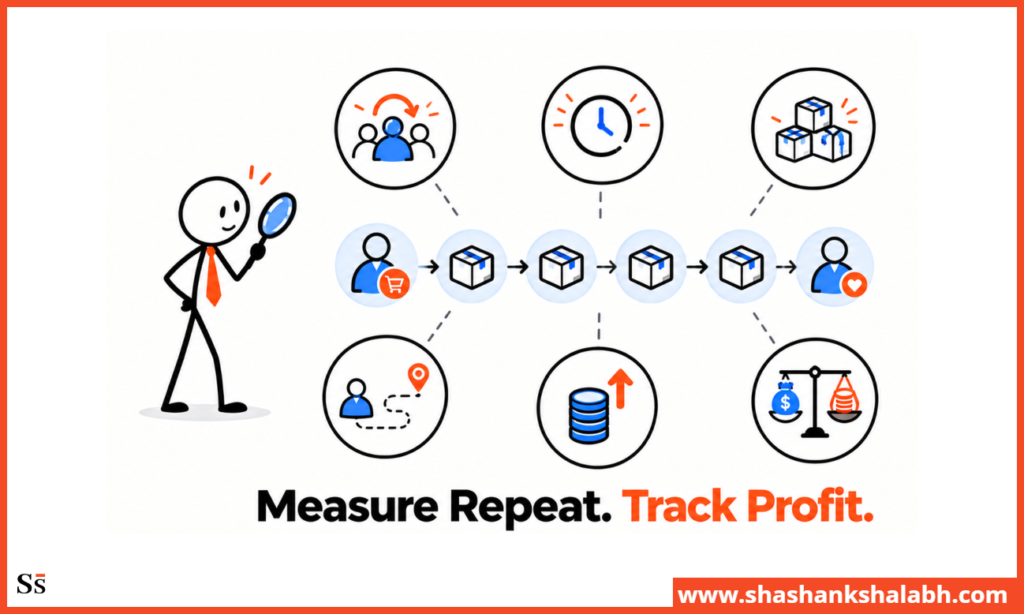
There are dozens of DTC metrics. Don’t waste your time chasing the unimportant ones.
Focus on these core metrics.
- Repeat purchase rate: Share of customers who buy again within a defined period.
- Time to second purchase: How long they take.
- Purchase frequency: How often they buy over a set period.
- Customer retention rate: Share retained under a clearly defined criterion.
- Customer lifetime value: Value over the relationship, calculated the same way every time.
- Contribution profit by cohort: Whether repeat buying actually makes money.
Don’t compare repeat rates across different time periods or product categories without accounting for buying cycles. A good repeat rate for furniture could be a bad one for skincare.
Why More Marketing Won’t Help
Loyalty programs, email, SMS, subscriptions, and discounts can all help, but they won’t fix a disappointing product, create a need to buy again, or help your business if they eat into your margins.
And if you can’t tell whether they’re driving extra purchases or just rewarding customers who would have bought anyway, you don’t know if they’re working.
Figure out why customers aren’t coming back first, then choose the right solution.

When It’s Time to Rethink Your Strategy?
If repeat purchases are low and no one knows why, marketing only measures first-order revenue, or retention is treated as just an email problem, you need someone who can connect the dots between product, offer, and acquisition.
That’s where a fractional CMO for ecommerce and DTC brands can help.
FAQ: Ecommerce Customer Retention
Why do customers buy once and never return?
Customers don’t come back because the product disappointed them, the wrong people bought it, the offer encouraged a one-time purchase, the experience was poor, or they had no reason to buy again.
What is a good repeat purchase rate for a DTC brand?
There’s no universal benchmark. It depends on your product and how often customers need to buy it. Start by comparing your own customer groups over time.
How do you calculate repeat purchase rate?
Divide the number of customers who bought again by the total number of customers in that group, within a set time period. Choose a window that fits your product and use it consistently.
How long should it take a customer to make a second purchase?
It depends on how often customers use up or need your product. Look at when repeat buyers typically place their second order and use that as your guide.
How can DTC brands increase repeat purchases without discounts?
Address what’s stopping customers from coming back. Then use helpful product tips, relevant recommendations, and timely reminders to give them a reason to buy again.
Do loyalty programs improve customer retention?
Loyalty programs work best when customers already like the product and have a reason to come back. They won’t fix a product that disappoints.
How can you tell whether low repeat purchases come from the product or the marketing?
Compare repeat purchases by product, channel, and offer.
If repeat rates are low across every channel, the product may be the problem. If they vary by channel or offer, marketing may be the issue.

Shashank brings over 22 years of global omnichannel marketing experience. As a 4x Chief Marketing Officer, he has helped several organizations (Startups and Fortune 500) drive sustainable revenue growth through strategic marketing.