
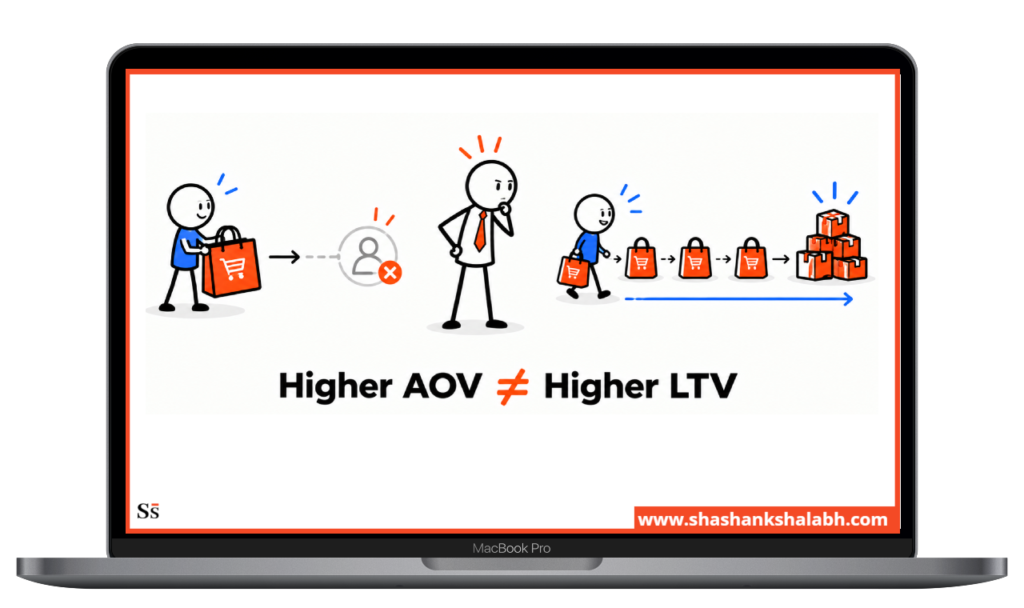
Direct-to-consumer brands often enjoy seeing their average order value go up.
But often, customers don’t spend more over time.
This happens a lot in DTC.
Whenever there is a bigger order, it feels like growth. Often it’s just the same customer spending the same total amount, sooner.
Getting people to spend more today doesn’t make them better customers. A higher AOV only helps if the extra order value improves customer economics (aka ecommerce customer lifetime value) without hurting future purchases.
Why A Higher AOV Doesn’t Always Mean Better Customers?
We all use AOV and ecommerce customer lifetime value (LTV)) freely in our marketing conversations.
However, it is worth understanding the nuances.
AOV is the average value of a single order. And customer lifetime value (LTV) is the value a customer generates over the whole relationship.
Read these definitions again. While AOV measures a transaction, customer lifetime value (LTV) measures a customer.
They can move in opposite directions.
A customer who buys a big bundle today may not need anything for six months.
While their first order looks great, their lifetime value may be no better than a customer who bought a small order and came back three times.
Don’t just focus on getting higher AOV. Try to assess if your customers are worth more over time.
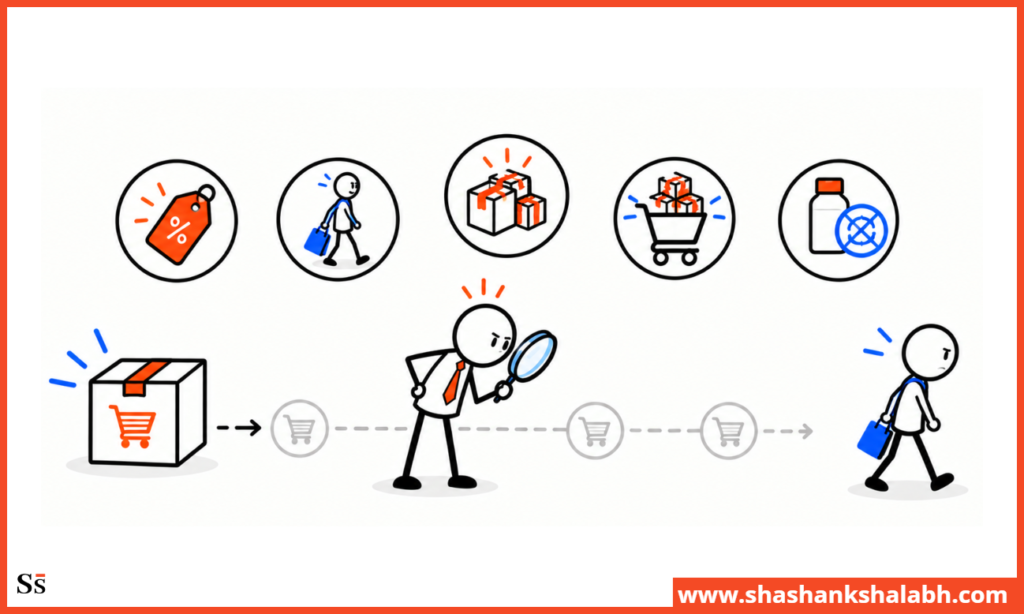
Reasons AOV Goes Up While customer lifetime value (LTV) Stays Flat
Let me walk you through the five core reasons why your AOV keeps rising while ecommerce customer lifetime value stays put.
Promotions/Deals/Discounts
Customers often buy more to get a discount or free gift, even when they don’t need the extra product.
Bundles can also lead to stockpiling, which means customers buy in bulk and take longer to come back.
Track repeat purchases and margins by offer type.
If your customers who buy through deals come back less often, your higher AOV may be coming at the cost of repeat sales.
A big first order doesn’t mean a loyal customer
Some customers place large first orders because they love a deal or are buying a gift.
They may never come back.
Different channels attract different customers, and some are more likely to buy again than others. I see this often when brands scale campaigns that drive big first orders but few repeat purchases.
Compare repeat rates by channel, campaign, and offer before assuming a high AOV means you’re attracting valuable customers.
Customers may be buying less often
When customers buy larger packs or stock up, they take longer to place their next order. They may not be spending more overall; just buying more upfront.
Track how long it takes customers to buy again and how much they spend over time. If higher AOV comes with a longer gap between orders, you may be shifting sales forward rather than driving more sales.
→ Why customers buy and never come back?
Your upsells hurt the experience
Irrelevant recommendations can make customers hesitate or leave.
Pushing bundles too hard can also hurt conversion or lead to more returns. A bigger order means little if the customer sends half of it back.
Look at profit per order, conversion rate, and customer feedback together. Each tells you part of the story.
Customers don’t need to buy again yet
Some products last for months or even years. Customers may not need a refill, an add-on, or another purchase anytime soon. They also may not have a reason to come back.
That isn’t necessarily a problem. If your product is built to last, repeat purchases will naturally take longer. Know what’s normal for your category before you decide something’s broken.
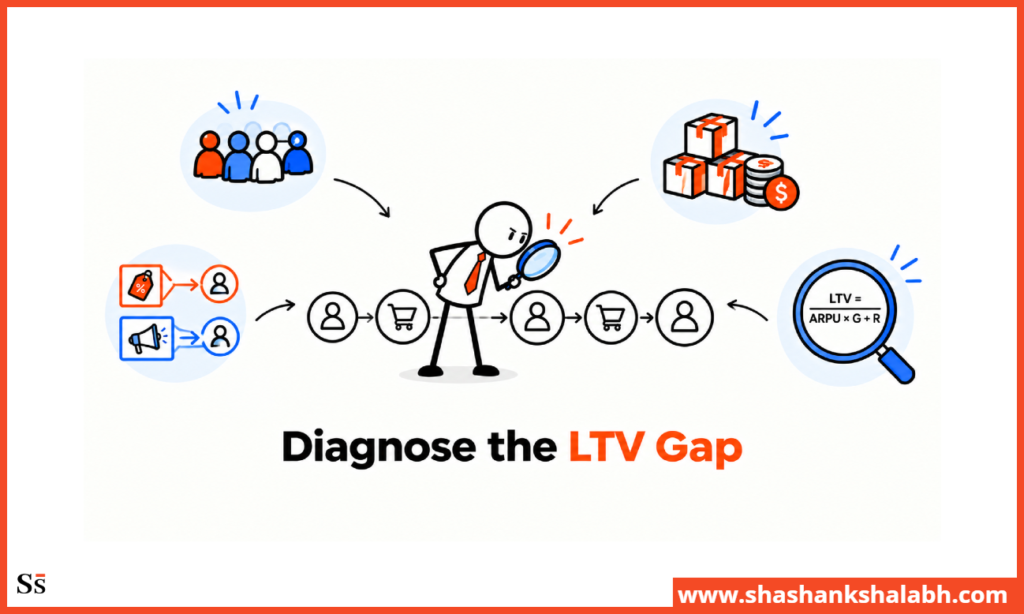
How to Find Out What’s Really Happening?
Compare cohorts, not store averages
Store averages blend old and new customers, and hide what changed. Compare customers acquired before and after AOV started rising.
Give both groups the same amount of time to make repeat purchases so you’re comparing them fairly.
Look Beyond the First Order
I want you to look at these numbers.
- AOV
- First-to-second purchase rate
- Time to second purchase
- Purchase frequency
- Revenue per customer over a set period
- Contribution profit by cohort
- Refund and return rates
Find out what’s driving the increase
Break down AOV by offer and sales channel to see whether bundles, discounts, upsells, or a single campaign are behind the increase.
Store averages can hide where the growth is really coming from.
Check how customer lifetime value (LTV) is calculated
Ecommerce LTV based on revenue can look healthy while profit shrinks.
Know whether yours is revenue, gross profit, or contribution profit. A higher revenue number doesn’t mean more profit.
Suggested Read: → Why Your DTC Brand Can’t Scale Ads Past a Certain Spend Level?
What AOV and Customer Lifetime Value (LTV) Reveal About Your Business
Use these patterns to spot potential issues, then check your data to confirm what’s happening.
| What you see | Possible explanation | What to check |
| AOV up, repeat rate down | Bulk buying or offer-driven purchases | Repurchase timing and offer cohorts |
| AOV up, conversion down | Upsell or price friction | Conversion and contribution profit |
| AOV up, returns up | Product or expectation mismatch | Returns and complaints by product |
| AOV up, customer lifetime value (LTV) flat | Bigger first orders, no extra cumulative value | Cohort spend over equal time windows |
| AOV up, profit down | Discounts, costs, shipping, or returns | Contribution profit per customer |
| AOV and Ecommerce LTV both up | Possibly healthier economics | Retention, margin, acquisition cost |

How to Raise AOV Without Hurting customer lifetime value (LTV)
Here are a few things you can do to improve your AOV without negatively affecting your ecommerce customer lifetime value (LTV).
Build bundles around products that naturally go together, set free shipping thresholds that increase profit, and recommend upsells that fit what customers need.
Track repeat purchases and profit by campaign to understand which offers bring in customers who keep coming back.
A high AOV or ROAS alone doesn’t tell you that.
When bigger orders aren’t translating into stronger customer value, you need to look at the bigger picture.
A fractional CMO helps DTC and ecommerce brands connect the dots between marketing spend, offer strategy, and customer retention to find what’s holding growth back.
FAQ: Balancing AOV and LTV
What is the average order value?
It is the average amount customers spend per order. Divide total revenue by the number of orders and you have the AOV.
What’s the difference between AOV and customer lifetime value (LTV)?
AOV shows how much customers spend per order, while customer lifetime value (LTV) shows how much they spend over time.
Can increasing AOV reduce customer lifetime value?
Deals, bulk packs, and pushy upsells can increase order value, but they may also lead to fewer repeat purchases and more returns.
How can DTC brands increase AOV without hurting retention?
DTC brands can Pair products customers naturally use together, recommend relevant add-ons, and measure success by repeat purchases and profit per order.
How long should a brand wait to measure customer customer lifetime value (LTV)?
It depends on how often customers need to buy again. Compare customer groups over the same length of time to get a fair picture of repeat purchases.
Should DTC brands prioritize AOV or repeat purchases?
DTC brands should track AOV and repeat purchases alongside contribution margin and CAC. The right balance depends on how often customers buy, how much it costs to acquire them, and how much profit each order brings in.

Shashank brings over 22 years of global omnichannel marketing experience. As a 4x Chief Marketing Officer, he has helped several organizations (Startups and Fortune 500) drive sustainable revenue growth through strategic marketing.