
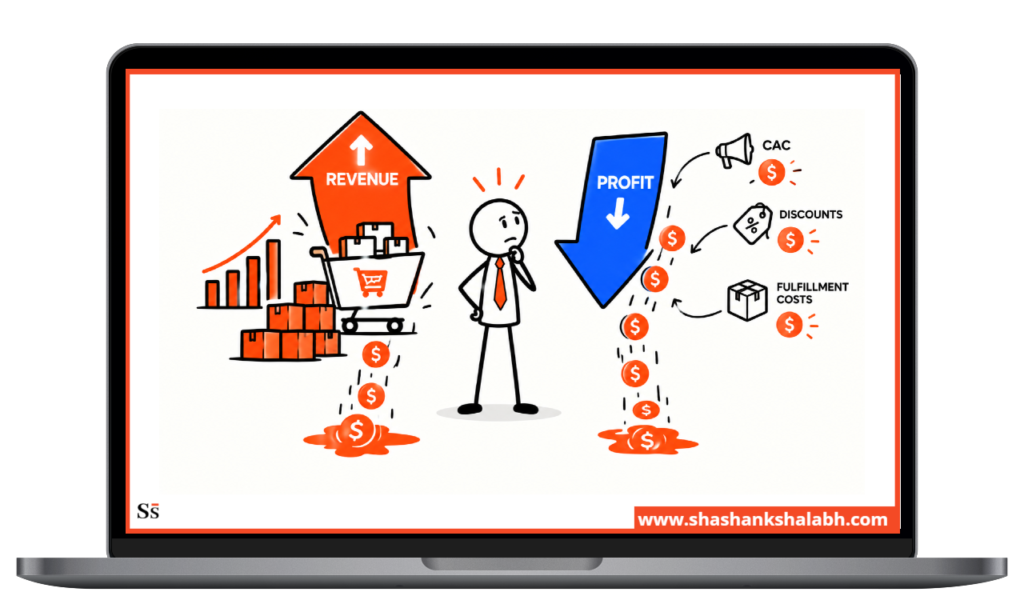
One of the most common and most dangerous patterns in DTC is when your revenue is going up while profit goes down.
Why do I call it “dangerous”?
For starters, to most DTC founder, it looks like success. After all, the top-line number is green. However, when you dive deep, the economics are quietly getting worse.
A DTC brand can grow revenue while making less money when the cost of generating and fulfilling that revenue grows faster than the profit each order actually produces.
The CAC climbs, discounts pile up, margins shrink; and by the time you see it in the bank, it’s been happening for months.
Why Revenue Can Grow While Profit Falls
Revenue is just one number. It doesn’t tell you anything about how much it cost to get there.
Here are the usual suspects, aka, warning signs:
- CAC is increasing
- Discounts are increasing
- Gross margin is declining
- Contribution margin is deteriorating
- AOV isn’t keeping pace with costs
- Returns and refunds are increasing
- Repeat purchase economics are weakening
- Marketing spend is scaling faster than profitable revenue
In most cases, two or three are getting worse at the same time, but rising revenue makes it easy to miss.
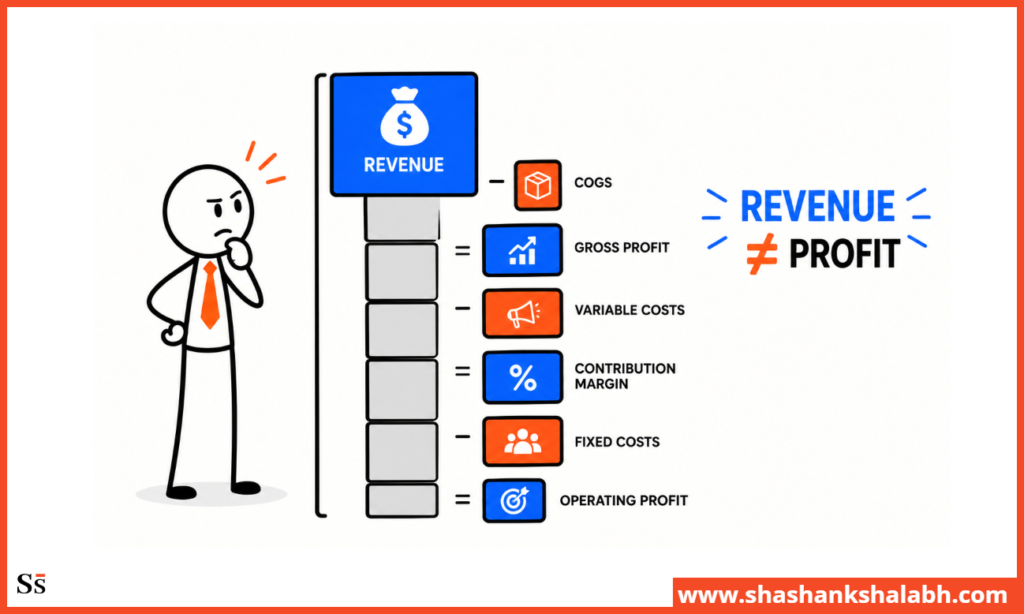
Revenue Growth Isn’t the Same as Profitable Growth
I think of it as a waterfall.
Revenue → COGS → Gross Profit → Variable Costs → Contribution Margin → Fixed Costs → Operating Profit
Revenue can grow at every one of these stages while what actually lands in your pocket shrinks.
Check Contribution Margin
If I’m looking at one number, it’s Contribution margin.
Contribution margin is what’s left from each order after the variable costs: COGS, fulfillment, shipping, payment processing, returns, discounts, and the cost to acquire the customer.
There’s no universal formula. Different companies include different costs.
That’s fine.
Define yours clearly and use the same one every time.
Revenue can look great while contribution margin gets worse.
You can have your best revenue month ever and your worst contribution margin month in a year at the same time.
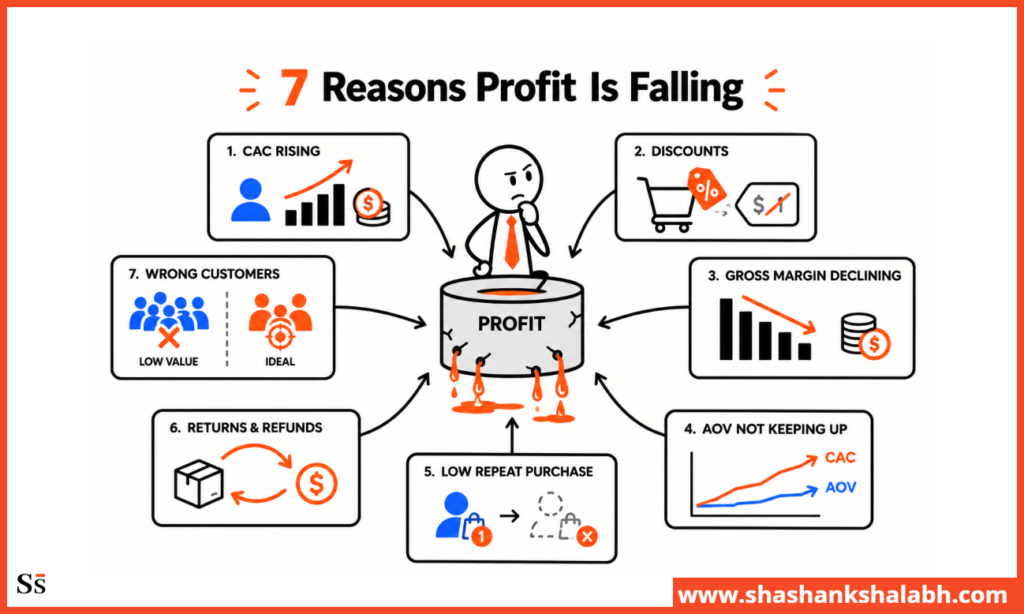
Problem 1: CAC Is Rising Faster Than Customer Value
Paid acquisition gets more expensive as auctions get more competitive, creative fatigues, and you’re forced into lower-quality traffic to hit volume targets.
Look at CAC by channel, not blended
Marketing channels such as Meta, Google, TikTok, influencer, affiliate, organic, and email/SMS behave completely differently, and blended CAC hides which one is actually breaking.
Also separate blended CAC from new customer CAC.
If existing customers are buying again, blended CAC looks healthier than your actual cost to acquire someone new. And that’s the number that matters for growth economics.
→ How to improve LTV:CAC Ratio?
→ Why Your CAC Is Too High (And How to Fix It)?
Problem 2: You’re Buying Revenue With Discounts
This is DTC’s most common blind spot. Look at discount percentage, average discount per order, promotional frequency, first-order discounts, and free shipping thresholds.
Compare revenue before discounts to revenue after discounts.
If discounts are growing faster than the revenue they’re producing, you’re reporting higher sales while keeping less of each dollar.
In other words, you’re growing revenue, but giving more of it back.
Problem 3: Your Gross Margin Is Getting Worse
Product, supplier, or shipping costs go up.
Or, and this one’s easy to miss, your product mix shifts toward lower margin items.
You can grow revenue by selling more of the products that make you less money.
Revenue doesn’t care which products are selling more, but your bank account does.
Problem 4: AOV Isn’t Keeping Up With Acquisition Costs
If CAC goes from $40 to $55 while AOV only moves from $90 to $95, your economics are getting worse even as revenue climbs.
A higher AOV doesn’t mean a healthier business. What matters is how much profit you make per order.
Problem 5: Customers Are Buying Once, Not Repeatedly
Revenue can look healthy for a while even when retention is slipping.
Watch repeat purchase rate, purchase frequency, time between purchases, and LTV by cohort.
Separate new customer revenue from existing customer revenue.
If most of your growth is coming from new customers while repeat purchases stay flat or fall, you’re working harder just to stand still.
Problem 6: Returns and Refunds Are Eating Into Revenue
Track return rates, refund rates, return shipping, and restocking costs.
Look at them by channel and cohort, not just overall.
A channel can drive plenty of revenue while its high return rate makes it far less profitable than it looks.
Problem 7: You’re Scaling the Wrong Customers
Compare customer economics by channel, product, cohort, and first-order offer.
Instead of focusing only on who generates the most revenue, think about who generates the most contribution profit over time.
Those aren’t always the same customers, and scaling the wrong ones only makes the problem bigger.
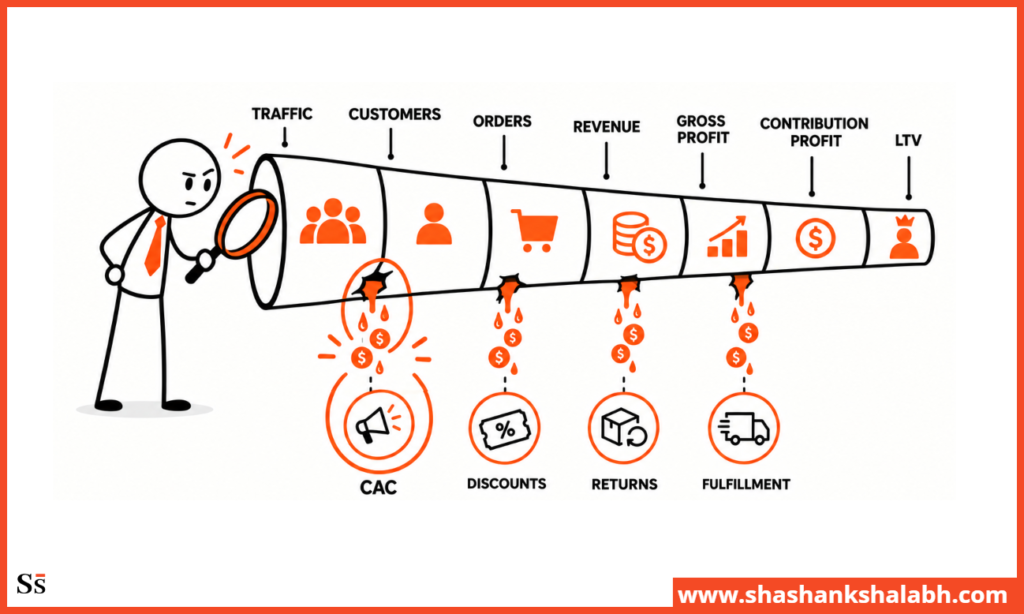
The DTC Profitability Funnel
Traffic → Customers → Orders → Revenue → Gross Profit → Contribution Profit → Customer Lifetime Value
Add CAC, discounts, returns, and fulfillment costs to that chain, and you should be able to see exactly where the money is leaking.
The 8 Numbers I’d Check First
Track revenue, gross margin, contribution margin, new customer CAC, AOV, discount rate, return and refund rate, and repeat purchase or LTV.
Don’t look at any of them in isolation. Look at how they’re moving together.
That’s where you find the problem.
A Simple DTC Growth vs Profitability Diagnostic
| If this is happening | Investigate |
| Revenue ↑, CAC ↑↑ | Acquisition efficiency |
| Revenue ↑, margin ↓ | Product/margin economics |
| Revenue ↑, discounts ↑ | Promotional dependency |
| Revenue ↑, AOV flat | Basket economics |
| Revenue ↑, returns ↑ | Product/customer/channel quality |
| Revenue ↑, repeat rate ↓ | Retention |
| Revenue ↑, contribution margin ↓ | Overall customer economics |
| Revenue ↑, profit ↓ | Entire economic model |
Don’t Fix Falling Profit by Just Increasing Revenue
If the economics are getting worse, spending more on acquisition only makes the problem bigger.
Find what’s actually holding you back, whether it’s CAC, margin, discounts, returns, or repeat rate.
Fix that first. Then scale.
What Healthy DTC Growth Looks Like
There’s no universal benchmark here. It varies too much by category.
But healthy growth generally means your revenue, gross profit, and contribution profit are all growing together.
Your CAC stays reasonable relative to customer value.
Discounts stay under control, and repeat purchase holds or improves.
You need to focus on whether your profit is growing with your revenue.

When a DTC Brand Needs a Marketing Strategy Reset
If revenue is growing but contribution profit isn’t, paid acquisition may be doing all the heavy lifting, promotions may be driving the growth, or no one may be accountable for the link between marketing spend and profit.
That’s a strategic problem where a fractional CMO can help.
Frequently Asked Questions
These are some of the most common questions DTC founders struggle with.
And I have come across these during my conversations with DTC founders as well.
Why is my ecommerce revenue increasing but profit decreasing?
This could be due to (a combination of) rising CAC, growing discounts, margin erosion, or weakening repeat purchase.
Can a DTC brand grow revenue and lose money?
Yes, easily. If the cost to acquire and fulfill each order grows faster than the profit it generates.
What is contribution margin in ecommerce?
This is revenue minus all variable costs tied to the order, such as COGS, fulfillment, shipping, payment processing, returns, discounts, and acquisition cost.
Why does CAC matter if revenue is growing?
This is because revenue doesn’t account for cost.
Rising CAC can offset or exceed revenue gains entirely.
How do discounts affect DTC profitability?
They inflate top-line revenue while reducing what you actually keep per order.
If they grow faster than order value, margin erodes even as sales rise.
How do I know if my DTC growth is profitable?
Check whether gross profit and contribution profit are growing alongside revenue.
What DTC metrics should founders track?
Contribution margin, new customer CAC, discount rate, return rate, and repeat purchase rate : alongside revenue, not instead of it.
How do you improve DTC contribution margin?
Focus on the issues that’s driving the deterioration (CAC, discounts, returns, or margin), rather than trying to outgrow the problem with more spend.

Shashank brings over 22 years of global omnichannel marketing experience. As a 4x Chief Marketing Officer, he has helped several organizations (Startups and Fortune 500) drive sustainable revenue growth through strategic marketing.