
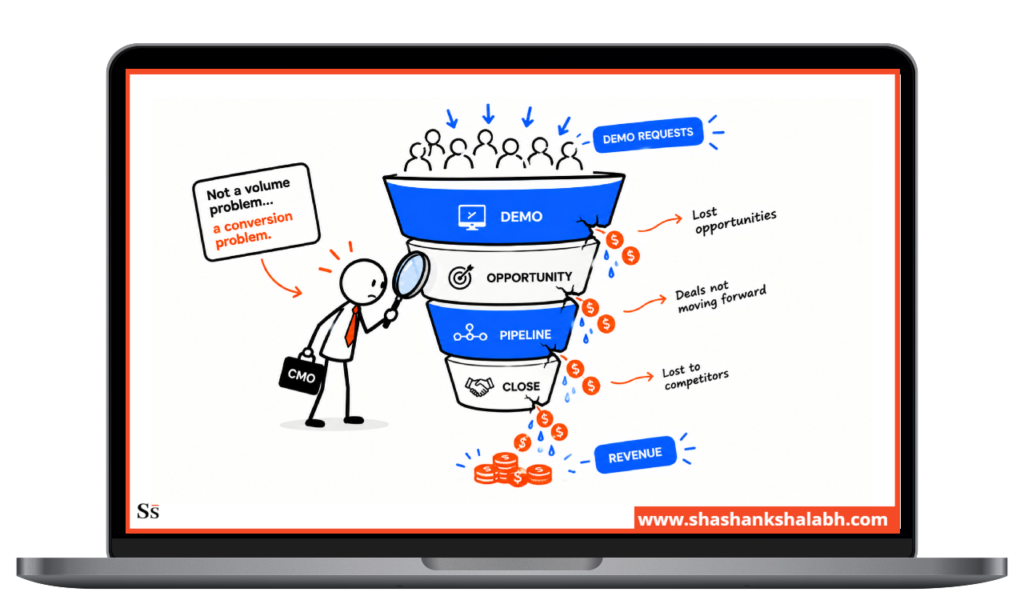
Do you know why your B2B SaaS revenue is not increasing even though you are getting enough demo volume?
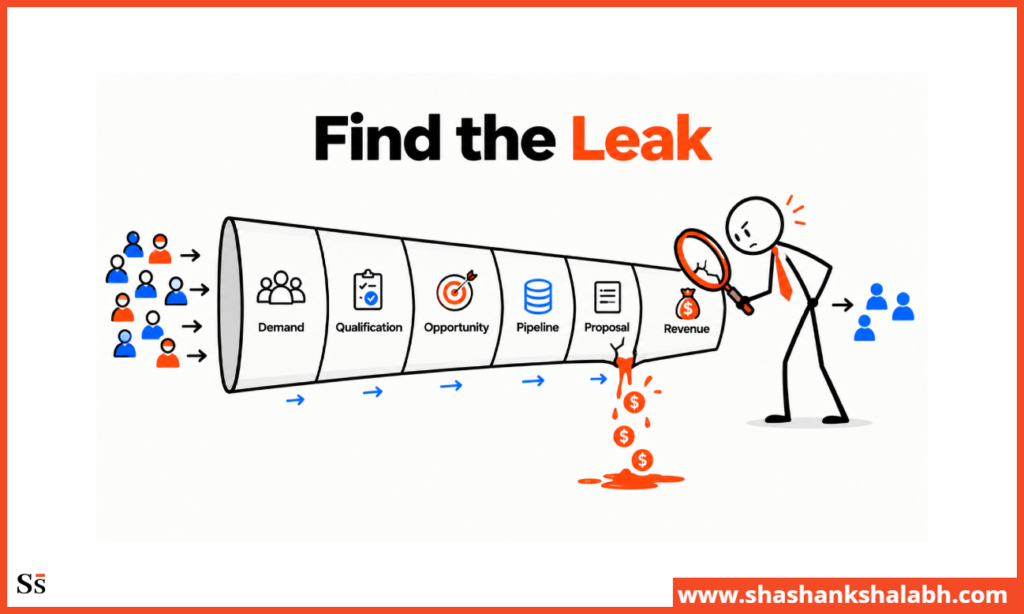
This is a classic conversion issue. In other words, somewhere between the demo and the closed deal, the funnel is leaking.
The leak could be either demo quality, qualification rate, opportunity creation, pipeline progression, or close rate.
If you are experiencing this, you need to pause and locate exactly where the revenue funnel has broken.
Why More Demos Don’t Always Lead To More Revenue?
This is where a lot of expensive confusion starts.
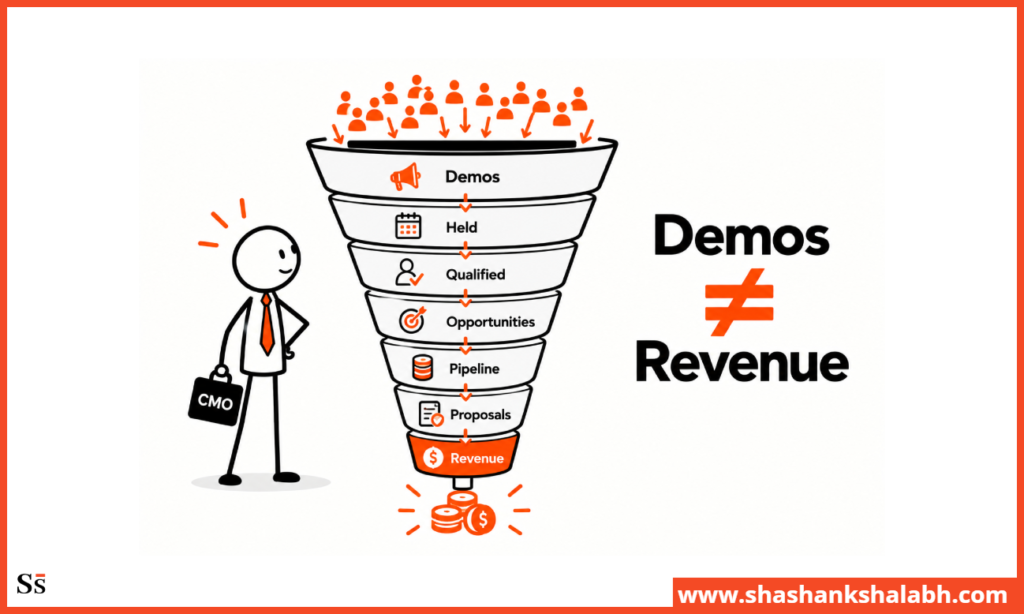
Demo volume is a mid-funnel activity metric, while revenue is the end result.
They’re connected, but not directly. There are several conversion steps in between, and any one of them can break.
More demos only matter when they lead to qualified opportunities, real pipeline, deals that progress, and ultimately closed revenue.
If a stage is broken, more demos won’t fix it.
If demos are going up and revenue isn’t, I’d stop chasing more demos and look at what’s happening after them.
→Why Your Marketing Is Not Driving Revenue
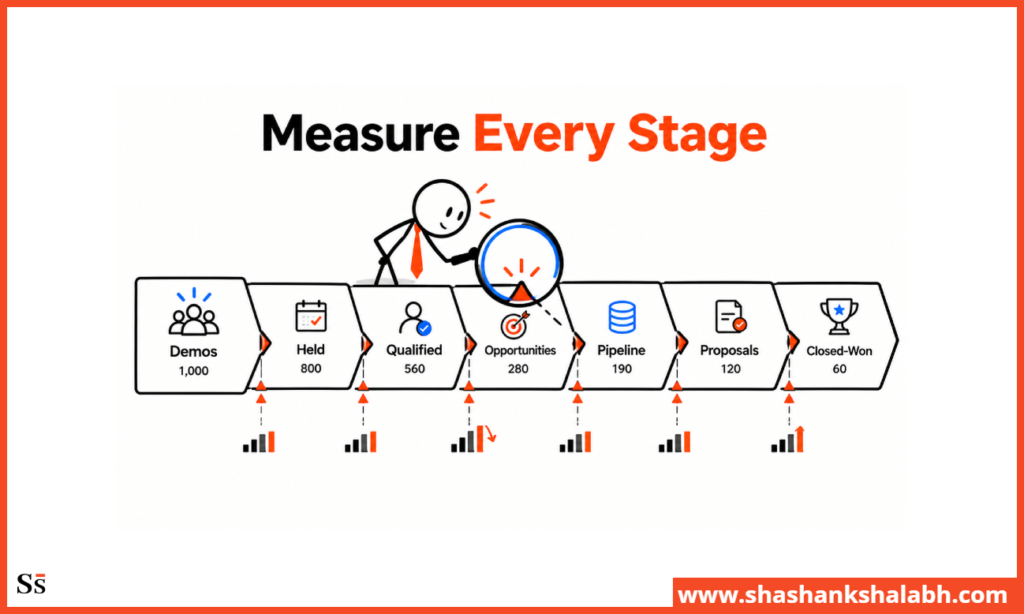
The Revenue Funnel You Should Actually Measure
I have observed that a majority of businesses track demos at the top and revenue at the bottom, but don’t pay much attention to what happens in between.
Here’s how I look at the funnel:
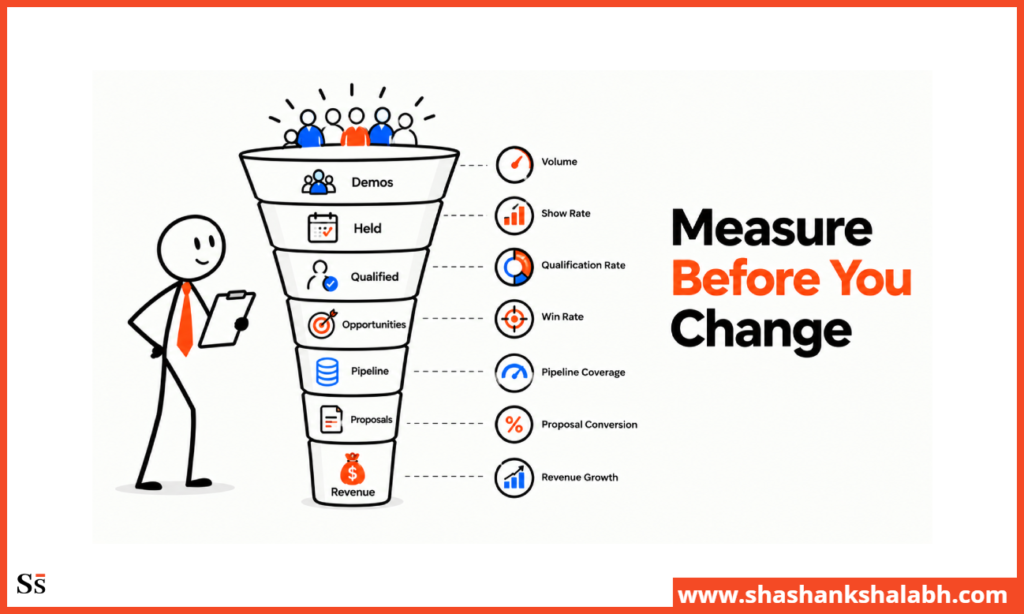
Demos booked → Demos held → Qualified demos → Opportunities created → Pipeline value → Proposals sent → Closed-won revenue
The important part is the conversion from one stage to the next. If one of those drops off more than it should, that’s where I’d start looking.
Start With the Demo-to-Revenue Funnel
Here’s what to measure at each stage and what to look for.
| Stage | What to Measure | What It Tells You |
| Demos booked | Demo volume | Demand generation effectiveness |
| Demos held | Show rate | Lead quality and intent |
| Qualified demos | Qualification rate | ICP fit of incoming leads |
| Opportunities created | Demo-to-opportunity rate | Sales qualification effectiveness |
| Pipeline created | Opportunity value created | Commercial potential of pipeline |
| Proposals sent | Opportunity-to-proposal rate | Sales progression capability |
| Closed-won | Close rate | Sales effectiveness at final stage |
| Revenue | Pipeline-to-revenue | Actual business outcome |
Each row is a conversion rate. Pull them for the trailing 90-180 days. Identify the largest drop-off, and that will be the primary problem.
Let’s look at these issues in detail.
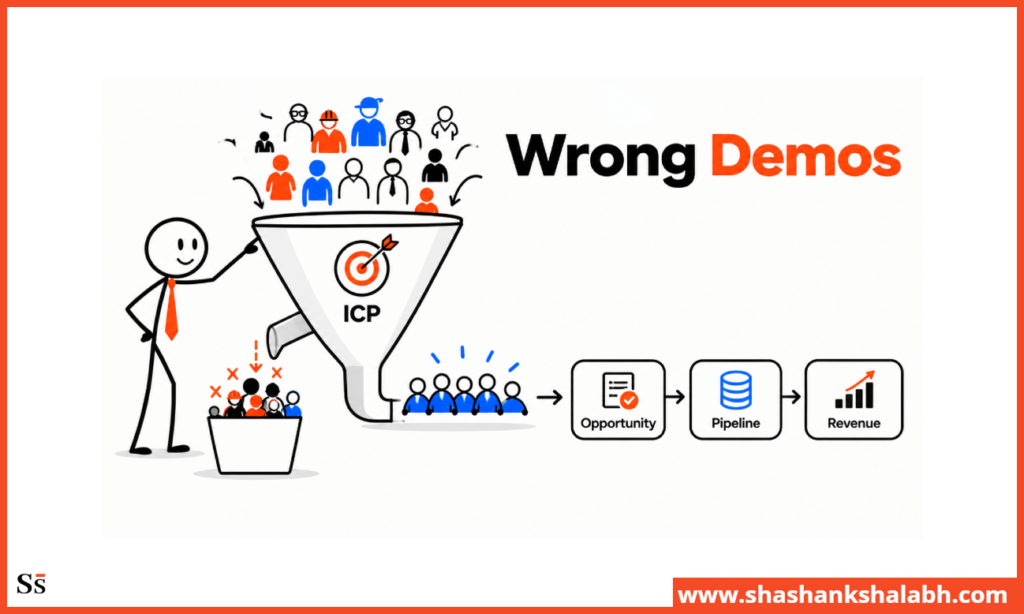
Problem: You’re Generating the Wrong Demos
A common reason demos go up while revenue stays flat is that the demos aren’t coming from the right prospects.
This is likely a marketing issue. That is, the ICP or messaging is bringing in interest, but not enough of it is from people who are likely to buy.
Your ICP may have changed without your targeting changing with it.
The buyers who helped you reach your first 2M-5M may have been early adopters who moved quickly and needed little convincing.
However, mainstream buyers tend to involve more people, take fewer risks, and need more proof.
At the same time, different channels bring different levels of intent.
So a jump in paid demos can look good in the CRM while producing far fewer buyers than organic or referral demos.
And if your messaging is broad, you may be attracting curiosity instead of people with a specific problem to solve.
The result is more demos that look fine on paper but don’t convert.
Problem: Your Demo-to-Opportunity Conversion Is Too Low
I want to emphasize here that a demo is not a sales opportunity. It is a conversation.
Converting it to a genuine opportunity requires that the prospect has a real problem, a real budget, a real decision-maker involved, and a real reason to solve the problem now rather than later.
When those four elements aren’t present, the demo produces a CRM entry and nothing else.
The problem may also be happening after the demo is booked. Some prospects have a related problem, but not one your product actually solves. Others have no urgency, no budget, or aren’t the person who can make the decision.
These are qualification issues, and they’re much cheaper to catch before the demo than after sales has spent 45 minutes on a call.
A quick pre-demo check for fit, urgency, budget, and decision-making authority can prevent a lot of wasted demos.
Problem: Opportunities Are Getting Stuck in the Pipeline
Pipeline problems show up as deals getting stuck at the same stage, sales cycles getting longer, or buyers struggling to make the internal case for change.
Look at where deals stall and why.
It may be a missing stakeholder, an unanswered objection, or a lack of urgency.
Also check how your stages are defined. If they track sales activity rather than buyer progress, your pipeline can look healthy while very few deals are actually moving toward a decision.
Problem: Your Pipeline Looks Healthy but Isn’t
If you are a CEO or founder reviewing pipeline data, pay attention to this one.
A pipeline that looks healthy but isn’t is more dangerous than a pipeline that looks thin.
It creates false confidence, delays corrective action, and produces forecast misses that are genuinely surprising.
A big pipeline number doesn’t necessarily mean you have a lot of revenue coming.
Look for opportunities with weak buying signals, deals that have gone quiet for too long, and stages based on sales activity rather than actual buyer progress.
Clean out old or unlikely deals and you’ll get a much clearer picture of what the pipeline can realistically produce. From there, you can see how much new pipeline you actually need.
→ Why Your Pipeline Is Inconsistent
Problem: Your Close Rate Has Fallen
If win rates keep falling, look at where the change is happening.
A competitor may be positioning themselves better, the company may be attracting buyers it’s less well suited to win, or sales may be struggling at a specific point in the close.
It’s also worth looking at positioning and timing.
Messaging that gets a buyer interested may not give them a strong enough reason to choose you.
And if sales enters the process after the buyer has already narrowed down their options, it’s much harder to change the outcome.
Problem: Marketing and Sales Are Measuring Different Things
This is one of the most expensive structural problems in B2B revenue systems.
It is also one of the hardest to fix because it requires both teams to change how they define success.
Marketing and sales often have different ideas of what “qualified” means.
Marketing may look at engagement and lead volume, while sales wants to know if there’s a real problem, budget, a decision-maker, and a reason to buy now.
The problem gets worse when neither team owns the conversion from demo to opportunity.
Agree on what a sales-ready opportunity looks like, use that definition for the handoff, and measure both teams on what happens after the demo.
7 Metrics to Check Before Changing Anything
These metrics will help you locate the leak. Each one is a conversion rate. Start with the smallest one.
| Metric | How to Calculate | What It Diagnoses |
| Demo show rate | Demos held ÷ Demos booked | Lead quality and intent |
| Demo qualification rate | Qualified demos ÷ Demos held | ICP fit of incoming leads |
| Demo-to-opportunity rate | Opportunities created ÷ Qualified demos | Sales qualification effectiveness |
| Opportunity-to-pipeline rate | Opportunities with value ÷ Opportunities created | Commercial viability of pipeline |
| Pipeline-to-proposal rate | Proposals sent ÷ Pipeline opportunities | Sales progression |
| Proposal-to-close rate | Closed-won ÷ Proposals sent | Close effectiveness |
| Pipeline-to-revenue rate | Revenue closed ÷ Pipeline value | Overall pipeline quality |
Also track these alongside the conversion rates:
- Average deal size : if it’s falling, you may be selling to a different customer or discounting more.
- Sales cycle length : if deals are taking longer, find out where they’re getting stuck.
- Win rate by competitor : shows where you’re losing and what you may need to address in your positioning.
- Pipeline velocity : how much pipeline is moving through the funnel each week.
How to Find the Leak in Your Revenue Funnel?
I want to give you a step-by-step framework to identify the leak.
Step 1: Pull the last 90-180 days of data
Don’t just look at what’s happening right now. Problems often show up months after the thing that caused them.
Step 2: Break it down by lead source
Look at organic, paid, referral, outbound, and other sources separately. The source bringing in the most demos isn’t necessarily bringing in the most revenue.
Step 3: Break it down by ICP
Look at company size, industry, funding stage, tech stack, or whatever else matters to your business. You’ll usually find that some types of customers convert much better than others.
Step 4: Calculate the conversion rates
Don’t just count demos and opportunities. Look at the percentage moving from one stage to the next. That’s what shows you where things are going wrong.
Step 5: Compare it with the previous period
If a stage used to convert well and suddenly doesn’t, something changed. If it’s always been weak, you’re dealing with a different problem.
Step 6: Find the biggest drop-off
Look for the stage where the most prospects are falling out. That’s where I’d start.
Step 7: Figure out what’s causing it
You should then look into the stage where deals drop off :
- Low demo quality or show rate → targeting, messaging, or lead source
- Low demo-to-opportunity conversion → qualification
- Opportunities stalling → sales process, champions, or stakeholder engagement
- Low close rate → positioning, competition, or timing
Step 8: Fix that before adding more volume
There’s no point sending more prospects into a funnel that isn’t converting. Fix the problem first, then worry about scaling.
Don’t Fix a Conversion Problem by Generating More Demos
When revenue is flat, the obvious reaction is to book more demos.
But if 100 demos aren’t turning into enough revenue, 300 demos won’t solve the problem.
If the issue is qualification, positioning, or closing, you’ve just given sales three times as much work without fixing the underlying issue.
You need to assess whether you have a volume problem or a conversion problem.
There are a few different problems that can look like a need for more demos.
If the funnel is converting well but there aren’t enough demos, you have a volume problem. If demos are coming in but they’re from the wrong prospects, it’s a targeting problem.
If good demos aren’t becoming opportunities, look at qualification. If the pipeline is healthy but deals aren’t closing, look at sales, positioning, or competition.
And if opportunities are sitting still, find out where they’re getting stuck before adding more volume.
If demo volume is already rising and revenue isn’t, I’d look at quality and conversion before trying to generate even more demos.
A Simple Funnel Example
Here’s a simple example to show how fixing one part of the funnel can affect everything downstream.
I made up the numbers for illustration, so the actual rates will vary by market, deal size, and ICP.
| Funnel stage | Current | After qualification fix |
| Demos booked | 500 | 500 |
| Demos held | 375 | 375 |
| Qualified demos | 150 | 225 |
| Opportunities | 60 | 90 |
| Pipeline | $1.2M | $1.8M |
| Proposals | 18 | 27 |
| Closed deals | 9 | 13 |
| Revenue | $180K | $260K |
The only change here is the qualification rate, which goes from 40% to 60%. Demo volume stays at 500, but revenue increases from $180K to $260K.
That’s why I’d look for the leak before trying to generate more demos.
Is the Problem Marketing or Sales?
Sometimes the problem is clearly on the marketing side.
Maybe, the ICP is too broad, the lead sources are bringing in low-intent prospects, or the positioning and messaging are attracting people who aren’t a good fit.
You may also see marketing hitting its MQL targets by lowering the qualification bar, while sales is getting leads that don’t meet its definition of qualified.
When that’s happening, work on the ICP, improve the messaging, and look more closely at which channels are actually producing customers.
It’s also possible that marketing is doing its job and the problem is further down the funnel.
If the demos are coming from the right customers, most are qualified, opportunities are being created, and the pipeline looks healthy, but few deals are closing, the issue is likely in the sales process.
Long sales cycles, stalled deals, or proposals that rarely close are other signs.
In that case, look at the sales process, decision-stage positioning, and champion development rather than trying to generate more demand. The key is finding the actual problem before deciding what to fix.
→ How to Build a Marketing Operating System
Demo Conversion Diagnostic
When revenue doesn’t match what the demos and pipeline suggest, I work through five parts of the funnel.
Demand: Are the right people coming in?
Compare the ICP of people booking demos with the ICP of customers who actually close. If they look very different, you’re attracting the wrong audience.
Qualification: Are the demos actually qualified?
Look at how many demos become qualified opportunities and why the others are being disqualified. If one source or customer segment is producing most of the bad leads, that’s a useful clue.
Opportunity: Are qualified prospects becoming real opportunities?
If qualified demos aren’t turning into opportunities, look at what’s holding them back. It could be a lack of urgency, a weak sales process, or both.
Pipeline: Are opportunities moving?
Look at how long deals sit in each stage and where they tend to stall. If the same stage keeps holding up deals, figure out what’s missing there.
Revenue: Are deals actually closing?
If proposals are going out but not turning into revenue, look at the close rate and whether it has changed. Competitive pressure, timing, positioning, or weak champion support can all play a role.
Why these five steps? My goal here is to find the biggest drop-off, figure out why it’s happening, fix it, and then measure again.
Don’t start adding more volume until you know where the existing funnel is breaking.
When You Need A Fractional CMO?
Sometimes the demos-but-no-revenue problem isn’t something another campaign or channel tweak will fix.
If marketing can’t explain the revenue gap, sales and marketing disagree on lead quality, different channels produce very different results, pipeline numbers don’t match what actually closes, or nobody owns the full funnel, the bigger issue is leadership.
Someone needs to own the path from demand to revenue, find where the funnel is breaking, and make sure the fix gets implemented.
That’s where a fractional CMO can help: Start with the data, find the leak, determine whether it’s a marketing, sales, positioning, or qualification problem, and then own the fix against revenue rather than demo volume.

Shashank brings over 22 years of global omnichannel marketing experience. As a 4x Chief Marketing Officer, he has helped several organizations (Startups and Fortune 500) drive sustainable revenue growth through strategic marketing.