
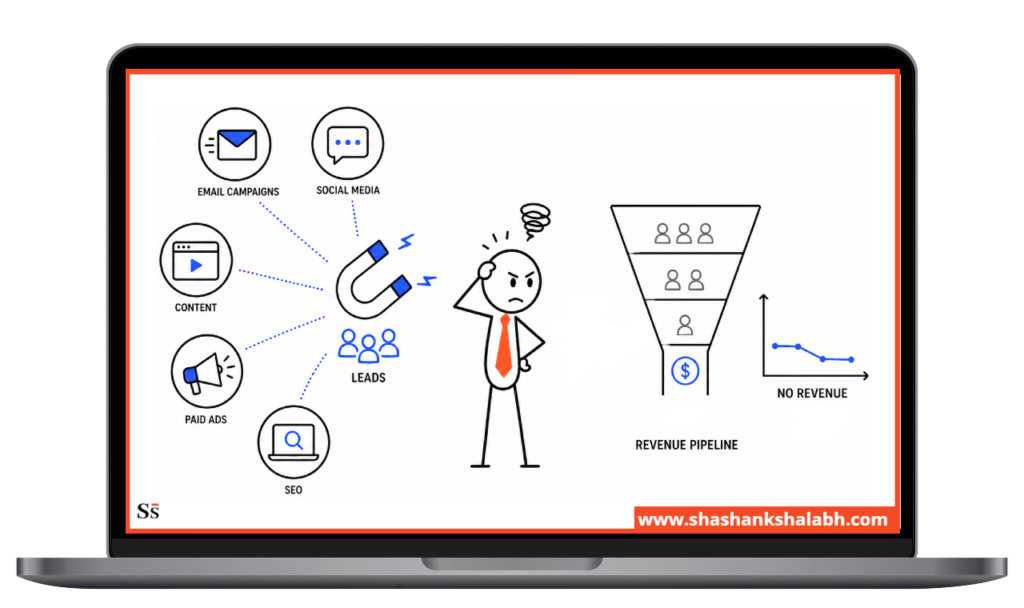
If your marketing is not driving revenue, it might not be a budget or channel issue.
In my experience as a CMO and fractional CMO, the underlying issue is almost always strategic. I am referring to the wrong ICP, unclear positioning, marketing-sales misalignment, and the wrong measurement framework.
In this guide, I will walk you through the seven most common reasons marketing fails to produce revenue, how to diagnose which one is breaking your system, and what to fix first.
Here is a quick snapshot:
- Why marketing feels like a cost center, and why it’s a strategic problem
- The seven reasons marketing isn’t driving revenue
- A 30-day diagnostic framework to identify the primary cause
- The solution and the right sequence
- What fixing it actually looks like with a real example
The Real Reason Marketing Feels Like a Cost Center
Founders are often frustrated because what marketing is doing isn’t connected to revenue.
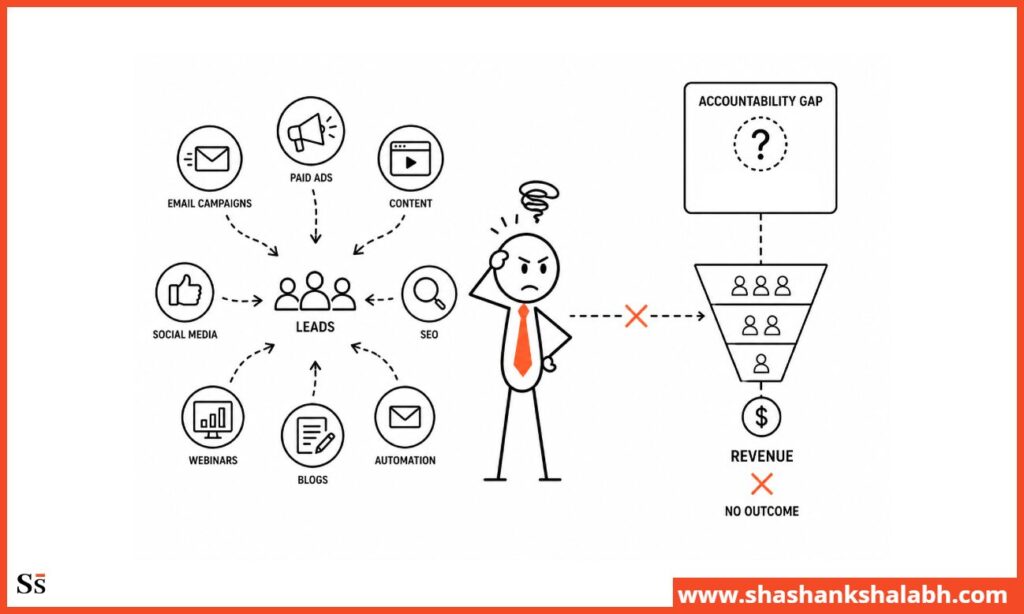
Activity Without Accountability
If you observe carefully, marketing team reporting is mostly about something they can check off of a project management board. For example, how many campaigns/content launches, leads generated, emails sent etc.
The issue is that none of these are revenue metrics. And that’s why these metrics fail to answer whether marketing is producing business results.
As a result of this, marketing feels like a cost center because it’s being measured like one. The metrics are wrong.
If your metrics are flawed, everything you optimize afterward moves you in the wrong direction.
The Accountability Gap
Marketing drives interest (top-of-funnel activity) and Sales closes deals.
But what about the gap between the two?
I am referring to the conversion journey from first marketing touch to signed contract. That gap is where revenue disappears.
Marketing hits lead targets. Yet, sales still sees a weak pipeline. The issue is that conversion is broken.
Why This Is a Strategic Problem
When marketing is not driving revenue, most teams react fast using tactical solutions.
They switch channels, increase spend, maybe hire an agency, or add a marketer.
Since the problem is strategic, these tactics rarely work. And you just burn the budget faster.
Without clear ICP, strong positioning, and shared metrics, marketing will not drive revenue.
The 7 Reasons Marketing Isn’t Driving Revenue
These are the seven most common reasons marketing fails to drive revenue.
Marketing Is Optimizing for the Wrong Metrics
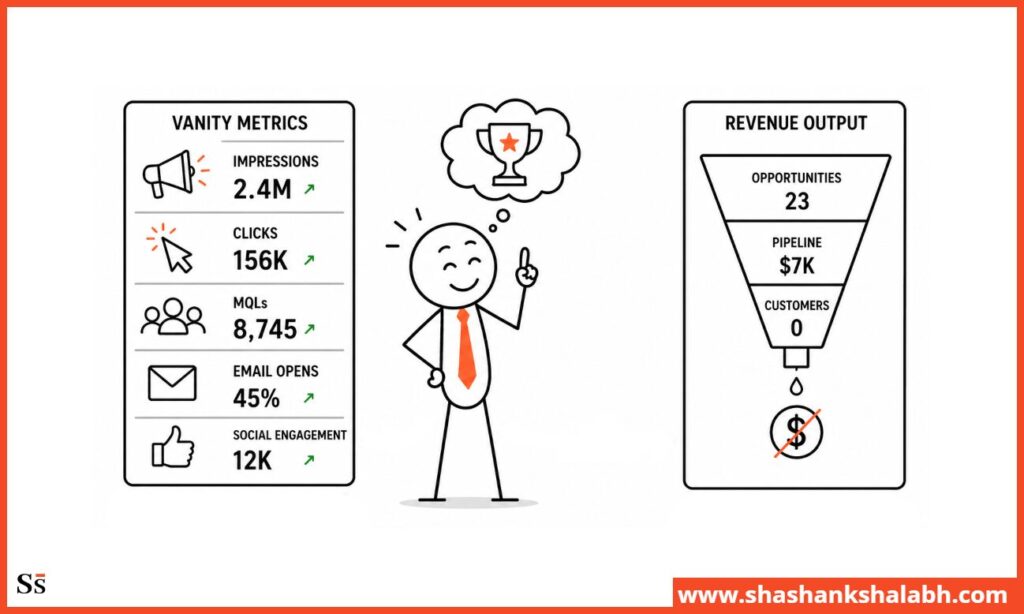
Marketing optimizes for what it measures.
If you track clicks, impressions, and MQLs, you will get more of those. Not more revenue.
And that is what I call the vanity metric trap.
And when this happens, your marketing reports will look healthy, yet you will miss revenue targets. After all, in this case, the CEO and the marketing team are looking at entirely different pictures of the same business.
The right thing to do here is to replace vanity metrics with revenue-connected metrics such as pipeline contribution, CAC, marketing-sourced revenue percentage, and MQL-to-SQL conversion rate.
Change the metrics and behavior changes.
→ Marketing KPIs Every CEO Should Track
Your ICP Is Wrong or Too Broad
I have talked about this in several of my previous posts.
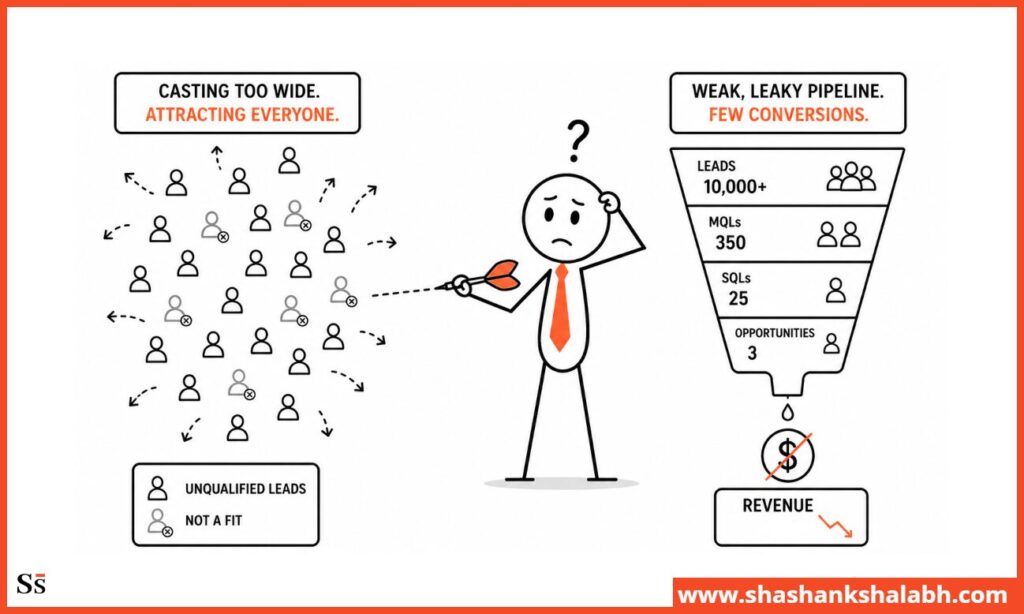
But I need to emphasize that marketing to the wrong audience produces leads that never convert to revenue.
Every dollar spent reaching people who won’t buy is a direct contribution to high CAC and zero revenue.
For several businesses, targeting “mid-market B2B companies” sounds reasonable as it produces a vast, unconverted audience where the right-fit buyers are buried under an avalanche of wrong-fit ones.
This forces marketing to spend more to reach fewer qualified buyers. And this drives CAC up and conversion rates down simultaneously.
The solution is to rebuild the ICP from closed-won data, that is, which customers converted fastest, paid reliably, and retained longest.
The right ICP feels restrictively specific. If it doesn’t feel too narrow, it’s probably still too broad.
→ Go-To-Market Strategy for Scaling Companies
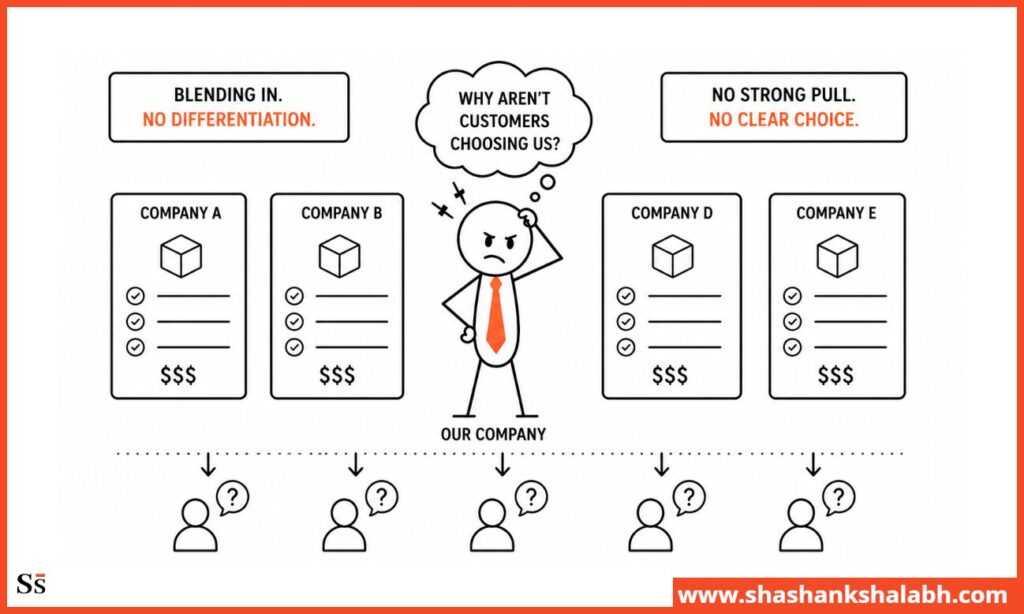
Positioning Doesn’t Differentiate
If your positioning sounds like everyone else, buyers cannot tell you apart.
That leads to price pressure, slow deals, and no decisions.
“We help companies grow.” “We deliver results.” Everyone says it. Buyers tune it out. These lead to long sales cycles, low win rates, and slow-moving (or even dead) deals.
Define a specific buyer, a specific problem, and a clear outcome.
Strong positioning makes the right buyers self-select, and wrong buyers disqualify themselves.
Both outcomes reduce CAC and improve revenue conversion.
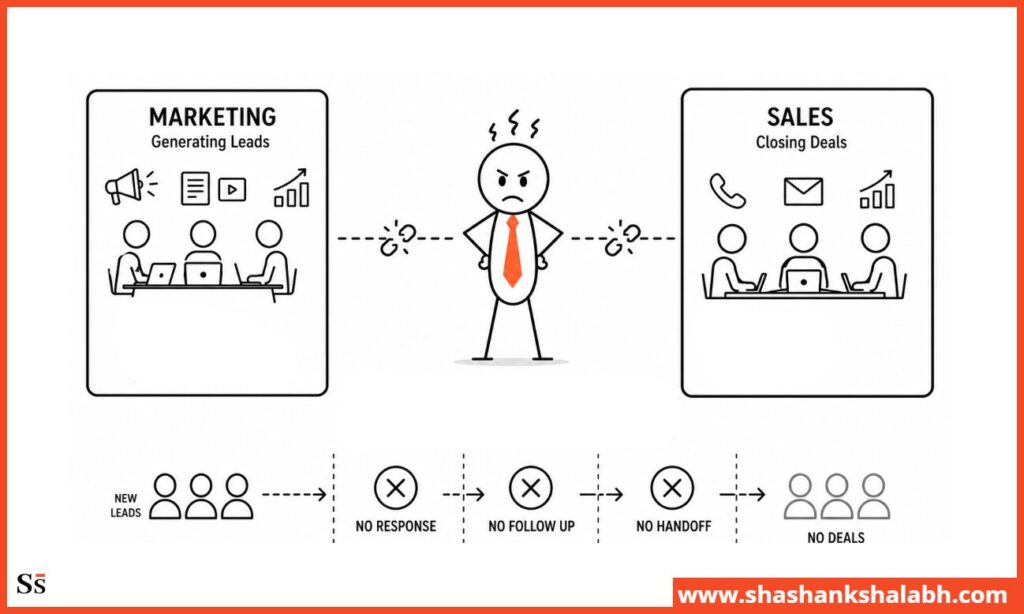
Marketing and Sales Are Disconnected
When marketing generates leads and Sales ignores them, the pipeline does not grow, and both budget and time are wasted on both sides.
This, to me, is a clear case of misalignment.
Marketing and Sales are using different definitions and metrics, and there is no shared ownership.
The answer to this disconnect between marketing and sales is shared ownership.
Agree on what a qualified lead is. Define the handoff, and review the pipeline together every week.
→ Why Your Lead Gen Isn’t Turning Into Pipeline
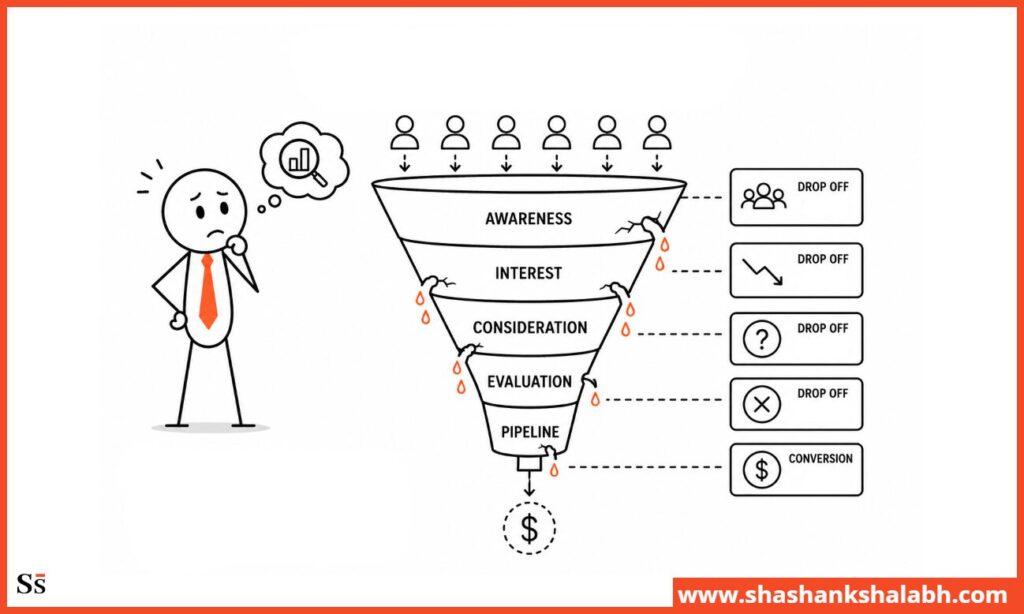
The Funnel Has a Leak Nobody Is Fixing
Revenue does not break evenly across the funnel.
One stage is almost always the problem.
Common leak locations and their causes:
- Visitor to lead: Traffic does not convert. Weak offer, unclear CTA, or poor message fit.
- Lead to MQL: Wrong signals. Behavioral activity without real fit.
- MQL to SQL: Broken handoff. Slow follow up or sales ignores leads.
- SQL to opportunity: Discovery fails. Poor positioning and weak objection handling.
- Opportunity to close: Deals don’t move further. Competition, weak champions, or procurement issues.
Map conversion rates at every funnel stage.
Find the biggest drop-off. Fix that stage before touching anything else.
Fixing the largest leak produces more revenue impact than optimizing every other stage simultaneously.
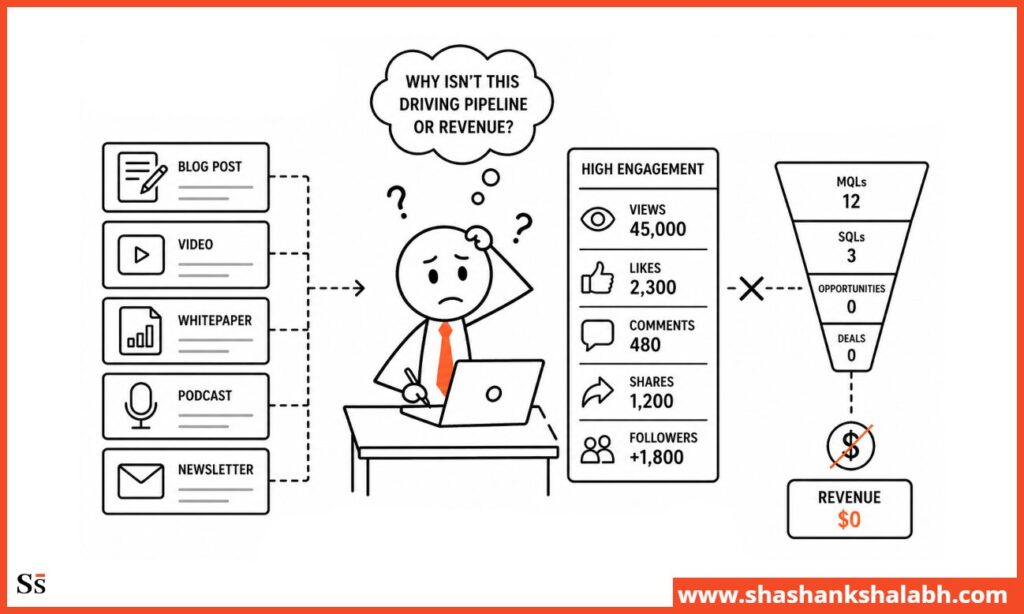
Content and Campaigns Aren’t Connected to Buying Decisions
It amuses me why most B2B content is produced for the content calendar, and not for the buyer’s journey.
Of course with high content output, you will grow organic traffic.
Readers and buyers are different audiences with different needs.
Content that doesn’t map to specific buyer questions at specific funnel stages doesn’t produce revenue regardless of quality.
Audit existing content against the buyer journey.
Which content helps a prospect recognize the problem and want to solve it? Which helps them evaluate options? Which enables a buying decision? Which equips a sales conversation?
Assign every content piece a job.
Content without a job is marketing spend without a revenue connection.
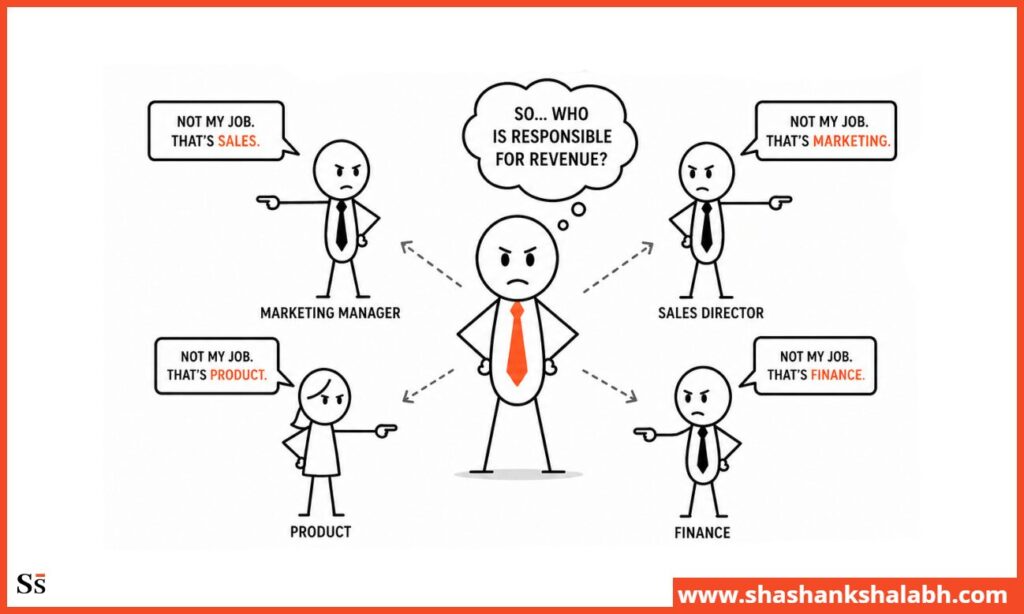
No Marketing Revenue Accountability
Without executive ownership, marketing becomes activity driven.
When the most senior marketing role is a manager or director, the focus stays on campaigns, content, and leads, instead of the pipeline, CAC, or revenue.
Managers run execution and CMOs own outcomes.
Many companies between $3M and $20M ARR are stuck here. They bring in strong execution, but lack executive ownership of revenue impact.
As a result, while internal targets are met, the revenue impact is unclear. The CEO has no visibility into what is actually working.
The solution here is to bring in a marketing leader, whether a fractional CMO or a full-time CMO, who is responsible for pipeline, CAC, and revenue contribution.
→ Fractional CMO for Growth-Stage Companies
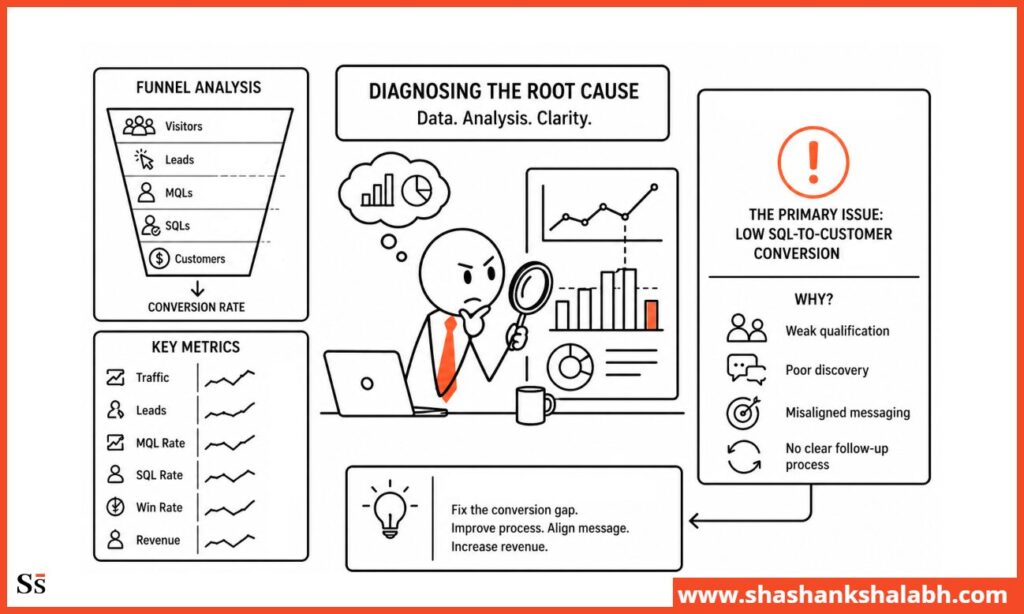
How to Diagnose Which Problem Is Breaking Your Revenue
Note that these causes I mentioned earlier rarely operate in isolation. You will see two or three simultaneously.
The Five-Minute Revenue Audit
Each of these five questions identifies the most likely primary cause.
| Diagnostic question | If the answer is… | What it means | Reason |
| Can marketing tell you what % of closed revenue came from marketing activity? | No | The measurement system is broken. Nothing else can be diagnosed reliably until this is fixed. | Reason 1 |
| Are more than 30% of MQLs converting to SQLs? | No | Targeting or handoff is broken. ICP may be too broad, or lead qualification and follow-up are misaligned. | Reason 2 / Reason 4 |
| Are deals frequently lost to “no decision” or “not the right time”? | Yes | Positioning is not differentiated. Buyers cannot see a clear reason to choose you, so they choose nothing. | Reason 3 |
| Is content producing pipeline or just traffic? | Just traffic | Content is not connected to buying decisions. Content sourced pipeline is not being tracked or does not exist. | Reason 6 (and often Reason 1) |
| Who is accountable for marketing’s contribution to revenue? | Nobody | Leadership gap. Without executive ownership, diagnosis and fixes do not stick. | Reason 7 |
The One Metric That Reveals the Most
If you can only measure one thing first, calculate marketing sourced revenue.
This is the share of closed revenue that came from marketing generated opportunities.
For growth-stage B2B companies, 30-50% is a healthy range. It shows marketing is actively driving revenue.
Below 20% means marketing is not independently driving revenue. It may be supporting sales conversations but it’s not creating the pipeline.
If you cannot calculate it at all, the measurement system is broken. Nothing else can be diagnosed until attribution is fixed.
The Diagnostic That Takes 30 Days
If the five minute audit shows a few possible issues, a 30 day review will identify the main one.
Week 1: Map funnel conversion rates at each stage; visitor to lead, lead to MQL, MQL to SQL, SQL to opportunity, opportunity to close. The biggest drop shows the main problem.
Week 2: Review CAC by channel and marketing sourced revenue. This shows if targeting or pipeline generation is broken.
Week 3: Audit content against the buyer journey. Find gaps in decision and sales support content.
Week 4: Check sales and marketing alignment. Look for shared definitions, handoff process, and regular joint reviews.
This will give you a clear diagnosis of what is breaking revenue and what to fix first.
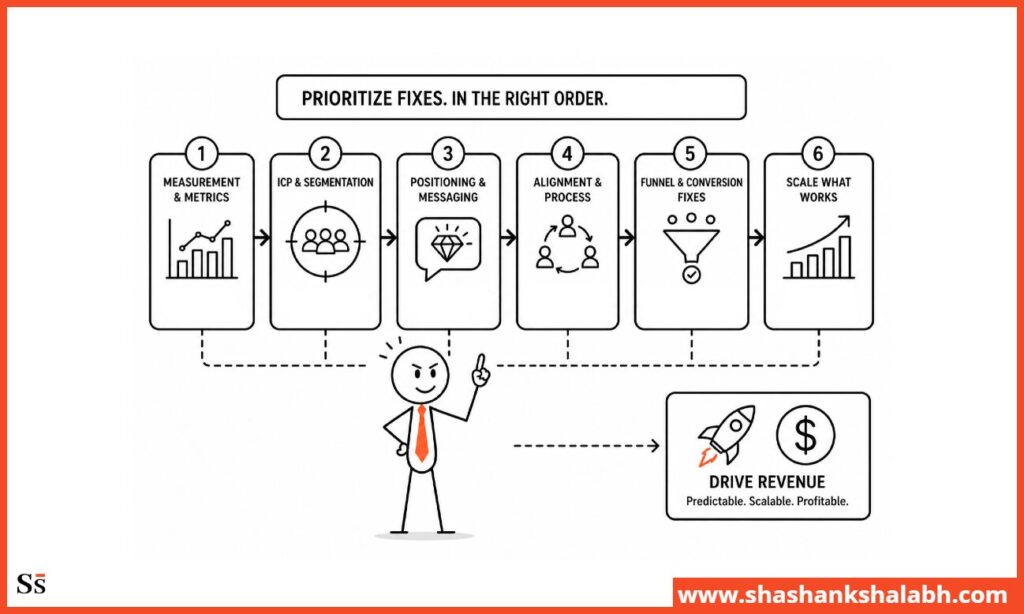
What to Fix First : The Sequence That Works
The order of fixes matters as much as the fixes themselves.
Even the right fix has little impact if it is done in the wrong sequence.
Fix Measurement Before Fixing Anything Else
You cannot fix what you cannot see.
If marketing cannot track what drives revenue, everything else is guesswork.
You need a basic KPI set first: pipeline contribution, CAC, MQL to SQL conversion, and marketing sourced revenue.
Once those are in place, the real problem becomes clear. And once it is clear, it can be fixed.
Fix ICP and Positioning Before Fixing Channels
Channels only distribute the message.
If the message is wrong or the audience is off, the channel cannot fix it.
Fixing ICP and positioning improves conversion across every channel at once, without increasing spend.
It is the highest leverage fix because it makes everything else work better.
Fix Alignment Before Scaling Spend
Spending more on a misaligned system just scales waste.
More leads going into a broken handoff means more wasted sales time.
Fix alignment before you increase the budget. Aligned teams can produce 50-80% more pipeline from the same spend because fewer leads get lost between marketing and sales.
Fix the Biggest Funnel Leak Before Adding Top-of-Funnel Volume
Adding more leads to a funnel with a 15% MQL-to-SQL conversion rate does not grow revenue. However, it certainly raises your CAC.
Find the biggest drop in the funnel and fix it first. Then increase the top of the funnel volume. Fixing the weakest stage improves conversion across everything that flows through it.
Then Scale
Once measurement is in place, ICP is clear, positioning is strong, alignment is fixed, and the biggest funnel leak is closed, then it is time to scale.
At this stage, every new lead enters a system that converts, every dollar reaches the right audience, and every qualified lead gets fast follow up.
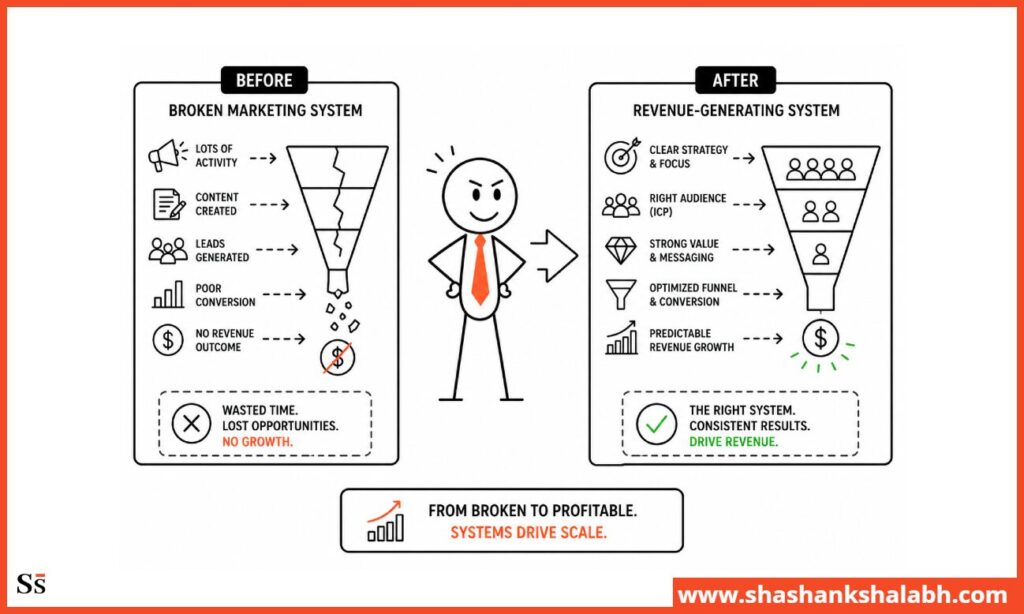
Case Study
Situation
I was working with a B2B SaaS company at $4.4M ARR. Even with 200 MQLs/month, the pipeline was flat, and they were missing revenue targets. During my conversations with the leadership (including finance and sales), all I heard was “marketing isn’t working.”
Diagnosis
ICP too broad: They were targeting any B2B SaaS business above a revenue threshold. The ICP was based on assumptions, not closed-won data. Good-fit buyers were buried in bad-fit volume.
Broken MQL definition: MQLs were defined by content engagement such as downloading a guide, attending a webinar, visiting three pages. The MQL volume was high but quality was low.
Broken handoff: Qualified leads were sitting 3-5 days before sales contact. Sales had stopped trusting marketing leads.
No revenue attribution: Marketing could not show revenue impact. There was no clear link to ARR.
What Changed in 90 Days
ICP rebuilt from closed-won data: We analyzed the best customers and narrowed the ICP to B2B SaaS companies with $2M-$10M ARR, a specific tech stack, and a defined org structure. MQL volume dropped, but quality improved immediately.
MQL definition rebuilt with firmographic criteria: We required firmographic fit before behavioral signals could qualify a lead. MQLs now required both fit and intent.
Handoff protocol: We enforced a 24-hour follow-up SLA in CRM and ran weekly joint pipeline reviews. Sales started working marketing leads because quality improved and accountability was shared.
Marketing-sourced revenue tracking: We established attribution for the first time, showing exactly how much pipeline and revenue came from marketing.
The Outcome at 18 Months
With these efforts, the ARR grew from $4.4M to $7.8M, and CAC dropped 22%.
Marketing-sourced pipeline increased from an estimated 15% to 41%.
It is important to note that we did not add more channels or increased the budget. We fixed the four core issues blocking the existing system from producing revenue.
Explore more Fractional CMO case studies →
How a Fractional CMO Fixes Marketing Revenue Failure
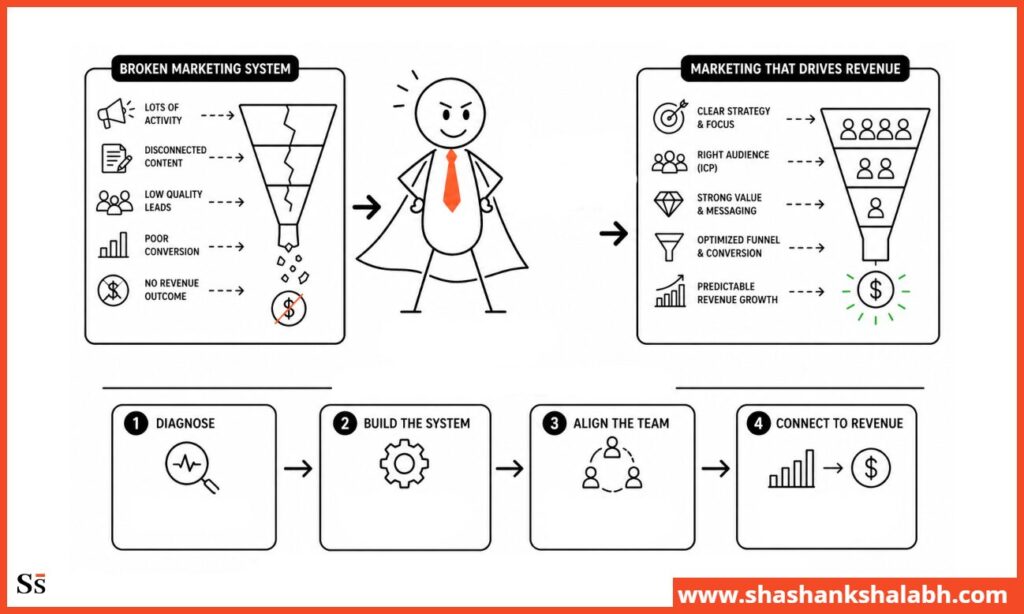
Marketing revenue failure is a strategic problem that requires executive-level ownership to fix.
Diagnosis Before Intervention
As a fractional CMO, I start with the five-minute revenue audit and the 30-day diagnostic before recommending any tactical changes.
Most revenue problems are misdiagnosed. Businesses fix what they can see, not what is actually broken.
They add budget to a broad ICP, test new channels on weak positioning, or push more leads into a broken handoff.
None of it improves revenue because the real issue is still in place.
Revenue Accountability
Being a fractional CMO, I own the pipeline contribution and CAC as core KPIs.
That level of accountability changes what gets measured, what gets prioritized, and what gets fixed.
Building the System That Connects Marketing to Revenue
Most companies between $3M and $20M ARR miss the four core pillars of ICP definition, clear positioning, sales and marketing alignment, and a working measurement system.
As a fractional CMO, I build these in the first 90 days.
→ Fractional CMO Responsibilities → Fractional CMO Services
FAQ: Why Your Marketing Isn’t Driving Revenue
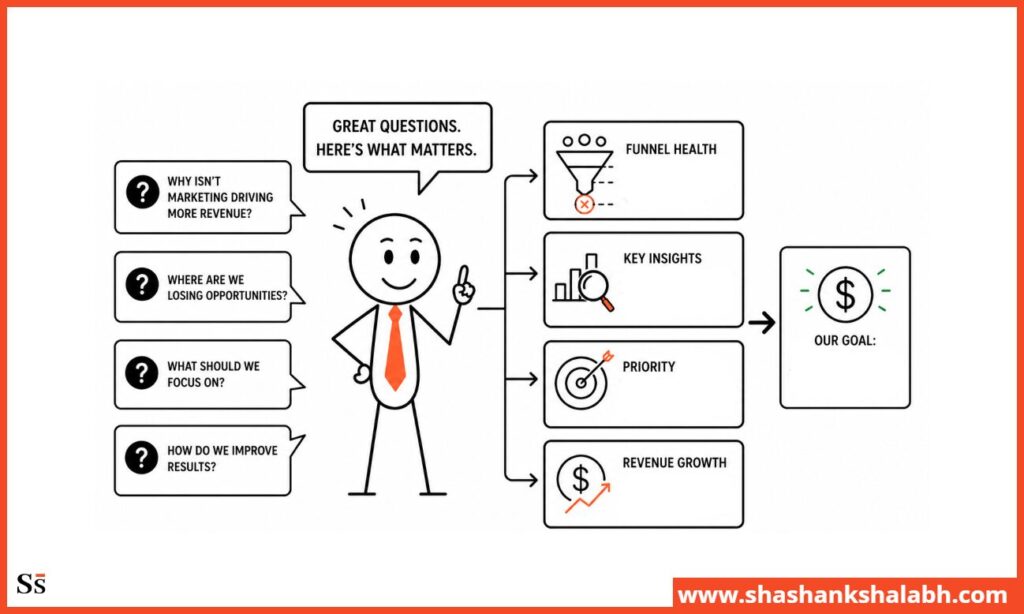
Why is my marketing not generating revenue?
Marketing fails for seven reasons, such as, wrong metrics, broad ICP, weak positioning, sales and marketing misalignment, funnel leaks, content not tied to buying decisions, and no executive ownership.
Most companies have two or three at once.
How do I know if my marketing strategy is broken?
If marketing cannot show revenue impact, MQL-to-SQL conversion is below 20%, deals often end in “no decision”, content drives traffic but not pipeline, and no one owns marketing’s revenue contribution, it means your marketing strategy is broken.
At this stage, more channels or budgets will not fix it. You need to rebuild the foundation before scaling.
What is the most common reason marketing fails to drive revenue?
The most common issue is marketing using vanity metrics to define success.
When teams track impressions, MQLs, and downloads, they get more of them. But the pipeline does not grow. Next is a broad ICP. This does not bring buyers who convert.
How long does it take to fix marketing that isn’t driving revenue?
Within 30-60 days, you should start seeing better MQL quality, cleaner handoffs, and clearer attribution after fixing ICP, MQL definitions, and the handoff process. Pipeline improvement follows in 60 to 90 days.
Revenue impact appears in months 4 to 8 as the pipeline moves through the sales cycle. Expect a 6-12 month timeline to see lower CAC and 30-50% marketing sourced pipeline.
When should I hire someone to fix my marketing revenue problem?
If your revenue has been stuck for two or more quarters and internal tactical fixes have not worked, it’s time to bring in a marketing leader. For companies at $3M to $20M in revenue, a fractional CMO at $10K to $25K per month serves the purpose without the cost of a full time hire.

Closing Thought
Marketing that isn’t driving revenue is telling you something specific.
It’s not telling you to spend more or try different channels.
This is an indicator that something in the foundation is broken: the ICP, the positioning, the alignment, the measurement, or the leadership.
Find the broken thing, fix it in the right order, and then scale.

Shashank brings over 22 years of global omnichannel marketing experience. As a 4x Chief Marketing Officer, he has helped several organizations (Startups and Fortune 500) drive sustainable revenue growth through strategic marketing.