
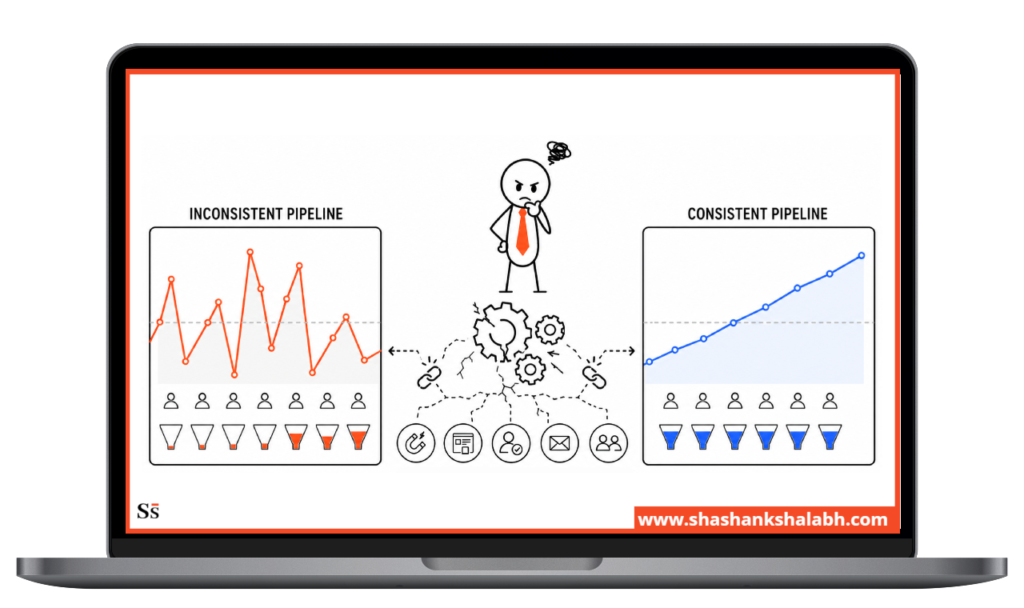
I have worked with several founders in my marketing career.
And more often than not, an inconsistent pipeline is one of their most frustrating problems.
I can almost guarantee that at most organizations, this is addressed by increasing spend, running more campaigns, or pushing sales harder.
In this guide, I will walk you through the eight most common causes and the structural fixes that produce predictable pipeline month over month.
Here is what you will learn:
- Why inconsistent pipeline is more dangerous than low pipeline
- The eight structural causes of pipeline inconsistency
- How to diagnose which cause is driving yours
- The structural fix: what consistent pipeline actually requires
- Realistic timelines for building pipeline predictability
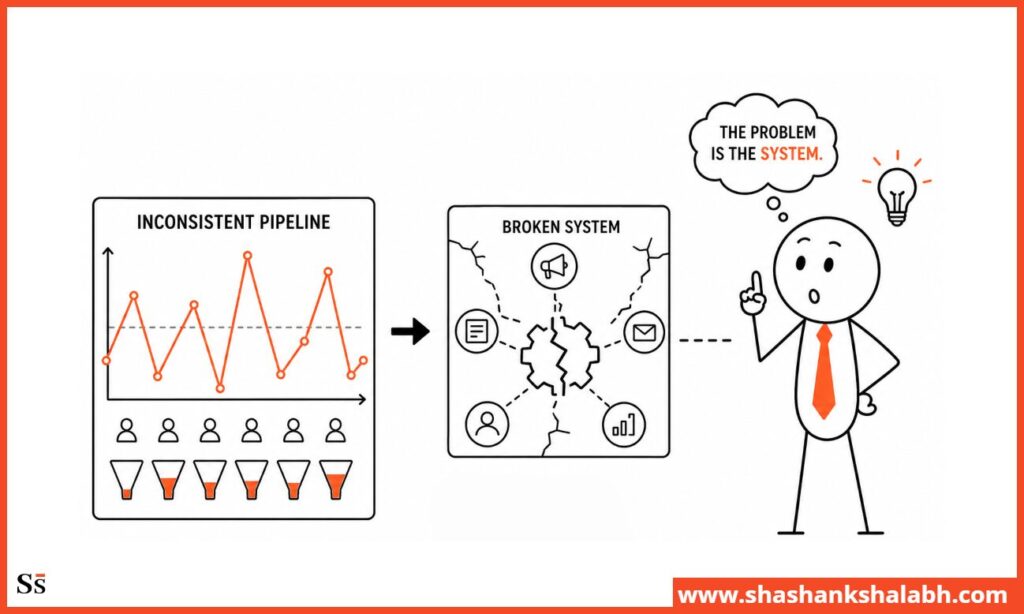
What Inconsistent Pipeline Actually Tells You
Before we look into the cause, it is important to understand what pipeline inconsistency suggests.
Pipeline Problems Aren’t About Effort
Good months followed by bad months look like a performance issue.
However, that’s not the case.
The good months came from something specific. Maybe a conference, founder outreach, a strong piece of content, or a referral. When that activity slowed, the pipeline dropped.
Since event driven pipeline depends on what happens, it is inconsistent by nature.
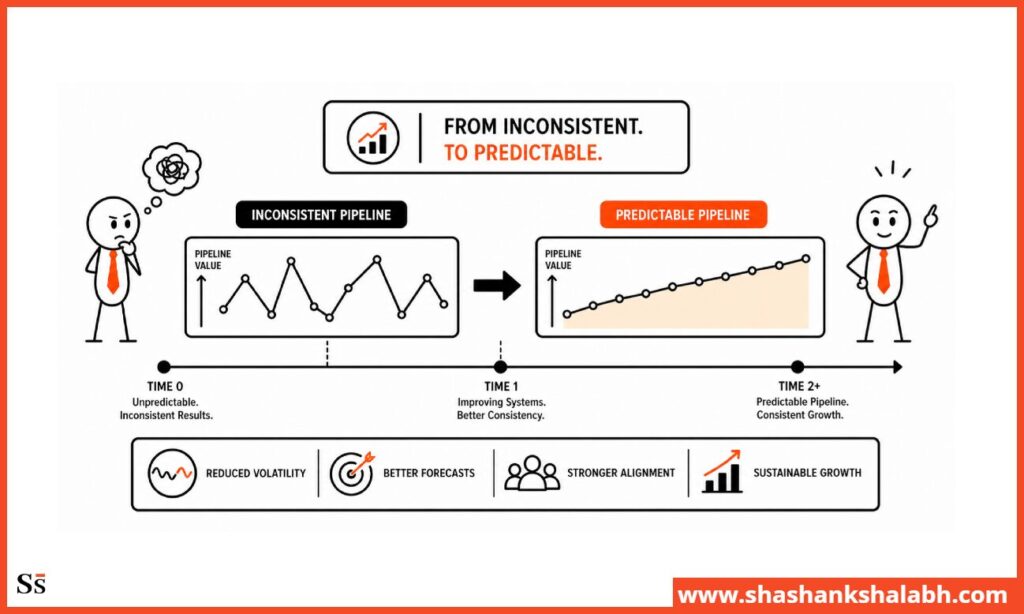
Process driven pipelines are different. They come from a repeatable system that produces a steady flow of qualified opportunities every month, regardless of events.
A majority of $3M-$20M ARR businesses rely on events. That is why the real marketing challenge at this stage is to build a process driven pipeline.
Why An Unsteady Pipeline Is Worse Than a Small One?
A low pipeline is obvious and urgent.
When pipeline is consistently low, the issue is inadequate demand generation. And the solution is directionally obvious as well.
However, an inconsistent pipeline is the real risk. Good months create false confidence, and bad months trigger panic.
Panic leads to bad decisions such as discounting to close deals, cutting marketing budget, or hiring and firing based on a single quarter’s results.
An inconsistent pipeline also makes forecasting impossible.
When the board asks about next quarter, the honest answer becomes uncertain. It depends on events, timing, and founder availability.
That answer destroys board confidence.
The Real Cost of Pipeline Inconsistency
The damage adds up over time:
- Sales has busy months and slow months, which wears down the team and leads to turnover.
- Forecasting accuracy drops below 70%, and the board starts to question the numbers.
- Discounting spikes at the end of the quarter as sales tries to push deals through.
- Growth targets turn into guesses because no one knows what next month will bring.
These aren’t minor inconveniences. They’re structural constraints on growth.
The 8 Most Common Causes of Inconsistent Pipeline
These eight issues explain most pipeline inconsistency in B2B companies between $3M and $25M in revenue.
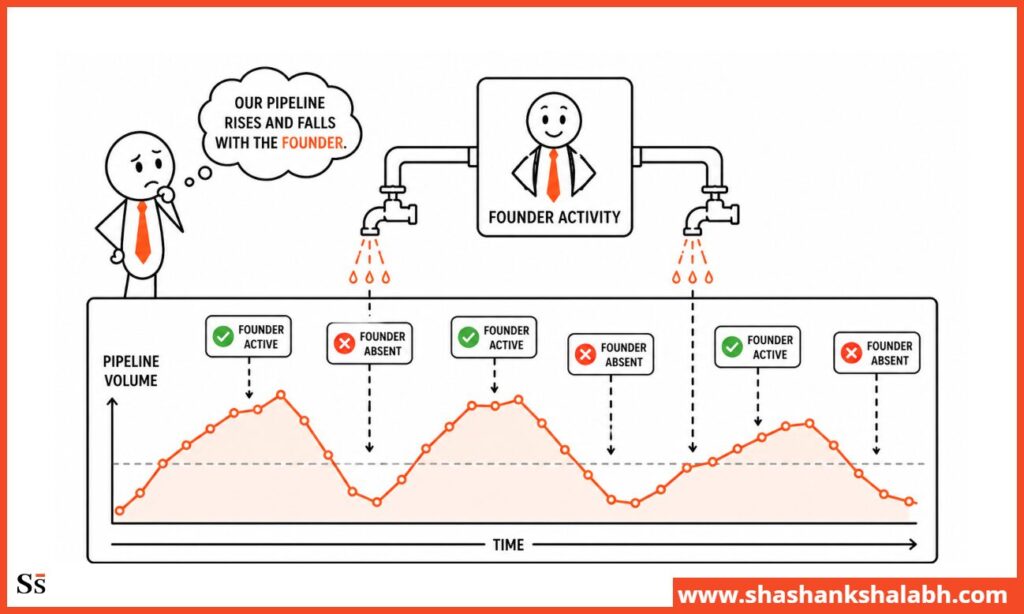
Pipeline Is Dependent on the Founder
This is the most common cause of inconsistent pipeline in companies at $3M to $15M ARR.
The pipeline is heavily driven by the founder.
Relationships, credibility, and founder led selling do most of the work. When the founder is active in the market, the pipeline is strong. When they are focused internally, it drops.
You can usually see it clearly. Strong months line up with high founder activity, and weak months line up with the founder being pulled into product, operations, or fundraising.
This creates a trap.
Founder closed deals grow revenue, but they do not build a system. The founder becomes the demand engine. Growth then depends on their time and calendar.
The solution is to remove that dependency. Build a system that generates the pipeline without the founder. This means a clear ICP, repeatable demand programs, and channels that run without founder involvement.
This shift from founder driven to system driven pipeline is the core marketing challenge at this stage.
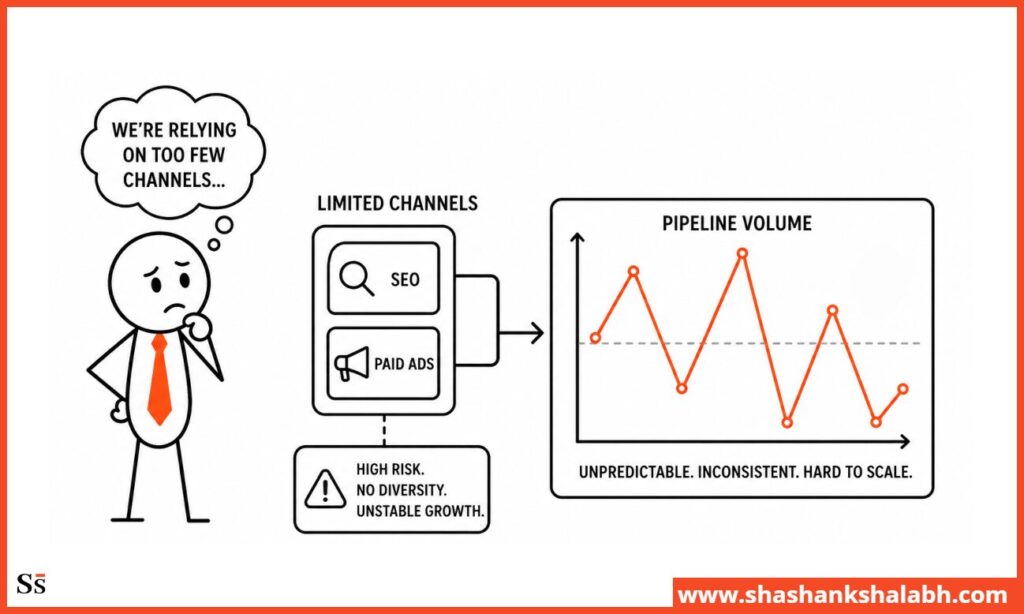
You’re Relying on One or Two Channels
Single channel pipeline is always inconsistent.
Paid acquisition, content, referrals, and events all fluctuate because costs change, algorithms shift, referrals come in bursts, and events create spikes rather than steady flow.
When one channel drives everything, its ups and downs become your pipeline.
You can see it in the numbers.
The pipeline rises and falls with that channel.
When it slows, the pipeline drops. When it spikes, forecasts look strong.
This creates a trap. One channel works, so the company doubles down. It feels efficient, so nothing else gets built. Then that channel dips and there is no backup.
In this case, you should build two or three channels that each produce a pipeline independently. When one is down, the others hold steady. The goal is to remove single points of failure.
→ Go-To-Market Strategy for Scaling Companies
Demand Generation Is Campaign-Based
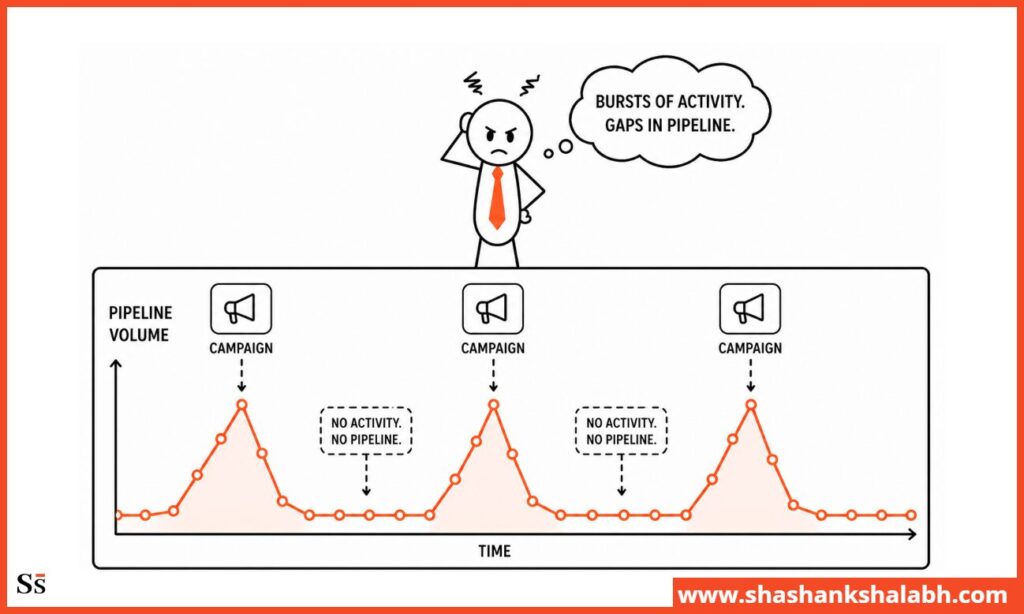
Campaign based demand generation creates an uneven pipeline.
You run a webinar, get a burst of leads, work them for a few weeks, then things go quiet until the next campaign. Pipeline becomes spikes with gaps in between.
It’s easy to see in the data. Pipeline goes up after campaigns and drops soon after. The timing of your highs matches your marketing calendar.
Most companies at $3M to $15M ARR are running campaigns, but not building a steady engine.
The right way to fix this issue is building always-on demand generation programs that produce pipeline continuously alongside campaigns.
Content, search, and outbound should bring in leads every week, and campaigns should add to that.
Top-of-Funnel Is Inconsistent
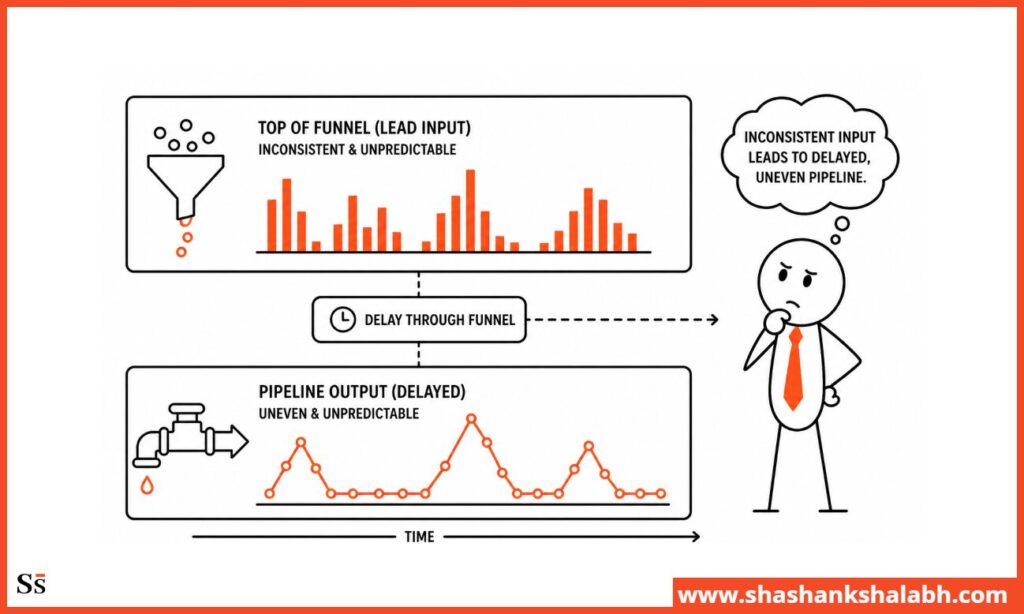
If lead volume goes up or down, the pipeline follows 60 to 90 days later. That is how long it usually takes B2B leads to turn into real opportunities.
Most companies miss this and only react when pipeline drops. By then, the real problem already happened earlier in the funnel.
You see a weak pipeline in one quarter, but the cause was low lead volume two months before.
This delay creates a trap. Teams respond too late. By the time the pipeline is down, it is already too late to fix that quarter. The outcome is already set.
You should watch lead volume like a leading signal. If it drops for two months in a row, treat it as an early warning for the pipeline, not just a marketing metric.
Pipeline predictability starts with tracking what happens upstream.
ICP Is Inconsistently Applied
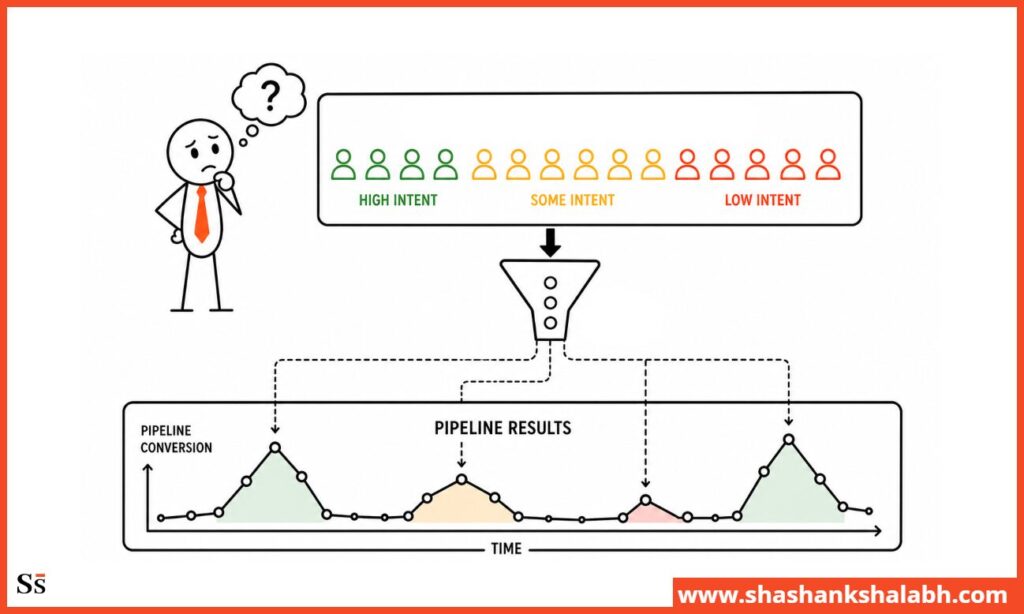
When ICP is unclear or applied inconsistently, every team targets differently.
Marketing optimizes for volume, sales takes what comes in, and lead quality becomes uneven.
You see it in pipeline velocity. Some months deals move quickly. Other months they sit with no clear reason why.
The problem is ICP drift. It gets defined once, then slowly ignored as teams chase volume or short term wins. Over time, targeting no longer matches the original ICP.
Define ICP clearly with firmographics, triggers, and structure. Review it quarterly against closed won deals. Build it directly into targeting so it is enforced.
Consistent ICP creates consistent lead quality, which creates consistent pipeline flow.
No Nurture System for Long-Cycle Buyers
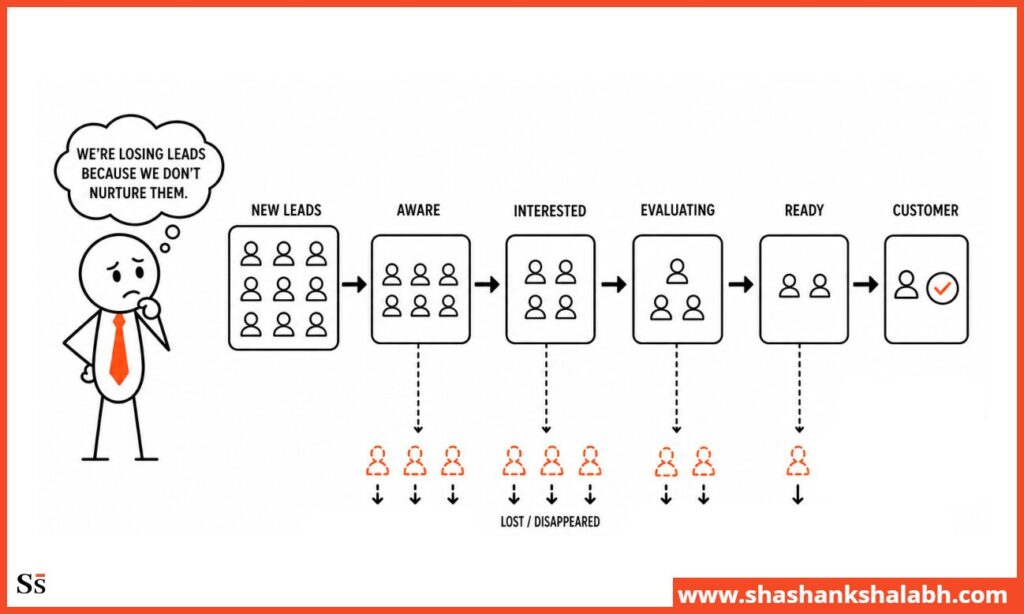
B2B buyers rarely buy on first contact. Most need time and multiple touchpoints before they are ready.
Without nurture, most leads go cold. The company then has to generate new leads every month just to replace the ones it already had.
You see it as strong lead generation but weak pipeline conversion. The leads are not bad. They are just not ready, and there is no system to stay in front of them.
The mistake is focusing only on “hot” leads. The rest are ignored, even though many were real buyers who just needed more time and context.
By the time they are ready, the company is no longer present.
Build a nurture system that keeps engaging non ready leads over time. Email, content, and light touchpoints that stay consistent until a buying trigger happens.
A steady nurture system turns old leads into new pipelines and reduces pressure to constantly refill the top of the funnel.
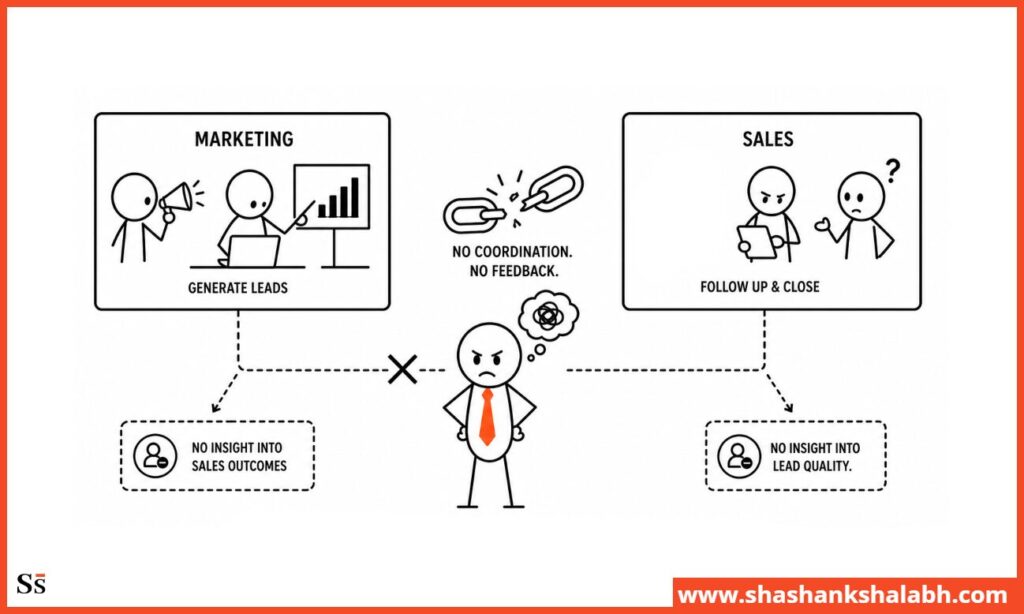
Sales and Marketing Are Operating in Isolation
When marketing and sales are not connected, the system does not improve.
Marketing cannot see what converts, and sales cannot see what marketing is building, so there is no shared learning.
Pipeline becomes dependent on which sales rep is most active, not on a consistent system.
The problem is misalignment. Marketing focuses on leads, while sales focuses on quota, and no one owns the full pipeline outcome.
The fix is to run weekly joint pipeline reviews, agree on one definition of a qualified lead, set clear handoff rules, and track revenue back to marketing activity.
→ Why Your Lead Gen Isn’t Turning Into Pipeline
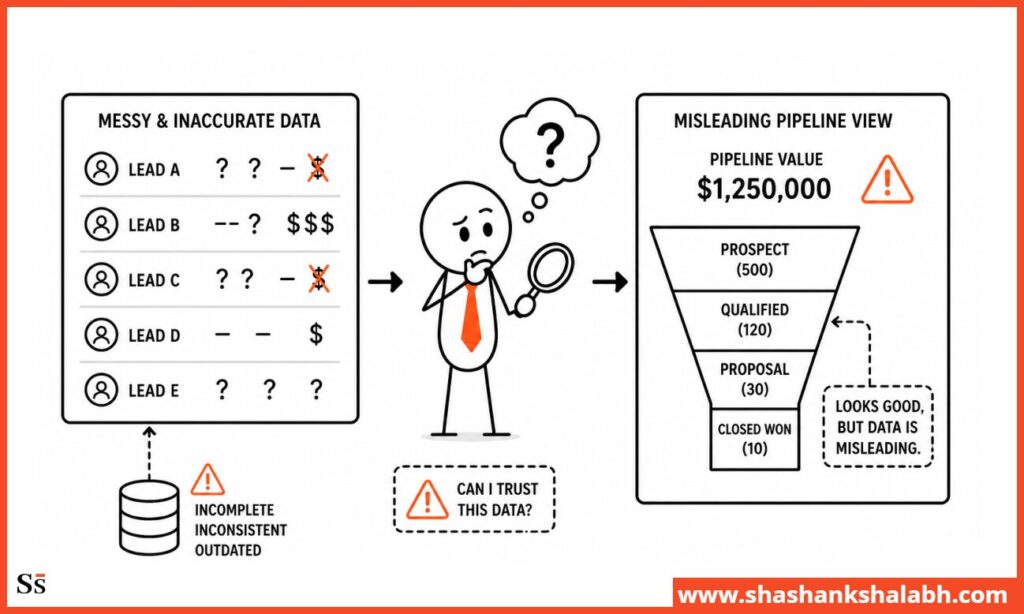
Unreliable Pipeline Tracking
Sometimes the issue is inconsistent data.
Teams enter deals late, sometimes weeks after they start. They move stages based on judgment instead of clear rules. They miss closed lost reasons. They leave attribution incomplete.
This creates a gap between pipeline data and revenue reality. The pipeline looks strong but revenue misses. Our pipeline looks weak but revenue shows up from elsewhere.
Bad data leads to bad decisions. Teams cut budgets from channels that were working. They fund channels that only look good in reporting.
The fix starts with CRM hygiene. Define clear stage rules, enforce timely updates, standardize attribution, and require closed lost reasons.
You cannot fix pipeline performance if you cannot trust the data.
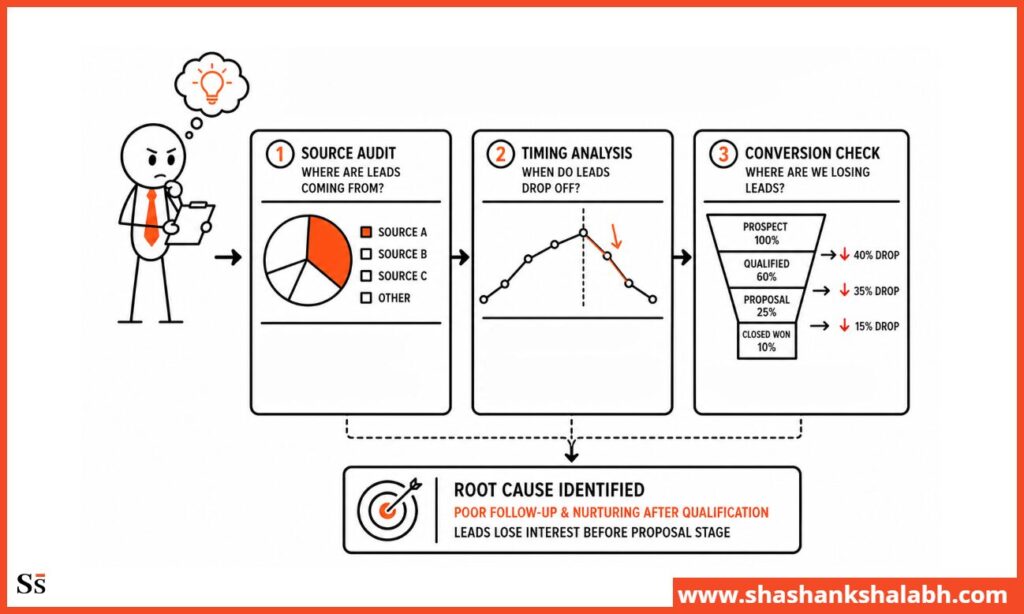
How to Diagnose Which Cause Is Driving Your Inconsistency
Eight causes are too many to fix at once, so you need to identify the primary one because the right fix depends on it.
The Pipeline Source Audit
For the last 12 months, map every closed won deal to its source, including founder relationships, referrals, inbound marketing, outbound sales, events, or any specific channel.
| Sign | Primary Cause | Meaning |
| Over 50% of revenue comes from founder relationships or one-off events | Cause 1 | Pipeline depends on the founder |
| Over 60% of revenue comes from a single channel | Cause 2 | One channel is driving all variance |
| Revenue is spread across sources but timing is uneven | Cause 3 | Demand is campaign driven, not continuous |
This audit takes one week and requires tracing each closed won deal back to its original source in the CRM.
The Pipeline Timing Analysis
Map monthly pipeline volume for the last 12 months, then layer in the timing of key events.
| Sign | Likely Cause | Meaning |
| Pipeline spikes align with conferences, webinars, or high founder activity | Causes 1 or 3 | Pipeline is event driven |
| Pipeline drops follow low lead volume by 60–90 days | Cause 4 | Top of funnel inconsistency is the issue |
| Conversion rates swing month to month despite similar lead volume | Cause 5 | ICP is being applied inconsistently |
The Conversion Consistency Check
Track MQL-to-SQL conversion rate month by month for the trailing six months alongside MQL volume.
| Signal | Likely Causes | Meaning |
| Consistent conversion rate, inconsistent volume | Causes 1, 2, 3, or 4 (top of funnel issue) | Lead quality is stable, but volume is uneven |
| Inconsistent conversion rate, consistent volume | Causes 5, 6, or 7 (ICP, nurture, or alignment issue) | Volume is stable, but lead quality varies |
| Both inconsistent | Multiple causes, full GTM diagnostic needed | Volume and conversion rate both fluctuate |
A Simple Test for Founder Dependence
Ask this: if the founder took a 60 day sabbatical, what would happen to the pipeline?
If the honest answer is that it would drop, the issue is structural. The pipeline depends on the founder.
You need a system that generates demand without the founder involved in every step.
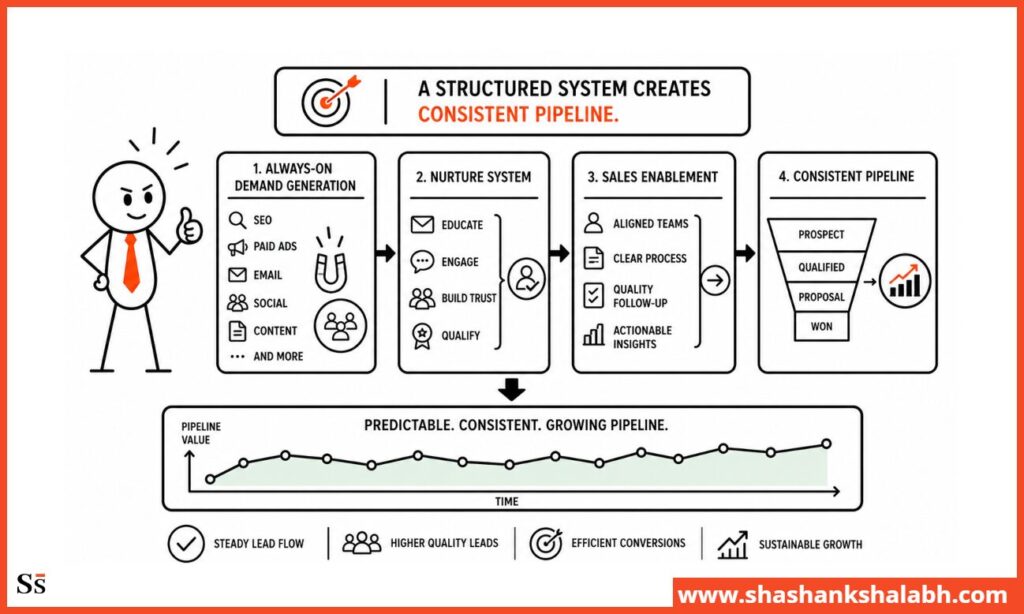
What It Takes to Build Steady Pipeline
Consistent pipeline comes from building a system that does not have bad months because it produces steady output regardless of events, campaigns, or founder activity.
From Campaigns to Always-On Pipeline
The structural alternative to campaign-based demand generation has three components – each producing pipeline continuously rather than in bursts:
- Organic: SEO content that drives daily traffic year round, building steady inbound demand from the right ICP.
- Paid (always on): Continuous, sustainable spend that produces predictable monthly leads instead of burst campaigns.
- Outbound: A consistent weekly outreach system to qualified ICP prospects, not quota driven spikes.
Together, these create a baseline of steady pipeline.
Diversified Channels, Consistent Results
Two or three validated channels each producing pipeline independently. When one channel underperforms in a given month, the others maintain baseline volume.
Channel mix should be diversified by type, not just platform.
- Inbound (content, SEO, organic social) captures active buyers.
- Outbound (prospecting, referrals) creates demand from inactive buyers.
- Referral and partner channels drive the highest quality leads with the best conversion rates.
Multiple paid channels isn’t diversification. For example, two paid social platforms both affected by the same CPM seasonality are a single point of failure with extra steps.
Real diversification means channels that perform independently under different conditions.
Full-Funnel Nurture That Actually Works
A functioning nurture system works across three segments:
- Top of funnel nurture keeps early leads engaged until a buying trigger appears.
- Mid-funnel nurture moves MQLs toward sales readiness.
- Re engagement reactivates closed lost and dormant leads when their situation changes.
A strong nurture system turns existing leads into an ongoing pipeline, reducing reliance on new lead volume for consistency.
Marketing and Sales Aligned on Results
Consistent pipeline requires both functions accountable to the same outcome:
- Marketing owns pipeline contribution: If the marketing-sourced pipeline is flat, that’s a marketing problem regardless of MQL count.
- Sales owns pipeline quality feedback: including what converts and why
- Joint weekly pipeline review: both teams looking at the same data
- Shared revenue accountability
When both teams are accountable to the same pipeline number, they stop optimizing separately and start building the system together.
Tracking Pipeline as a Leading Indicator
Most growing B2B companies aim for a 3:1 pipeline coverage ratio.
That means three dollars in qualified pipeline for every dollar of revenue target.
Tracking this monthly gives you a 60-90 day early warning before a shortfall turns into a missed target.
If coverage slips below 2.5:1, take action immediately.
Waiting until the quarter ends locks in the revenue miss. Increasing top-of-funnel campaigns, re-engaging dormant leads, and ramping up outbound efforts work when applied 60-90 days in advance.
Trying them in the last 30 days rarely moves the needle.
Realistic Timeline for Building Pipeline Consistency
You cannot build a consistent pipeline in 30 days.
What Changes in 30 Days
During the first 30 days, focus on diagnostics and building a strong foundation.
Audit pipeline sources to identify the main causes of inconsistency, whether founder dependency, channel concentration, campaign reliance, or unreliable data.
Define and document ICP criteria to ensure all outreach targets the right companies.
Clean up the CRM by standardizing stage definitions, attribution tagging, and data entry rules, making pipeline reporting reliable.
And launch always-on paid and organic campaigns to establish baseline volume.
These changes don’t generate an immediate pipeline but build the foundation that enables predictable, sustainable growth.
What Changes in 60-90 Days
In the next 60 to 90 days, the focus shifts from foundation to predictable pipeline.
Two or three channels run continuously, each driving its own pipeline and establishing baseline volume.
Dormant and non-ready leads are actively engaged through a systematic nurture process instead of being ignored.
Sales and marketing operate in alignment, with seamless handoffs, regular joint pipeline reviews, and consistently applied definitions.
The pipeline coverage ratio is tracked as a leading indicator, providing 60 to 90 days of forward visibility and enabling action before a shortfall ever occurs.
What Changes in 6-12 Months
Here’s what actually changes when the system is in place.
Your pipeline evens out. Month-to-month swings get smaller, and programs keep building results over time.
You’re less dependent on the founder.
And Marketing starts filling more of the pipeline, around 30-50% for growth-stage B2B companies.
Finally, forecasts become reliable. Teams are on the same page, coverage is clear, and boards start trusting the numbers again.
How a Fractional CMO Builds Pipeline Consistency?
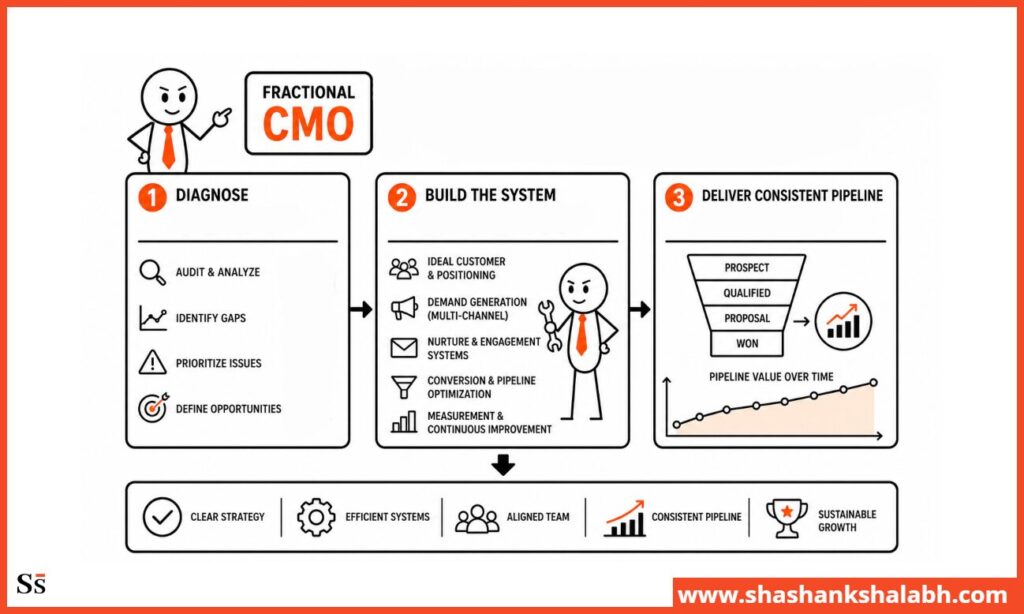
Inconsistent pipeline is a structural problem. You need someone who can diagnose the root cause, design the system, and align two functions around the same outcome.
Diagnosis Before Intervention
In the first 30 days, a fractional CMO audits pipeline sources and timing, before touching the budget.
Most companies just spend more, which only makes an inconsistent system more expensive.
A fractional CMO finds the structural cause first. The right fix comes from the diagnosis, not from throwing money at the wrong system.
Building the Always-On Demand Generation System
A fractional CMO builds multi-channel, always-on demand programs that generate pipeline without relying on the founder, campaigns, or events.
For most companies at $3M-$20M ARR, this is the system they’ve never had. It’s the core structural fix that tackles the biggest pipeline challenges all at once.
The system isn’t built overnight.
The system builds in layers, starting with a foundation in the first 30 days, then always-on programs, expanding channels, and maturing nurture over the first year. Each stage compounds the results of the one before.
Owning Pipeline Consistency as a Primary KPI
A fractional CMO tracks pipeline volume, coverage, and sources every month and is accountable to the board. When coverage dips below 2.5:1, action begins immediately.
This accountability catches issues early. Monthly reviews flag problems 60-90 days before they hit revenue, compared with reactive management, which often reacts a month after the quarter ends.
FAQ: Why Your Pipeline Is Inconsistent
Why is my sales pipeline so inconsistent?
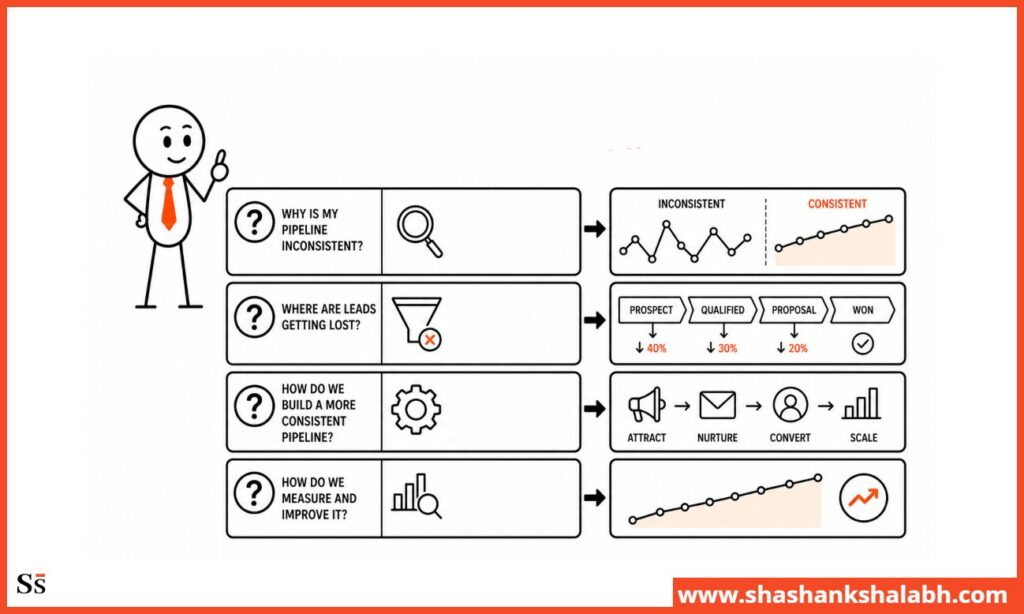
Inconsistent pipeline usually comes from two or three structural issues at once, like founder-dependent demand, single-channel reliance, campaign-driven bursts, weak top-of-funnel, inconsistent ICP, missing nurture, sales-marketing misalignment, or poor tracking.
A pipeline source audit shows which issue is driving the problem.
What is a healthy pipeline coverage ratio?
For high-growth B2B companies, a healthy pipeline coverage ratio is 3:1.
In other words,three dollars of qualified pipeline for every dollar of revenue target. Below 2:1 signals a demand problem; above 4:1 may indicate low win rates. Track it monthly and act immediately if it drops below 2.5 to 1.
How long does it take to build a consistent pipeline?
Early signs of pipeline consistency such as smaller month-to-month swings, reliable tracking, and initial always-on volume show up in 60-90 days.
However, meaningful results, like less founder dependency, 30-50% of pipeline from marketing, and 80%+ forecast accuracy, take 6-12 months.
What is the difference between campaign-based and always-on demand generation?
Campaign-based demand generation creates spikes. For example, webinars, events, and campaigns drive bursts of leads followed by valleys.
Always-on demand generation runs continuously. Organic search and content generate daily inbound leads, outbound touches reach prospects weekly, and paid campaigns run steadily. Most B2B companies at $3M-$20M ARR rely on campaigns. Building always-on programs is the key fix for inconsistent pipelines.
When should I hire someone to fix an inconsistent pipeline?
If your pipeline issues persist for two or more quarters, and tactical fixes such as more campaigns, bigger budgets, pushing sales harder don’t work, it’s time to bring in a fractional CMO.
A fractional CMO ($10K-$25K/month) diagnoses the structural cause, builds an always-on demand system, and aligns marketing and sales. At $3M-$25M revenue, this delivers CMO-level impact without a $300K-$700K hire.
Closing Thought
Inconsistent pipeline is a structural problem with a structural fix.
I have observed this first-hand that almost all high-growth businesses with a consistent pipeline have a system in place.
This includes always-on demand generation, multi-channel architecture, nurture that works the full pipeline lifecycle, and shared accountability between marketing and sales.

Shashank brings over 22 years of global omnichannel marketing experience. As a 4x Chief Marketing Officer, he has helped several organizations (Startups and Fortune 500) drive sustainable revenue growth through strategic marketing.