

I’ve seen healthcare organizations spend heavily on healthcare marketing techniques and still struggle to turn that spend into business growth.
For example, they might have decent patient inquiries, but low appointments
Meanwhile, key services remain underused, and leadership is curious whether their marketing investment is actually paying off.
If a clinic is already fully booked, bringing in more patients won’t solve the problem. And if the goal is to grow a specific specialty, marketing needs to focus on that service instead of spreading the budget across everything.
Marketing decisions need to account for business goals, service-line priorities, available capacity, patient access, and financial performance.
A clear healthcare marketing strategy brings these pieces together, so you can decide where to invest, what to prioritize, and how to measure results.

Strategic Healthcare Marketing: Business First, Marketing Second
Most healthcare marketing plans jump straight into tactics.
These could be a new website, paid ads, or social media. Well, that’s not the best way to grow a healthcare business.
As a fractional CMO for healthcare, I start by assessing what the organization needs to achieve. This helps me then build the right healthcare marketing strategy.
What Does the Business Need?
Growth can mean different things to different healthcare organizations.
First, zero in on what you actually want to grow.
It could be a specific service line, a new location, a particular patient segment, referral volume, or a new service offering.
Each goal calls for a different approach.
For example, growing a new service in one location requires a very different plan from filling appointment slots across a general practice.
Can You Handle More Demand?
Marketing can only do so much if you can’t accommodate more patients.
Before spending money to bring in new inquiries, check clinician availability, appointment wait times, and capacity at each location.
If patients have to wait five weeks for an appointment, many will go elsewhere, and your marketing spend goes with them.
Define “Success”
Success can mean more patients, more completed appointments, higher revenue, growth in a specific service line, or expansion into new markets.
It depends on the business.
A hospital system, private practice, and healthtech company will each measure success differently.
Decide what matters most from the start, or your reports may tell different stories about what’s working.
Healthcare Marketing Strategy Case Study
Here’s a hypothetical example of how I’d approach a common problem.
Say a specialty clinic is getting patient inquiries, but appointments aren’t growing as expected. Instead of adding more marketing budget, I’d take a step back and find out where things are going wrong.
Here’s what I would assess first:
- Awareness. Do enough people in the target market know about the service?
- Fit. Are the inquiries coming from patients the clinic can actually treat?
- Response. How quickly does the team follow up, and how many inquiries turn into appointments?
- Access. Can patients get an appointment when they need one?
- Completion. Are cancellations and no shows affecting the number of completed visits?
- Financials. Does the service generate enough revenue to justify further investment?
Let’s say the clinic is getting the right inquiries, but the front desk takes two days to respond and the first available appointment is a month away.
More marketing won’t help here, isn’t it?
Patients may simply go elsewhere. The real issue is access and scheduling.
Now, if most inquiries come from patients the clinic can’t treat, that’s a different problem. The targeting or messaging may be attracting the wrong audience.
You need to understand what’s holding growth back before spending more. Sometimes the problem is marketing, and sometimes it’s how the clinic runs.

Choose Which Services and Patients to Prioritize
Spreading the budget across every service line might seem fair, but it often leads to weak results across the board.
Evaluate each service line
Look at local demand, strategic importance, available capacity, competition, and financial contribution, where reliable data is available.
A service that’s already at capacity may not need more marketing, while one with fewer patients and better returns may be a smarter bet.
Know which patients you’re trying to reach
Consider where patients live, what care they need, how easily they can access it, payer considerations, and relevant referral sources.
The audience for one service line may look very different from the audience for another.
Decide what can wait
You can’t prioritize everything. Every service line you add to the plan takes resources away from something else.
Be clear about what deserves attention now and what can wait.
A simple way to compare opportunities is to look at two things: growth potential and your ability to deliver the service.
Services with strong potential and enough capacity should be the first priority. Those with strong potential but limited capacity may need operational changes before more marketing makes sense.
Use the data to decide where the budget will have the biggest impact.
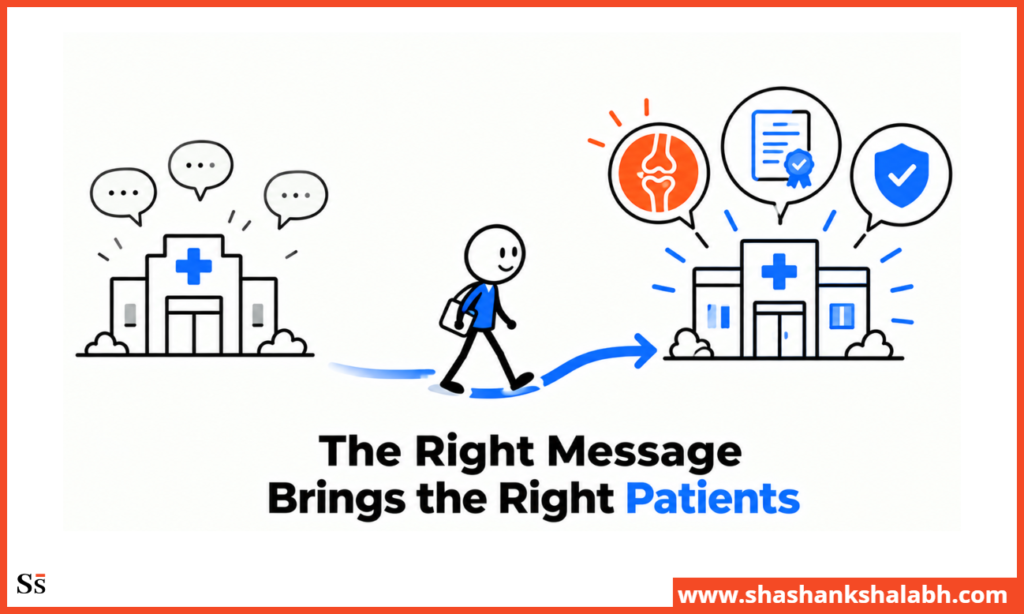
Position the Practice So Patients Feel Confident
Choosing a healthcare provider is a big decision.
Patients want to know they’re making the right choice, and your messaging should help them feel confident about it.
Make it clear what you offer
Explain who you treat, what services you provide, and how patients can access care.
If someone has to dig around your website to figure that out, they’re more likely to leave.
Show what makes you different
Think about clinician expertise, appointment availability, convenient access, patient experience, or other advantages you can back up.
Saying you provide “quality care” won’t set you apart. Every provider says that.
Show people what makes your offering different.
Support your claims with evidence
Credentials, patient reviews, testimonials, and educational content can help build trust.
Just make sure any patient stories or claims about outcomes are reviewed for compliance with applicable privacy, advertising, and professional requirements.
This is about deciding how you want patients to understand and choose your services.
Website design comes later, once you’re clear on what you want to communicate and who you’re speaking to.
Spend Budget Where It Matches Your Priorities
Choose marketing channels based on which services need to grow.
| Investment area | When it may make sense | What to evaluate |
| Local SEO and business listings | Patients are searching for local care | Relevant visibility and qualified inquiries |
| Paid search | Existing demand can be captured efficiently | Cost per qualified inquiry and completed appointment |
| Educational content | Patients need information to evaluate services | Relevant engagement and downstream actions |
| Referral development | Professional referrals influence patient volume | Referral volume, quality, and continuity |
| Reputation and patient experience | Confidence and experience affect provider choice | Review themes and operational feedback |
| Lifecycle communications | Follow-up or continued engagement matters | Consent, engagement, and relevant outcomes |
Match the budget to the service line
A specialty that relies on physician referrals needs a different approach from an elective service patients search for themselves.
Referral relationships may matter more for the first, while local search and patient education may be more effective for the second.
Look beyond the initial inquiry
A low-cost inquiry means little if it never turns into an appropriate appointment.
Track cost per qualified inquiry and cost per completed appointment, not just clicks or form submissions.
Don’t assume one channel mix works for everyone
The right budget split depends on your services, market, patient audience, available capacity, and financial goals.
There’s no universal formula.
The mix should reflect your specific needs and where marketing is most likely to deliver results.
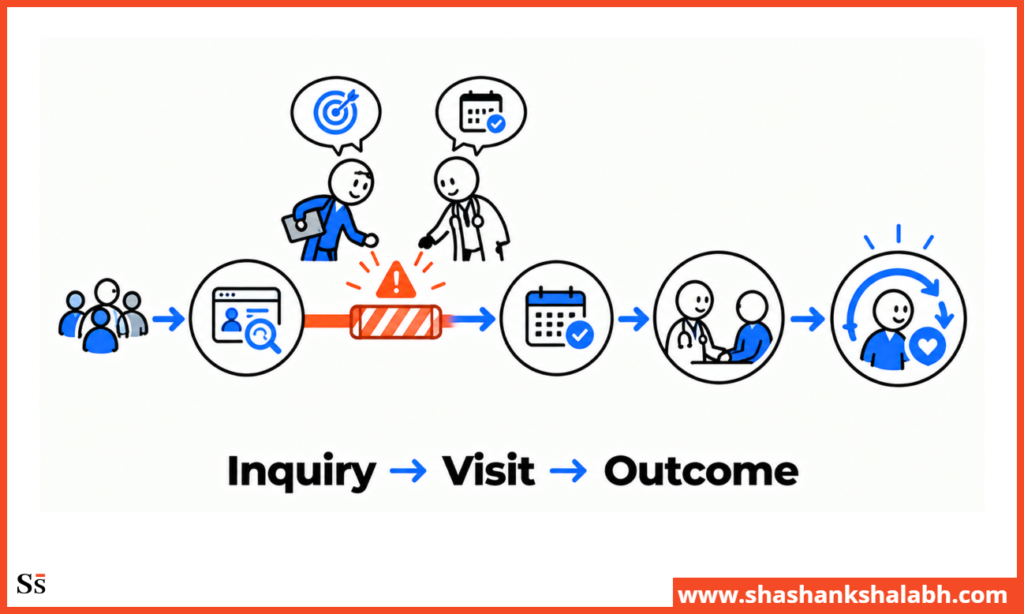
Connect Marketing to Patient Access and Results
Marketing doesn’t work in isolation.
Once a patient makes an inquiry, the front desk, scheduling team, and clinical staff all play a role.
If something goes wrong along the way, marketing often gets the blame, even when the problem lies elsewhere.
Track the journey from inquiry to completed visit
Look at what happens after someone reaches out.
Are they contacted, scheduled, and seen? Track cancellations and no shows as well.
A campaign that generates 100 inquiries but only 20 completed visits tells a very different story from one that generates 60 inquiries and 35 completed visits.
Diagnose: Demand vs Access Issue?
Marketing may bring in more inquiries, but if appointments are hard to get because of scheduling delays, staff shortages, or limited availability, those inquiries may never turn into visits.
If you don’t separate the two, you might spend more on marketing when the real issue is operations, or blame the front desk when the campaign is attracting the wrong patients.
Make accountability a shared effort
Be clear about what marketing, front-office teams, operations, and leadership are each responsible for. Review results together.
Marketing shouldn’t be judged on inquiry volume alone when the rest of the organization plays a role in turning those inquiries into completed visits.
Track The Right Metrics
If you start following every metric, you will be lost in an ocean of data, and your leadership won’t be happy.
Instead, choose the metrics that are connected to business outcomes. No one wants to just know how much traffic you generated if you can’t connect it to conversions or revenue.
| Metric | Executive question |
| Cost per qualified inquiry | Are we attracting relevant demand? |
| Inquiry-to-appointment rate | Are inquiries becoming scheduled visits? |
| Appointment completion rate | Are scheduled visits actually happening? |
| Cost per new patient | How efficiently are we acquiring patients? |
| Service-line volume and capacity | Does demand match our ability to deliver care? |
| Financial contribution | Is growth supporting our economic goals? |
Break down results by service line, location, and channel
Overall numbers can look healthy while individual service lines, locations, or marketing channels underperform.
Break down the results to see what’s working, what’s not, and where your budget may be going to waste.
Measure what matters to your business
A private practice, hospital system, and healthtech company won’t measure success in the same way.
Choose KPIs that reflect your business goals, and calculate costs consistently so you’re comparing like with like.
Patient volume alone doesn’t tell you whether a service is profitable. Neither does the return on ad spend reported by an advertising platform.
To understand the real value of your marketing, you need to know what those patients or customers contribute financially.
→ Marketing KPIs Every CEO Should Track
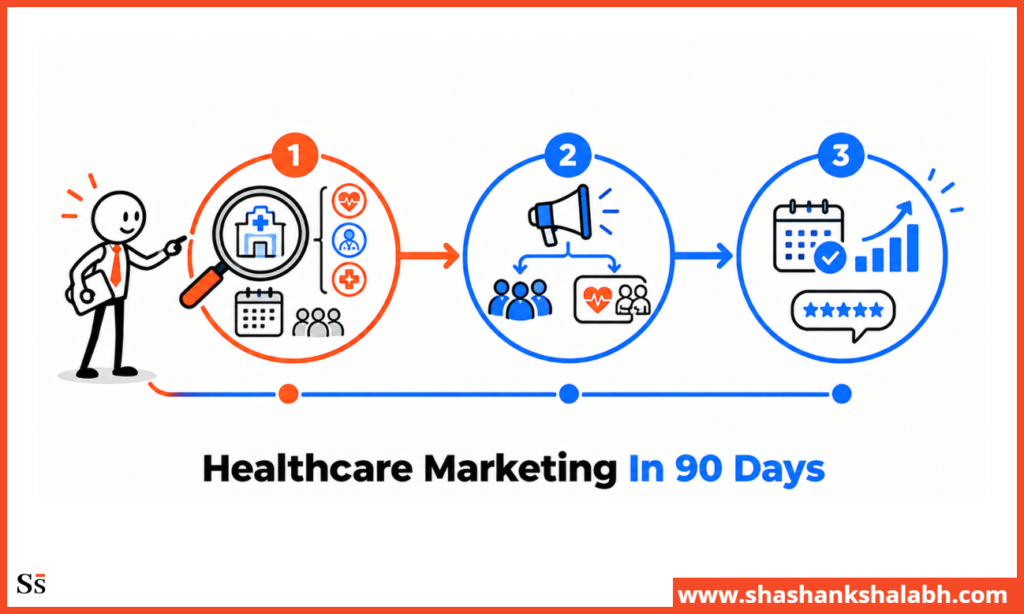
A Practical 90-Day Healthcare Marketing Plan
Before you commit to this 90-day health marketing strategy, please understand this is not a promise of results in 90 days.
It’s a way to bring focus to your healthcare marketing efforts and make better decisions about where to invest.
Days 1-30: Assess and prioritize
Review business goals, service-line performance, appointment availability, marketing results, and gaps in measurement.
Identify what’s holding growth back and decide what needs attention first.
Days 31-60: Put the plan into action
Set clear priorities, assign responsibilities, allocate the budget, and establish baseline metrics. This gives you a way to measure progress and see what’s changing.
Days 61-90: Review and adjust
Look at early performance indicators alongside business results.
Use what the data tells you to decide which initiatives to continue, which to change, and which to stop.

Frequently Asked Questions: Strategic Healthcare Marketing
What is a healthcare marketing strategy?
A healthcare marketing strategy connects business goals with priority services, patient demand, marketing spend, and measurable results. It helps healthcare organizations decide where to invest, not just which tactics to use.
What are the most effective healthcare marketing strategies?
That depends on your services, market, and how patients find and access care.
A specialty that relies on physician referrals needs a different approach from an elective service patients search for themselves.
How should healthcare organizations measure marketing ROI?
Look at cost per new patient, completed appointments, and financial contribution where reliable data is available. Inquiry volume and ad platform ROAS alone won’t tell you whether marketing is driving real business value.
How much should a healthcare organization spend on marketing?
There’s no one size fits all budget. Spending should reflect your growth goals, available capacity, market conditions, and financial priorities.
What’s the difference between healthcare marketing and healthcare digital marketing?
Healthcare marketing covers the overall strategy for growing the right services and reaching the right patients.
Digital marketing is one part of that strategy, using channels like search, paid ads, email, and social media to reach them.

Final Thoughts
If you’re spending on marketing but not seeing the growth you expected, it’s worth taking a closer look at what’s working and what’s not.
You might be surprised that sometimes the answer isn’t more marketing, but a clearer plan and better alignment with your business goals.
A fractional CMO for healthcare can help you figure out the right healthcare marketing strategy.
→ Why Your Marketing Isn’t Driving Revenue?

Shashank brings over 22 years of global omnichannel marketing experience. As a 4x Chief Marketing Officer, he has helped several organizations (Startups and Fortune 500) drive sustainable revenue growth through strategic marketing.