
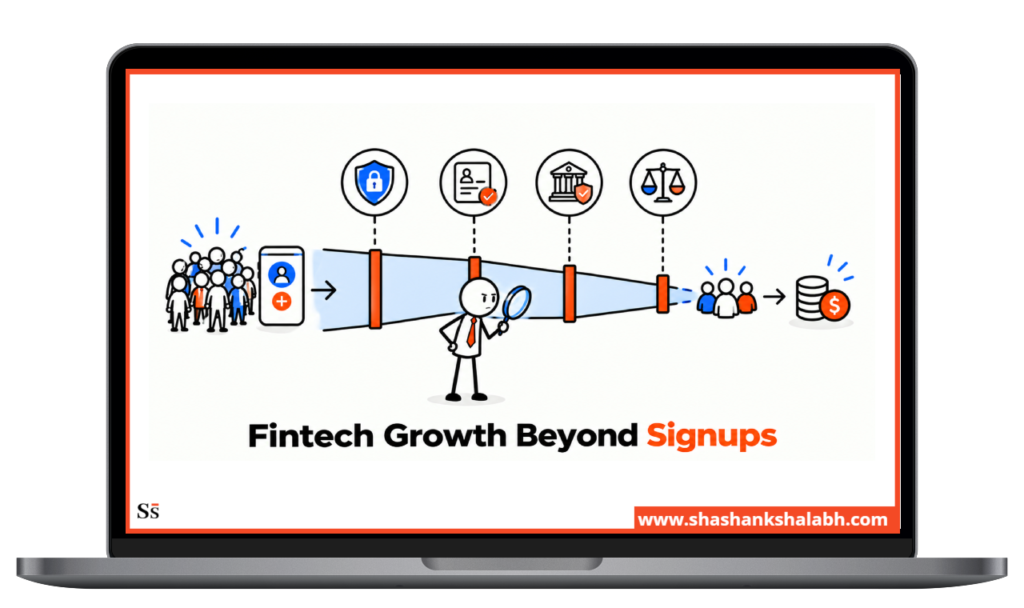
A fintech business can generate plenty of awareness and signups but still struggle to turn them into active customers, repeat usage, and profitable revenue.
As a Fractional CMO for fintech businesses, I’ve seen this more often than I’d like.
Fintech marketing has a few challenges you can’t ignore.
Customers are trusting you with their money and personal data.
They need to understand your fees, feel confident their money is safe, and know your business is legitimate.
Identity checks and document requests add friction to onboarding. Compliance shapes what you can say. And your unit economics determine whether acquiring more customers actually makes financial sense.
A fintech marketing strategy needs to account for all of this.
That means connecting the right audience, acquisition channels, trust-building, activation, and retention to measurable business outcomes. If one part of that journey isn’t working, more marketing spend is not going to help.
In this post, I’ll share how I approach financial services marketing and show you how to find what’s holding your growth back.
What Is a Fintech Marketing Strategy?
A fintech marketing strategy is the plan that connects your target customer, positioning, channels, customer journey, measurement, and the business outcome you need.
In a nutshell, it answers the following questions:
- Who are we trying to win?
- Why would they choose us?
- How do we reach them?
- What do they need to believe before they sign up?
- What do they need to do next?
- How do we know it’s paying off?
Note that a fintech marketing strategy is not a channel plan or a campaign calendar (which are outputs of the strategy).
Now, how the actual financial services marketing strategy would look also depends on what you sell, product type, customer, revenue model, and regulation(s).
| Fintech type | Main priority | Growth constraint |
| Consumer payments app | Trust and first transaction | Activation and usage frequency |
| Lending platform | Qualified applicants and approvals | Acquisition cost versus loan economics |
| B2B fintech SaaS | Qualified pipeline | Long buying cycles, multiple stakeholders |
| Wealthtech | Funded accounts and assets | Trust and onboarding friction |
Now all these fall under the fintech vertical, and yet, they have very different strategies. A fintech marketing strategy copied from a payments app will mislead a lending platform, and the other way around.
Start With the Business Goal
I have observed that most fintech marketing strategies start with channels.
Which ads should we run? Should we do content? Should we try partnerships?
Those are fair questions, but they come too early.
I’d start one step before that, with the outcome the business actually needs.
If you don’t know that, you will get excited about every channel, and end up testing everything and learning nothing.
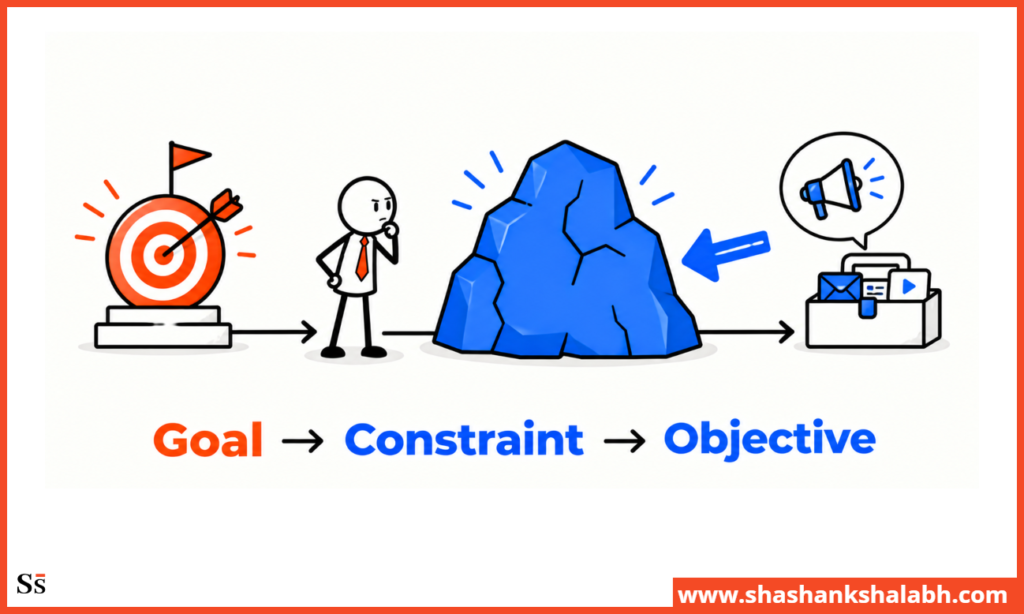
Pick the growth objective
Depending on your model, the real objective could be:
- Customer acquisition
- Verified or funded accounts
- First transaction or product activation
- Repeat usage and retention
- Revenue, assets under management, or qualified B2B pipeline
Now, more signups don’t always lead to more business. Focus on the outcome that actually drives growth.
Pick the one objective that matters most right now. You can have several over time, but you can’t push on all of them at once with a limited team and budget.
→ Why Your CAC Is Too High (And How to Fix It)
Find the constraint holding growth back
Once you know the objective, ask what’s in the way, aka, what’s holding you back.
In most fintechs it’s one of these:
- Not enough qualified prospects
- Prospects don’t trust the product
- Signups don’t activate
- Acquisition costs exceed customer economics
- Customers don’t stay or don’t generate enough value
Generally, there’s one main constraint, with a couple of smaller ones behind it. Don’t treat all five as equally urgent.
Match the marketing objective to the constraint
This is where a fintech growth strategy goes wrong.
You can’t fix an onboarding issue with more ad spend. Likewise, better onboarding won’t fix a shortage of qualified demand.
I use what I call a Fintech Growth Constraint Map to address this:
Demand → Trust → Conversion → Activation → Retention → Economics
Walk the chain from left to right.
Is there enough qualified demand? Do those people trust you enough to start?
Are people converting once they arrive? Do they reach a meaningful first action? Do they stay? Does the math work?
If people don’t trust you, improving retention won’t do much because too few people stick around long enough to be retained.
Who’s Your Ideal Customer; Why They Switch?
Define your ideal customer by need, behavior, eligibility, and economic value. Demographics alone won’t do it. “Millennials who want better banking” tells you almost nothing you can act on.
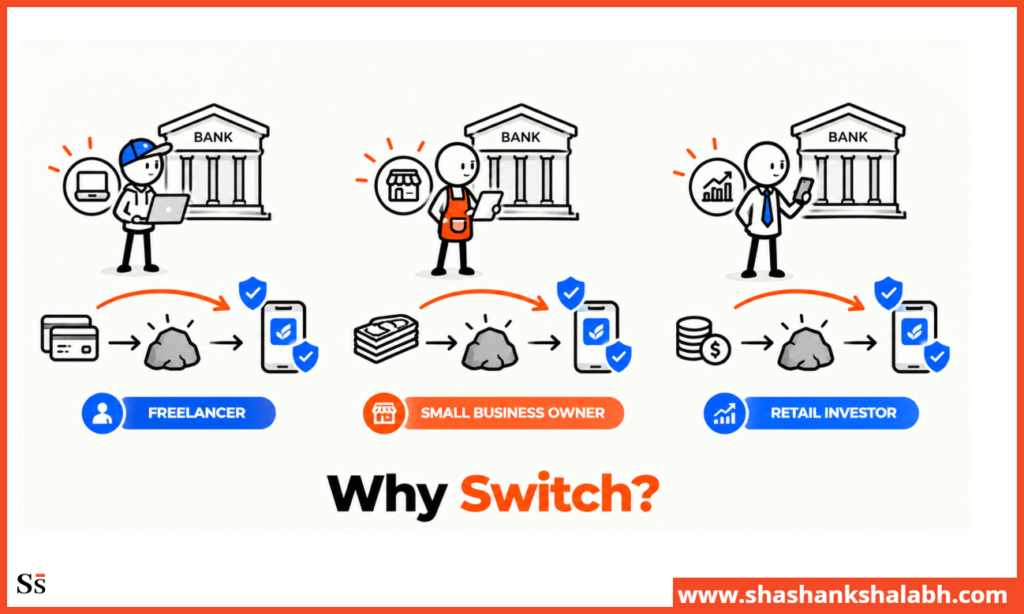
Then get specific about the switch.
Why would this person leave their bank, their current app, or their spreadsheet for you? What are they tired of? What would they gain?
If you can’t say that in a sentence, your marketing can’t either.
Be honest about the alternatives.
In fintech the real competitor is often inertia.
People stay with the bank they have because moving money feels risky. Your reason to switch has to be strong enough to beat that.
One message rarely works for every segment. A freelancer, a small business owner, and a retail investor have different needs and different fears.
Map each segment on its own:
| Customer segment | Primary need | Main objection | Proof required | Desired action |
| Freelancers | Fast, cheap payouts | “Will my money be safe?” | Clear fees, security info | Connect an account |
| Small business owners | Cash flow access | “What’s the catch?” | Transparent terms, references | Apply |
| Retail investors | Simple way to start | “Can I trust this firm?” | Regulatory status, track record | Fund an account |
This table is just to help you get started,.
Build your own using real customer conversations, support tickets, and sales calls.
Focus on the objections column. It shows you what your messaging needs to address first to get through to customers.
Build Trust Into the Strategy
This is where fintech differs from other industries.
Customers are trusting you with their money and personal data.
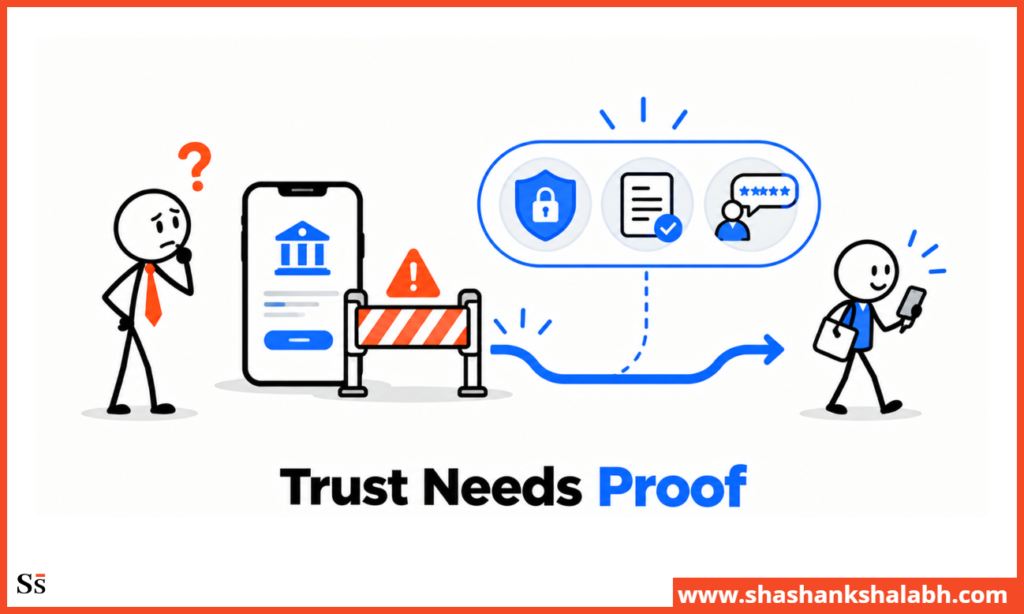
So trust isn’t something you add to the website at the end. It needs to be built into your marketing strategy from day one.
Know what customers fear or don’t understand
Start by listing what actually worries people.
Don’t guess. Ask them.
Customers often worry about hidden fees, confusing terms, security and privacy, and whether a company is trustworthy and properly regulated.
They also want to know what happens after they sign up.
That last point is easy to overlook.
People may hesitate simply because they don’t know what comes next. What information will they need to provide? How long will verification take? When can they access their money?
When customers can’t see what lies ahead, they’re more likely to drop off.
Make the next steps clear, and you remove one more reason for them to hesitate.
Match the proof to the concern
Once you understand the concern, address it with clear, relevant proof.
Be upfront about fees, explain your security and regulatory measures, share credible customer feedback, and show people what to expect after signing up.
Keep every claim accurate and compliance-approved, especially when it comes to security, regulations, or returns.
Overpromising can do more harm than good.
See if conversions improved
Instead of assuming that a trust-building change worked, measure it.
Track conversion by traffic source, customer segment, landing page, and onboarding stage.
If you added customer reviews, security details, or other trust signals and conversion didn’t improve, they may not be addressing the concerns holding your customers back.
Over time, this data helps you understand which concerns matter most to different customer segments.
That insight becomes a real competitive advantage. And helps you improve your messaging, improve conversion, and make smarter marketing decisions.
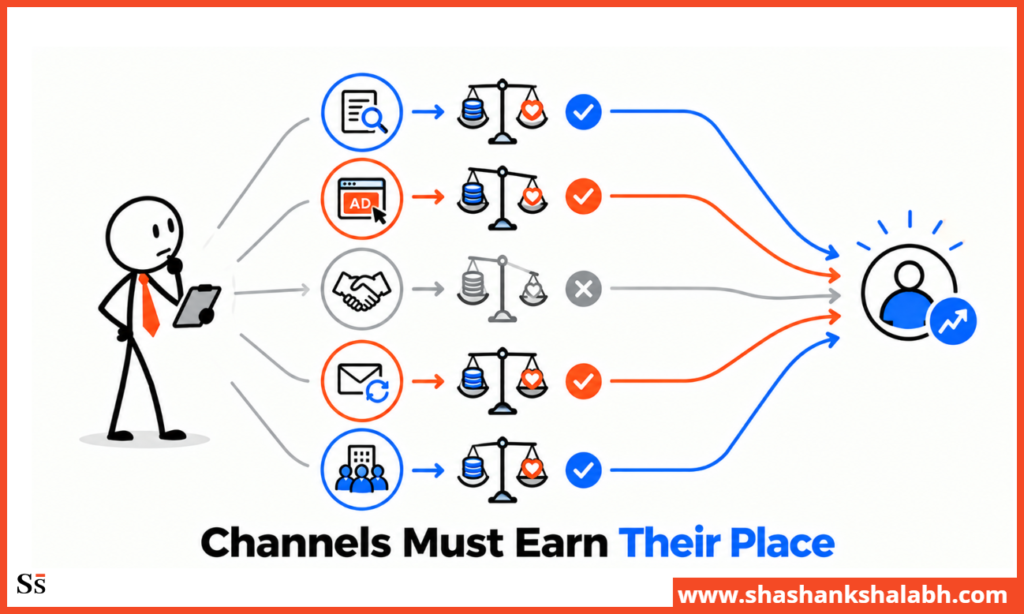
Choose Channels Based on Economics
If you want to pick channels only because they are trending, you’d end up wasting the budget.
Choose fintech marketing channels by what the economics support for your product, audience, and buying cycle.
Here is a simple way to think of channel-selection:
| Channel | Best fit | Leading metric | Main limitation |
| SEO and education | Evaluation-stage buyers with questions | Qualified organic signups | Slow to build |
| Paid search and social | Clear, measurable demand | Cost per activated customer | Gets expensive at scale |
| Partnerships and referrals | Products with natural distribution | Activation rate by partner | Hard to control volume |
| Email and lifecycle | Moving signups to first value | Onboarding completion | Needs an audience first |
| ABM and sales enablement (B2B) | Long cycles, many stakeholders | Pipeline from target accounts | Resource-heavy |
These fintech marketing channels are not ranked in any way.
Which one works depends on your model. Paid might be the best channel for one fintech and a money pit for another.
SEO and Educational Content
Fintech customers do their homework before committing. They want to understand the fees, risks, and how your product works.
Educational content helps answer those questions, reduce uncertainty, and build trust before a customer is ready to buy.
The tradeoff?
Well, it takes time to build momentum. Content is a long-term investment, so don’t rely on it alone to hit short-term growth targets.
Paid Search & Paid Social
Paid ads work well when demand is clear and measurable.
Think beyond cost per signup. Track cost per activated customer to see whether the channel is bringing in customers who deliver value.
Partnerships & Referrals
Partnerships can give you a head start on trust.
When customers discover you through a business they already know and trust, they have fewer reasons to hesitate. That can lead to stronger fintech user activation, though you have less control over the volume of new customers.
Partnerships work best when your product naturally fits into another business’s ecosystem through integrations, referrals, or shared customers.
Email, Lifecycle, Product-led Communication
Lifecycle messaging helps prospects complete onboarding and guides new customers toward meaningful product value.
It won’t generate demand, but it helps you convert more of the demand you’ve already paid to acquire.
B2B Fintech: Account-Based Marketing & Sales Enablement
If you sell to businesses, expect longer sales cycles and more decision-makers.
Account-based marketing and strong sales enablement often matter more than broad reach. Buyers need proof that your product works, clear security documentation, and a solid business case.
Whatever channels you use, look beyond leads and signups.
Measure what happens next: who activates, converts, and becomes a valuable customer.
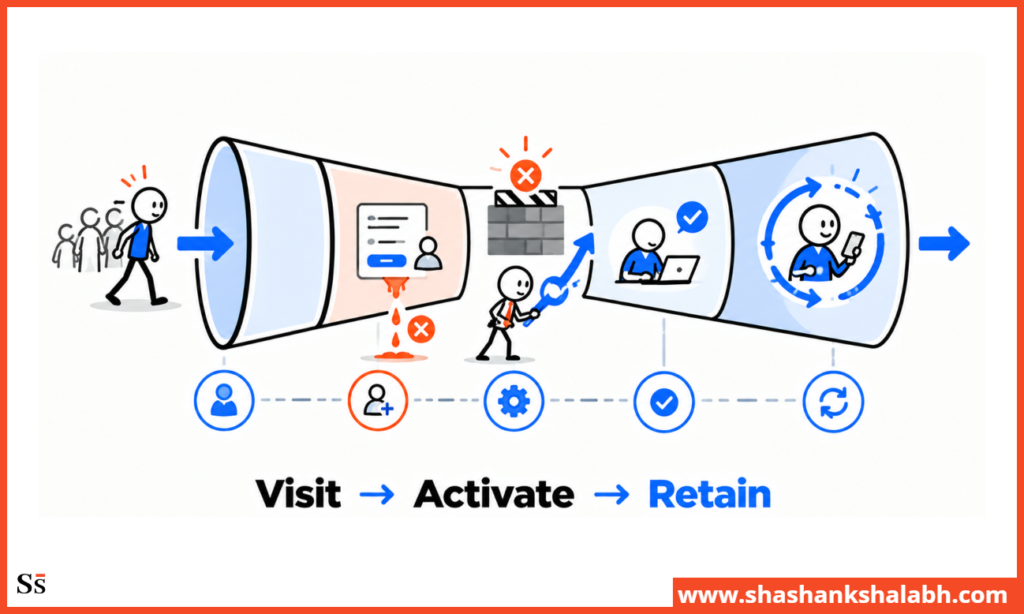
Improve the Funnel From First Visit to Retention
This is the strategic overview.
I recently covered this in depth in this post: Why Your Fintech Has Plenty of Signups But Not Enough Active Users
Measure acquisition quality, not just signups
Compare fintech marketing channels by customer fit, activation, retention, and revenue. This shows which sources bring in valuable customers, not just signups.
Find conversion and onboarding friction
Look at your messaging, document requirements, verification steps, and where people drop off.
Some friction is unavoidable, especially when identity checks and compliance are involved. You should aim at making every step clear, predictable, and easy to complete.
Define What Activation Means for Your Product
Define one key activation event that shows a customer is getting real value from your product. That might be funding an account, completing a transaction, linking a financial account, or reaching a key product milestone.
Choose the action that matters most for your business, and use it consistently to measure activation.
Improve retention and repeat usage
Check whether customers continue getting value after their first success. Acquiring customers is only part of the job; you also need to give them reasons to stay and return.
Measure What Drives Profitable Growth
Track metrics that fit your business model and stage of growth.
A lender and a payments app have different priorities.
| Metric | What it answers |
| Cost per qualified prospect | Are we attracting the right audience? |
| Customer acquisition cost (CAC) | What does a customer cost us? |
| Cost per activated customer | Do acquired users reach real value? |
| Activation rate | Where do new users drop off? |
| Retention or repeat usage | Do they keep using it? |
| CAC payback period | How long until acquisition cost is recovered? |
| Contribution margin | Does growth create economic value? |
Keep your definitions consistent.
Be clear about what goes into fintech customer acquisition cost, from ad spend and tools to salaries and fees. Use the same formula every month so you can track performance accurately.
Measure payback using contribution margin, not revenue alone.
A customer who generates revenue but costs almost as much to serve may contribute very little to the business.
Choose a handful of key metrics and review them regularly.
Check out my posts on How to Improve LTV:CAC Ratio and Marketing KPIs Every CEO Should Track
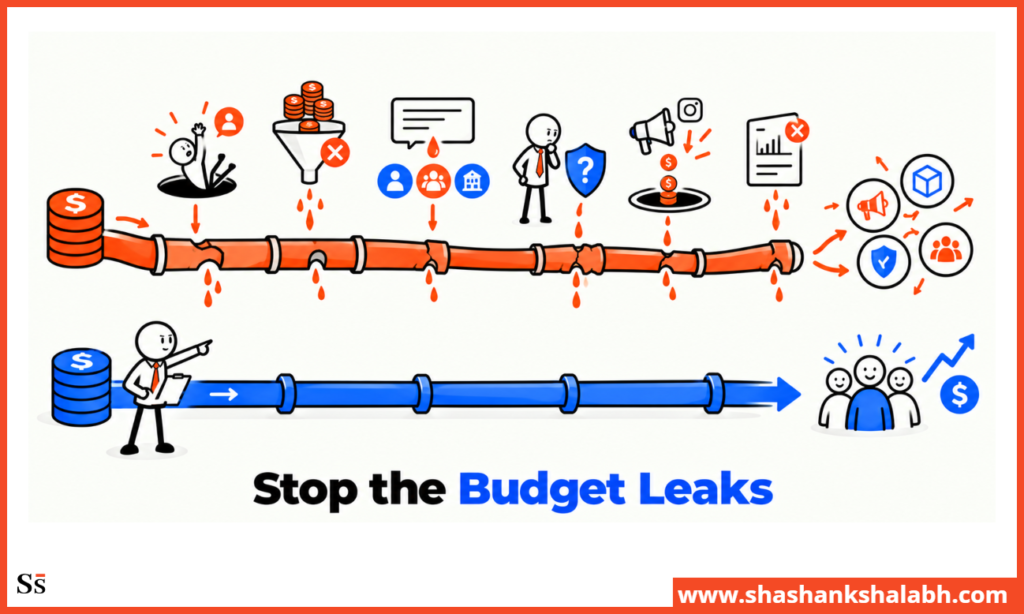
Fintech Marketing Mistakes That Waste Your Budget
Every marketing mistake has a cost. Here are the most common ones, and how to address them.
Scaling spend before fixing the funnel
You end up paying more to acquire customers without solving what’s holding them back. Find the bottleneck before increasing spend.
Using the same message for everyone
Different customers have different needs and concerns. Tailor your messaging to what matters most to each segment.
Treating trust as a design problem
A polished website won’t ease real concerns on its own. Build trust with clear terms, transparent pricing, and relevant proof.
Chasing trendy channels
A popular channel isn’t always a profitable one. Test small, measure customer value, and scale only when the numbers make sense.
Tracking activity instead of results
Clicks and impressions don’t tell the whole story. Focus on metrics that connect marketing to revenue and customer value.
Working in silos
When marketing, product, compliance, and sales aren’t aligned, launches slow down and messaging gets inconsistent.
Set shared goals and assign clear ownership across the customer journey.
A 90-Day Plan for Building the Strategy
Here’s how I would build a fintech marketing strategy in three months.
Please note that results will vary depending on your market, product, and starting point. Each phase represents a 30-day period.
Phase 1: Diagnose
Review your business goals, customer segments, funnel data, channel costs, positioning, and measurement gaps.
Talk to customers, sales, and support to understand what’s holding growth back. Use the Constraint Map to identify the biggest bottleneck and the evidence behind it.
Phase 2: Prioritize
Choose the most important fixes and assign an owner to each.
Set baseline metrics to track progress, launch your first experiments, and agree on how you’ll measure CAC, activation, and payback.
Keep the focus on what matters most right now.
Phase 3: Implement and Evaluate
Put your priorities into action.
Track early signals alongside business results, then decide what to scale, adjust, or stop. Use what you learn to improve your approach and shift resources where they’ll have the greatest impact.
After 90 days, repeat the cycle and tackle the next biggest growth constraint.

When Does a Fintech Need Senior Marketing Leadership?
You may need a strategic, experienced marketing leader when you’re spending on multiple channels without knowing which ones work, customers sign up but don’t use the product, or marketing costs keep rising without better results.
It can also become a problem when your teams have different priorities and every big decision still falls to the founder.
A fractional CMO for fintech can help bring things into focus by setting priorities, guiding spending, and making sure marketing supports the business’s goals.
FAQ: Fintech Marketing Strategy
I sincerely hope these questions and answers will help you understand financial services marketing.
What is a fintech marketing strategy?
A fintech marketing strategy is a plan that connects your target customers, messaging, channels, and customer journey to real business results. It starts with your growth goal, identifies what’s holding you back, and focuses your marketing on fixing it.
How is fintech marketing different from traditional marketing?
Trust matters when people share their money and personal data. Compliance limits what you can say, onboarding can slow signups, and unit economics determine whether growth pays off.
Which marketing channels work best for fintech companies?
It depends on your product, audience, sales cycle, and economics.
There’s no one-size-fits-all answer. Measure channels by how many customers activate and what they do afterward, not just how many sign up.
How should fintech companies measure marketing performance?
Track the customer journey from first click to activation, retention, and revenue. Use consistent metrics, and calculate CAC payback based on contribution margin, not just revenue.
When should a fintech hire a Fractional CMO?
If marketing isn’t driving results, teams lack direction, or the founder is still making every decision, a fractional CMO can bring the strategy, execution, and measurement together around clear business goals.
Final Thoughts
If your fintech is generating signups but struggling to turn them into active, profitable customers, start by finding out where prospects drop off and why.
That should guide your next marketing decision, whether it’s improving lead quality, reducing onboarding friction, or addressing retention.
As a Fractional CMO, I help fintech teams work out what needs attention first and build a marketing strategy around the business’s actual priorities.

Shashank brings over 22 years of global omnichannel marketing experience. As a 4x Chief Marketing Officer, he has helped several organizations (Startups and Fortune 500) drive sustainable revenue growth through strategic marketing.