
As a CMO and fractional CMO, I have worked with founders for a large part of my career.
And every time, revenue slows down, they default to ramping up lead generation.
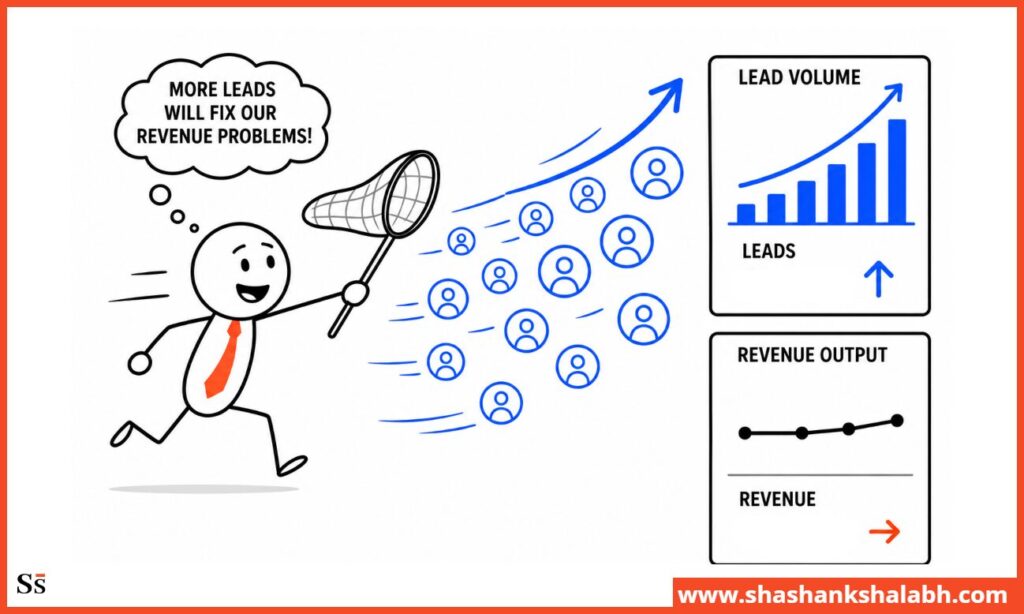
More leads feel like the answer because they’re visible, measurable, and easy to associate with growth.
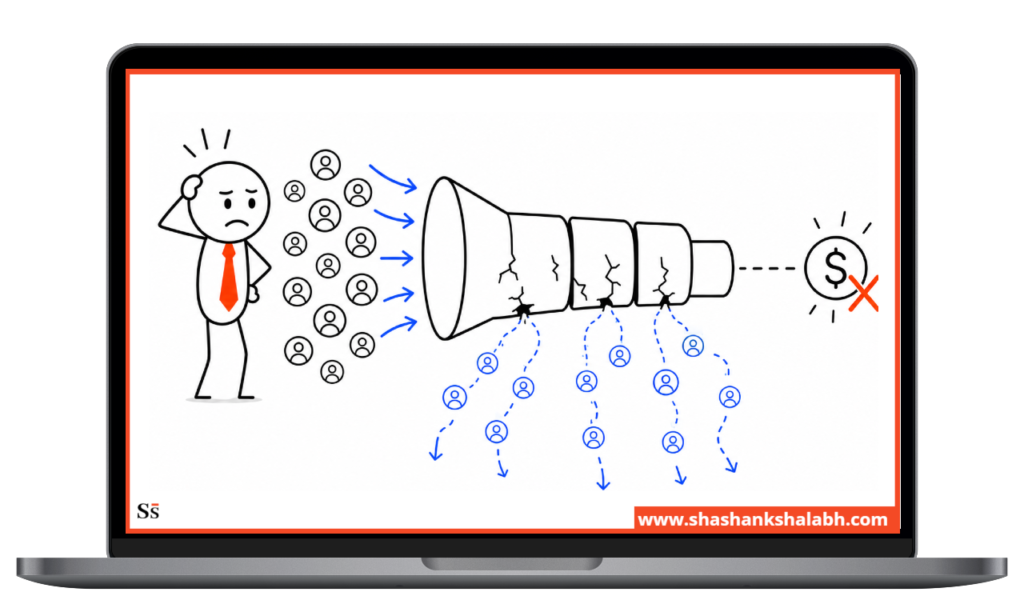
But more leads fed into a broken system produce more waste at higher cost.
In this post, I will cover why more leads are almost never the right first fix, what the actual problem is, and the sequence that produces sustainable revenue growth.
Here is a quick snapshot of everything you will learn:
- Why lead volume feels like the right (and easiest) solution?
- Which 5 issues more leads cannot fix
- The Math: Fixing the System beats scaling spend
- What to fix before adding more leads, and in what order
- Outlier: When more leads actually is the right answer
Why “More Leads” Feels Like the Answer
As I said before, when the revenue is flat, the instinct is to generate more leads.
After all, this is the most visible, most actionable, most measurable marketing activity out there.
Lead volume is easy to measure, easy to report, and easy to increase with more budget.
Just spend more on paid acquisition, publish more content, and you will see a higher lead count.
The issue is that unlike revenue (which is an output metric), lead volume is an input metric.
Businesses that respond to flat revenue with more leads almost always watch CAC climb while conversion stays flat.
For example, when you generate more leads from the wrong ICP, you bring more wrong-fit prospects in the funnel. This wastes sales time and marketing budget simultaneously.
Likewise, if your positioning is weak and you generate more leads, you will have more prospects who engage briefly and disappear. That’s more traffic without conversion.
When the marketing system is diagnosed on a “we need more leads” engagement, the data almost always shows one of two things.
Either lead volume is already adequate and the conversion problem is downstream. This could be wrong ICP, weak positioning, broken handoff, or measurement that’s tracking the wrong things. That is, the leads are there but the system isn’t converting them.
Or lead volume is genuinely low but the root cause is wrong channel selection or wrong ICP targeting. Fixing those produces better-quality leads.
The answer to a low-quality lead problem is never more leads of the same quality.
The 5 Problems More Leads Won’t Fix (With solutions)
In my experience as a marketer, more leads will not solve these issues. These all are system failures that get more expensive with more lead volume.
Missing Revenue Accountability
I want you to pay attention to this as this is what drives most “we need more leads” conversations.
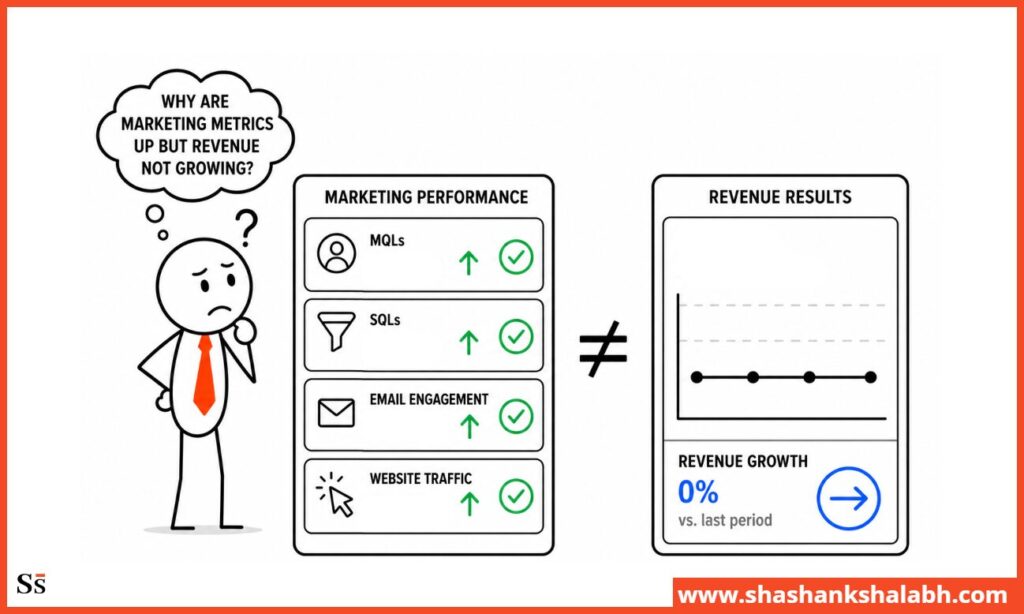
Another issue is that the issue of missing revenue accountability is invisible until you look at what marketing is actually measuring.
I have seen a majority of businesses measure marketing on lead volume.
As a result, marketing optimizes for lead volume, hitting MQL goals. However, this does not drive revenue in most cases.
Solution: Replace Lead Volume KPIs With Revenue-Connected Metrics
The first thing you should do here is replace lead volume as the primary marketing KPI. And start focusing on pipeline contribution, MQL-to-SQL conversion rate, CAC, and marketing-sourced revenue percentage.
This small change makes every other solution (mentioned below) more effective.
It changes what the system is optimizing toward.
→ Marketing KPIs Every CEO Should Track
Leaky Funnel
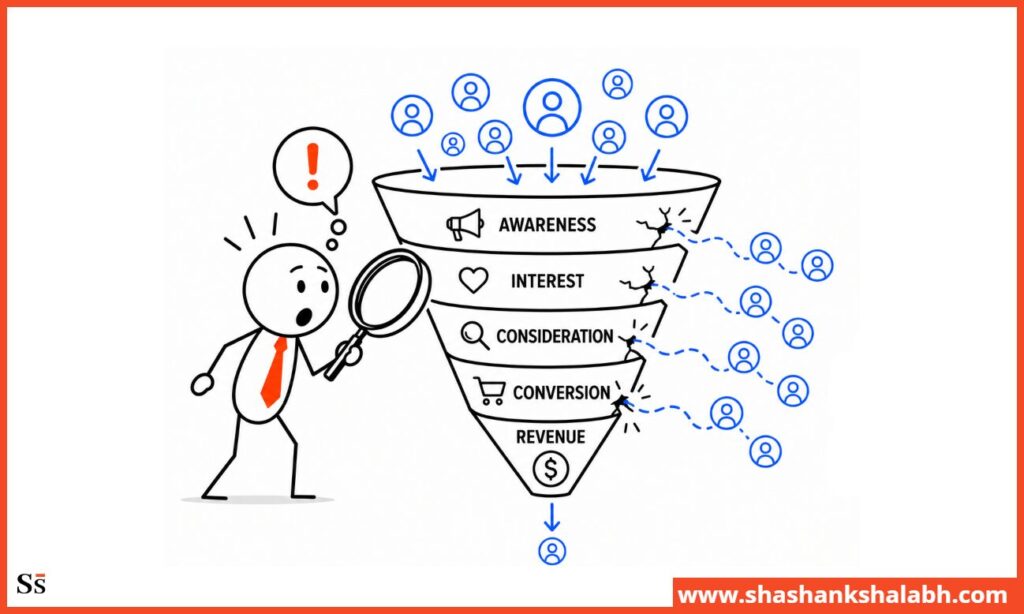
The second issue is when a funnel stage is converting poorly relative to the others.
The challenge here is that businesses often don’t know which stage that is because they don’t track conversion rates by stage.
Say, the MQL-to-SQL conversion is 12%. That is, 88 out of 100 marketing-qualified leads are going nowhere.
In this case, doubling lead volume doubles the number of leads being wasted.
It is important to understand that each leak location (in the funnel) points to a different problem.
- Visitor to lead: The message isn’t matching the audience’s intent. So it’s attracting the wrong traffic
- Lead to MQL: Qualification criteria are capturing engagement signals without ICP fit
- MQL to SQL: The handoff is broken or sales isn’t following up
- SQL to opportunity: The sales conversation isn’t landing. This is a positioning mismatch at discovery
- Opportunity to close: Deals are slowing down or getting stuck. This could be due to competitive positioning, procurement, champion development
Solution: Audit Conversion Rates at Every Funnel Stage
The right way to address this issue is by mapping conversion rates at every funnel stage. Find the biggest drop-off. Fix that stage before touching top-of-funnel spend.
Let’s do that math.
When you bring the MQL-to-SQL conversion from 15% to 30%, this doubles the pipeline output without a single additional lead. And adding 50% more leads at 15% conversion produces 50% more pipeline.
The same result costs twice as much and takes three times as long.
Wrong ICP = Higher CAC
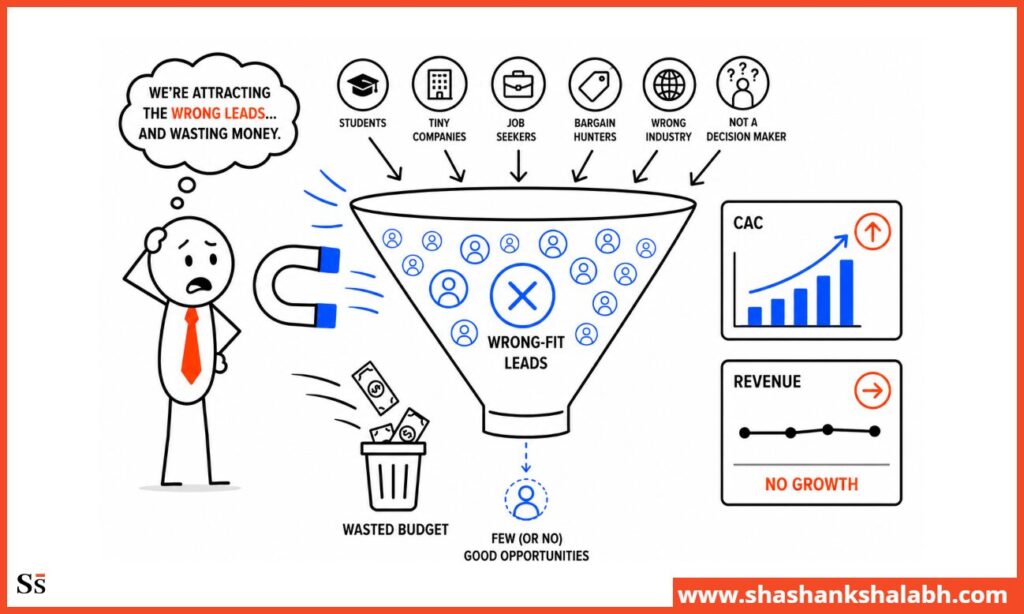
In case of a broad ICP, more leads often means more wrong-fit companies entering the funnel.
Wrong-fit leads don’t convert regardless of volume.
But they cost the same to acquire, consume sales time to qualify out, and inflate CAC by increasing leads without increasing customers.
Let’s do that math.
A business with a broad ICP generating 200 leads per month at 5% conversion produces 10 customers.
If it doubles leads to 400 without fixing the ICP, it produces 20 customers, but spends twice as much per customer because the wasted spend on the wrong 95% has also doubled.
Solution: Rebuild ICP From Closed-Won Data
If you are struggling with a broad ICP issue, narrow targeting to the specific firmographic profile of the best customers. These are the ones with fastest conversion, best retention, and highest LTV.
While this may drop the lead volume, it will certainly improve your conversion rates and reduce your CAC. And you will see higher revenue from the same budget.
This is the counterintuitive truth about lead volume.
Fewer leads from the right ICP consistently outperforms more leads from the wrong one.
→ Go-To-Market Strategy for Scaling Companies
Weak Positioning
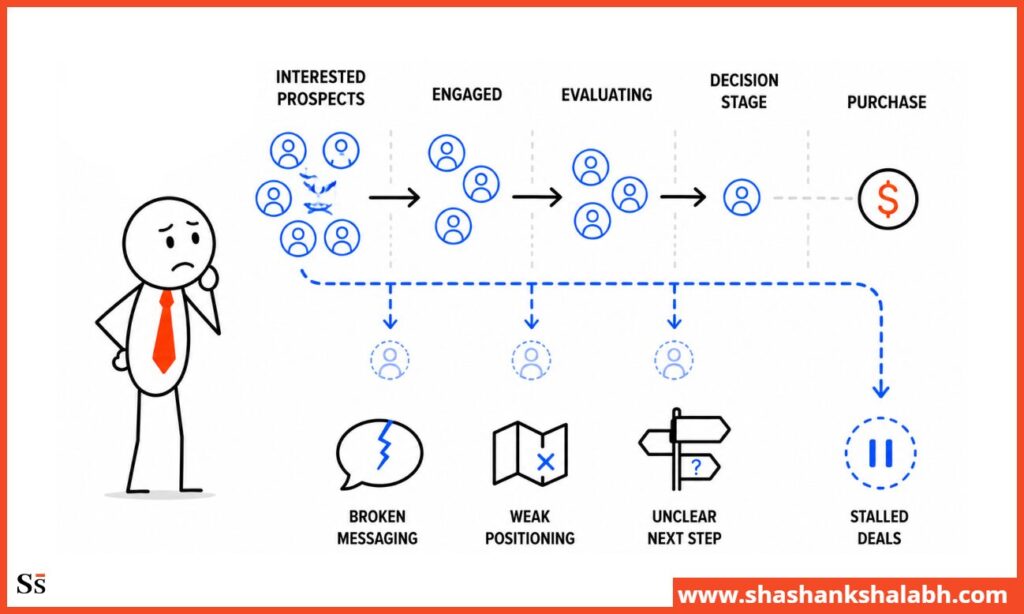
Weak positioning attracts broad interest and converts narrow segments.
More leads into weak positioning means more of this cycle:
Attract → Engage briefly → Disengage → Repeat
Each cycle costs acquisition spend, sales time, and founder confidence.
Solution: Sharpen Positioning Against ICP Buying Criteria
Strong positioning does the opposite. It self-selects.
Right-fit buyers recognize themselves and move faster. Wrong-fit buyers opt out before consuming sales capacity.
This reduces the CAC and shortens the sales cycle. And, as a result, the revenue from the same lead volume increases.
Better positioning produces better leads from the same spend.
Scaling Before System Efficiency
This is the meta-problem that contains the other four mentioned earlier.
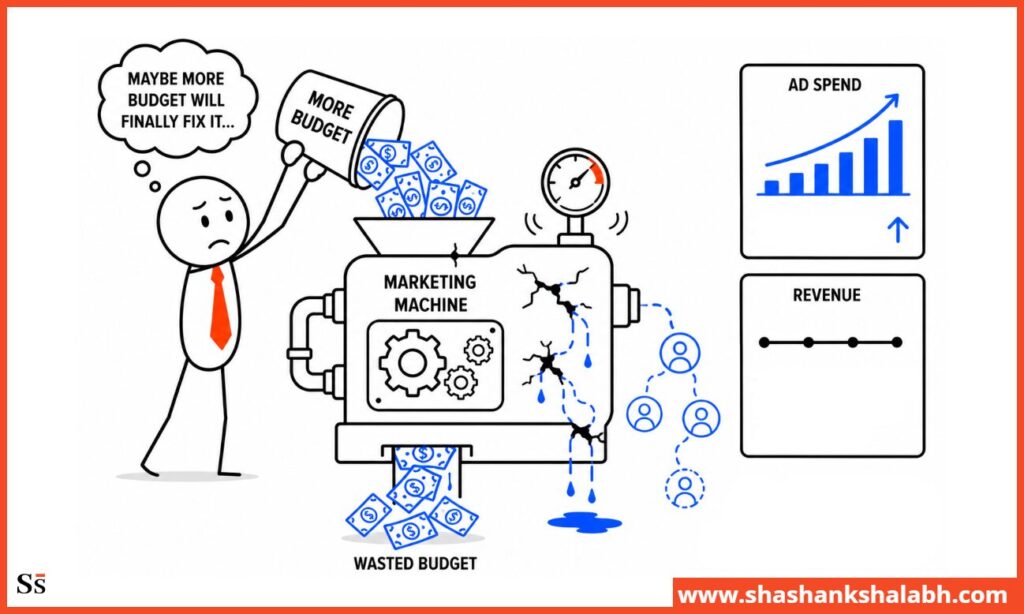
If a business scales lead gen before nailing its ICP, positioning, conversion metrics, and revenue tracking, it just ends up scaling inefficiency too.
A system with a $25,000 CAC will usually keep acquiring customers at the same CAC, or at an even higher one as channels saturate and lead costs rise.
Scaling spend doesn’t automatically improve efficiency.
Every month of spending at the wrong scale trains the organization to expect a certain cost-per-customer.
The business starts building budgets around it. And when performance doesn’t improve, the default response is always “more leads,” which only pours more budget into the inefficiency instead of fixing it.
Solution: Document and Implement the Handoff Protocol
Scale top of funnel spend only after revenue tracking is in place, conversion rates are improving, the ICP is clear, positioning is sharp, and the sales handoff is working.
Every new lead enters a system built to convert efficiently. CAC decreases as scale improves channel performance, revenue grows more predictably, and the system compounds over time.
The Math That Proves It
Here’s the same company, same lead volume, same budget with a broken system versus a working one.
Note: The following scenarios use illustrative figures to demonstrate the principle. The specific numbers will vary by company, deal size, and market
Scenario A More Leads, Broken System
- Monthly leads: 500
- MQL-to-SQL conversion: 8% = 40 SQLs
- SQL-to-opportunity conversion: 25% = 10 opportunities
- Close rate: 20% = 2 customers
- Average contract value: $15,000
- Monthly marketing-sourced revenue: $30,000
- CAC: High significant spend producing 2 customers
The instinct: generate more leads. Double to 1,000 leads. Result: 4 customers. $60,000 revenue. Spend doubled. Revenue doubled. CAC unchanged.
Scenario B Same Leads, Fixed System
- Monthly leads: 500 no increase
- MQL-to-SQL conversion: 25% = 125 SQLs (fix ICP targeting and MQL definition)
- SQL-to-opportunity conversion: 40% = 50 opportunities (fix positioning and handoff)
- Close rate: 25% = 12.5 customers (better fit leads close at higher rates)
- Average contract value: $15,000
- Monthly marketing-sourced revenue: $187,500
- CAC: Significantly lower same spend, 6x more customers
Same 500 leads. Same budget. Six times the revenue.
What This Suggests
In Scenario B, systematic improvements to ICP, positioning, and sales handoff can increase MQL-to-SQL conversion rates from 8% to 25% and SQL-to-opportunity rates from 25% to 40% within 60 to 90 days.
The company that doubled lead volume from Scenario A to hit $60,000 in monthly revenue spent twice as much to produce one-third of what fixing the system produces at the same spend level.
It is expensive to generate more leads. But it’s efficient to fix the system first.
Outlier: When More Leads Actually Is the Answer
As I mentioned earlier, more leads is the wrong first answer almost every time.
There is one situation where this does not hold true.
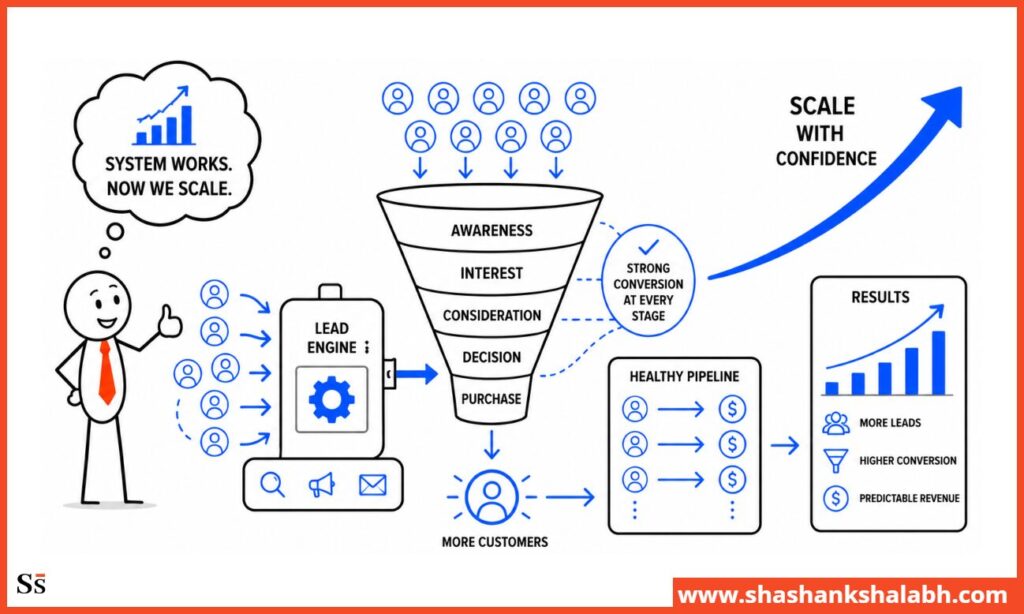
And that is when the system is already working (and is efficient).
You have an efficient system when:
- MQL-to-SQL conversion is consistently above 30%
- Leads are being worked within SLA through a documented handoff process
- Sales is converting opportunities at or above benchmark rates
- ICP definition is based on closed won data and applied consistently
- Marketing is measured on pipeline contribution and CAC, not lead volume
In this situation, pipeline is below target simply because there aren’t enough leads entering an otherwise healthy funnel. This is the one case where “more leads” is actually the right answer, because the system is built to convert them efficiently.
How to Know If This Is Your Situation
Start with the revenue target and work backward using real conversion rates.
If the business needs X customers to hit revenue goals, and sales converts Y% of opportunities, then you need Z opportunities.
If generating Z opportunities requires W MQLs at current MQL-to-SQL conversion, can the current lead volume produce W MQLs?
If the system is converting efficiently, increase the top of funnel volume.
If conversion rates are weak, fix the system first. More leads will not solve a funnel that cannot convert.
The Mental Test
Imagine doubling the leads entering your current system.
Would revenue approximately double? If yes, the system is working and more leads is the right lever.
But if sales immediately questions lead quality, MQL to SQL conversion stays flat, or pipeline growth barely moves, the system is broken.
More leads will only create more waste.
Most founders who run this test honestly realize the issue is not lead volume, but conversion.
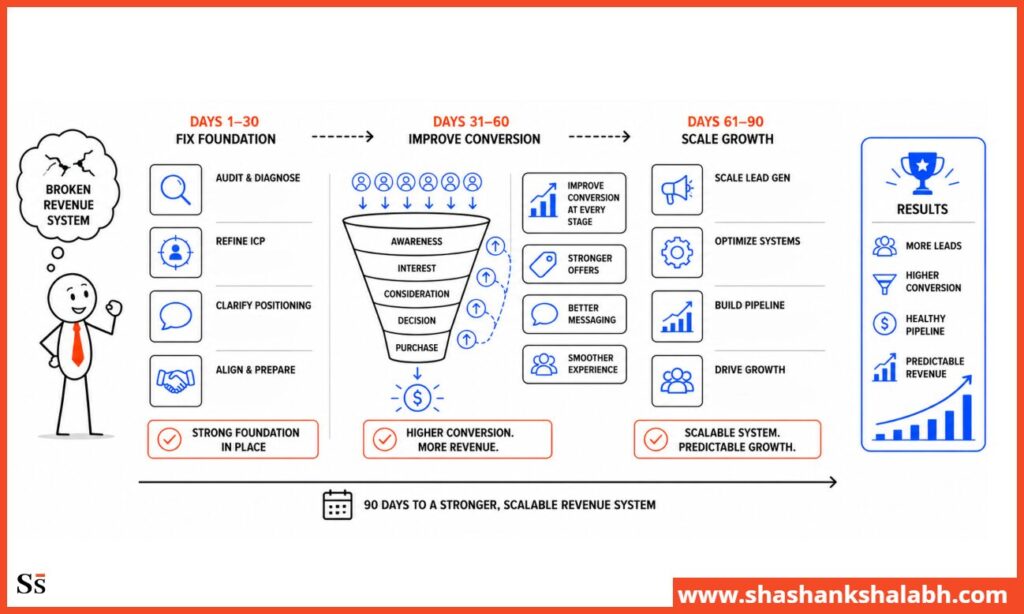
The 90-Day Sequence
Here is the sequence I suggest you implement.
First 30 Days
Replace lead volume KPIs with revenue-connected metrics. Audit conversion rates at every funnel stage and identify the primary leak.
And rebuild ICP from closed-won data and tighten targeting criteria.
Days 31-60
Start by sharpening positioning against the refined ICP buying criteria.
Next, implement the handoff protocol, including MQL definition, SLA, and joint pipeline review. And measure early conversion rate improvement.
Days 61-90:
Add top-of-funnel volume in the channels showing the best conversion efficiency.
The increase in spend now goes into a system that converts, thus producing measurable revenue improvement rather than measurable lead volume increase.
This should yield a 20-40% improvement in marketing-sourced revenue without increasing total marketing spend.
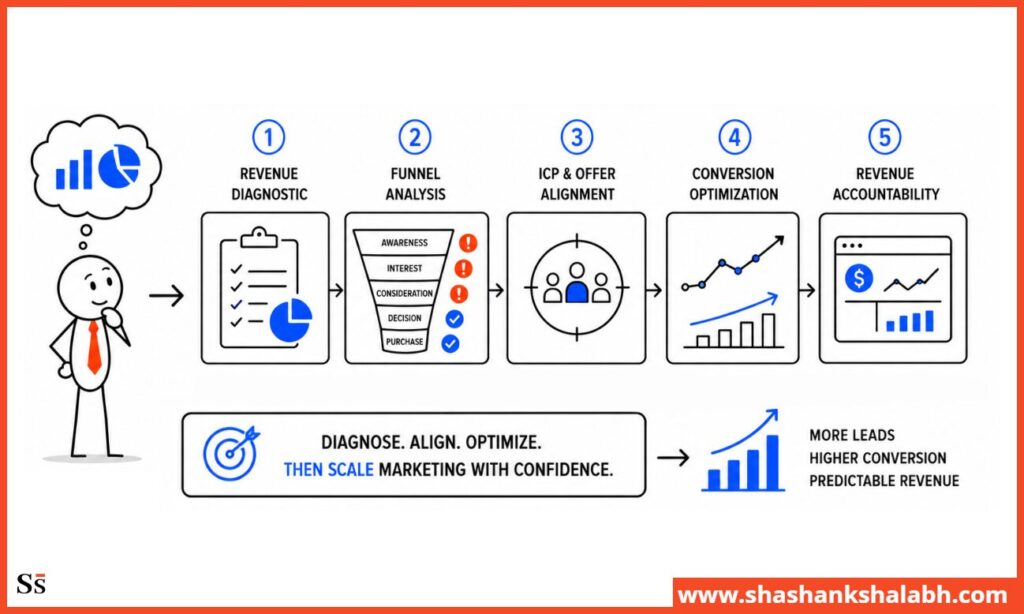
What a Fractional CMO Does Differently
Most marketing teams respond to flat revenue by doing more, such as more campaigns, content, ad spend, and leads.
A fractional CMO looks at the system first.
Where is conversion breaking? Are the right leads coming in? Is sales converting them efficiently?
Most of the time, the issue is not lead volume, but conversion. Fix that first, then scale what works.
Check out Fractional CMO Responsibilities to learn more.

FAQ: More Leads Won’t Fix Your Business
Here are the most common questions related to why more leads will not fix your business.
Why aren’t more leads converting to revenue?
More leads do not increase revenue when your funnel is not converting.
This could be due to weak targeting, poor positioning, broken sales handoff, low conversion rates, or tracking lead volume instead of revenue.
First, identify where conversion is breaking, fix it, then scale lead volume.
What should I fix before generating more leads?
Start by replacing lead volume KPIs with revenue metrics like pipeline contribution, conversion rates, and CAC. Next, identify where conversion is breaking in the funnel and fix the biggest leak. Now, you can refine the ICP using closed won customer data and tighten targeting.
Next, improve positioning around real buyer needs. And lastly, align marketing and sales with a clear handoff process and fast follow up.
Only then should you increase the top of funnel spend. More leads only matter when the system converts efficiently.
How do I know if my lead generation is working?
Lead generation is efficient and effective when marketing leads consistently convert into sales opportunities, sales follows up quickly, marketing sourced pipeline keeps growing, and CAC stays stable as volume increases.
What is a good MQL-to-SQL conversion rate?
For most B2B businesses, healthy MQL-to-SQL conversion rate falls between 30-50%. However, this varies by ICP, deal size, and sales motion.
If the conversion rate is below 20%, it means poor ICP fit, weak MQL definition, or breakdowns in sales follow up. And if it is below 10%, there could be multiple issues across targeting, qualification, and handoff.
The conversion rate is a more reliable indicator of system health than lead volume.
When does lead volume actually matter?
Lead volume only matters when the system is already working.
That means strong MQL to SQL conversion, a clear ICP based on closed won customers, a working sales handoff, and sales performance at benchmark levels.
In that case, more leads will reliably produce more revenue. In every other case, more leads just scale inefficiency. They increase cost without fixing conversion.

Closing Thought
More leads is the most expensive way to avoid fixing the real problem.
That problem is usually inside the system itself: ICP, positioning, funnel conversion, sales handoff, or measurement.
These are structural problems with structural fixes. But they require diagnosing the system rather than adding volume to it.
Fix the system, and revenue will follow. Then scale the leads into a system that converts them.
→ Why Your Marketing Isn’t Driving Revenue
→ Why Your Lead Gen Isn’t Turning Into Pipeline

Shashank brings over 22 years of global omnichannel marketing experience. As a 4x Chief Marketing Officer, he has helped several organizations (Startups and Fortune 500) drive sustainable revenue growth through strategic marketing.