
I have worked as a CMO and fractional CMO for several businesses, and have worked closely with marketing agencies.
I even have even been a full time employee at four different agencies.
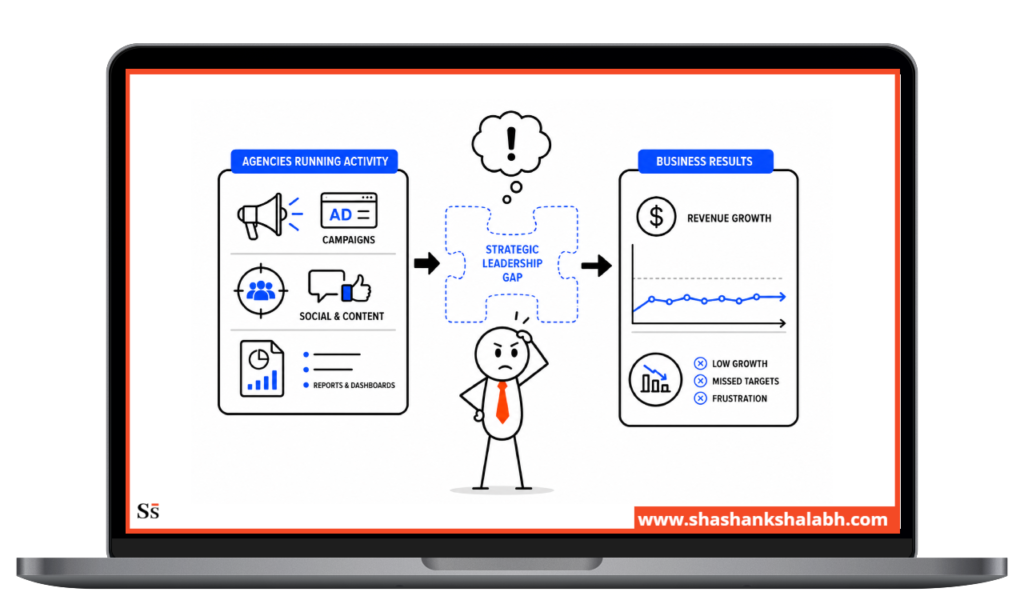
Most founders realize too late that their agency is limiting growth. After 12 to 18 months of retainer fees, activity reports, and missed revenue targets, the cost becomes clear.
Agencies are not bad, per se. They are built to execute, not to own business results. When a company hires an agency to fill a strategic leadership gap, it often pays for execution but never receives the strategy or revenue impact it needs.
In this guide, I will discuss how agencies can slow growth; and show what to do instead.
Here’s a quick snapshot:
- Why agencies are structurally built for execution, but not for growth
- The six ways your agency is costing you growth
- How to diagnose whether your agency is a growth driver or a growth blocker
- What the alternative actually looks like
- The cost of waiting 12 more months
Why Agencies Are Built for Execution, Not Growth
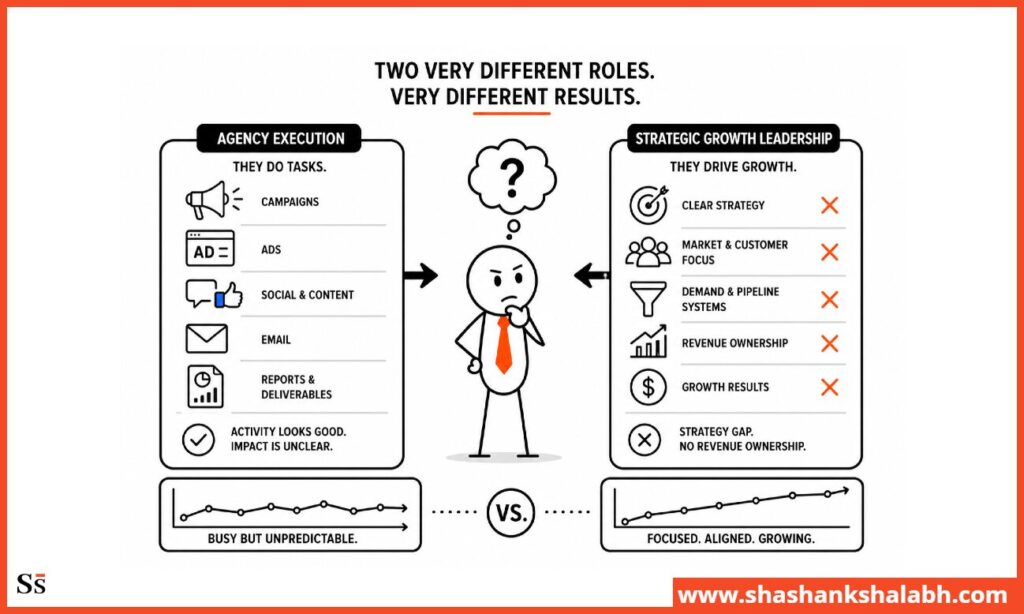
Agencies don’t drive growth because of how they are built. Their focus, incentives, and structure make it impossible for them to fully own revenue outcomes, no matter how skilled they are.
What Agencies Actually Sell
Agencies sell deliverables. They launch campaigns, publish content, optimize ads, complete SEO audits, and schedule social posts. These are outputs, and they’re easy to measure.
On the surface, they look like progress. But output is not the same as outcome.
For example, a campaign running is an output, and pipeline growth is an outcome.
Agencies are built to deliver outputs. However, driving real revenue requires a structure that links every action to business results and holds someone accountable for those results.
How Agency Incentives Are Structured
Agencies get paid a retainer regardless of the results they deliver. Their business model rewards client retention, not client growth.
A client that grows quickly, builds internal capability, and relies less on the agency is a lost retainer. On the other hand, a client that grows slowly but renews every year is a reliable revenue stream.
These incentives don’t create urgency around your revenue targets.
They create urgency around completing scope, keeping the client happy, and renewing the contract.
The agency’s financial health depends on renewal. But, your company’s financial health depends on growth.
When incentives are misaligned, it shows up in every monthly report that looks good while the pipeline stays stagnant.
The Strategy Gap Agencies Can’t Fill
Agencies need a strategy to guide their work.
Things like defining your ideal customer, clarifying positioning, prioritizing channels, and setting KPIs create the foundation for what to build, who to reach, and how to measure success.
Most agencies are hired before that strategy exists.
Without it, they default to what they know. That is, running the channels they specialize in for the audience the founder vaguely describes.
For example, a paid search agency runs paid search, and a content agency produces content. They are doing what they were hired to do.
The problem is that what they were hired to do wasn’t tied to a strategic objective. The result is execution without direction, and this doesn’t drive revenue.
What Agencies Are Genuinely Good At
Agencies aren’t the enemy. They’re simply the wrong solution for the wrong problem in certain situations.
Let me also share with you scenarios where a marketing agency can be of value.
They execute a defined strategy efficiently when the ICP, positioning, and channel plan are clear.
They provide specialist channel expertise at scale, managing paid acquisition, SEO, or content production beyond what an in-house team can handle.
And agencies are effective at producing creative output faster than internal teams, including design, copy, and video.
The issue (with most businesses) is that they use marketing agencies as a substitute for strategic leadership.
→ Fractional CMO vs Marketing Agency
The 6 Ways Your Agency Is Costing You Growth
These six failure patterns often drain budget without driving revenue, and most companies face several at once.
You’re Paying for Work, Not Results
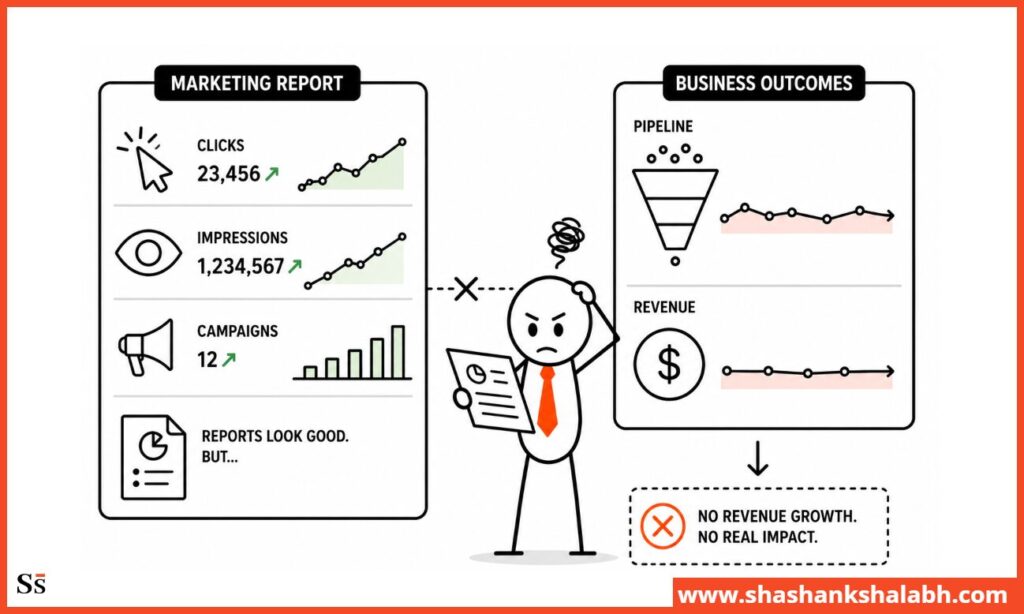
Every month, the agency sends a report full of impressions, clicks, content published, and campaigns running.
None of these metrics show revenue growth.
Agencies optimize campaign metrics as they can control these. But they don’t have control over the pipeline, CAC or or sales follow-up.
Every dollar spent on activity that doesn’t close deals is a dollar lost. For example, a $15,000 retainer generating 200 MQLs with a 5% conversion only produces 10 sales conversations.
Whether those 10 conversations create value depends on actual CAC. And most agencies don’t track it.
The solution is to measure agency success by pipeline contribution, CAC by channel, and marketing-sourced revenue. If an agency can’t report these, it can’t prove the impact. Resistance to reporting is the answer in itself.
The Agency Sets Strategy Without Owning It
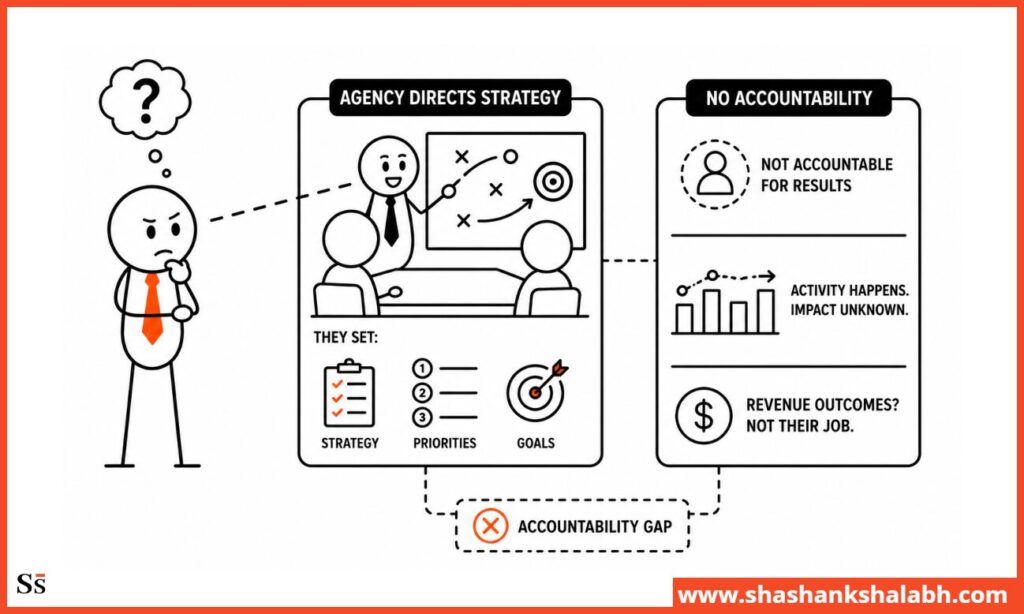
Without a marketing leader, agencies fill the strategic vacuum.
They recommend channels, set priorities, and define goals.
But they make decisions without accountability for results because they are paid to execute, not drive outcomes.
A paid search agency recommending paid search or a content agency recommending content isn’t strategic advice. It reflects what the agency knows, not what the business needs.
CEOs end up asking the agency for strategy, and the agency answers with what it can execute. While the budget grows, the pipeline growth lags.
In this case, you should bring in a marketing leader. A fractional CMO or VP of Marketing defines ICP, positioning, channel architecture, and KPIs.
Agencies then execute against a clear plan, which is where they deliver real value.
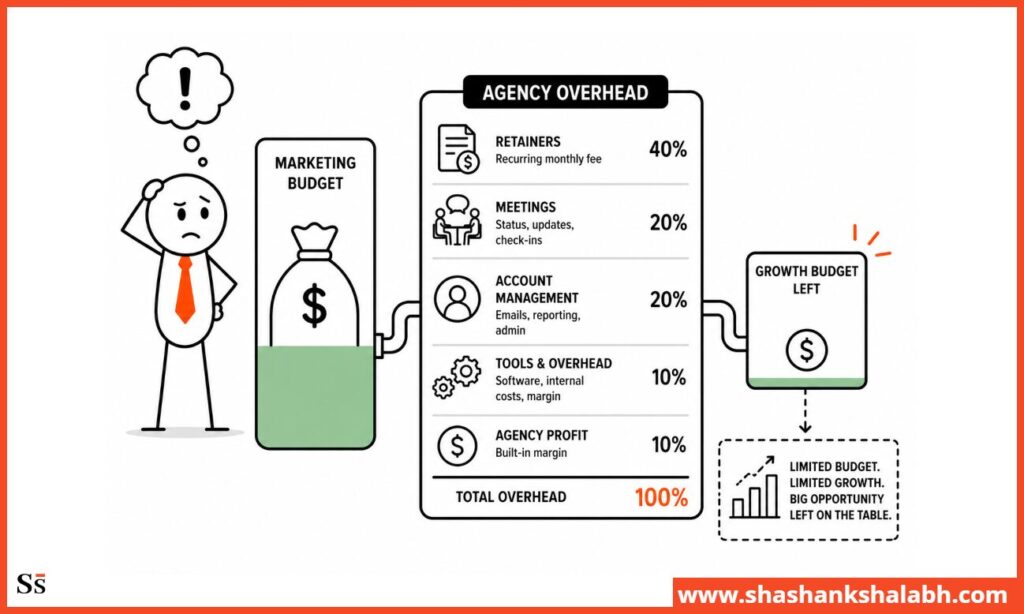
Agency Overhead Is Eating Into Your Growth Budget
Agency retainers include account management, project coordination, creative overhead, meetings, reporting, and margin.
On a $15,000 monthly retainer, $6,000 to $9,000 often goes to agency infrastructure, not actual marketing work. Media spend, content production, and technical work make up only a fraction of the invoice.
Founders assume the full retainer funds marketing, but much of it covers the agency’s operations. The result is high spend with low media volume or thin content output. When audited, actual marketing work often represents less than half the retainer.
Compare that to $15,000 per month with a fractional CMO who allocates a separate, auditable budget directly to execution. Same retainer, but very different results.
If you are reeling with this challenge, audit the agency retainer to see how much goes to real marketing work versus overhead. You’ll often find your true investment is far smaller than it seems.
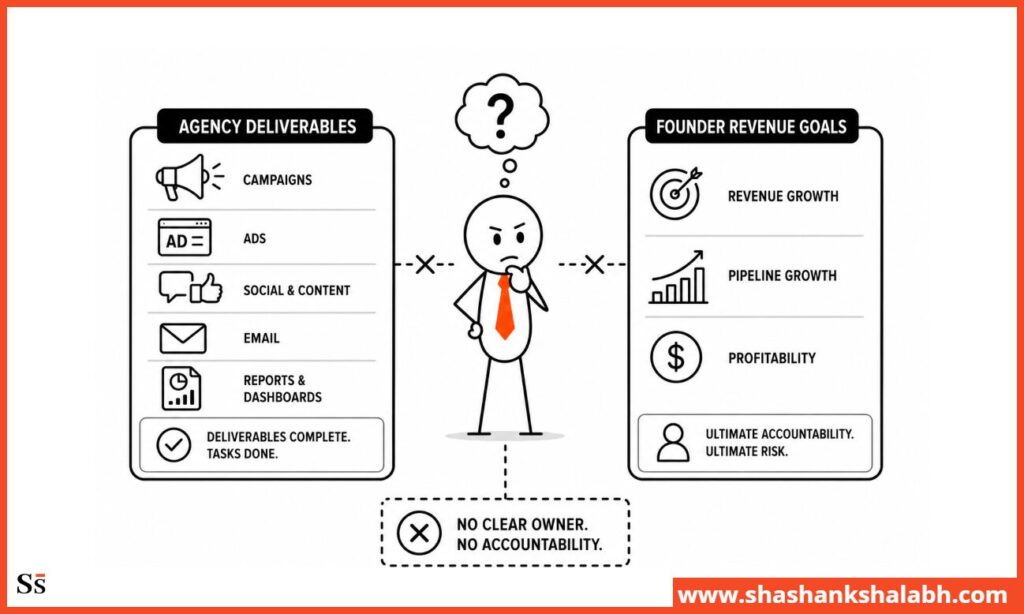
No One Is Accountable for Revenue
The agency is accountable (for deliverables) to the retainer, and the founder is accountable (for revenue) to the board.
However, no one is accountable for connecting agency work to revenue targets.
When two parties are each accountable for different things, the gap between them produces nothing. Assumed connections don’t produce results.
Track the agency’s work for a year or more, and if you see lots of activity and positive reports but no clear impact on revenue, monthly reviews focus on campaign metrics instead of pipeline contribution or CAC, and you can’t tell how much of last month’s closed revenue came from their work, there is an accountability gap.
How to solve this?
Set revenue-connected KPIs and review them monthly. Track marketing-sourced pipeline, CAC by channel, and MQL-to-SQL conversion from agency leads.
Hold the agency accountable, and treat any resistance as a sign of how they see their role in driving revenue.
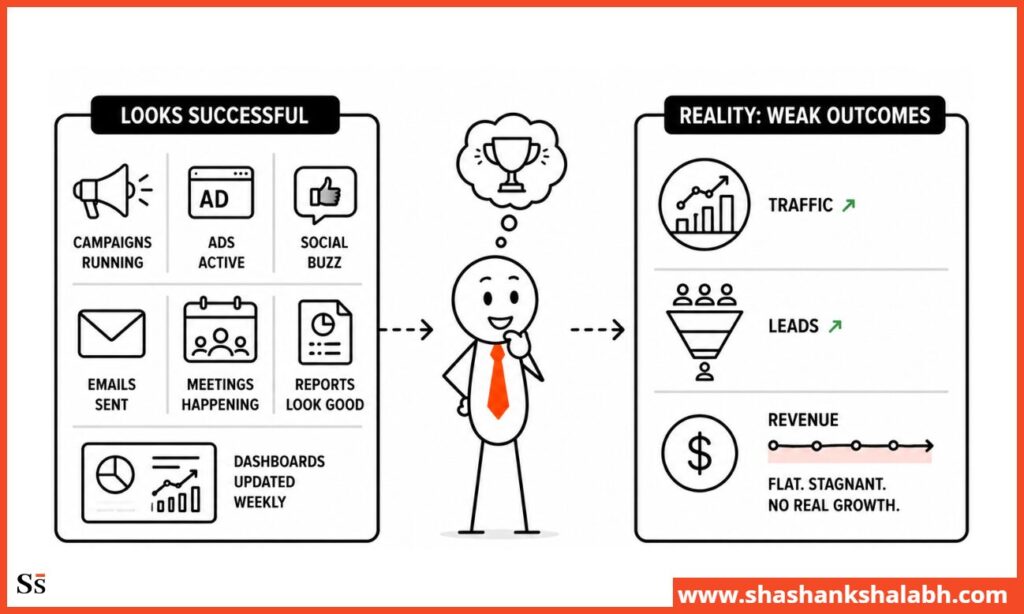
The Agency Relationship Creates False Confidence
Agencies create the feeling that marketing is covered.
When you get monthly reports, calls, visible activity, logos on materials, it all looks managed.
The issue is that all these feel like progress even when outcomes are missing.
Founders see polished reports and assume marketing is under control, even if pipeline does not grow and CAC rises.
Do you know what’s the costliest outcome here?
Delaying the hire of strategic marketing leadership. The founder needed a fractional CMO 18 months ago, but the agency made that need invisible.
If you have this issue, separate activity from results. Agencies almost always deliver activity. Only revenue impact shows if the engagement is worth the cost.
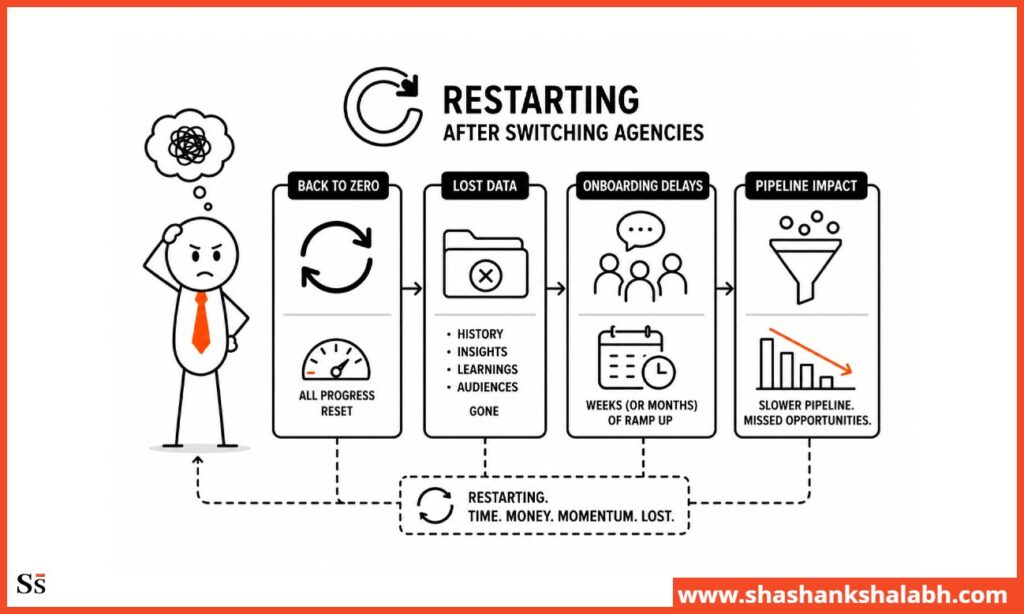
Switching Agencies Sets Your Marketing Back
It is quite common to switch agencies rather than fixing the underlying problem.
However this does not solve the underlying strategic problem.
Each agency transition costs 60-90 days of ramp time.
During this time, campaign history and optimization data are lost or transferred imperfectly. The new agency needs weeks to understand the product, the ICP, the competitive landscape.
Meanwhile, marketing slows and the pipeline suffers.
Before hiring a new agency, ask whether the issue is the vendor or the missing strategy. If it’s the latter, you need a fractional CMO (not an agency).
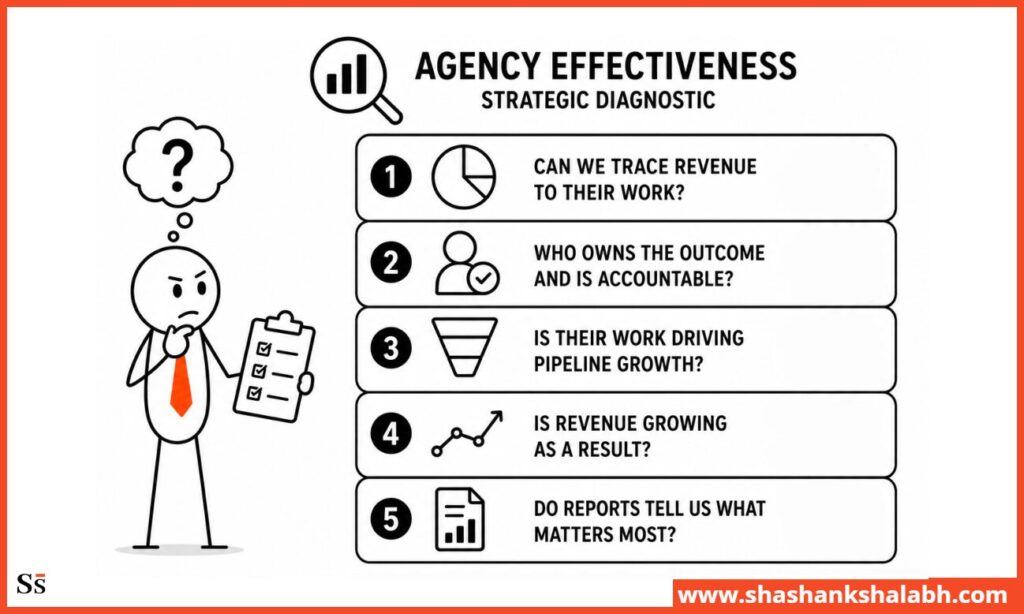
Is Your Agency Driving Growth or Holding You Back?
Here are five questions to help you understand if your agency is driving growth or is actually blocking your growth.
The Five Diagnostic Questions
| Question | Red Flag | What It Means |
| Can the agency tell you what percentage of closed revenue came from their work? | No | No one is accountable for connecting agency work to revenue targets. |
| Who set the marketing strategy the agency is executing? | Agency | There is a strategy vacuum. |
| What % of the retainer goes to media, content, or technical work versus account management and overhead? | Don’t know | You need an overhead audit. |
| Who is accountable for connecting agency work to revenue targets? | Nobody | There’s an accountability gap. |
| Has the pipeline grown consistently and attributable since the agency engagement started? | No | The agency isn’t driving growth because the work isn’t structured to grow revenue. |
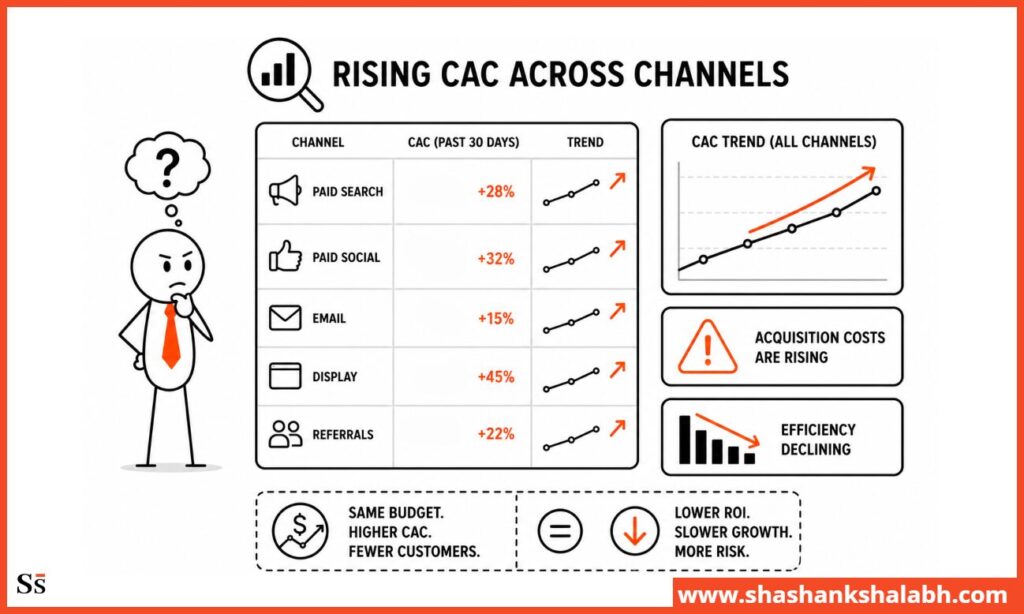
The One Metric That Matters: CAC by Channel
Focus on the channels the agency manages.
If paid acquisition costs are rising while your retainer stays flat, the agency is getting less efficient. Same budget, fewer customers, and higher cost.
A strong agency relationship drives stable or declining CAC over time. Scale economics should lead to better campaigns/targeting, smarter creatives, and audiences.
Rising CAC is also a strategy problem. The agency lacks clarity on your ideal customer and positioning, so targeting never improves.
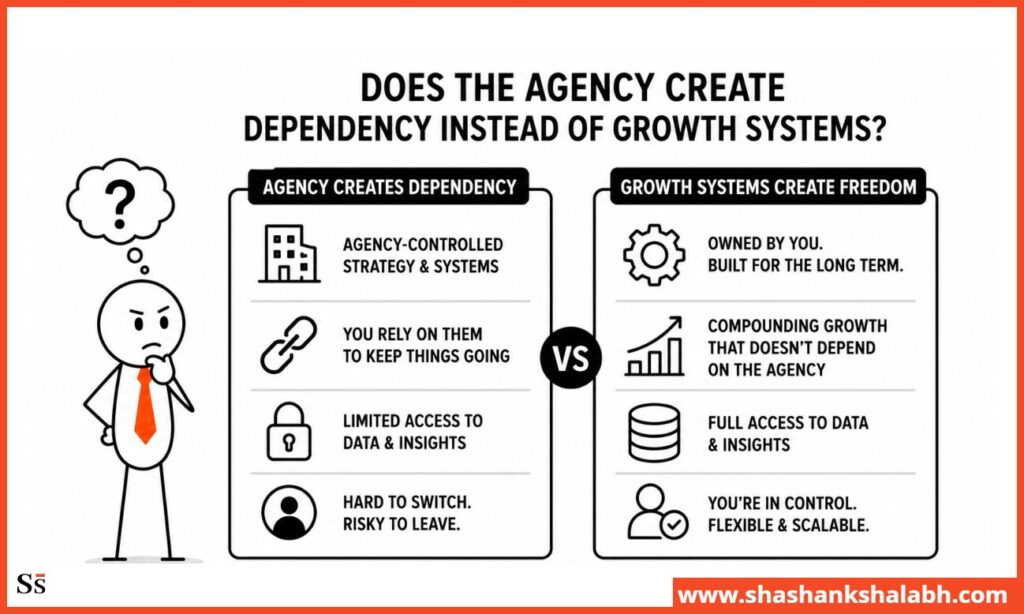
The Conversation Most Founders Avoid
Ask the agency what’s their plan to make themselves less necessary over time?
Agencies that build sustainable marketing systems such as SEO authority, content libraries, nurture infrastructure, create value that compounds beyond the engagement. When the retainer ends, the assets remain and continue producing.
However, vendors that require continuous retainer spend to maintain results create dependency. When the retainer ends, the results end as nothing was built.
Is the agency building your system or making you dependent on theirs?
Most founders never ask this question.
What the Alternative Actually Looks Like
Running away from the agency model is not the solution. Use an agency “after” building the strategic foundation.
Strategic Leadership > Agencies
Find a marketing leader before you hire or keep agencies.
A fractional CMO or VP Marketing sets the ICP, positioning, channels, and KPIs. That’s the foundation agencies need to do good work.
With strategy in place, the same agency often performs much better right away.
Most companies get the order wrong. They hire the agency first to fill the gap, then realize the gap was strategy all along, not execution.
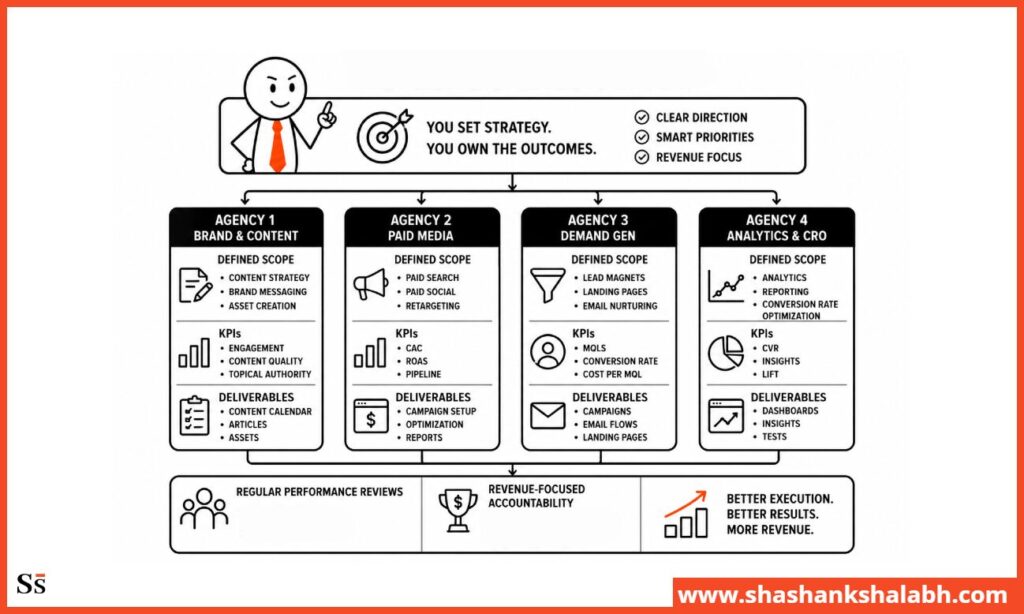
Agencies as Execution Partners
In the right structure, agencies become strong execution partners.
The marketing leader defines the scope clearly, including channels, deliverables, KPIs, and budget. Teams review performance monthly against revenue metrics like pipeline and CAC.
Also, the marketing leader replaces underperforming agencies without resetting strategy, which usually drives most of the cost in switching.
This structure turns agencies into growth drivers instead of cost centers. Agencies execute a strategy they did not create, but they stay accountable to business outcomes that matter.
The incentive model does not change. Agencies still earn fees based on scope, but clear leadership keeps them aligned with results.
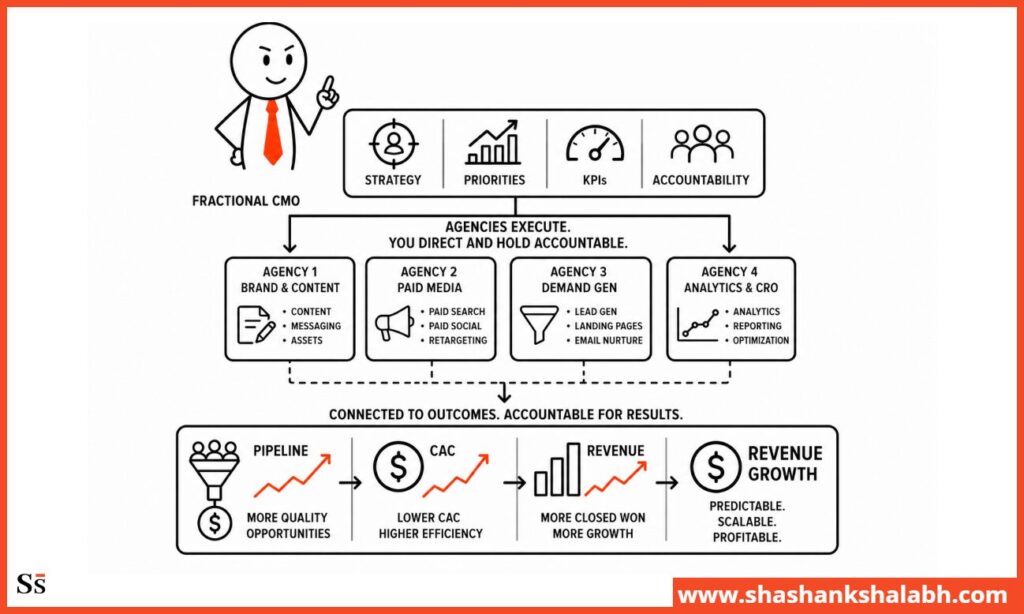
The Right Agency Relationship Structure
The fractional CMO defines agency scope and directs execution.
And they hold agencies accountable for outcomes like pipeline, CAC, and marketing-sourced revenue. They also control budget allocation, scaling what works and cutting what doesn’t.
This structure creates the accountability agencies often lack.
The fractional CMO owns strategy, and the agency handles execution.
Each focuses on its core role. One sets direction. The other delivers the work. Neither replaces the other.
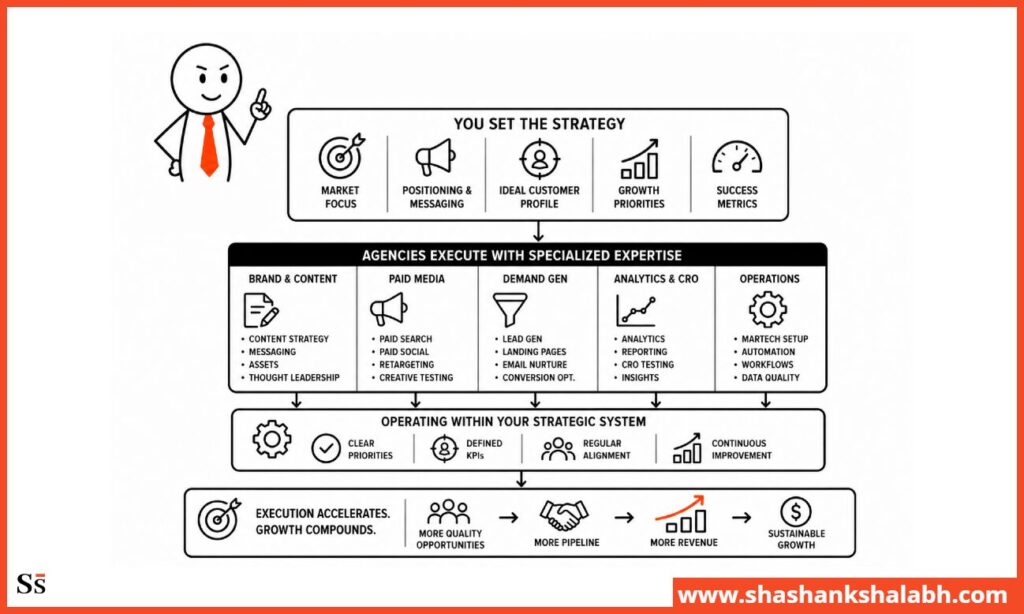
When A Marketing Agency Is The Right Move?
Structure matters more than agency selection.
When the structure is right, agencies create real value.
Strategy is already defined, and the team needs execution support to move faster. The business also needs specialist skills like paid search, SEO, or content at scale that don’t justify full-time hires.
In many cases, campaign volume exceeds internal capacity even when the strategy is strong.
In this setup, agencies act as growth partners. Without it, they produce activity without revenue, regardless of how skilled they are.
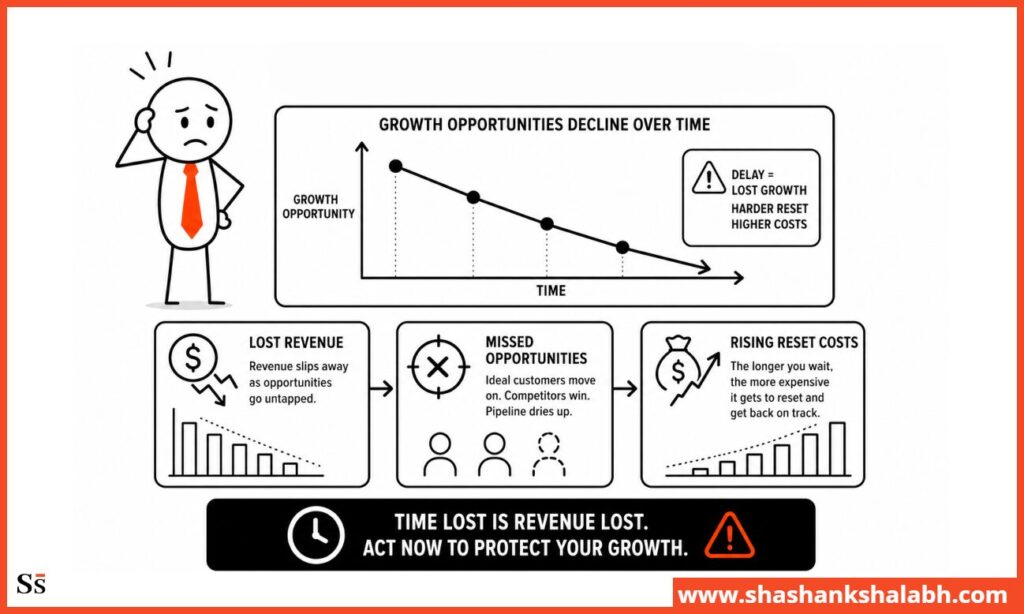
The Cost of Waiting: What 12 More Months of the Wrong Agency Relationship Costs
The decision to continue a misaligned agency relationship has a specific cost. Most founders underestimate it.
The Direct Cost
A $10,000 to $20,000 monthly agency retainer adds up to $120,000 to $240,000 per year. Many agencies also manage $5,000 to $30,000 per month in ad spend.
That brings total annual investment to roughly $180,000 to $600,000.
This is the visible cost.
The Opportunity Cost
The bigger cost is what founders don’t see on invoices, but in flat ARR, lost deals, and missed opportunities.
Pipeline does not materialize even after months of marketing spend. CAC keeps rising because no one fixes ICP clarity or performance problems.
Competitors gain ground while they build structured demand systems and capture the buyers that should have entered the pipeline. And board confidence drops as revenue targets get missed and scrutiny on marketing spend increases.
The Reset Cost
When the agency relationship ends, the marketing program resets. Misaligned agency relationships always end.
A new search takes time. Onboarding takes 60 to 90 days. Campaign history and optimization data do not transfer cleanly. Any momentum built stops and restarts from zero.
The reset also affects the team. A costly agency that did not drive growth lowers confidence. In some cases, it also leads to team turnover.
The Comparison
$180,000 spent on a misaligned agency delivers very different results than $180,000 spent on a fractional CMO at $15K per month who builds the strategy and holds agencies accountable.
The budget stays the same, but the outcomes change completely.
The fractional CMO defines strategy, sets KPIs, manages agencies against revenue goals, and drives improvements in pipeline and CAC.
Agency fees sit as a separate, clearly defined budget tied to execution, not blended overhead.
Same spend, but different structure, and different results.
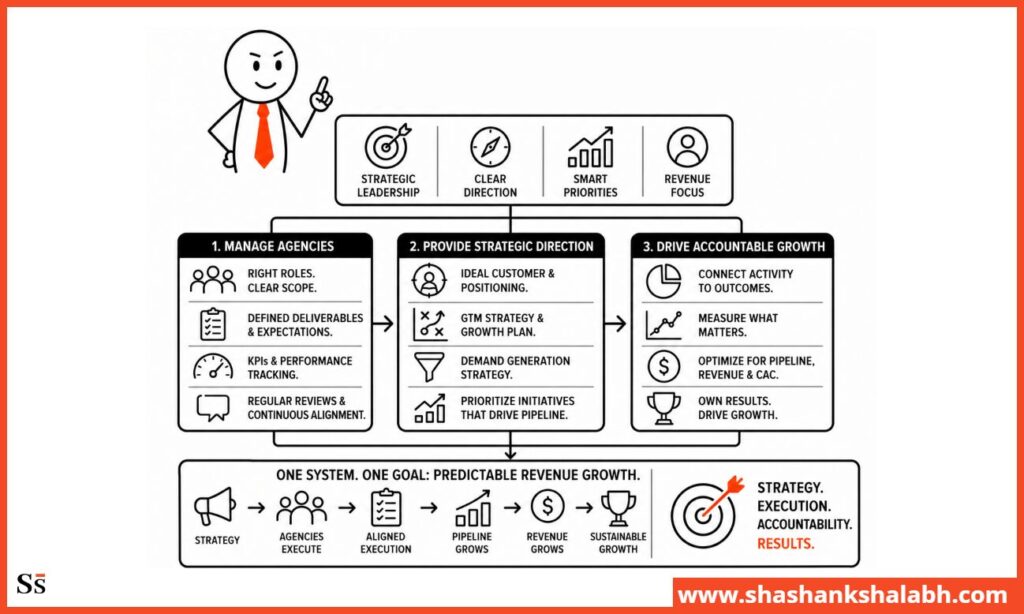
How a Fractional CMO Fixes the Agency Problem
A fractional CMO can help address several issues (that we discussed earlier). Let’s look into the specifics.
Diagnoses the Agency Relationship Before Replacing It
Not every agency relationship needs to end.
Many agencies are capable executors working without clear strategic direction. They follow instructions, but they lack the guidance needed to perform well.
When a fractional CMO adds the missing strategy, these same agencies often improve quickly.
A fractional CMO first evaluates the current agency before making any change. They ask whether the agency can execute a clear strategy or whether performance issues exist on their own.
Sometimes the problem is structure. Replacing a capable agency without fixing the strategic gap only repeats the same outcome and adds unnecessary transition cost.
Gives Agencies the Direction They Need to Succeed
ICP, positioning, channel strategy, and a clear KPI framework are what agencies need to execute well.
When that foundation is in place, existing agencies often improve results within 30 to 60 days. Without that foundation, even a strong new agency delivers the same outcome.
Manages Agencies With Revenue Accountability
A fractional CMO holds agencies accountable for pipeline and CAC. They define scope clearly and review performance monthly against business outcomes.
Agencies that deliver results earn more budget. And those that do not get replaced without resetting the entire marketing function, because the strategy stays in place.
This is the accountability layer most agency relationships lack. It is also why many produce activity without revenue. The fractional CMO provides that missing layer.
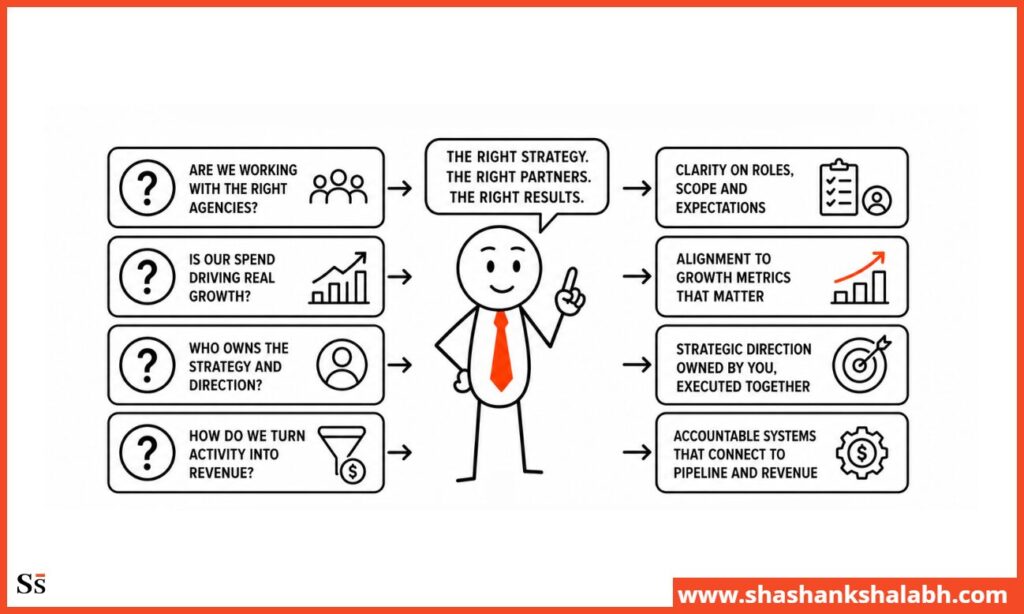
FAQ: Your Agency Is Costing You Growth
Why isn’t my marketing agency driving growth?
Most agency relationships fail because they report activity, not revenue; set strategy without accountability; spend too much on overhead; lack ownership of revenue outcomes; create false confidence; or reset progress when switched.
Absence of strategic leadership is almost always the root cause.
How do I know if I should fire my marketing agency?
I use a set of five questions to make this decision:
- Can they link closed revenue to their work?
- Who set the strategy?
- How much of the retainer funds real marketing work?
- Who owns revenue outcomes?
- Has pipeline grown consistently?
First determine whether the issue is the agency or the lack of strategic leadership. Switching agencies without filling the strategic gap just repeats the problem.
What should a marketing agency be accountable for?
Agencies should be accountable for pipeline contribution, CAC efficiency, and lead quality measured by MQL-to-SQL conversion.
In short, agencies should have revenue accountability.
Should I hire a fractional CMO instead of an agency?
The question isn’t usually either/or.
Bring a fractional CMO first. They set the strategy, establish KPIs, and decide what agency skills are needed to execute.
Agencies execute strategy well but struggle to define it. A fractional CMO at $10K-$25K per month, working with a clearly scoped agency, often produces better results than a bigger agency retainer without strategy. Often at the same or lower total cost.
Can a fractional CMO work alongside my existing agency?
This is often the most capital-efficient approach.
Instead of ending the agency and losing campaign history, a fractional CMO provides the strategic foundation the agency has been missing.
Many underperforming agencies improve significantly within 60 days once strategic leadership is in place. The fractional CMO decides what the agency should build, holds them accountable to business outcomes, and reallocates budget based on performance.
The fractional CMO owns the strategy, and the agency executes.

Closing Thought
Without strategic direction, agencies do not deliver revenue.
They run campaigns, but they fail to grow the pipeline.
The fix is leadership that sets strategy, holds the agency accountable, and reallocates budget based on performance.
With the right structure, agencies become growth drivers instead of just costs.
→ Why Your Lead Gen Isn’t Turning Into Pipeline

Shashank brings over 22 years of global omnichannel marketing experience. As a 4x Chief Marketing Officer, he has helped several organizations (Startups and Fortune 500) drive sustainable revenue growth through strategic marketing.